AI for credit analysis earns its keep first on the questions analysts ask of their bank's own credit policy, because every answer can be checked against a source. When a credit analyst asks the policy a question in plain words, a well-built system does not simply search the policy PDF and summarise what it finds. It reads the deal the question is about, finds the governing section in the current version, ranks the bank's past decisions on the same point, reads what senior reviewers wrote about them, applies the test to the deal's own numbers, and checks every sentence against the passage it cites before anything is shown. In Botminds' Credit Policy & Precedent Search those are six agents, each with one job and limits it may not cross. This page traces one question through all six, second by second, on the solution's fictional sample bank.
The question comes from Priya Raman, a credit analyst seven months into the role, writing up Hollis & Crane Packaging's acquisition of Pell Corrugated: "Can the acquisition synergies count toward leverage on Hollis & Crane?" It is a question every acquisition memo meets, and one a senior credit officer has usually answered many times. In the sample run, the full cited answer was ready in 14.0 seconds. The design target for a cited answer is 14 seconds.
Fourteen seconds, six steps, one cited answer
- Question scoper2.1 s
- Policy finder2.4 s
- Precedent finder2.8 s
- Reviewer-comment miner2.2 s
- Worked-example calculator2.6 s
- Citation checker1.9 s
How do AI agents answer a credit policy question?
By splitting the work into steps that each read one thing, produce one thing and refuse one thing, instead of handing the whole question to a single model prompt. The common design for answering from a document library is retrieval-augmented generation: search the documents, pass the best passages to a language model, and let it write an answer from them. That design reduces invented content but does not remove it. In the best published test of retrieval-based research tools, each tool still hallucinated between 17% and 33% of the time (Magesh et al., Stanford).
A credit question needs more than one retrieval. It needs the deal, so the right section is chosen; the current policy, so the rule is in force; the bank's past decisions with their outcomes; the reviewers' own words; arithmetic on the deal's numbers; and a final check that every sentence is supported. Giving each of those its own agent has two advantages a buyer can test. Each step can be measured on its own, so a wrong answer can be traced to the step that caused it. And each step can be given a limit it cannot cross, such as never citing a superseded version as current, which is far easier to enforce on a narrow step than on a general assistant.
0.0 to 2.1 seconds: the deal is read before the question
The first step reads the analyst's open deal so that every later search starts from the right facts. A question about synergies means nothing without the deal's purpose, industry, proposed grade and numbers. The question scoper took them from Priya's memo draft of 9 October: an acquisition, commercial and industrial, grade 5 proposed, $12.0 million requested. Its limits are simple and absolute. It never guesses a deal figure; it reads it from the draft or asks. And it reads only deals the analyst may open.
This step is what separates an answer beside the deal from an answer about the policy in general. "Synergies count only when documented, capped at 10%" is true of every deal. "$423,000 of the $580,000 counts on Hollis & Crane" is the answer the analyst needs, and it is reachable only if the deal was read first.
2.1 to 4.5 seconds: the rule in force, quoted
The policy finder found the governing sections of the current policy and quoted them with section and page. For this question that was §4.3.1, leverage limits by risk grade, which puts the grade 5 limit at 3.25x funded debt to EBITDA. It added §4.3.4 on acquisition adjustments and §9.2 on exception authority. The §4.3.4 sentence is the heart of the answer: synergies "may be included in EBITDA only when documented by a quality-of-earnings report or signed contracts, and in no case above 10% of pro forma EBITDA."
The rule in force beside how the bank has used it
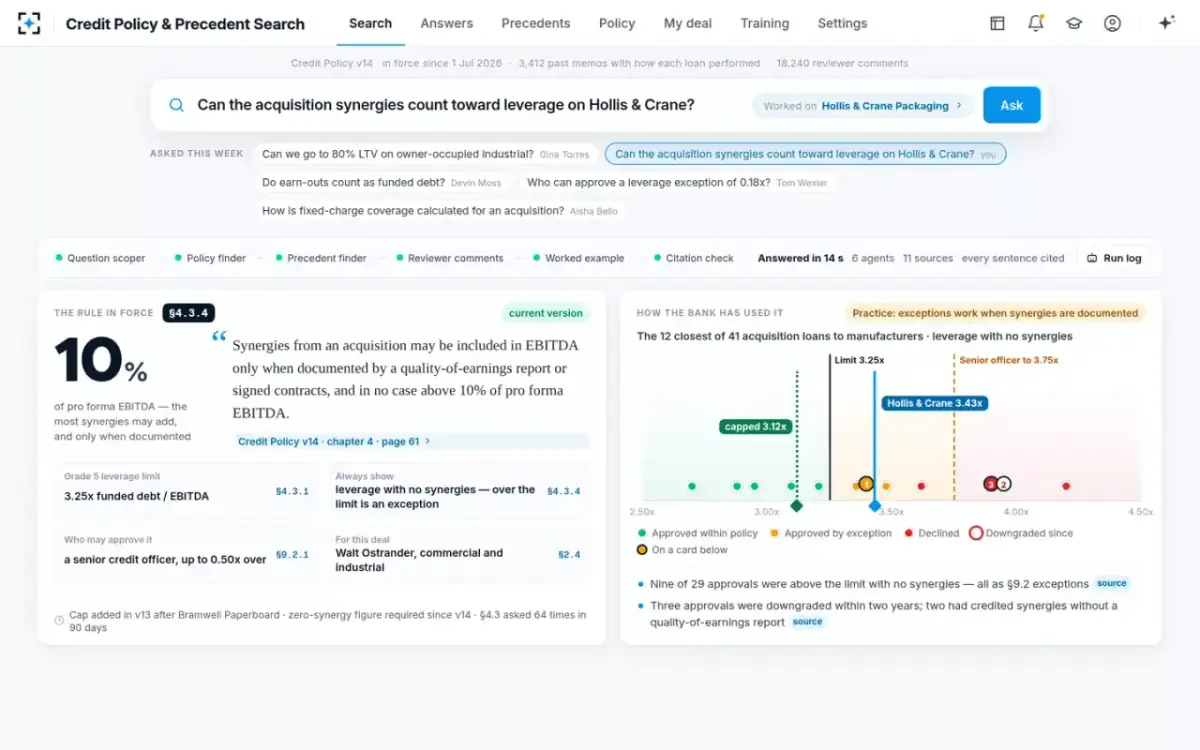
Two refusals govern this step. The policy finder never cites a superseded version as current: older versions stay searchable but are shown with their version and dates. And when no passage answers, it says "no passage" rather than inferring a rule. The second matters more than it sounds. A language model asked about policy will happily produce a plausible rule, and the U.S. Treasury's 2024 report notes that generative AI "can be susceptible to 'AI hallucinations,' producing confidently stated but incorrect output" (Treasury, 2024). In credit, a plausible rule that is not in the policy is worse than no answer.
4.5 to 9.5 seconds: precedents, and what the reviewers wrote
The next two steps turn the rule into practice: how the bank has actually decided the question, and what the people who decide it have said. The precedent finder ranked the sample bank's 3,412 approved and declined memos by purpose, industry, size and structure. That narrowed them to 41 acquisition loans to manufacturers since 2019, and from those to the closest few. For each it added what happened after, from annual reviews and grade changes. Ardent Valve & Fitting: approved by exception at 3.40x with no synergies, paid as agreed. Bramwell Paperboard: approved on planned synergies with no quality-of-earnings report, downgraded to grade 7. Tanager Tool & Die: declined at 3.90x.
What the two middle steps searched, and what they kept
3,412
approved and declined memos since 2019, ranked against the deal
41
acquisition loans to manufacturers, the precedents that matter
18,240
reviewer comments read
7
comments on synergy add-backs, the latest dated 9 September 2026
The reviewer-comment miner then read what senior credit officers had written about the same point on similar memos. It found seven comments on synergy add-backs. It quotes reviewers word for word and never says a reviewer approved what they did not. One comment from Walt Ostrander, the bank's senior credit officer for commercial and industrial lending, became part of the answer: "Show me leverage with zero synergies. If it's over policy at zero, call it an exception and say why we live with it."
Both steps carry access limits that follow the bank's credit file. The precedent finder never shows a memo the user may not open, and declined memos are visible to credit staff only. A relationship manager asking the same question would see the approved precedents and not Tanager.
9.5 to 12.1 seconds: the test on the deal's numbers
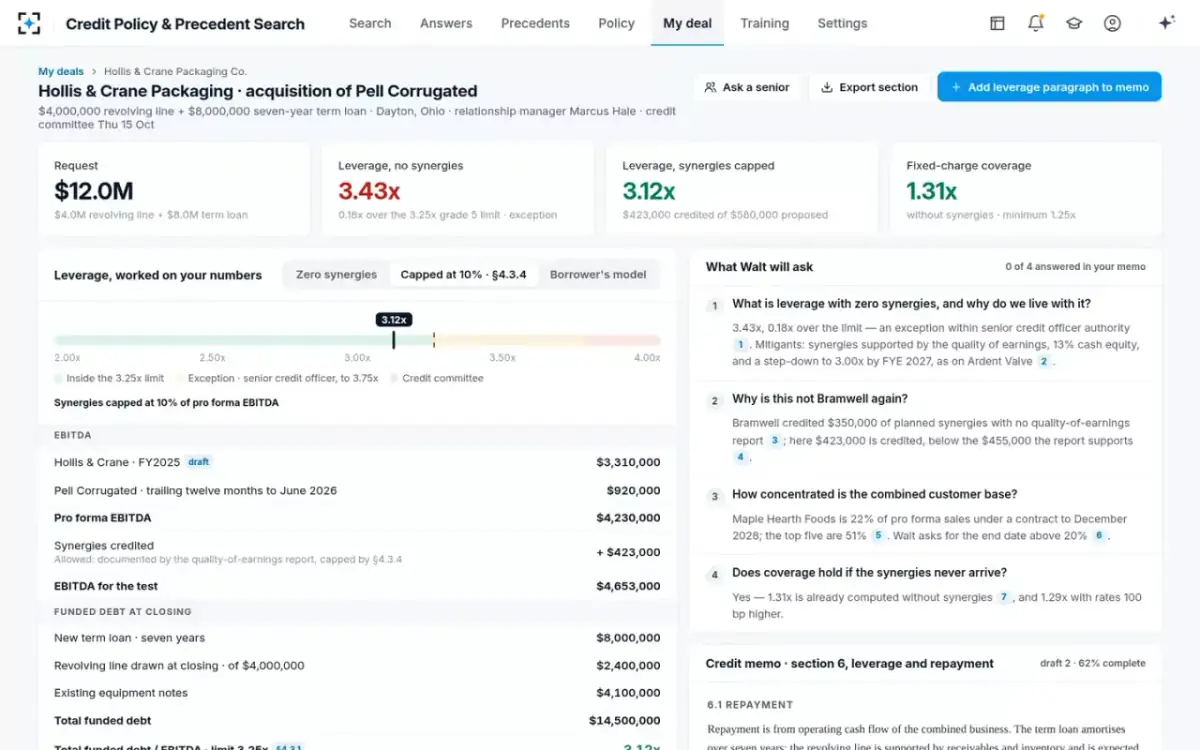
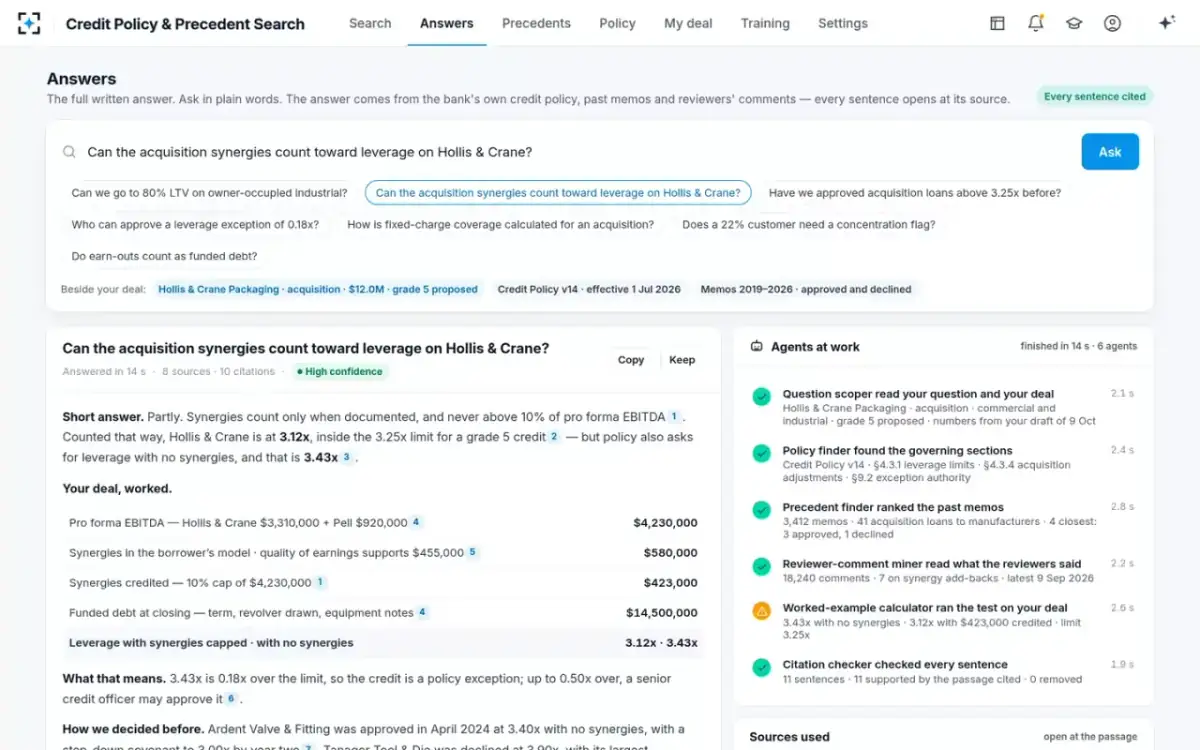
The worked-example calculator applied the policy's tests to the deal's own figures and showed every line with its source. It is the step that turns "partly" into a number the memo can use. It read the pro forma EBITDA from the draft and the quality-of-earnings support from the report. It applied the 10% cap and computed leverage both ways: 3.12x with synergies capped, inside the limit, and 3.43x with none, which the policy treats as an exception.
The leverage test, line by line, as the answer shows it
| Line | Figure | Where it comes from |
|---|---|---|
| Pro forma EBITDA | $4,230,000 | Hollis & Crane $3,310,000 plus Pell $920,000, from the memo draft |
| Synergies in the borrower’s model | $580,000 | The quality-of-earnings report supports $455,000 |
| Synergies credited | $423,000 | §4.3.4 cap: 10% of $4,230,000 |
| Funded debt at closing | $14,500,000 | Term loan, revolver drawn and existing equipment notes |
| Leverage, synergies capped | 3.12x | Inside the 3.25x grade 5 limit of §4.3.1 |
| Leverage, no synergies | 3.43x | 0.18x over: an exception a senior credit officer may approve under §9.2 |
The calculator's two limits are the ones that keep it a calculator: it never alters a deal figure and never assigns a risk grade. If the draft's EBITDA is wrong, the answer is wrong in a traceable way, and the line that is wrong opens at its source. The fuller version of the same working, with three synergy treatments and the reviewer's likely questions, sits on the deal's own screen.
The same test, worked on the deal's screen
12.1 to 14.0 seconds: every sentence checked, nothing approved
The last step checks every sentence of the answer against the passage it cites and removes anything the passage does not support. On this run the citation checker read 11 sentences, found each supported by its cited passage, and removed none. Its rules are the solution's governance in miniature. No sentence leaves without a source. And the answer never says a deal or an exception is approved. It names who may approve: here a senior credit officer, because 0.18x is within the 0.50x the policy delegates.
Six agents, each with one job and one line it does not cross
Agent
Question scoperReads the question and the open deal.
Never: guesses a deal fact
Agent
Policy finderQuotes the governing sections with section and page.
Never: cites a superseded version as current
Agent
Precedent finderRanks past memos and adds how each loan performed.
Never: shows a memo the user may not open
Agent
Reviewer-comment minerFinds what senior credit officers wrote on the same point.
Never: says a reviewer approved what they did not
Agent
Worked-example calculatorApplies the policy tests to the deal’s numbers, line by line.
Never: alters a deal figure or assigns a grade
Agent
Citation checkerChecks each sentence against its passage and removes the unsupported.
Never: says a deal or exception is approved
A person decides
The analyst, then the approverThe analyst writes and signs the memo; the senior credit officer or committee named by the policy decides the exception.
That division of labour matches what supervisors describe as the norm for generative and agentic AI in banks. The OCC's Spring 2026 Semiannual Risk Perspective found adoption "generally limited to specific use cases with guardrails and human-in-the-loop accountability to manage risk", with use cases "primarily productivity and customer experience enhancement tools" (OCC, Spring 2026). A citation check is a guardrail of that kind, but it is not proof that the answer is right. A sentence can be faithful to its passage while the passage is the wrong one. That gap is the subject of why a cited answer can still be wrong.
What the analyst sees, and what happens when the credit policy has no answer
The analyst sees the answer in four parts: the short answer, the deal worked line by line, what it means under the exception section, and how the bank decided before. Beside it, each agent's step is shown with its time and what it read. Every citation opens at its highlighted passage. From there one click adds a cited leverage paragraph to section 6.2 of the memo, where the analyst can edit it.
The full answer, with the steps beside it
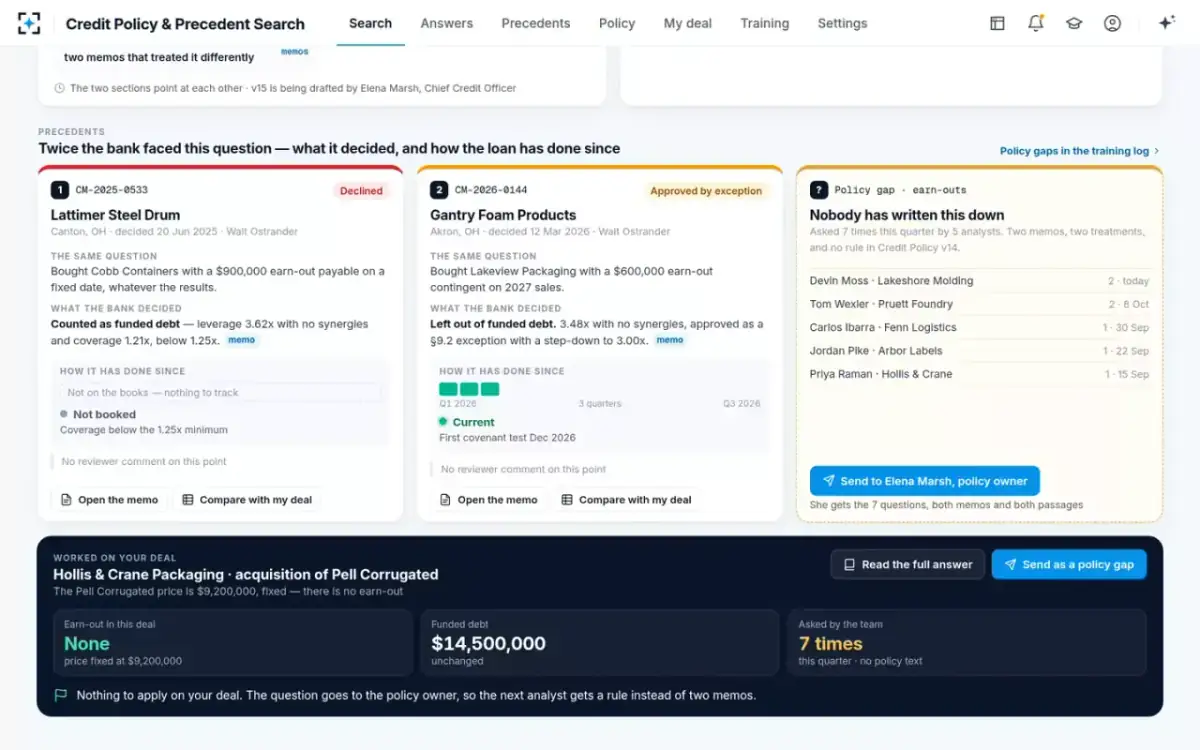
The trace is different when the policy is silent. Asked whether earn-outs count as funded debt, the sample bank's policy has no passage. Two past memos treated earn-outs differently: one counted a fixed earn-out as debt and was declined, the other left a contingent earn-out out and was approved by exception. In that case the solution writes no answer of its own. It shows the two memos, says there is no rule to quote, and offers to send the question to the named senior with everything that was searched. Seven questions on the same point in one quarter have made it a policy gap, ready to go to the chief credit officer.
When the policy is silent: two memos, no rule, a gap for the policy owner
How to use AI in credit analysis: where it helps and where it stops
Use it for the work that ends in a checkable output, and keep the work that ends in a decision with people. The checkable work is large: finding the governing section, finding the bank's past decisions and their outcomes, quoting what reviewers wrote, and redoing ratio tests under different structures. The decisions are few and heavy: the risk grade, the structure, the recommendation and the approval of any exception.
That split is where banks already are. The OCC describes generative and agentic AI use in banks as "primarily productivity and customer experience enhancement tools" (OCC, Spring 2026). Automated approval of business credit is rare even with conventional scoring: in the FDIC's Small Business Lending Survey, "less than one in one hundred banks will auto-approve a loan of $250,000" (FDIC SBLS). A tool that answers policy questions sits comfortably inside that practice; one that recommends grades does not.
The regulatory frame matters to how the tool is governed. The 2026 model risk guidance excludes from its definition of a model "simple arithmetic calculations, such as those found within spreadsheets, as well as deterministic rule-based processes", and it places generative and agentic AI outside its scope altogether (OCC Bulletin 2026-13). That is not a pass. It means the bank governs the tool through its own risk framework and its third-party program, under guidance that says a vendor "does not diminish or remove banking organizations' responsibilities" (88 FR 37920).
What is the best AI tool for credit analysis? What to test before you buy
The best tool for a credit team is the one that passes your own hard questions, on your own policy, with every sentence traceable to its source. Feature lists say little; a trace like the one above says a great deal. Ask any vendor to run your questions and show the steps, the timings and the passages, including the questions where the right answer is "the policy does not say".
Eight things to test in any AI for credit analysis
- It reads the deal before it searches
Property type, purpose, grade and figures decide which section governs. An answer about the policy in general is not an answer about the deal.
- It quotes only the version in force as current
Ask about a section that changed in the last release. The quote must come from the new version, with its effective date.
- It keeps rule and precedent apart
A past exception must appear as an exception, with its approver and the policy version it was decided under.
- It shows how each precedent performed
Approval is not the end of the story: grade changes, past dues and payoffs belong beside the decision.
- It follows the credit file’s access rules
A relationship manager should not see declined memos if your policy limits them to credit staff.
- It checks every sentence before showing it
Unsupported sentences are removed, not footnoted. Ask to see how many were removed on a hard question.
- It says when the policy is silent
And routes the question to a named senior or policy owner, rather than writing a rule of its own.
- It never approves, grades or speaks for a reviewer
Those limits should be set in the product and locked by the chief credit officer, not left to a prompt.
Where Credit Policy & Precedent Search fits is narrow by design: questions about the bank's own credit policy, underwriting guides, past memos and reviewer comments, answered beside the analyst's deal. It does not spread financial statements, score borrowers or write the whole memo; those are separate jobs with separate checks. A team comparing it with a general chatbot or a policy PDF should cost the options on the same basis, which is the method in what each option costs over three years.
Speed is not the point of the 14 seconds. The point is that the senior's answer, the policy's text and the bank's history arrive together, with their sources, while the analyst is still writing. How a credit team comes to rely on that, and when it should still open the policy itself, is covered in why analysts stop checking the policy PDF. To run the same question on the sample bank, start from Credit Policy & Precedent Search.
Questions people ask
Is AI for credit analysis just search plus a summary?
A basic one is. The difference that matters is whether it reads the deal first, quotes only the current version, shows how the bank has applied the rule and how those loans performed, works the test on the deal's numbers, and checks each sentence before showing it. Without those, it summarises the policy rather than answering the question.
Does it ever approve a deal or an exception?
No. Answers name who may approve under the policy's exception section. The agents never approve an exception, assign a risk grade or speak for a reviewer.
What if the policy and a past memo disagree?
The current policy governs and is quoted as such; the memo is shown as what the bank decided at the time, with its policy version and how the loan performed. Where the policy has no passage at all, no rule is written in its place.
Can AI read a bank's whole credit policy and its past memos?
It can search them once they are indexed. The sample bank's library holds a 212-page credit policy, nine underwriting guides of 386 pages, 3,412 memos and 18,240 reviewer comments, refreshed nightly. What is left out matters as much: relationship managers' call notes, for example, are not searched.
Is AI credit analysis accurate?
Only as accurate as a test on your own questions shows. The closest published evidence, the preregistered study of retrieval-based legal research tools described above, found that every tool it tested still hallucinated. That is why a sentence-level citation check, version control and an honest "no passage" matter more than the model behind them.
Is an AI credit policy tool a model under model risk guidance?
The April 2026 interagency guidance places generative and agentic AI outside its scope and excludes simple arithmetic and deterministic rules from its definition of a model. The bank still governs the tool through its own risk framework and third-party program, and remains responsible for how it is used.