AI for policies and procedures does two different jobs: helping write them, and answering questions from them. For a bank's credit team the second changes the daily work, and a credit analyst's assistant of that kind earns trust on questions whose answers the team already knows. Senior credit officers ask it the questions they answer every week, including the hard ones, and check both the answer and its sources. Analysts then use it side by side with the policy. Reviewers sample its citations on live memos. Only after that does it become the analyst's first stop, with seniors receiving what it cannot answer. Analysts stop opening the policy PDF once the cited answers keep holding, and that is the point. They should still open it in a handful of situations that do not go away: after a policy release, when an answer rests on an exception, when the deal is unusual, and whenever the answer is "no passage". This page sets out that ladder for Botminds' Credit Policy & Precedent Search, the measures that move a team up it, and the standing checks.
Four rungs from trial to first use
1Shadow
Senior credit officers ask
Questions they already know the answer to, including the hard ones: changed sections, exceptions that look like rules, questions the policy does not answer.
Move up when the seniors would have signed the answer and its sources, and every “no passage” was right.
2Side by side
Analysts ask; seniors still answer
Analysts use the answers next to the policy PDF and the senior’s reply, and note every difference.
Move up when differences are explained by the policy, not by the tool, and seniors stop finding wrong versions.
3Cited drafts, reviewed
Analysts write; reviewers sample sources
Cited paragraphs go into memos. Reviewers open a sample of citations on each memo.
Move up when sampled citations hold and fewer memos come back for policy reasons.
4Analyst first
The library answers first
Seniors receive only what the library cannot answer, with the search attached, and the policy owner receives the gaps.
Stay here while the standing checks below keep passing; drop back a rung after any policy release.
What is the best AI for policies and procedures? Writing them versus answering from them
The best one for a credit team is the one that answers from the approved text without ever becoming a second, unapproved policy. Much of what is offered as AI for policies and procedures helps with drafting. Drafting tools are useful to the policy owner once a year. Answering tools are used by every analyst every day, and they carry a different risk: an answer that paraphrases the policy loosely is, for the analyst who relies on it, the policy.
The regulators are clear about whose text the policy is. The FDIC's examination manual says that "The board of directors of every institution is responsible for formulating lending policies and to supervise their implementation" (FDIC RMS Manual §3.2). Real estate lending policies must "Be reviewed and approved by the FDIC-supervised institution's board of directors at least annually" (12 CFR 365.2). The OCC adds that procedures "complement policies and describe how policies are put into practice", including "approval authorities, necessary steps for approvals, approval documentation requirements" (OCC, 2026). An answering tool has to respect both layers: quote the policy as the board approved it, and the procedure as credit administration wrote it.
So a buyer should look for five properties before any feature. Answers quote the current approved version, with section and page. Every sentence is checked against its passage before it is shown. Precedent is presented as precedent, never as rule. When the text is silent the tool says so and routes the question to a named owner. And the answer rules are owned by the credit function, not set by each user. Botminds' Credit Policy & Precedent Search is built on those five; it answers from the policy, underwriting guides, past memos and reviewer comments, and it does not draft or attest the policy itself.
How do you get employees to trust AI answers about policy?
A team should trust an answer engine first on the questions its seniors can answer without it, because those are the only questions on which the team can tell a right answer from a confident one. A senior credit officer who has answered "can synergies count toward leverage?" a hundred times knows the section, the cap, the precedent that went bad and the one that did not. Thirty such questions, scored by the people who would otherwise answer them, tell a credit department more than any vendor benchmark.
The questions must include the ones built to fail. Published research gives the reason. In the first preregistered test of retrieval-based legal research tools, each tool hallucinated between 17% and 33% of the time, counting both incorrect answers and answers whose cited source did not support them. The study defines the second kind as citing a source that is misread or "inapplicable", and built its questions around cases such as "overruled precedents" (Magesh et al.). In credit, the equivalents are a section changed in the last policy release, an exception presented as a rule, and a precedent whose loan was later downgraded. The full test set is in why a cited answer can still be wrong.
What is automation bias, and why does it matter to a credit team?
Automation bias is excessive deference to an automated system's output; in a credit team it is the analyst who stops opening sources because the answers have been right so often. It has an opposite failure, and a team adopting AI meets both. The failure at the bottom of the ladder is aversion, and the failure at the top is deference. Both are named in the federal government's generative AI risk profile. NIST notes that experts "may be unnecessarily 'averse' to GAI systems, and thus deprive themselves or others of GAI's beneficial uses." It also warns that over time people "may over-rely on GAI systems". That "is an example of automation bias, or excessive deference to automated systems" (NIST AI 600-1).
A credit team sees both. The senior who refuses to look at the answers keeps answering every question personally and remains the bottleneck. The analyst who has seen two hundred correct answers stops opening the sources. The two-hundred-and-first then quotes a section that changed last week. The ladder deals with the first by asking seniors to set the test themselves. It deals with the second with standing checks that do not relax as confidence grows.
How do you roll out an AI assistant to a credit team? Four rungs, one measure each
Each rung has one measure, and the team moves up only when it holds. The measures are things a head of credit analysis can count, not impressions. They also mirror how supervisors describe current practice. The OCC's Spring 2026 Semiannual Risk Perspective found banks' generative AI use "generally limited to specific use cases with guardrails and human-in-the-loop accountability to manage risk" (OCC, Spring 2026). Every rung keeps a named person accountable; only the amount of checking changes.
An illustrative path up the ladder
- Shadow2 wks
- Side by side4 wks
- Cited drafts, reviewed6 wks
- Analyst firstongoing
Shadow. The senior credit officers ask, and they score every answer twice: was the conclusion right, and did each source say what the sentence claimed? A "no passage" answer is scored as right only when the policy really is silent. The team moves on when the seniors would sign the answers.
Side by side. Analysts start asking, but the senior still answers and the policy PDF stays open. Every difference between the three is noted. Most will turn out to be the policy's ambiguity rather than the tool's error, and those are worth sending to the policy owner.
Cited drafts, reviewed. Cited paragraphs go into memos, and reviewers open a sample of the citations on each memo they review. In the solution, agents draft cited paragraphs the analyst can edit before they go in, and every citation opens at its highlighted passage, so sampling takes seconds. The measure is how often a sampled citation fails to hold. The second measure is how many memos reviewers send back.
Analyst first. The library answers first and seniors get only what it cannot answer, routed by topic with the search attached. The measure becomes the share of questions the library answers, and what the remainder says about the policy.
Share of each analyst's questions answered by the library, last 30 days
When should an analyst still check the source policy?
Some checks should never relax, however good the record. They are the situations in which a correct-looking answer is most likely to be wrong, or in which being wrong costs most. None of them requires distrusting the tool. They require knowing which questions sit near the edge of what any document library can settle.
Open the source when…
- The policy has just changed
For the first weeks after a release, read the changed sections directly. The sample bank’s v14 changed four, including the zero-synergy rule and office-property coverage.
- The answer rests on an exception
A precedent granted by exception is not the rule. Read the rule and the precedent’s memo before citing either.
- The answer says “no passage”
Check the obvious sections yourself, then send the question to the named senior; never fill the gap from a memo.
- The deal sits between two sections
Mixed-use property, a construction-to-term loan, an acquisition with an earn-out: confirm which section governs.
- The exception is large or goes to committee
Every citation in the paragraph should be opened by the analyst before the memo goes up.
- A figure in the working looks wrong
The calculator uses the memo draft’s figures and never changes them. A wrong input gives a wrong answer that looks right.
- The reviewer quoted is not the approver
A comment from one senior credit officer is not an approval from another.
- Nothing like the deal has been done before
With no close precedent the answer rests on the rule alone; a senior’s view is worth asking for even when the policy answers.
Should AI answers about a policy always be cited?
Yes, sentence by sentence, because a citation is what turns trust from a feeling into a check someone can perform in seconds. NIST's generative AI profile recommends that organisations "Review and verify sources and citations in GAI system outputs during predeployment risk measurement and ongoing monitoring activities" (NIST AI 600-1). Without a citation there is nothing to review, and the reviewer's only options are to trust or to redo the research.
Citations also serve the examiner. The FDIC tells its examiners that "it will be the examiner's responsibility to determine whether the policies are realistic and being followed" (FDIC RMS Manual §3.2). A memo whose policy statements each point to the section they rest on shows that the policy was followed, or shows exactly where it was not and who approved the departure. A paraphrase from an assistant, however accurate, shows neither.
The citation must be the right kind, though. NIST warns that generative AI "may also include confabulated logic or citations that purport to justify or explain the system's answer". So the rule is not merely "every answer has a source"; it is that every sentence is checked against the passage it cites before anyone sees it, and the sentences that fail are removed. In the solution that rule is locked by the chief credit officer and cannot be switched off by a user.
How should banks train employees on AI? Role by role
Training differs by role because each role checks something different. The analyst learns to read an answer critically. The reviewer learns to sample citations. The head of credit analysis learns to read the log. The policy owner learns to treat gaps as work.
What each role learns before the team relies on the answers
Today
Reads the policy PDF and waits for a senior to confirm.
With agents
Reads the answer, opens any citation that carries the conclusion, and knows the standing checks by heart.
Still theirs: the memo and its accuracy
Today
Answers questions one at a time and reviews memos that missed them.
With agents
Sets the shadow test, samples citations in review and answers what the library routes to them.
Still theirs: approving exceptions
Today
Learns where analysts struggle when memos come back.
With agents
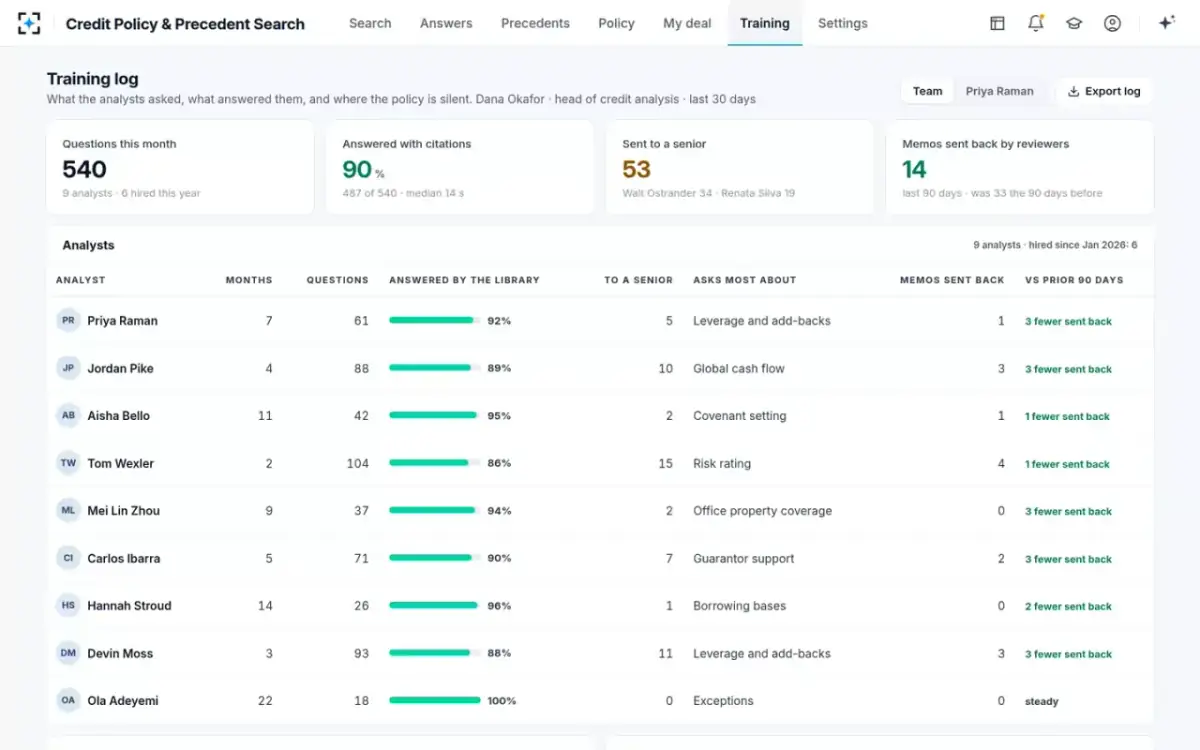
Reads the training log: what each analyst asked, what answered it, what went to a senior.
Still theirs: coaching and readiness
Today
Finds gaps when two memos have treated a point differently.
With agents
Receives policy gaps after three unanswered questions on one point, and owns the answer rules.
Still theirs: the policy and its locked rules
What the head of credit analysis watches
How do you measure AI adoption in a bank's credit team?
After go-live, the measures shift from whether the answers are right to whether the team still behaves as if they might not be. Watch the share of questions answered, the share routed to seniors, and the reasons memos come back. Watch the policy gaps raised and how quickly they close. Above all, watch what happens after each policy release: whether the changed sections are re-tested before analysts rely on them again.
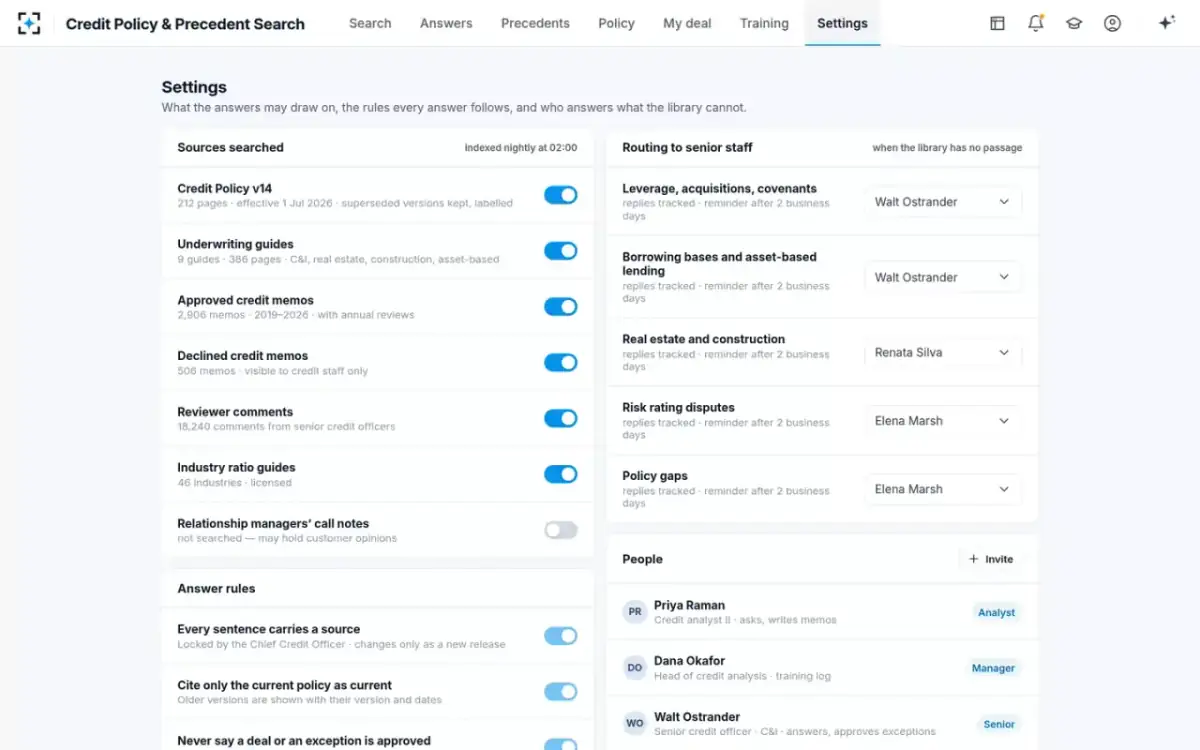
The settings that govern the answers belong to the credit function, not to IT. They decide which sources are searched, who sees declined memos, whether relationship managers' call notes are included and who receives unanswered questions. In the solution, the rule that every sentence carries a source is locked by the chief credit officer.
The rules the answers follow, owned by credit
Trust has a cost side as well. How the cost of a senior's time compares across a policy PDF, a general chatbot and agents over the bank's own memos is set out in credit policy software cost over three years. To see the training log and settings on the sample bank, start from Credit Policy & Precedent Search.
Questions people ask
How do you get senior credit officers to use an AI assistant?
Ask them to test it, not to use it. Seniors who set the shadow questions and score the answers become the people who decide when the team may rely on it, which is the role they already hold for the policy.
How do you stop analysts from over-relying on AI answers?
Make a small set of checks permanent: re-read changed sections after every release, open the source when an answer rests on an exception or says there is no passage, and have reviewers sample citations on every memo. Over-reliance is managed by habit, not by warnings.
Can AI write a bank's credit policy?
It can help draft language, but the policy belongs to the board. The FDIC holds the board responsible for formulating lending policies, and real estate lending policies must be reviewed and approved by the board at least annually. Whatever a tool drafts becomes policy only through that approval.
Does an AI assistant replace the credit policy manual?
No. The manual stays the approved text; the assistant answers from it and quotes it. When the two seem to disagree, the manual governs, and the disagreement is a defect to report or a gap to send to the policy owner.
How long does it take a credit team to trust an AI assistant?
Our estimate for a team of about ten analysts is around twelve weeks to reach the analyst-first rung, but the measures, not the calendar, should decide. Every policy release sends the changed sections back to side-by-side testing.
How many banks use AI today?
A Census Bureau study of U.S. banks estimated that "on average 11% of banks use AI from 2017 to 2022" (CES-WP-25-07). That predates most generative AI. Supervisors describe current generative and agentic AI use as measured and limited to specific cases.