A credit analyst training program in commercial lending is mostly an apprenticeship: a new analyst learns the bank's credit policy by writing memos and asking a senior credit officer every question the binder does not answer. In the first month those questions fall into four kinds: where the rule is, what the bank did last time, who may approve an exception, and what the reviewer will ask. Each one has an answer somewhere in the bank's own policy, underwriting guides, past approved and declined memos and reviewers' comments. The hard part is reaching it without waiting a day for the one person who remembers. Botminds' Credit Policy & Precedent Search is built for that month. It answers an analyst's question beside the deal being written, quotes the rule in force, shows how the bank has used it and how those loans performed, and works the test on the deal's own numbers, with every sentence opening at its source.
The pressure behind this is that the bank's lending knowledge sits with a few senior people, who are also the review bottleneck on every deal. Each question a junior takes to them is time not spent reviewing. This page follows a month of questions through a fictional sample bank, its nine analysts and its two senior credit officers. The people, companies and deals named here are invented; the regulations and research are real.
Four people around one new analyst's memo
Today
Writes three to four memos a week and waits on a senior for every policy question the binder does not answer.
With agents
Asks beside the deal and gets the rule, the precedents and the test on the deal’s numbers, then writes the cited paragraph the same morning.
Still theirs: writing and signing the memo
Today
Learns where analysts struggle when reviewers send memos back.
With agents
Sees what every analyst asked, what answered it and where the policy is silent.
Still theirs: coaching, and who is ready for bigger deals
Today
Answers the same synergy and loan-to-value questions every week, then reviews memos that miss them.
With agents
Past comments answer the next analyst; the questions that reach the desk are the ones only a senior can answer.
Still theirs: approving exceptions within delegated authority
Today
Hears about gaps in the policy when two memos have treated the same point differently.
With agents
Receives a policy gap once three questions on one point have found no policy text.
Still theirs: writing the policy
What does a credit analyst do in a bank, and what does a new one ask?
A commercial credit analyst spreads a borrower's financial statements, tests the deal against the bank's credit policy, and writes the credit memo that a senior credit officer or committee approves or declines. The BLS describes the related loan officer role as analysing "the finances of businesses applying for credit", which needs an understanding of "how to read financial statements" (BLS). A new analyst's questions are predictable in kind, if not in detail, and they move from the rulebook towards judgement. In week one the questions are about where a rule lives and what it says. By week four they are about how the rule applies to a live deal and what the reviewer will push on. The sequence matters to whoever runs training, because the early questions can be answered from documents while the later ones need judgement. Both kinds currently reach the same two or three senior people.
The supervisory texts explain why the questions are so many. A commercial loan policy is supposed to be a statement of the bank's appetite, not an operating manual. The OCC's 2026 lending booklet describes policies as setting "outer limits, with procedures or guidelines including more granular instructions" (OCC, Lending and Loan Portfolio Risk Management). So the answer to almost any practical question is spread across the policy, a guide and the bank's past decisions. The Federal Reserve's examination manual asks that a credit file give "the loan officer, loan committee, and internal and external reviewers" all the information needed to analyse the credit (CBEM §2010.1). That standard is written for the file, not for the person trying to learn from a few thousand of them.
A small profession that learns on the job
64,390
credit analysts employed in the US, May 2025
median annual wage $83,510
1%
projected growth in loan officer jobs, 2025 to 2035
283,000
loan officer jobs in 2025
Week one: where is the rule, and which version is current?
The first questions are lookups that take longer than they should. A new analyst knows the deal needs a loan-to-value limit, a leverage ceiling or a coverage minimum. The difficulty is finding the section, confirming that it is current and telling a policy limit from an underwriting guide's target. In the sample bank, the credit policy runs to 212 pages and nine underwriting guides add 386 more. The questions sound like these, all taken from the sample bank's week:
- Can we go to 80% LTV on owner-occupied industrial?
- Is a seller note funded debt?
- How is fixed-charge coverage calculated for an acquisition?
Each has a written answer. The 80% question is answered by §6.4.2 of the sample policy, which caps owner-occupied industrial at 75% of the lower of price or appraised value. A further rule calls anything between 75% and 80% a policy exception. Above both sits the interagency supervisory limit of 85% for improved property, which the bank's internal limit may not exceed. A senior can recite all three in a sentence. A new analyst finds them in three places, and has to confirm along the way that v14 is current and v13 is not.
Week one's question, answered beside the deal
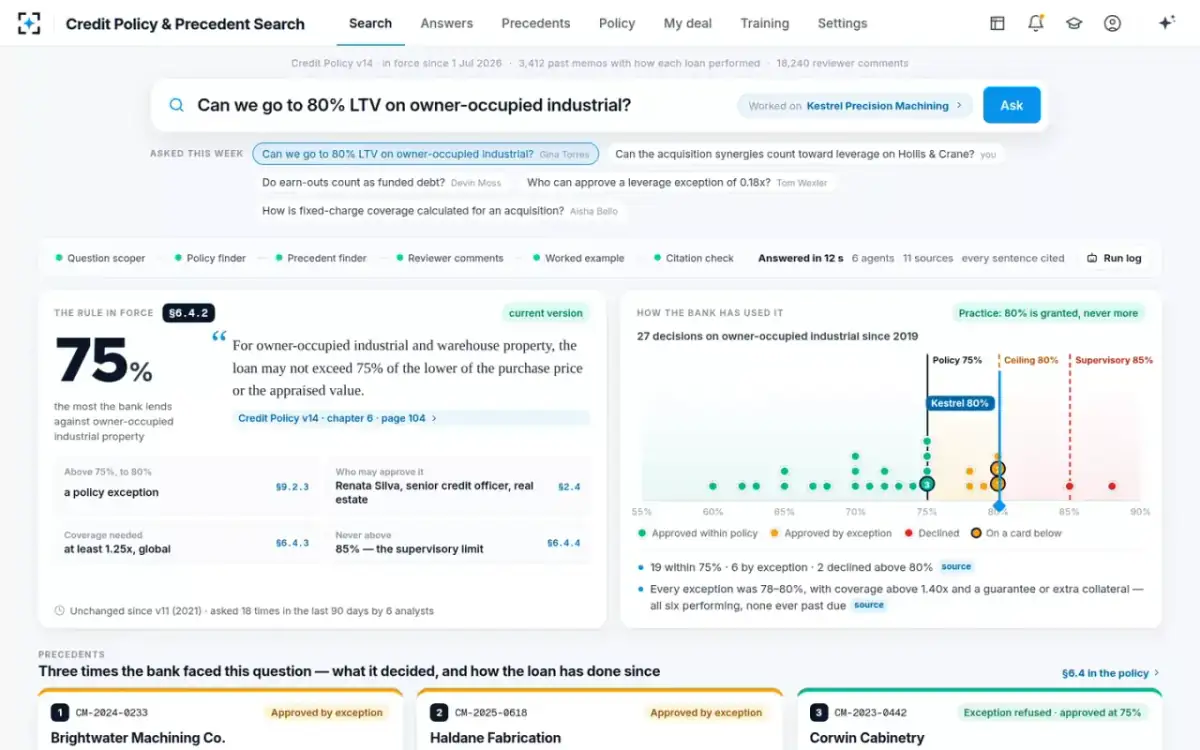
In the solution, the policy finder agent answers this kind of question by quoting the passage with its section and page, and it never cites a superseded version as current. Older versions stay searchable, but they are shown with their version and dates. For a new analyst that removes the most embarrassing week-one error, which is quoting a limit the bank changed last year.
Week two: what did we do last time?
The second week's questions are about practice rather than text. The analyst has found the rule and now wants to know how the bank actually applies it. Has it granted this exception before, to whom, on what mitigants, and how did those loans do? This is the knowledge that lives in people. Economists have a name for the part of lending that is never written down. Allen Berger and Gregory Udell put it directly: "Because the loan officer is the repository of this soft information, agency problems are created throughout the organization" (Federal Reserve, 2001).
When that person is away, the cost shows up in the loans. In a study of loan officers going on leave, Alejandro Drexler and Antoinette Schoar found that their borrowers were "less likely to receive new loans from the bank, are more likely to apply for credit from other banks, and are more likely to miss payments or go into default" (Management Science, 2014). The costs were smaller when officers had incentives to pass the information on. A searchable memo archive, with reviewers' comments attached, is one of those incentives made permanent.
Five points on owner-occupied is fine when the operating company carries the debt at 1.4x or better. Below that, no.
Renata Silva, senior credit officer for real estate at the sample bank, in a comment on a 2024 memo
That sentence is the lesson a new analyst needs, and in most banks it lives in a reviewer's margin note on one memo. In the sample bank, 27 decisions on owner-occupied industrial since 2019 sit on one scale against the 75% line: 19 within it, 6 by exception, 2 declined above 80%. Every exception was at 78% to 80% with coverage above 1.40x and a guarantee or extra collateral, and none has been past due. The analyst learns the bank's real appetite in the time it takes to read the chart. How to read such a chart without treating it as a promise is the subject of how to read a past approved exception.
Week three: who decides, and what will the reviewer ask?
By the third week, the analyst's questions are about people and authority. Who may approve an exception of 0.18x on leverage? Does a 22% customer need a concentration flag? What will the senior credit officer ask when this memo reaches the desk? The first has a written answer in the exception section of the policy. In the sample bank, §9.2 lets a senior credit officer approve up to 0.50x over a leverage limit, and anything beyond goes to credit committee. The other two are answered by habit, which is harder to find.
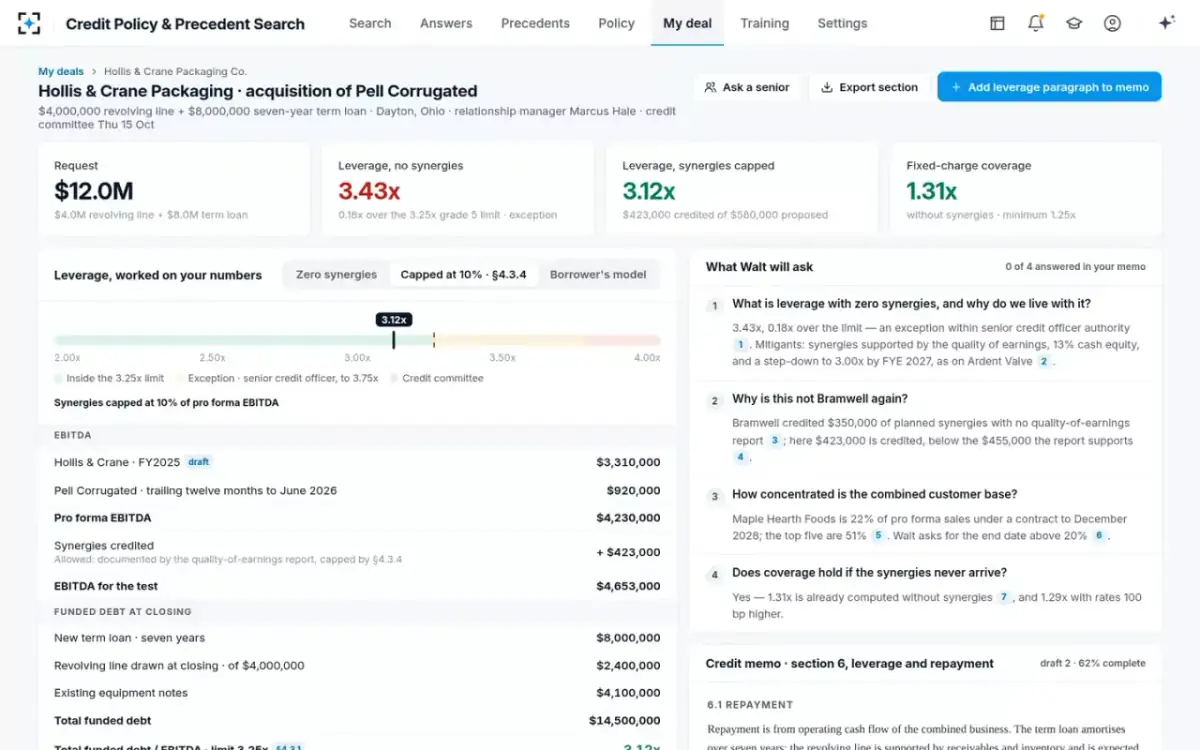
The habit is in the reviewers' comments. On the sample bank's memos, Walt Ostrander, the senior credit officer for commercial and industrial loans, has asked the same things for years. He wants leverage with zero synergies, the contract end date for any customer above 20% of sales, and coverage without the synergies. In the solution, the reviewer-comment miner agent finds what senior credit officers wrote about the same point on similar memos and quotes them word for word. It never says a reviewer approved something they did not.
Week three: the test on the deal, and what the reviewer will ask
Week four: the test on a live deal
By the end of the month the analyst is writing memos that go to committee, and the questions become calculations. Priya Raman, seven months into the role at the sample bank, is writing up Hollis & Crane Packaging's acquisition of Pell Corrugated. Can the acquisition synergies count toward leverage? The policy answer is partly. They count only when documented by a quality-of-earnings report or signed contracts, and never above 10% of pro forma EBITDA. On her deal that is $423,000 of the $580,000 in the borrower's model. Leverage is 3.12x with that credit, inside the 3.25x grade 5 limit, and 3.43x with no synergies, which the policy treats as an exception.
The month's earlier questions all reappear in this one. The rule is in force (§4.3.4, v14). The bank approved Ardent Valve & Fitting at 3.40x with no synergies and a step-down covenant, and it was paid as agreed. It approved Bramwell Paperboard on planned synergies without a quality-of-earnings report, and downgraded it to grade 7 when only $80,000 of $350,000 arrived. A senior credit officer may approve up to 0.50x over the limit. The reviewer will ask about leverage at zero. A new analyst who has learned these four things has learned how the bank lends to acquisitive manufacturers. How to write the result as a paragraph a senior can sign off is covered in how to document a loan policy exception.
Where the hours go on one policy question, by hand and with the solution
By hand · about 11.5 hours, most of it waiting
- Finding the rule and past memos · 13%
- Waiting on a senior · 70%
- Working the test and writing · 17%
With the solution · about 2 hours
- Finding the rule and past memos · 10%
- Waiting on a senior · 51%
- Working the test and writing · 39%
The estimate's largest line is the wait, and it does not fall to zero. Some questions still go to a senior, because the answer is a judgement or because the policy is silent. What changes is that the question arrives with the search already done. In the solution, when nothing in the policy or the memos answers, no answer is written. The analyst can send the question to the named senior for that topic, with everything that was searched, and a reminder follows after two business days.
What the head of credit analysis sees at the end of the month
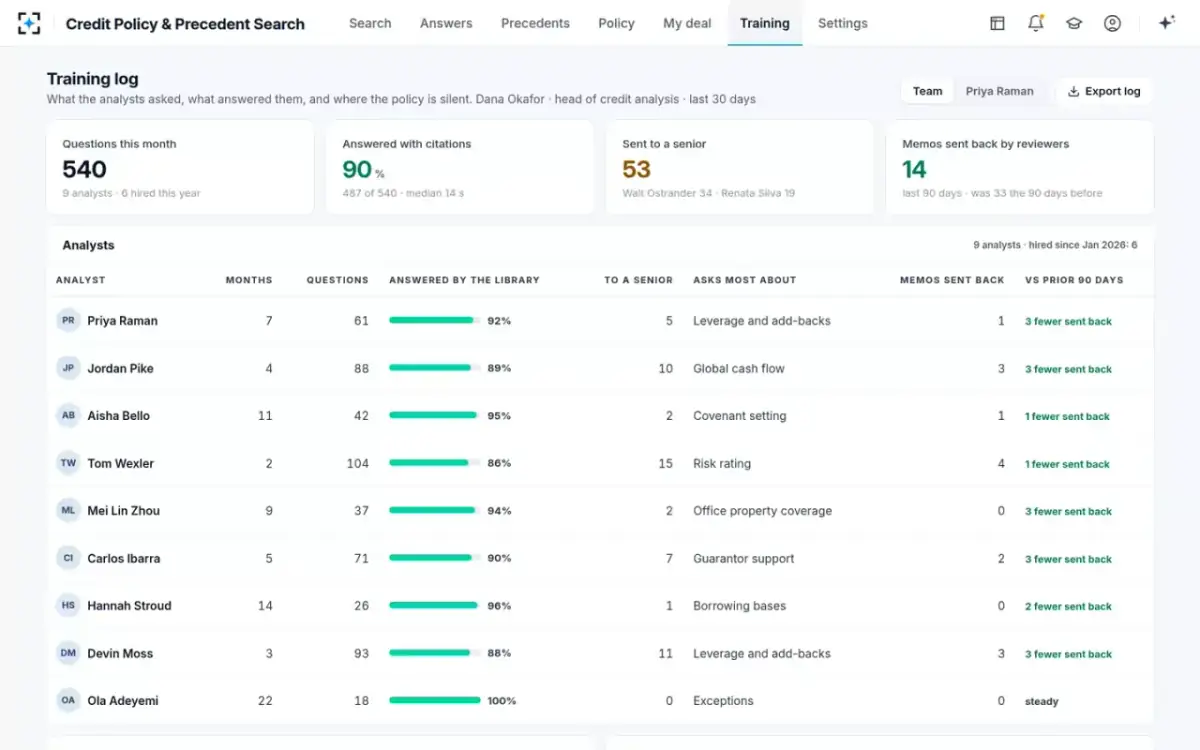
The month leaves a trail that a training lead can use: who asked what, what answered it, and what had to go to a senior. In most banks that trail exists only as interruptions remembered by the seniors who took them. In the solution every question, its answer and its sources go into a training log by analyst and topic. Dana Okafor, head of credit analysis at the sample bank, has nine analysts, six of them hired this year. In the last 30 days they asked 540 questions. The library answered 487 of them with citations, at a median of 14 seconds, and 53 went to a senior.
Questions asked in 30 days fall as months in role rise
Read across, the log shows each analyst's learning curve. Tom Wexler, two months in, asks most about risk rating. Jordan Pike asks about global cash flow and Devin Moss about leverage and add-backs. That is a curriculum, drawn from the bank's own questions rather than a generic course. The log also shows where the policy itself is thin. A question asked seven times in a quarter by five analysts with no passage to quote is not a training problem but a gap in the policy. In the solution it goes to the chief credit officer, who owns the policy.
The month, as the head of credit analysis sees it
One result from outside banking suggests why the gain concentrates on the newest people. In a study of 5,179 customer support agents, a generative AI assistant raised productivity 14% on average and 34% "for novice and low-skilled workers", with minimal effect on the most experienced. The authors' reading is that the tool "disseminates the best practices of more able workers and helps newer workers move down the experience curve" (NBER w31161). Credit analysis is a different job and no such study exists for it. The mechanism, though, is the one a training lead wants: senior practice made available to the newest person, in the moment they need it. For what this means for the role itself, see will AI replace credit analysts.
What mistakes do junior credit analysts make?
Mostly mistakes of reference rather than of arithmetic: the wrong version, the wrong base, the wrong kind of document, the wrong reading of a precedent. Each is easy to make in the first months and easy for a reviewer to catch, which is why they send memos back. They also map onto weaknesses examiners look for. The OCC's 2026 booklet lists among "potential underwriting and structural weaknesses" items such as "Inadequate financial analysis", "Elevated leverage ratio" and "Nonexistent, weak, or waived covenants" (OCC, 2026).
Six first-year mistakes, and what prevents each
| Mistake | How it happens | What prevents it |
|---|---|---|
| Quoting a superseded limit | The binder or a saved PDF is last year’s version; the office coverage minimum rose from 1.25x to 1.30x in v14. | Quoting only the version in force, with its effective date. |
| Measuring against the wrong base | Loan-to-value taken on the appraisal when the policy says the lower of price or appraisal. | Reading the base from the section itself, every time. |
| Treating a guide target as a policy limit | Asking for an exception that is not one, or missing one that is. | Knowing which document each number comes from. |
| Citing an exception as the rule | One approved 80% loan read as “we lend 80%”. | Reading every precedent with its approver, policy version and performance. |
| Crediting undocumented synergies or add-backs | The borrower’s model is taken as the earnings base. | Applying the policy’s documentation test and cap, and showing leverage with none. |
| Missing what the reviewer always asks | Customer concentration, contract end dates, coverage without synergies. | Reading the reviewer’s past comments on similar memos before writing. |
None of these is a gap in intelligence; each is a gap in access. The rule, the base, the document type and the reviewer's habits are all written down somewhere in the bank. A training program that puts them in front of the analyst at the moment of writing prevents the mistake; one that teaches them in a classroom and hopes they are remembered catches it in review, a week later.
How long does it take to train a credit analyst?
There is no published industry figure, and the honest answer has two parts: the bank's rules can be learned in weeks, while credit judgement comes deal by deal over years. What a training lead can measure is how fast a new analyst stops needing a senior for questions the documents already answer. In the sample bank's log for one month, Tom Wexler at two months asked 104 questions and sent 15 to a senior; Priya Raman at seven months asked 61 and sent 5; Ola Adeyemi at 22 months asked 18 and sent none. Memos sent back followed the same slope, from four for Tom to none for the two longest-serving analysts.
That slope is what a training program should try to steepen. The best evidence that it can be steepened comes from outside banking, in the study of support agents described below, where an assistant helped the newest workers most. Within a bank, the levers are the ones this page follows: put the rule, the precedent and the reviewer's habit in front of the analyst when the question arises, and keep a log so the head of credit analysis can see who is ready for larger deals.
What should a credit analyst training program include? A first-month plan
It should teach the bank's own limits, its past decisions with their outcomes, who approves what, and what each reviewer asks, in that order and from the bank's own memos. A head of credit analysis can build this month without new software, though more slowly. The principle is to teach from the bank's own decisions, with the rule and the outcome side by side, and to protect the seniors' time for questions only they can answer. The checklist below is the curriculum the sample bank's log implies. The rules that a loan policy has to carry in the first place are set out in what a bank loan policy should include.
A first-month curriculum for a new commercial credit analyst
- Week one: the five limits every memo touches
Leverage by grade, coverage, loan-to-value by property type, concentration and equity, each read in the current policy with its section and the version date.
- Week one: policy versus guide
Which numbers are policy limits that need an exception, and which are underwriting-guide targets that need an explanation.
- Week two: three precedents per limit
One granted, one granted and later downgraded, one declined, each with the reviewer’s own words and how the loan performed.
- Week three: the exception section, by name
Who may approve how far over each limit, and which questions each senior asks every time.
- Week four: one live memo, fully cited
Every policy statement points to its section, every precedent to its memo, every number to its source.
- Every week: log the questions
What was asked, what answered it and what went to a senior. Repeated questions with no passage are policy gaps, not analyst gaps.
To see the month on the sample bank's policy and memos, screen by screen, start from Credit Policy & Precedent Search.
Questions people ask
How do you onboard a new credit analyst in the first week?
Give them the current policy and guides, access to the memo archive with how each loan performed, and one senior to whom unanswered questions go by name. Then have them read three live memos end to end before writing their own, and start logging every question they ask.
How do you know a new analyst is ready for larger deals?
Count rather than guess: the share of their questions answered from the documents, how many still go to a senior, and how many of their memos come back from review. In the sample bank, the three analysts with no memos returned in 90 days had been in the role nine, 14 and 22 months.
Who should run a credit analyst training program?
The head of credit analysis, with the senior credit officers choosing the precedents and the questions that matter, and the chief credit officer receiving the policy gaps the training exposes. Training run only by HR or a vendor course teaches credit in general; the bank's own limits and habits have to come from the people who apply them.
Should new analysts learn the policy before writing memos?
They should learn where its limits are, and then learn the rest on live deals. The policy states outer limits; the bank's appetite inside them is visible only in its past decisions and reviewers' comments, which is why reading precedents belongs in week two rather than year two.
Does a search tool replace the senior credit officer's teaching?
No. It answers the questions the documents already answer, and it routes the rest to the named senior with the search attached. The questions that reach a senior are then the ones that need judgement, which is the teaching worth their time.