Underwriting exceptions are loans a bank approves outside its own credit policy or underwriting guidelines, and each approved one becomes a precedent the next analyst will find. To read a past approved exception, ask five questions of it. Which version of the credit policy was it decided under? Who approved it, and with what authority? What carried it: which mitigants, which numbers? How has the loan performed since? And is it a single decision or part of a pattern? A precedent answers those questions and no others. It is evidence of how the bank has used its policy. It is not permission to do the same again, because the policy, the borrower and the bank's experience may all have moved since. Credit precedent search is the work of finding the past memos that faced the same question and reading them this way.
Botminds' Credit Policy & Precedent Search does the finding: it ranks the bank's past approved and declined memos by purpose, industry, size and structure, and adds what happened after from annual reviews and grade changes. The reading stays with the analyst and the reviewer. This page uses the solution's fictional sample bank, whose analyst is writing up the acquisition of a corrugated packaging company. Policy §4.3.4 lets acquisition synergies count toward leverage only when documented, and never above 10% of pro forma EBITDA. The question is how the bank has treated deals like hers.
One precedent, read with five questions
CM-2022-0631 · approved by exception
Bramwell Paperboard
Zanesville, OH · decided 23 Jun 2022 · credit committee
The same question
Bought Kessler Carton at 3.95x with no synergies, 3.55x on $350,000 of planned synergies and no quality-of-earnings report.
What the bank decided
0.70x over, by credit committee. Approved on the integration plan alone, before the 10% cap existed.
How it has done since
Downgraded to grade 7, March 2024
1 · Which policy version?
Decided 23 June 2022, before v13 added the 10% cap on synergies. The rule it was decided under no longer exists.
2 · Who approved, with what authority?
Credit committee, at 0.70x over the limit: beyond what a senior credit officer may approve.
3 · What carried it?
“Approved on the integration plan alone”: $350,000 of planned synergies and no quality-of-earnings report.
4 · How has it performed?
Downgraded to grade 7 in March 2024. $80,000 of the $350,000 arrived; leverage reached 4.60x.
5 · Alone or a pattern?
Since 2019 three of the bank’s acquisition approvals were downgraded within two years; two had credited synergies without a quality-of-earnings report, as this one did.
What are underwriting exceptions?
They are departures from the bank's written lending standards that are found and approved when a loan is underwritten, as opposed to problems that appear later. The OCC's 2026 booklet draws the line by timing. Underwriting exceptions arise when "the loan is underwritten and approved". Financial exceptions "are identified during the life of the loan", and administrative exceptions are lapses in documentation and process (OCC, 2026). Only the first kind is a decision someone took on purpose, which is what makes it a precedent; how each kind is written up is set out in how to document credit policy exceptions.
The supervisors do not treat an underwriting exception as a fault. The OCC says banks "sometimes approve loans outside of policy standards to service creditworthy borrowers and meet the legitimate credit needs of the communities they serve, and loans with approved exceptions that are properly justified often present acceptable credit risk." The Federal Reserve's manual goes further: a lending policy "should require loan officers to present credits they believe are fundamentally sound and worthy of consideration, even though they may not conform", with the reason "detailed in writing and submitted for approval to a designated authority" (CBEM §2010.1).
For real estate, one class of underwriting exception carries hard limits. Loans above the supervisory loan-to-value limits should be supported by "a written justification that clearly sets forth all of the relevant credit factors", reported to the board at least quarterly, and kept within 100% of total capital in aggregate, and 30% for commercial, agricultural, multifamily and other non-1-to-4 family property (12 CFR 365, Appendix A). Every exception of this kind is both a decision and a draw on a capped budget, which is one more reason to read past ones carefully.
Can a past approval justify a new exception?
Not by itself. A precedent tells you that a particular argument persuaded a particular approver under a particular policy, and what followed. A credit decision is not a court ruling. No later approver is bound by it, and the policy it applied may have been rewritten because of how it turned out. The sample bank's Bramwell decision shows this. The bank approved a leveraged acquisition on planned synergies with no quality-of-earnings report. The synergies did not arrive, the loan was downgraded, and a later version of the policy, v13, capped synergies at 10% of pro forma EBITDA and required them to be documented. An analyst who cites Bramwell as support for crediting synergies is citing the reason the rule exists.
The supervisory texts treat past decisions the same way, as material for learning rather than authority, and the place they do it most explicitly is the postmortem review, taken up below. A precedent search that shows only the approval misses the half of the story a postmortem exists to find.
Five questions to ask of any past exception
The five questions take a minute each when the memo, the policy history and the loan's performance are on one screen. They take an afternoon when they live in three systems and a senior officer's memory.
Which policy version was it decided under? A decision under v11 of a policy is evidence about v11. If the section has changed since, the precedent may show why it changed. In the sample bank, the synergy cap arrived in v13, and the requirement to show leverage with no synergies in v14. Any acquisition approved before those dates was decided under different rules.
Who approved it, and with what authority? An exception approved by credit committee at 0.70x over the limit is not a precedent for a senior credit officer, whose authority stops at 0.50x. The approver's level tells you how unusual the decision was meant to be.
What carried it? Read the mitigants and the reviewer's comments, not only the outcome. Ardent Valve & Fitting was approved at 3.40x with no synergies, 0.15x over the limit. What carried it was a quality-of-earnings report behind the synergies, 15% cash equity and a covenant stepping leverage down to 3.00x by year two. A request with the same leverage and none of those is not like Ardent.
How has it performed since? This is the question most memo archives cannot answer, because performance sits in the annual reviews and grade history rather than the memo. Ardent was paid as agreed and stood at 3.02x at fiscal year-end 2025. Bramwell was downgraded to grade 7 within two years.
Is it alone, or one of a pattern? A single exception is a judgement. Twenty similar ones are a change in appetite that nobody wrote down, and that is where examiners look.
The same question, three outcomes
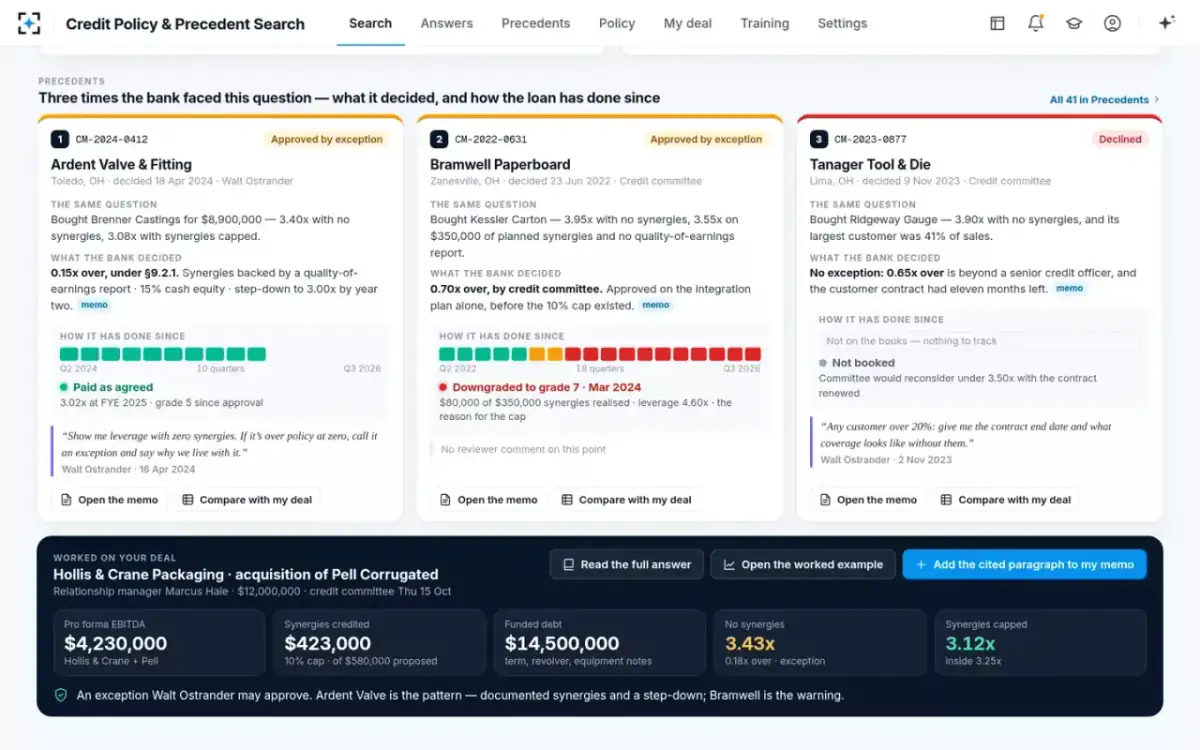
Same ratio, different outcomes: Ardent Valve and Bramwell Paperboard
Two exceptions at similar leverage can carry opposite lessons, and the difference is in what stood behind the numbers. Both sample-bank loans financed a manufacturer's acquisition. Both were above the 3.25x grade 5 limit with no synergies. One was paid as agreed and the other was downgraded. Put side by side, the difference is not the ratio but the evidence for the earnings and the structure that protected the bank if the earnings fell short.
Two acquisition exceptions above the same limit
Ardent Valve & Fitting · 2024: 3.40x: 0.15x over the 3.25x limit.
Bramwell Paperboard · 2022: 3.95x: 0.70x over.
Ardent Valve & Fitting · 2024: Backed by a quality-of-earnings report; 3.08x with the 10% cap.
Bramwell Paperboard · 2022: $350,000 planned, no quality-of-earnings report; 3.55x with them.
Ardent Valve & Fitting · 2024: Senior credit officer, within the 0.50x authority of §9.2.1.
Bramwell Paperboard · 2022: Credit committee.
Ardent Valve & Fitting · 2024: 15% cash equity; leverage covenant stepping down to 3.00x by year two.
Bramwell Paperboard · 2022: Approved on the integration plan alone.
Ardent Valve & Fitting · 2024: After the 10% cap.
Bramwell Paperboard · 2022: Before the 10% cap, which was added in v13 because of it.
Ardent Valve & Fitting · 2024: Paid as agreed; 3.02x at FYE 2025.
Bramwell Paperboard · 2022: Downgraded to grade 7 in March 2024; $80,000 of $350,000 realised; 4.60x.
The senior credit officer's comment on Ardent states the lesson the bank drew: "Show me leverage with zero synergies. If it's over policy at zero, call it an exception and say why we live with it." The sample bank's v14 made that a rule. Every acquisition memo now shows leverage with no synergies, and above the limit it is an exception. For an analyst, Ardent is the pattern to follow and Bramwell is the difference to explain. How to put both into the memo paragraph is set out in how to document a loan policy exception.
When do underwriting exceptions become a risk? When precedent turns into drift
Precedent becomes drift when exceptions on the same point accumulate until the exception is the practice and the policy no longer describes the bank's appetite. Supervisors watch for exactly this, in both directions. The OCC's booklet says that "loans with approved exceptions that are properly justified often present acceptable credit risk". It also says that "a loan portfolio with a high level of underwriting exceptions, however, is generally an indication that the bank's practices deviate from the bank's risk appetite" (OCC, 2026).
The absence of policy exceptions could indicate the policy is overly broad or that underwriting standards represent a more liberal risk appetite than senior management and the board are willing to accept.
OCC, Lending and Loan Portfolio Risk Management, Version 1.0 (June 2026)
The Federal Reserve's manual puts the two readings in one sentence: the frequency of exceptions "may indicate a lessening of underwriting standards on the one hand, or a need to adjust the policy" on the other (CBEM §2010.1). The OCC notes that "some banks track exceptions by loan officer, broker, or dealer", and that examiners determine "whether corrective action follows when necessary". A pattern of precedents is therefore a question for the policy owner, not ammunition for the next request.
How the sample bank has decided two recurring questions since 2019
Read as precedent, the owner-occupied numbers show a stable, narrow practice: six exceptions in seven years, all in the same band, all on the same mitigants, all performing. That is the policy working as designed. The acquisition numbers are more mixed. Nine of 29 approvals were above the limit with no synergies, every one a §9.2 exception, and three acquisition loans were downgraded within two years. That is the kind of pattern a policy owner should look at. The sample bank's response was the v13 cap and the v14 zero-synergy rule.
Every acquisition loan like the one being written, ranked
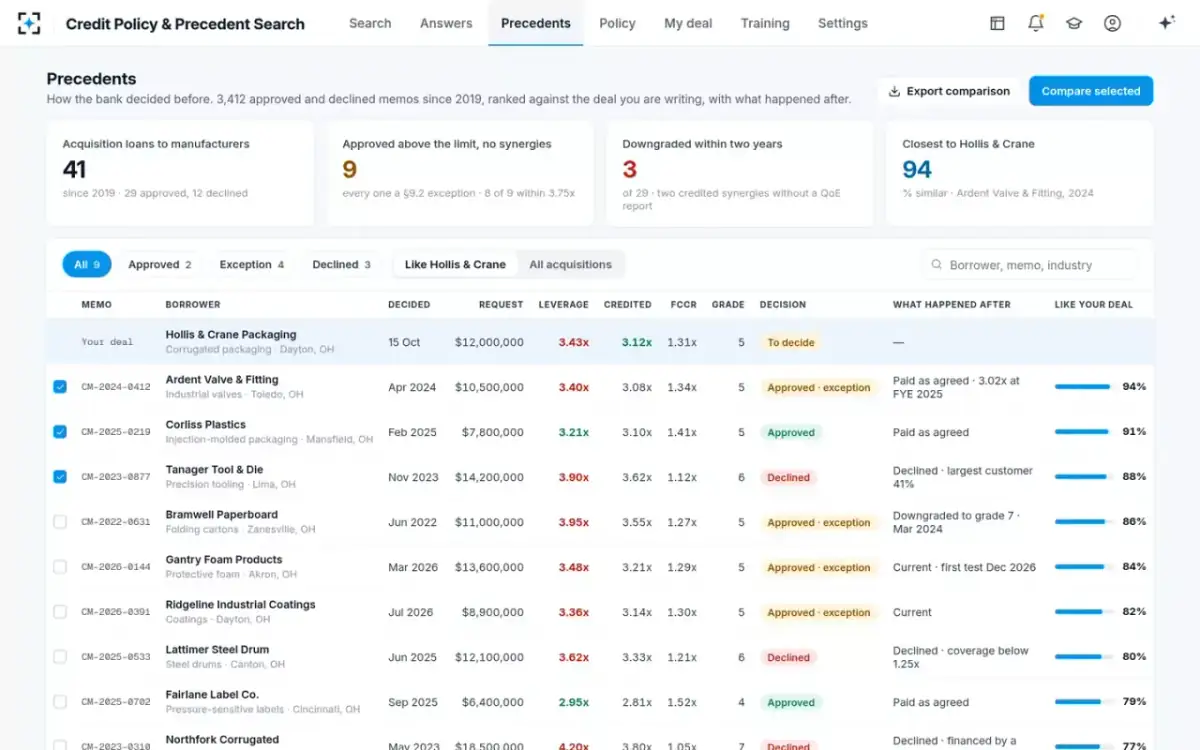
Should exceptions be tracked by loan officer?
Yes, if the bank wants to see drift where it starts, because exceptions cluster around the people who request them. The OCC notes that "Some banks track exceptions by loan officer, broker, or dealer", that "Limits are often set on the level of exceptions in aggregate, by portfolio, and by type", and that examiners "should determine whether the bank tracks and analyzes exceptions in a thorough and timely manner and whether corrective action follows when necessary" (OCC, 2026). The FDIC tells its examiners that "Prudent management and boards monitor compliance with internal policies and maintain reports of all exceptions to policy", and to review those reports "to determine whether exceptions are adequately documented and appropriate in light of all the relevant credit considerations" (FDIC RMS Manual §3.2).
The reason is incentive, not suspicion. A Federal Reserve study of risk rating at large banks observed that "All institutions evaluate the performance of RMs—and thus set their compensation—on the basis of the profitability of the relationships in question" (Treacy & Carey, 1998). A relationship manager whose deals carry three times the exceptions of their peers may be serving a harder market, or may be leaning on the process. Only the count by person raises the question.
The same tracking makes precedent safer to use. When an analyst finds a past exception, the useful next questions are whether the same officer requested most of the others on that point, and whether the same approver granted them. A pattern that runs through one desk is a different kind of evidence from one spread across the bank.
What is a postmortem loan review, and what does it teach about precedent?
A postmortem is a structured look back at a loan that went bad, to learn how the problem developed and whether the bank's standards, structure or monitoring should change. The OCC describes postmortem reviews as "an important part of the collections and loan workout processes", carried out "to understand how problem loans and losses develop", and notes that they "can inform strategic execution and changes in risk selection" (OCC, 2026).
What the OCC lists as common in a postmortem review
- Comparing each loan’s terms and characteristics with underwriting guidelines
Which exceptions were granted at approval, and on what reasoning.
- Reviewing the borrower’s financial condition at approval and over time
Did the earnings the approval relied on arrive?
- Assessing the timeliness of risk-rating changes and problem loan identification
How long the grade lagged the facts.
- Assessing the timeliness and effectiveness of collections and workout
What the bank did once the loan was in trouble.
- Assessing the adequacy and timeliness of collateral valuations
Whether the security was what the memo said it was.
- Assessing the effectiveness of the loan and covenant structure
Whether the structure gave the bank a say before the loss.
In the sample bank, Bramwell Paperboard is what a postmortem produces. Read against the guidelines, it was approved on planned synergies with no quality-of-earnings report; read over time, $80,000 of the $350,000 arrived and leverage reached 4.60x; and the bank's answer was a change in risk selection, the v13 cap. A precedent search that carries the postmortem's finding beside the memo turns one bad loan into a lesson every later analyst sees, instead of a file only the people who worked it remember.
How do you search past credit memos for precedent?
Rank past memos by the deal's purpose, industry, size and structure rather than by borrower name, and put the five answers beside each result. A list of similar memos, with no policy version, approver, mitigants, performance or pattern, sends the analyst back to reading files one by one. Keyword matching on a borrower name misses the precedents that matter.
What each precedent should carry, beside the memo itself
- The decision, and who made it
Approved, approved by exception, or declined; the approver’s level and the section that gave them authority.
- The policy version in force
With what has changed in the section since, so a superseded rule is never read as current.
- The numbers on the policy’s own basis
Leverage with and without synergies, coverage, loan-to-value on the policy’s base.
- The reviewer’s words, quoted
Never paraphrased into an approval the reviewer did not give.
- How the loan has performed since
From annual reviews and grade changes: paid as agreed, downgraded, past due.
- Its place in the pattern
How many decisions on the same question, how many by exception, how many declined, and how those performed.
- Declined deals too, for those allowed to see them
A refusal shows where the line is; access follows the credit file.
Every number on a precedent card is a claim that can be wrong: a grade change missed, a policy version mislabelled, a reviewer's comment attached to the wrong memo. How to test a cited answer before relying on it is the subject of why a cited answer can still be wrong. To see the precedents for both sample deals, start from Credit Policy & Precedent Search.
Questions people ask
How do I find precedent for a credit exception?
Search past memos for the same purpose, industry, size and structure, not the same borrower name, and include declined deals. Then read each with its policy version, approver, mitigants and later performance. Without performance, a precedent shows only that the bank said yes once.
Can an analyst cite a past approval in a credit memo?
Yes, as evidence of the bank's practice, with the memo number, the policy version and how the loan has performed, and with any refusal on the same question explained. It should never be presented as a reason the approver must agree.
How many underwriting exceptions are too many?
There is no regulatory number for commercial loans generally. The OCC reads a high level as a sign that practice deviates from appetite and the absence of exceptions as a sign the policy may be too broad; banks often set limits by portfolio and type, and examiners check that they are tracked. The one hard cap is for real estate loans above the supervisory loan-to-value limits: 100% of total capital in aggregate.
Is a declined deal a precedent too?
Yes, and often the more useful one, because a refusal shows where the bank drew the line. In the sample bank, Tanager Tool & Die was declined at 3.90x with one customer at 41% of sales; an analyst asking for more than the limit has to explain why the new deal is not Tanager. Access to declined memos should follow the credit file.
Do underwriting exceptions have to be reported to the board?
The Federal Reserve expects the directors' loan committee or a similar body to "review and approve all exceptions at reasonable intervals". For real estate loans above the supervisory loan-to-value limits, the aggregate should be reported to the board at least quarterly, and exceptions of significant size individually.