A loan policy review in 2026 should re-check at least five sections of a commercial loan policy, because the texts behind them changed in ten months. In December 2025 the OCC and FDIC rescinded the 2013 leveraged lending guidance. In April 2026 the agencies replaced SR 11-7 and OCC 2011-12 with revised model risk guidance. In June 2026 the OCC replaced its Loan Portfolio Management booklet. In September 2026 it issued version 3.0 of its Concentrations of Credit booklet. And on 1 October 2026 SBA SOP 50 10 8.1 took effect. A policy that still cites the old texts is not wrong in every sentence, but it points analysts and examiners at documents that no longer govern. Botminds' Credit Policy & Precedent Search answers analysts from the current policy only, and it makes the stale citations findable: every passage that names a superseded source can be searched for and listed by section.
Five changes in ten months
5 Dec 2025
Leveraged lending guidance rescinded
OCC and FDIC: each bank defines its own leveraged loan.
17 Apr 2026
Model risk guidance replaced
SR 11-7 and OCC 2011-12 superseded; generative and agentic AI out of scope.
25 Jun 2026
New OCC lending booklet
“Lending and Loan Portfolio Risk Management” replaces “Loan Portfolio Management”.
Sep 2026
Concentrations of Credit, version 3.0
OCC booklet reissued; the 25% of tier 1 plus allowance definition kept.
1 Oct 2026
SBA SOP 50 10 8.1 in effect
Replaces SOP 50 10 8 for 7(a) and 504 lenders.
What changed in bank lending guidance in 2026?
Five texts behind commercial loan policies changed between December 2025 and October 2026: leveraged lending, model risk, the OCC's lending booklet, concentrations and the SBA's operating procedure. Each change touches a section most commercial loan policies have. The leveraged-loan definition sits in underwriting standards or a leveraged lending appendix. Model governance covers any model used in underwriting or grading. Credit administration and exceptions are often written around the OCC's booklet. Then come concentration limits, and the SBA lending section for SBA lenders. The table maps each change to the section and the action it calls for.
What changed, where it lands in the loan policy, and what to do
| Change | What it says | Policy section it touches | What to re-check |
|---|---|---|---|
| Leveraged lending guidance rescinded (OCC, FDIC) · 5 Dec 2025 | “Each bank should determine its own definition of a ‘leveraged loan.’” The Federal Reserve had not announced a rescission as of October 2026. | Underwriting standards; leveraged lending definition and limits. | Write the bank’s own definition and limits; keep the Fed position in view if Fed-supervised. |
| Model risk guidance replaced (OCC, Fed, FDIC) · 17 Apr 2026 | Supersedes SR 11-7 and OCC 2011-12. Generative and agentic AI are “not within the scope”. Most relevant above $30 billion in assets. | Models used in underwriting, risk rating and pricing; AI tools. | Replace citations to SR 11-7; decide how the bank governs AI tools the guidance excludes. |
| OCC “Lending and Loan Portfolio Risk Management” · 25 Jun 2026 | Revises and combines the rescinded “Loan Portfolio Management” booklet and its 1998 cover letter. | Credit administration, exceptions, annual review, postmortems. | Re-point references; compare exception categories and tracking with the new text. |
| OCC “Concentrations of Credit” v3.0 · Sep 2026 | A concentration is obligations “exceeding 25 percent of a bank’s tier 1 capital plus the allowance for credit losses”; still points to the 2006 CRE guidance. | Concentration limits and reporting; CRE limits. | Check the definition and base used in the policy’s limits and reports. |
| SBA SOP 50 10 8.1 · effective 1 Oct 2026 | Replaces SOP 50 10 8; restates the credit memo content, tax verification and debt service coverage of at least 1.15 business and 1:1 global. | SBA lending section; credit memo standards for 7(a) and 504. | Update citations and the memo checklist for SBA loans. |
Was the leveraged lending guidance rescinded? The definition is now the bank's own
Yes, by the OCC and FDIC on 5 December 2025; the Federal Reserve had announced no rescission of its own as of October 2026. With the 2013 guidance and its 2014 FAQs rescinded by those two agencies, a policy can no longer borrow its leveraged-loan definition from the agencies; it has to state one. The joint release is direct. "Each bank should determine its own definition of a 'leveraged loan.'" It also asks for an analysis of a leveraged borrower's "past and current performance compared with projections, as well as the assumptions on which the projections are based" (NR-IA-2025-119). The agencies gave their reason as well: the old guidance had been "overly restrictive", with a "significant drop in leveraged lending market share by regulated banks".
Each bank should determine its own definition of a 'leveraged loan.'
OCC and FDIC, joint release NR-IA-2025-119, December 5, 2025
Two cautions apply. First, the Federal Reserve's SR letter index for 2026 lists no rescission of its own version (Federal Reserve). A state member bank or a holding company should not write that "all agencies rescinded" the guidance. Second, a definition is only half the section. The limits that hang off it, such as maximum leverage by grade, how acquisition synergies count and when an exception is needed, are what analysts actually ask about. In the solution's sample bank, §4.3.4 caps credited synergies at 10% of pro forma EBITDA, and v14 requires every acquisition memo to show leverage with no synergies.
Was SR 11-7 rescinded? Model risk sections need a new citation
Yes: revised interagency guidance replaced it on 17 April 2026, so any section that cites SR 11-7 or OCC Bulletin 2011-12 now cites rescinded guidance. On 17 April 2026 the Federal Reserve, OCC and FDIC issued revised guidance that "supersedes and replaces SR letter 11-7" (SR 26-2), and the OCC's bulletin rescinds OCC 2011-12 (OCC Bulletin 2026-13). The new guidance says it "is expected to be most relevant to banking organizations with over $30 billion in total assets". It excludes "simple arithmetic calculations, such as those found within spreadsheets" from the term model. And it states that "Generative AI and agentic AI models are novel and rapidly evolving. As such, they are not within the scope of this guidance."
That last sentence leaves a gap the loan policy, or the bank's AI policy, has to fill. If analysts use AI tools to answer policy questions or draft memo text, no federal model-risk text now tells the bank how to govern them. The agencies have said they plan "a request for information" on AI and model risk; none had been published by late October 2026. A sensible policy names the controls the bank expects: answers limited to the bank's own documents, current versions only, decisions kept with named people, and testing after each release. Third-party guidance from 2023 remains in force while a proposed replacement, issued on 15 September 2026, is open for comment until 16 November 2026 (proposal).
The new OCC lending booklet: exceptions and credit administration
Sections on credit administration, exceptions and annual review that cite the OCC's "Loan Portfolio Management" booklet now cite a rescinded text. Bulletin 2026-29 of 25 June 2026 says the new "Lending and Loan Portfolio Risk Management" booklet "revises and combines" it and its April 1998 cover letter, "which are rescinded with the publication of this booklet" (OCC Bulletin 2026-29). The solution's fictional sample bank shows how easily the timing can catch a policy. Its v14 was approved by the board on 24 June 2026, one day before the booklet changed.
The new booklet is worth more than a change of reference. It sorts exceptions into underwriting, financial and administrative kinds. It lists "Covenant breaches (even if waived)" and "LTV above policy at the time of annual review" as financial exceptions. It warns that "the absence of policy exceptions could indicate the policy is overly broad" (OCC, 2026). A policy whose exception section predates it should be compared line by line. How exceptions should be written up under these texts is set out in how to document a loan policy exception.
The thresholds a 2026 policy review should confirm
25%
of tier 1 capital plus the allowance: the OCC’s definition of a credit concentration (v3.0)
300%
total CRE as a share of tier 1 capital plus the allowance (100% for construction): the 2006 CRE screens, on the 2020 base
1.15x · 1:1
SBA minimum debt service coverage, business and global, under SOP 50 10 8.1
$30bn
assets above which the revised model risk guidance is “most relevant”
Concentrations v3.0 and the CRE screens
The OCC's Concentrations of Credit booklet, now version 3.0 dated September 2026, keeps the definition most policies already use. "A concentration is defined as the sum of direct, indirect, or contingent obligations exceeding 25 percent of a bank's tier 1 capital plus the allowance for credit losses (ACL)" (OCC, v3.0). It still points to the 2006 interagency guidance on commercial real estate concentrations. That guidance carries the familiar screens: construction and land loans at 100% or more of total capital, or total CRE at 300% or more with 50% growth over 36 months (71 FR 74580). The base is no longer the one the 2006 text names. Since March 31, 2020 the agencies “consistently calculate credit concentrations using tier 1 capital plus the appropriate allowance for loan and lease losses (ALLL) or allowance for credit losses (ACL) as the denominator” (OCC Bulletin 2020-29). A policy whose CRE limits still divide by total risk-based capital is on the pre-2020 method. The review question is whether the policy's limits use the same base as the reports it produces and as the examiners' ratios.
What changed in SBA SOP 50 10 8.1 for SBA lenders?
For a bank that makes SBA 7(a) or 504 loans, the policy's SBA section and the memo checklist behind it should now cite SOP 50 10 8.1. It was published on 25 September 2026, took effect on 1 October 2026 and replaces SOP 50 10 8 (SBA). It restates what the lender's credit memorandum must address, including "ability and likelihood to repay the loan from the cash flow of the business". It requires financial analysis "based on the three most recent years of historical financial information … plus an interim financial statement". And it sets the coverage floor: debt service coverage "equal to or greater than 1.15 on a historical and/or projected cash flow basis and 1:1 on a global basis."
Two adjacent changes belong in the same review, though they touch fair lending rather than credit sections. The CFPB's amendments to Regulation B on disparate impact took effect on 21 July 2026 (CFPB). Section 1071 was rewritten in May 2026, with a compliance date of 1 January 2028; it is covered in Section 1071 after the 2026 rule. Banks writing their own leveraged-loan definition may also want to see how portfolio teams apply one, in Commercial Loan Portfolio Analysis.
How often should a loan policy be reviewed, and what should the annual review cover?
At least once a year for real estate lending policies, which must be "reviewed and approved by the … board of directors at least annually" (12 CFR 365.2), and most banks review the whole loan policy on the same cycle. The credit risk review policy is expected to follow a similar annual rhythm (2020 guidance). A rule change behind a section, like the five above, is a reason to amend between reviews rather than wait.
The annual review should start from evidence, not from the old document. Supervisors say where to look. The Federal Reserve reads the frequency of exceptions as something that "may indicate a lessening of underwriting standards on the one hand, or a need to adjust the policy" on the other (CBEM §2010.1). The FDIC asks its examiners to work out "whether troublesome loans result from inadequate lending and collection policies and practices or merely reflect exceptions to basically sound credit policies and practices" (FDIC RMS Manual §3.2). Both point the policy owner at the same inputs.
The evidence an annual loan policy review should start from
| Input | What it tells the policy owner | Section it usually changes |
|---|---|---|
| Exception report for the year, by section | Limits excepted so often that they no longer describe practice, or never excepted at all | The limit itself, or the exception authority |
| Loans downgraded within two years of approval | Which approvals, and which exceptions, did not work; the postmortem findings | Underwriting standards, documentation requirements |
| Concentration reports against limits | Whether limits bind, and whether the report uses the same base as the limit | Concentration limits and reporting |
| Questions analysts asked with no passage to quote | Points the policy is silent on, and how past memos filled the gap | New sections or definitions |
| Changes in people and roles | Lending authority granted to people who have moved, left or been promoted | Lending authority schedule |
| Rule changes since the last approval | Citations to superseded texts, and new expectations | Every section that cites them |
How do you find outdated references in a loan policy?
Search the policy and every underwriting guide for the names of superseded texts, and list each hit by section and page. The fastest part of a policy review should be finding where the policy cites something that has changed. In a 200-page document plus its underwriting guides, that is a search problem. It is also the one part of the review where a missed reference does lasting damage, because analysts keep quoting the old text. The solution's answer rules help on both sides. Only the current policy is ever cited as current, so analysts do not quote a superseded version. And the policy and guides can be searched for any source name, such as "SR 11-7", "2013 Guidance" or "Loan Portfolio Management", with every hit listed by section and page.
The policy with its version history beside it
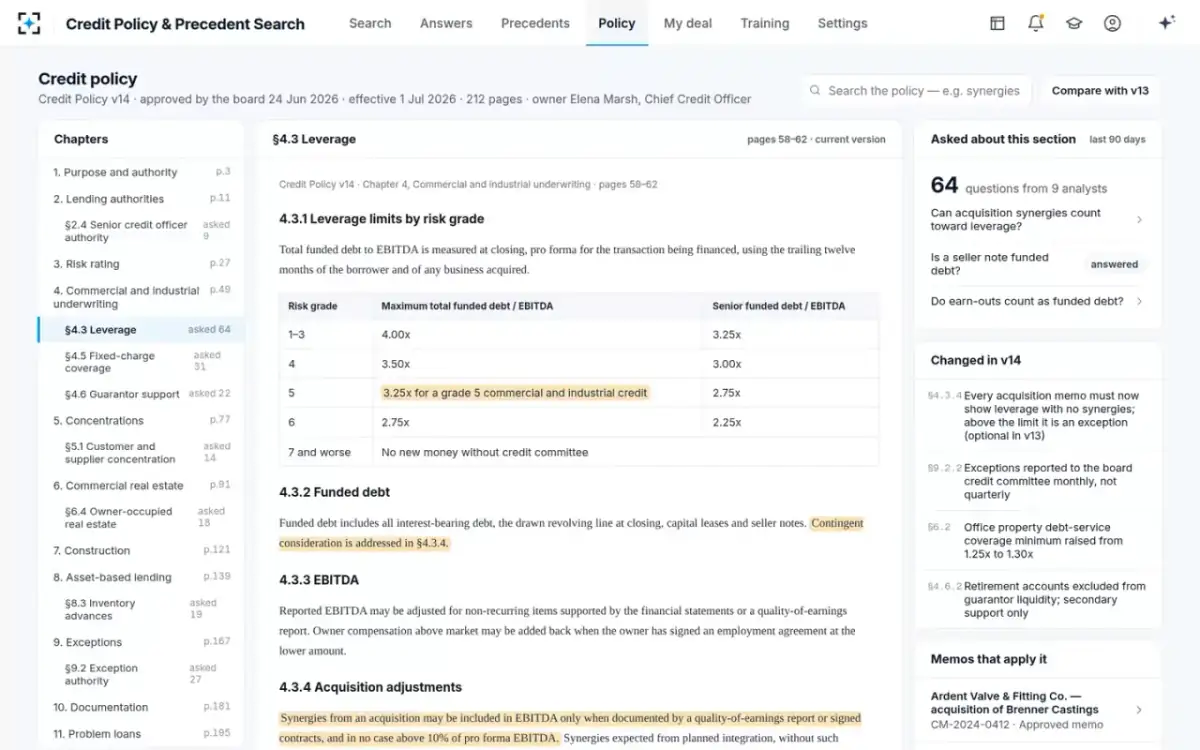
A policy review also has evidence the policy text alone cannot provide: what analysts actually asked about each section, and where they found no answer. In the sample bank, §4.3 on leverage was asked about 64 times by nine analysts in 90 days. Earn-outs had been asked about seven times in a quarter with no passage to quote, and two past memos had treated them in opposite ways. That makes them a policy gap, and v15 is being drafted. A review that starts from those questions fixes the sections analysts use most.
Who answers what the policy does not
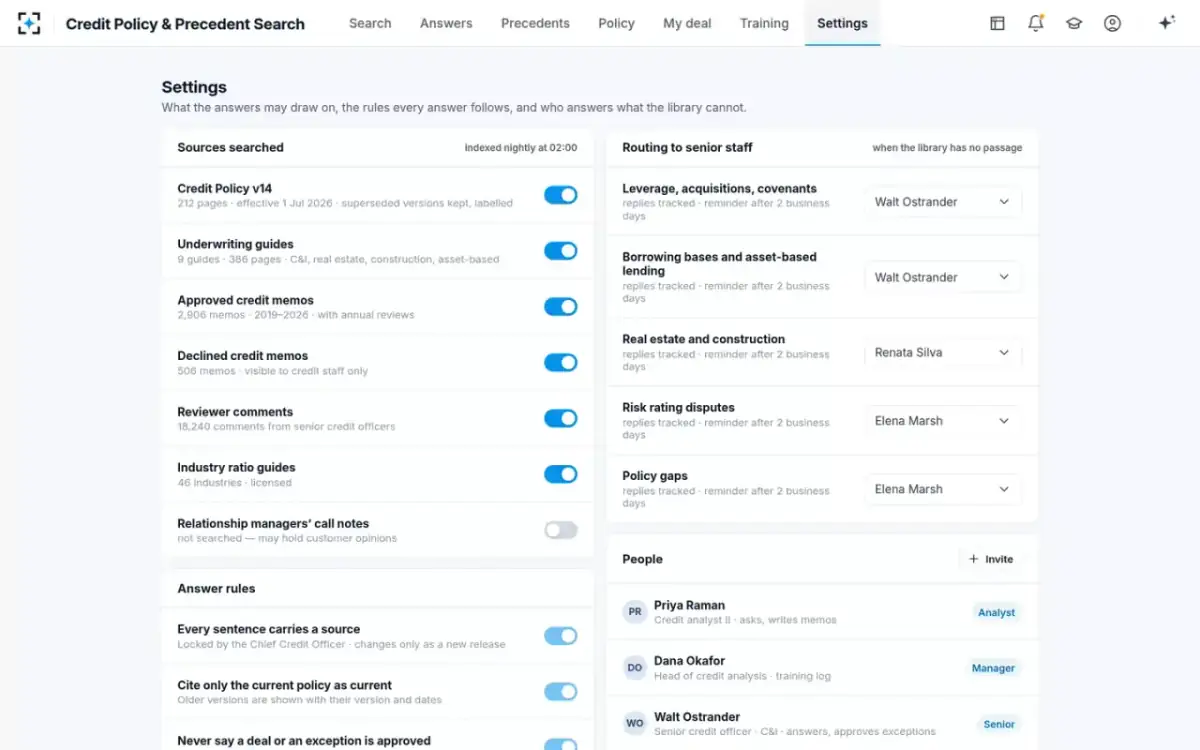
A 2026 loan policy review, in order
- Search the policy and guides for superseded sources
“2013 Guidance”, “Leveraged Lending”, “SR 11-7”, “2011-12”, “Loan Portfolio Management”, “SOP 50 10 8”. List every hit by section.
- Write the bank’s own leveraged-loan definition
And the limits that depend on it; note the Federal Reserve’s position if the bank is Fed-supervised.
- Decide how AI tools used in credit are governed
The revised model risk guidance leaves generative and agentic AI out of scope; say what the bank expects.
- Compare the exception section with the new OCC booklet
Underwriting, financial and administrative exceptions; tracking; reporting frequency.
- Confirm concentration bases
Tier 1 capital plus the allowance for the 25% test and both CRE screens, as since 2020; the same base in the limit and the report.
- Update the SBA section and memo checklist
SOP 50 10 8.1 from 1 October 2026.
- Close the policy gaps analysts have found
Questions asked repeatedly with no passage to quote.
- Re-test answers on every changed section
Before analysts rely on cited answers about them again.
The full list of what a loan policy has to contain, and the beliefs about it that do not survive the text, are in what a bank loan policy should include. Re-testing after a release is part of the upkeep counted in what an AI knowledge base for credit policy costs. To see the sample bank's policy, its version history and its gaps, start from Credit Policy & Precedent Search.
Questions people ask
Does the Federal Reserve still apply the 2013 leveraged lending guidance?
Its SR letter index showed no rescission of its own as of October 2026, while the OCC and FDIC rescinded theirs on 5 December 2025. A state member bank or holding company should confirm its supervisor's position before rewriting the section on the strength of the OCC and FDIC release.
Do community banks have to follow the revised model risk guidance?
The guidance says it "is expected to be most relevant to banking organizations with over $30 billion in total assets" and "does not set forth enforceable standards or prescriptive requirements". The OCC adds that its model risk guidance should not be read to require community banks to perform annual model validation. A smaller bank still needs to replace any SR 11-7 citation in its policy.
When does the proposed third-party guidance take effect?
Not yet. It was proposed on 15 September 2026 with comments due by 16 November 2026, and the 2023 interagency guidance stays in force until a final version replaces it. A policy that cites the 2023 guidance is current for now.
What should the board see from the 2026 policy review?
A short list of changed sections, each with the rule change or evidence behind it: the bank's own leveraged-loan definition, the replacement for any SR 11-7 citation and how AI tools are governed, the exception section compared with the new OCC booklet, and the policy gaps closed. The approval minutes should record the version and its effective date.
Should a loan policy cite regulations by name?
Yes, where a section exists because of a rule, so readers and examiners can see its authority. Keep the citations consistent, ideally listed in one appendix as well as in the text, so that a rescission like SR 11-7's is a search and a set of edits rather than a page-by-page read.