A corporate resolution to change signers on a bank account is a written decision of a company's board, or of an LLC's members or managers, that names who may sign on the company's accounts, adding, removing or replacing people, and is certified by an officer such as the corporate secretary. A bank changes the signers only when it holds that resolution, a signature card signed by the signers who will remain, and enough about each new signer to know who they are. The hard part is not the form. It is deciding whether the person who certified the resolution had the power to, and Botminds' Account Maintenance Requests is account maintenance request software whose agents read the resolution against what the bank already holds, ask for what is missing instead of guessing, and leave the approval to two specialists.
The worked example is a sample signer change at Kessling Millwork LLC, a fictional customer of the fictional Corvane National Bank, as the solution handles it. Statutes and federal guidance are linked where they appear.
A signer change in Account Maintenance Requests: agents read and ask, people approve
Agent
Intake agentReads the resolution, the new signature card and any certification into the fields that change: signers added and removed, the signing rule, the effective date.
Never: Never guesses a value it reads with low confidence
Agent
Authority agentChecks that the certifying officer is the one the bank’s earlier resolution names, and lists any document the change type needs.
Never: Never waives a document
Agent
Takeover agentReads the business account’s recent contact changes, online banking administrators and wire templates for signs the request is not the company’s.
Never: Never decides
Agent
Callback agentPicks a number the bank held before the request, for an officer already on file, and drafts the script.
Never: Never calls a number in the request
A person decides
MakerReviews the evidence and approves, holds, or asks the business for what is missing.
A person decides
CheckerTicks a separate checklist against the same evidence and signs; only then does the core banking update post and get read back.
What is a corporate bank resolution, and who signs it?
A corporate bank resolution is the company's own record that its governing body decided who may act on its bank accounts; it is signed, or certified, by the officer who keeps the company's records. Corporate law puts the decision with the board. Delaware's statute, for example, says "The business and affairs of every corporation organized under this chapter shall be managed by or under the direction of a board of directors" (8 Del. C. § 141(a)).
The same chapter explains why banks ask for an officer's certification. Officers hold "such titles and duties as shall be stated in the bylaws or in a resolution of the board", and one of them "shall have the duty to record the proceedings of the meetings of the stockholders and directors" (§ 142(a)). That officer, usually the secretary, is the person who can truthfully certify what the board resolved. Unless the certificate of incorporation or bylaws say otherwise, a board can also act without meeting if all directors consent in writing, and the consent is then "filed with the minutes" (§ 141(f)), so a written consent is as good as a meeting's resolution, if it is unanimous.
For a bank, the consequence is precise. The question is not whether the resolution looks official. It is whether the person certifying it is the officer the bank's existing documents name, and whether what it resolves is within that body's power. A resolution certified by the person it adds as a signer is the case that should stop everything.
What documents are needed to change signers on a bank account?
Expect a bank to ask for three things to change signers on a business account: the resolution or consent that authorises the change, a new signature card, and identifying information for each new signer. A fourth applies when the change also changes who owns or controls the business. Which document carries the authority depends on the entity.
Who can authorise a signer change, by type of business
| Entity | Who decides | What the bank usually asks for | What to check |
|---|---|---|---|
| Corporation | Board of directors (8 Del. C. § 141(a)) | Board resolution or unanimous written consent, certified by the secretary | The certifier is the officer the bank’s last resolution names, and is not the person being added |
| LLC, member-managed | The members, by share of profits unless the agreement says otherwise | Members’ consent, or the operating agreement’s authority clause | Whether the agreement limits who may bind the company |
| LLC, manager-managed | The manager or managers the agreement names | Manager’s consent and the page of the operating agreement naming them | That the signer is still a manager |
| General partnership | The partners, as the partnership agreement provides | Partnership resolution or partners’ consent | All partners the agreement requires have signed |
| Nonprofit corporation | Board, under its bylaws | Board resolution certified by the secretary | Quorum and any officer limits in the bylaws |
The fourth document is the beneficial ownership certification. Since February 13, 2026, FinCEN has allowed banks to identify a legal entity customer's beneficial owners at the first account opening rather than at every new account, and again "any time thereafter when the covered financial institution has knowledge of facts that would reasonably call into question the reliability of beneficial ownership information previously obtained" (FinCEN Order FIN-2026-R001). A signer change that removes a co-owner or installs a new chief financial officer can be exactly such a fact. What the 2026 relief changed at the second account is covered in its own guide.
How a bank changes signers on a business account, step by step
A signer change on a business bank account runs in a fixed order: the business passes a resolution, the certifying officer signs it, all continuing and new signers sign a fresh signature card, new signers bring identification, and the bank checks, keys, second-checks and confirms the change to the business's address on file. The sample change shows each step on real-looking paper.
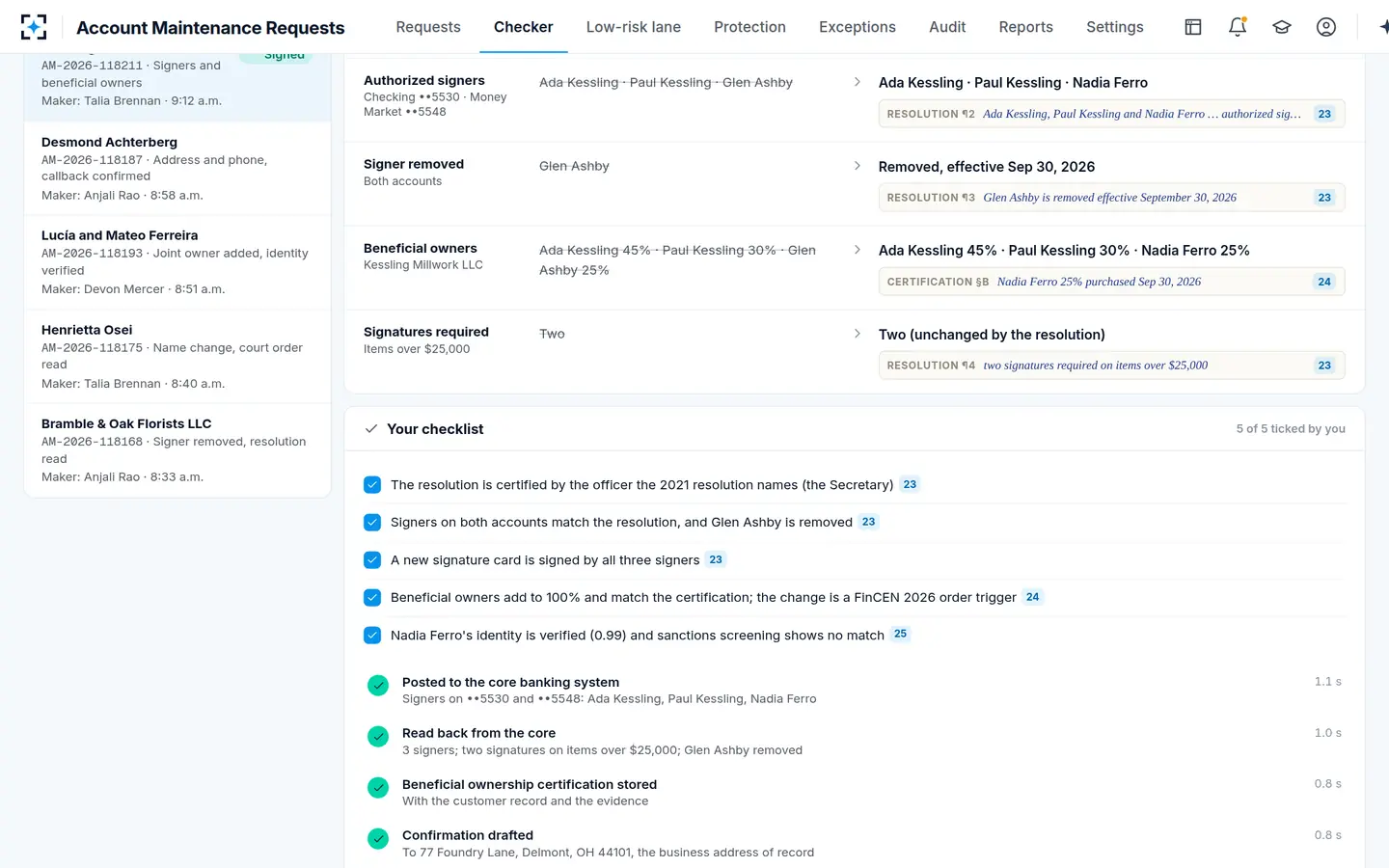
Kessling Millwork LLC's resolution, processed by Corvane National Bank on October 20, 2026, adds Nadia Ferro, the company's chief financial officer, as a signer on Business Checking ending 5530 and Business Money Market ending 5548, and removes Glen Ashby effective September 30, 2026. Two signatures are still required on items over $25,000. The beneficial ownership certification changes too: Ada Kessling 45%, Paul Kessling 30%, and Nadia Ferro 25%, purchased on September 30, 2026, replacing Glen Ashby's 25%.
The maker, Talia Brennan, approved at 9:12 a.m. The checker, Marcus Oyelowo, ticked five checks of his own and signed at 9:41 a.m. The update then posted to the core banking system, was read back to confirm the core held what was keyed, and a confirmation was drafted to the business address the bank already had, not to any address in the request.
The checker signs a business signer change against the evidence, not the keystrokes
Corporate resolution to add a signer to a bank account: what the bank checks
Adding a signer is the riskier half of a signer change, because it creates a new person who can move money. The five checks the sample checker ticked are a usable standard: the certifier is the officer the earlier resolution names; the signers on each account match the new resolution exactly; a new card is signed by every continuing and new signer; any ownership change adds up and matches a certification; and the new signer's identity is verified and screened.
The first check carries the most weight and is the easiest to skip. Corvane's file held a 2021 resolution naming Kessling's secretary as the certifying officer, so a 2026 resolution certified by the same office could be relied on. Had it been certified by Nadia Ferro herself, the authority chain would loop back to the person who benefits, and the right response is to ask for certification by someone else.
Add an authorized signer to an LLC: the operating agreement decides
To add an authorized signer to an LLC's bank account, the bank needs evidence that the people with power to bind the LLC approved it, and the LLC statute points to the operating agreement first. In Delaware, "Unless otherwise provided in a limited liability company agreement, each member and manager has the authority to bind the limited liability company" (6 Del. C. § 18-402). The default is broad; the agreement can narrow it to one manager or require all members.
That is why "a member signed it" is not a complete answer for an LLC. A specialist, or an agent, should ask whether the bank has the operating agreement's authority clause on file, whether the LLC is member-managed or manager-managed, and whether anything in the agreement limits who may open or change bank accounts. Where the bank has none of that, the honest output is a request for it.
Does a new signer need to be identified by the bank?
Usually yes, though the federal rule leaves the depth to the bank's risk assessment. For a business account the customer under the identification rule is the business, not each signer. The interagency CIP guidance adds that, based on its risk assessment, a bank may need to gather information about the people with authority or control over such an account, signatories included, to verify the business itself (Interagency CIP FAQ, 2005; KYB vs KYC sets out what changes when the customer is a company). How far to go is the bank's own procedure; verifying every new signer is the cautious setting.
Two other rules reach the same person. The BSA recordkeeping rule requires a bank to keep each document granting signature authority over a deposit account, with any notations of the identifying information used to verify the signer (31 CFR 1020.410(c)). And if the new signer is also the new control person, the beneficial ownership rule asks for more: FinCEN's consolidated FAQs give a chief financial officer and a treasurer as examples of a control person, and say that where the update is a change of beneficial ownership, the bank collects, certifies and verifies the new owner's identity (FinCEN CDD FAQs, May 2026; beneficial owner declarations for existing customers covers the trigger).
Five questions an agent should ask instead of guessing
An agent reading a signer change should stop and ask whenever the documents do not prove authority on their face. Guessing is the failure mode that matters: a model that fills a missing certifier's name from the last resolution, or reads an unsigned consent as signed, produces a confident change that no person checked. The solution's agents have the opposite instruction: they never waive a document and never accept authority the paper does not show.
When the papers fall short, the agent asks, and here is what it asks for
- No resolution, only a letter or an email from an officer
Ask for the resolution or written consent the bank’s form requires; a letter says what someone wants, not what the board decided.
- The resolution is signed by one of two required signers
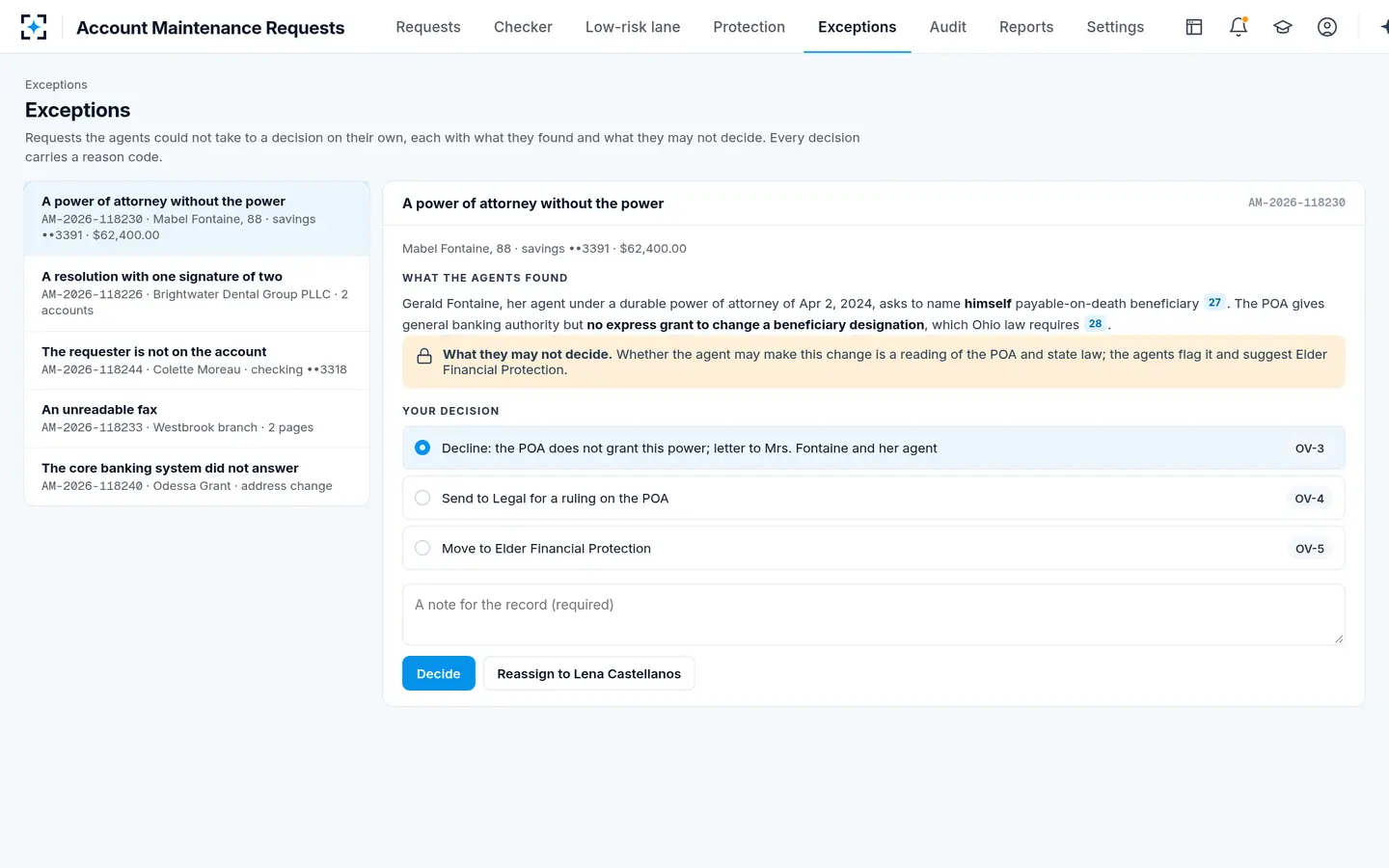
Ask for the second signature; Corvane’s exceptions list holds exactly this case for a dental practice’s two accounts.
- The certifying officer is not the one on file, or is the person being added
Ask for certification by the officer the earlier resolution names, or for evidence of the new officer’s appointment.
- A new signer with no identification on file
Ask for identification before the change, as the bank’s CIP procedures require for signers.
- The ownership shares in the certification do not add up, or someone left
Ask for a new beneficial ownership certification; a change of owner is identified, certified and verified, not just keyed.
Asking is also where fraud tends to show itself. A real treasurer who is asked for the missing signature sends it. A fraudster who is asked for something the bank can verify, through a channel the bank already trusts, tends to push for speed instead.
That is why the callback matters as much as the paper. The FFIEC's guidance lists, among effective controls for resets handled by call centers, "call-backs to a pre-established phone number" (FFIEC, 2021). For a business, the pre-established number belongs to an officer already on file, not to the person the resolution adds and not to the number on the cover letter. FinCEN's 2024 alert on deepfakes is the reason the bank should place the call rather than take one: it lists a customer who switches communication channel in the middle of a live verification check as a red flag (FinCEN Alert FIN-2024-Alert004; wire fraud red flags has the full list), and a voice on an inbound call proves less every year.
Exceptions the agents may not decide, each with a reason code
Can a bank refuse a corporate resolution?
Yes. A bank decides on its own terms whether a resolution is sufficient, and it may require its own resolution form or specific language before it relies on one. Corporate statutes such as Delaware's say who governs a company and how officers are named; they do not tell a bank what it must accept.
Powers of attorney are the contrast. Virginia's version of the uniform act requires a person presented with an acknowledged power of attorney to accept it or request a certification, translation or opinion within seven business days, and a wrongful refusal can bring a court order and the presenter's attorney fees (Va. Code § 64.2-1618). A bank that treats every authority document the same way, with one checklist and one deadline, gets one of the two wrong.
The maker, the checker and the read-back
The control that makes the rest trustworthy is that no single person, and no agent, can move a signer change from paper to the core. The maker approves on the evidence. The checker, a different specialist, re-checks the same evidence against a checklist of their own. The update posts only after the second signature, and the core is read back so the bank knows the system holds what the people approved.
The resolution is certified by the officer the 2021 resolution names (the Secretary).
The checker’s checklist at Corvane, first item
The read-back is the step most manual processes skip. A keyed change that was approved but posted wrongly, the old signer left on the money market account or the signing threshold dropped, is invisible until a check clears that should not have. Reading the core back and comparing it with the approved change turns that silent error into an exception the same morning. The same logic of approve, check, post and read back runs through the questions to ask before buying account maintenance software, and what the signature card has to show is a guide of its own.
Questions people ask
Who signs a corporate resolution for a bank account?
The board adopts it and an officer certifies it, usually the secretary, because corporate law gives one officer the duty to record the board's proceedings. Banks check that the certifying officer is the one their earlier resolution names. A resolution certified by the person it adds as a signer should be re-certified by someone else.
Can a bank accept a signer change through online banking?
Some banks accept resolutions uploaded through business online banking, but the document requirements stay the same: a resolution, a signature card and identification for new signers. The FFIEC's 2021 guidance lists supplementary controls for business customers' administrators who can change digital banking configurations among its examples, so an online request does not lower the bar.
When does a removed signer lose access?
On the effective date the resolution gives and the bank posts, which can be earlier or later than the day the bank receives it. In the sample case, Glen Ashby was removed effective September 30, 2026. Banks should also remove the person's online banking access and any templates they set up, which is a separate change on a separate system.
Does every signer have to sign the new signature card?
The cautious practice is a fresh card signed by all continuing and new signers, so the card on file matches the resolution exactly. That card is what later signatures are compared against, and the BSA rule requires the bank to keep each document granting signature authority.
What if the resolution requires two signatures and only one person signed?
The change should wait for the second signature. Posting on one signature changes the authority the business itself set; Corvane's exceptions list holds a dental practice's resolution for exactly that reason, with a request to the business for the missing signature.
Is a signer the same as a beneficial owner?
No. A signer is anyone authorised to transact on the account; a beneficial owner under FinCEN's rule is each person owning 25% or more plus one control person. A new chief financial officer can be both, which is why a signer change can also require a new beneficial ownership certification.