An account maintenance request is a customer's instruction to change an existing account: its owners, signers, mailing address, phone or email, payable-on-death beneficiaries or name. What one costs a bank depends on which lane it falls in. A clean change costs a few minutes of specialist time; a request carrying takeover signals costs more than an hour if it is worked properly, and an unbounded amount if it is a fraud that gets through. The unit cost a deposit operations head should defend is therefore two numbers added together: minutes multiplied by a loaded wage in each lane, and the expected loss on the requests that are not what they seem. Botminds' Account Maintenance Requests, account maintenance request software for deposit operations, changes both terms, and this guide shows the arithmetic so a bank can run it on its own volumes.
Volumes and case details below come from a fictional sample bank, Corvane National Bank, as it runs through the solution; minute counts are our estimate, explained where they appear; wage data are from the Bureau of Labor Statistics.
Seventy-seven minutes become twenty-one, and the callback becomes the largest share
Flagged request, by hand (77 min)
- Find, read and key · 29%
- Authority and signature · 13%
- Cross-channel history · 26%
- Callback · 19%
- Second check · 13%
Same request, with the solution (21 min)
- Find, read and key · 14%
- Authority and signature · 14%
- History · 15%
- Callback · 38%
- Second check · 19%
What is an account maintenance request at a bank?
At a bank, an account maintenance request is any request to change who owns, signs on, receives mail for, is contacted about, or inherits a deposit account, together with routine changes such as a name after marriage or a statement preference. It arrives on a maintenance form by mail, through a branch, as a secure message or from a contact center call, and a deposit operations specialist processes it.
What makes the cost interesting is that the same request type spans two very different populations. Most address changes are people who moved. A small share are the second step of an account takeover, after a phone change, and before a card request or a new beneficiary. A cost model that averages the two hides the only number that matters to the risk committee, which is what the bank spends, and loses, on the second group.
The unit cost formula: minutes, lanes and the loss you avoid
The unit cost of an account maintenance request is the sum, across lanes, of the share of requests in each lane times the minutes each takes times a loaded wage, plus the expected loss from takeovers that pass. The formula below names each term, who owns its inputs and which terms a solution can move.
The cost of one maintenance request, written as a sum
Clean-lane time
share in lane × minutes × loaded rate
Address, phone, name and preference changes with no warning signs. Minutes fall when a checker can approve in groups with a sample.
Deposit operations
Specialist-lane time
share × minutes × loaded rate
Signer, owner and beneficiary changes, business accounts, powers of attorney.
Deposit operations
Flagged-lane time
share × minutes × loaded rate
Requests with takeover signals, worked to a callback. The largest unit cost, the smallest share.
Deposit operations and fraud
Expected takeover loss
takeovers attempted × share that pass × exposure each
Exposure includes electronic transfers the bank may have to reimburse and balances passed at death to a forged beneficiary.
Fraud and finance
How much does an account maintenance request cost a bank? Pricing the minutes
Priced at a loaded wage of about $31 an hour, a flagged request worked properly by hand costs about $39 of specialist time, and about $11 with agents doing the finding, reading and cross-checking. The wage comes from public data. The Bureau of Labor Statistics has no separate occupation for maintenance staff; the closest is New Accounts Clerks, whose mean wage was $21.48 an hour in May 2023 (BLS OEWS 43-4141). Its employer cost survey for June 2026 shows wages and salaries at 70.0 percent of private employers' compensation costs, with benefits the other 30.0 percent (BLS Employer Costs for Employee Compensation, released September 9, 2026).
The two public numbers behind a loaded rate
$21.48/h
mean wage of New Accounts Clerks, May 2023
70.0%
share of private employers’ compensation cost paid as wages, June 2026
$30.69/h
loaded rate: $21.48 ÷ 0.70, our arithmetic
One flagged request, priced step by step at $30.69 an hour
| Step | By hand | With the solution | Who does it with the solution |
|---|---|---|---|
| Find the customer, open the card and earlier documents | 10 min · $5.11 | 1 min · $0.51 | Intake agent; specialist reviews |
| Read the form and key the change | 12 min · $6.14 | 2 min · $1.02 | Intake agent drafts the fields that change |
| Check authority and compare the signature | 10 min · $5.11 | 3 min · $1.53 | Authority and Signature agents; specialist decides |
| Read calls, devices, card requests and other requests | 20 min · $10.23 | 3 min · $1.53 | Takeover agent; specialist reads its summary |
| Choose a safe number and call back | 15 min · $7.67 | 8 min · $4.09 | Callback agent picks and scripts; specialist calls |
| Second check | 10 min · $5.11 | 4 min · $2.05 | Checker, against the same evidence |
| Total | 77 min · $39.38 | 21 min · $10.74 |
The table also shows where the minutes do not fall. The callback drops from 15 to 8 minutes because the number and script are ready, not because anyone skips the call; it becomes the largest single cost on the request, and it should. That is the step that stops the fraud, and a business case that removes it is a business case for losses.
How many maintenance requests does a bank handle? A sample day
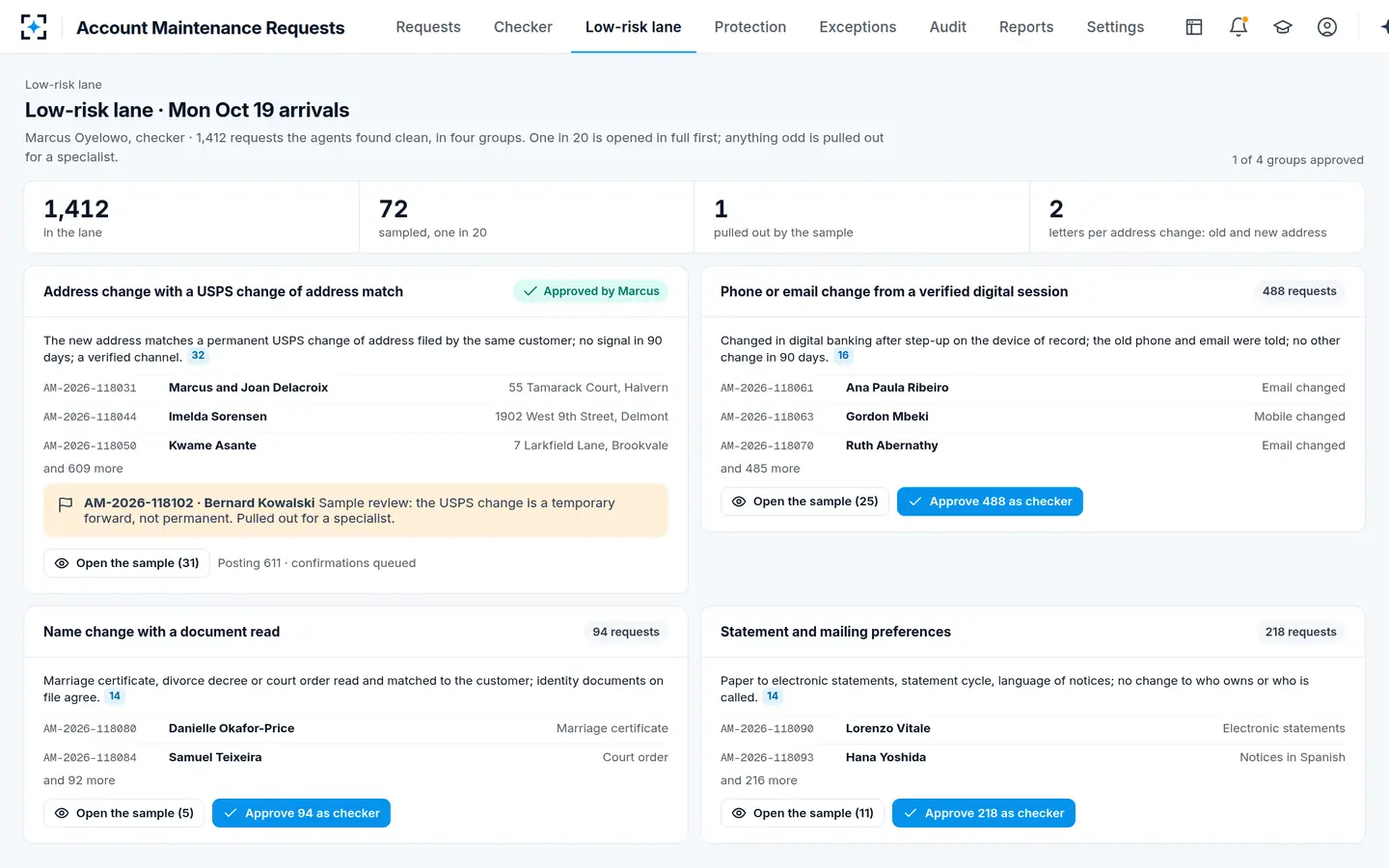
Public data do not answer this: we found no regulator or research source that publishes maintenance volumes, so each bank has to count its own. Corvane's day is a useful shape to test against. On Monday, October 19, 2026, it received 2,214 requests: 1,412 went to the low-risk lane, 647 needed a specialist, and 155 carried takeover signals, with none late.
Most of a day's requests are clean; about one in fourteen carries a takeover signal
Run the flagged lane through the table and the scale shows. If all 155 flagged requests were worked to the standard above by hand, they would take about 199 specialist hours that day, roughly $6,100 at the loaded rate; at 21 minutes each, about 54 hours and $1,700. The clean lane is where volume lives, and where the solution's design changes the work most: a checker approves a group of clean changes at once after opening one in 20 in full.
1,412 clean requests in four groups, each approved by a checker after a sample
What does a missed account takeover cost a bank?
A missed takeover can cost the bank the money that leaves electronically, the customer's balance at death if a forged beneficiary is paid, and the cost of the investigation and remediation that follow. For electronic transfers, Regulation E caps a consumer's liability for unauthorized transfers at $50 if they report a lost or stolen access device within two business days, and at $500 if they report later, under the conditions the rule sets (12 CFR 1005.6(b)). The rest can fall on the bank. Who pays in a given takeover depends on facts the rule spells out, and who pays when a session is hijacked works through them.
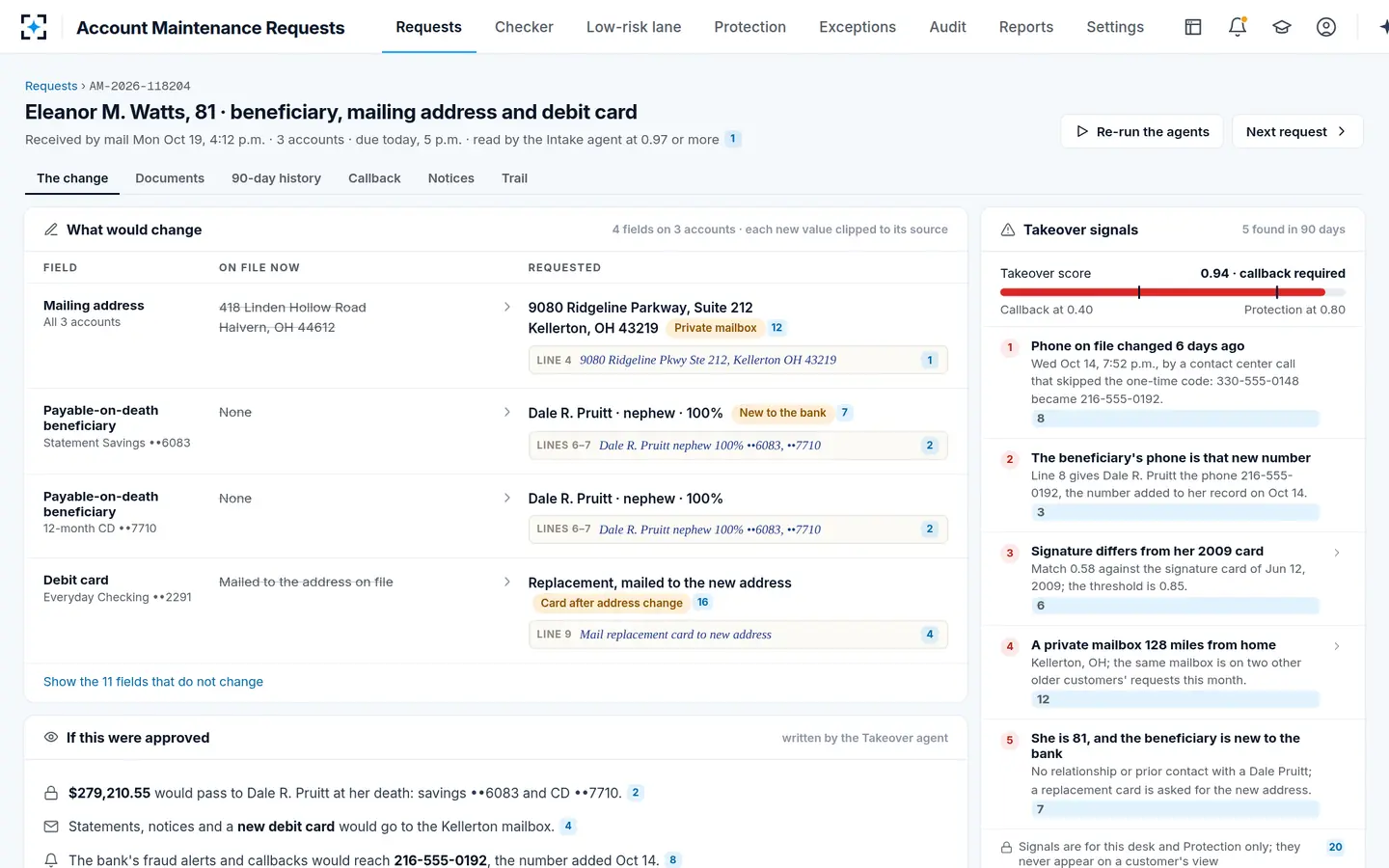
Beneficiary fraud is slower and can be larger. In Corvane's hardest case, a forged form would have named a stranger payable-on-death beneficiary on two accounts holding $279,210.55, and the bank's own records would have directed that money to him at the customer's death. Nothing would have looked wrong until then, and by then the customer could not say she never signed. The callback that stopped it took 4 minutes and 12 seconds.
National figures describe suspicious activity, not losses, but they show the scale of the pool these requests sit in. FinCEN counted about 1.6 million identity-related suspicious activity reports in 2021, 42% of all reports, tied to $212 billion of suspicious activity, with depository institutions filing 54% of them (FinCEN Financial Trend Analysis, identity-related activity, 2021 data). For older customers, FinCEN reviewed 155,415 elder financial exploitation reports tied to more than $27 billion of suspicious activity between June 2022 and June 2023 (FinCEN, April 2024).
Account maintenance request forms, and why the form drives the cost
The form is the cheapest place to remove cost. A maintenance request form that asks for each change in its own numbered field, names the accounts affected, asks for a phone number only if the customer wants it changed, and states which supporting document each change needs produces a request that can be read once. A free-text letter, a fax with a cover note, or a form two versions out of date produces a request that a specialist reads three times.
In Corvane, the Intake agent read 2,214 overnight requests at 0.95 confidence or better and stopped three for a person; one of the exceptions was an unreadable fax. The Authority agent checks that the form is the current version, and every value the Intake agent reads opens the line it came from, so the maker, the checker and an examiner read the same evidence once.
Only the fields that change, each clipped to the line it came from
How long does an account change take at a bank?
A clean change can post the same day; a request with warning signs should wait for a callback, and that wait is a feature. Corvane's design target is same-day for clean requests received by 2 p.m., and its callback setting gives a held request four business hours. Turnaround promises that do not distinguish the two lanes push banks to rush the requests that most need a pause.
Elapsed time also has a cost the model above leaves out: the customer's. A clean change that sits for days behind a risky one generates calls, complaints and repeat requests, each a new maintenance request in its own right. Separating the lanes is how a bank shortens the wait for most customers without shortening it for the fraudster.
Where Account Maintenance Requests moves the cost, and where it does not
The solution moves the terms that are reading and searching: finding the customer and documents, reading the form into the fields that change, checking the authority document and the signature card, reading 90 days of calls, devices, card requests and earlier changes, choosing a safe callback number and drafting the script, and grouping clean requests so a checker approves them together after a sample. Those are the steps that shrink in the table above.
It does not remove the people the controls depend on, and a buyer should not want it to. Every change still needs a maker and a checker, and nothing posts on one signature. The callback is placed and recorded by a specialist. Requests the agents cannot take to a decision, such as an unreadable fax, a resolution signed by one of two required signers or a power of attorney without the power asked for, go to a person with a reason code. And a new version of any agent runs on the previous month's requests, 45,870 at Corvane, before it goes live, with Compliance signing the comparison; that test is a recurring cost of doing this safely.
What changes in the cost model, term by term
| Term | What the solution changes | What stays with the bank |
|---|---|---|
| Clean-lane time | Groups clean requests by type; checker opens one in 20 in full, then approves the group | Choosing the lane rules and the sample rate |
| Specialist-lane time | Fields read with their source lines; authority and signature checks drafted | The approval, and every reading of a legal document the agents flag |
| Flagged-lane time | Cross-channel history assembled; callback number chosen; script drafted | Placing the call, recording the outcome, the hold or referral decision |
| Expected takeover loss | Requests with signals are held before anything posts, as a design target | Thresholds, the callback standard, and the protection team’s actions |
| New costs | Connections to the core, document imaging, contact history, digital banking, the card processor and address validation | Integration work, monthly version tests, licence |
What to measure before you buy
Before buying account maintenance software, a bank should measure four numbers on its own last quarter: requests by lane, minutes per request in each lane from a time study, the share of flagged requests that ended in a customer denial on callback, and losses traced to maintenance changes. The first three price the time; the last two price the risk. Corvane's September shows what the denial count looks like when callbacks go to a number of record: 241 requests declined because the customer denied them.
The comparison should then run on the bank's own files rather than a vendor's slide. Twelve questions to ask in an account maintenance software comparison sets out what to test, and segregation of duties on the maintenance desk shows how those minutes become a staffing plan.
Questions people ask
What does an account maintenance request form usually include?
The customer's name and accounts, each change requested in its own field, the effective date, the signature of an owner or authorised signer and the date, with business forms asking for a corporate resolution and beneficiary changes asking for each beneficiary's details. The FDIC needs a payable-on-death beneficiary named in the bank's account records for the trust coverage to apply, so the form's beneficiary lines matter (12 CFR 330.10(d)).
What does account maintenance request mean?
It means a request to change information about an existing account and the people on it, as opposed to opening or closing an account. Banks use the term for consumer and business accounts alike; the work is done by deposit operations, often with a second person checking each change.
Is the cost of account maintenance mostly labour?
On a clean request, yes. On a request that is part of a takeover, the potential loss dwarfs the labour: one sample case put $279,210.55 at stake against minutes of work. That is why the cost model has to carry both terms.
Can automation remove the callback cost?
It should not. Agents can choose the number, draft the script and summarise the call, which cuts the callback's minutes roughly in half in our estimate. A person still places the call and records what the customer says, because that conversation is where a forged request is caught.
How many requests should one specialist handle a day?
It depends on the lane mix more than on effort. Corvane's specialist works 35 to 50 requests a day in a regional queue, with clean changes cleared in groups by a checker; a desk that works every clean change one by one will need more people for the same volume, and will have less time for the flagged few.
How should a bank load the hourly wage?
With its own payroll and benefit costs. Where those are not to hand, the BLS employer cost survey is a public benchmark: in June 2026, wages and salaries were 70.0 percent of private employers' compensation costs, so dividing a wage by 0.70 approximates the loaded cost of an hour.