A CTR teller's job is to identify the person presenting cash over $10,000 in a business day, verify that identity with a real document, and record it, together with whoever the cash is for, before the transaction ends. The rule puts it plainly: a bank "shall verify and record the name and address of the individual presenting a transaction" and record the identity, account number and taxpayer number of anyone on whose behalf it is conducted, "before concluding any transaction" that needs a currency transaction report (31 CFR 1010.312). Everything the compliance office does later depends on what the teller captured at the window. That is why Botminds built CTR Filing & Exemptions around the teller's evidence: agents add up the day's cash, draft each CTR with the source of every field, and find the conductor details a busy teller missed, so the back office stops rebuilding them by phone.
The stakes are volume and precision at once. Banks and other filers sent FinCEN 21.5 million CTRs in fiscal 2025 (FinCEN, Year in Review FY2025), and each one names a person by an ID number that a teller typed. A wrong or generic entry does not just fail a form: it points an investigator at the wrong person.
CTR Filing & Exemptions: three seats behind one CTR, and what moves to the agents
Today
Counts the cash, decides in seconds whether this deposit might join others for the same person today, asks for an ID, keys the number, the address and the occupation, and does it with the queue watching.
With agents
Still asks for the ID and still keys it. What changes is that a missing or prohibited entry comes back as one named question about one transaction, with a coaching note, instead of a vague call from the back office a week later.
Still theirs: Verifying the person in front of the window before the transaction is concluded. No system can do that after the customer has left.
Today
Pulls teller, ATM and night-drop activity, adds it up by person and business day, opens each draft, finds the blank and generic fields, and writes to branches while the 15-day clock runs.
With agents
Opens on stacks already added up and drafts already filled, checks each ID the agents read from a teller image, and accepts, edits or rejects it with a reason.
Still theirs: Accepting every reading, and preparing the batch.
Today
Approves the batch, answers for every blank field to the examiner, and learns about a branch habit only when a sample turns it up.
With agents
Approves a batch in which every field points at its source, and sees which branches and tellers produce the gaps.
Still theirs: The decision to file, and anything that looks like evasion.
What does a teller do for a CTR?
The teller does three things the rest of the process cannot: notices that a transaction may be reportable, verifies the presenter's identity from a document, and records the specific identifying details on the spot. A CTR is owed for any "transaction in currency of more than $10,000" by, through or to the bank (31 CFR 1010.311), and several smaller transactions for the same person in one business day count as one. So the teller is not only watching for a large bag of cash; she is watching for the third $3,500 deposit of the day into the same business account.
Verification is specific. A driver's license or another document "normally acceptable within the banking community as a means of identification when cashing checks for nondepositors" is the standard for a U.S. resident. A non-resident must show a passport, an alien identification card or another official document of nationality or residence. A signature card counts only if it was issued after identity documents were examined and their details noted on it. And then the rule closes the shortcut tellers reach for most: "the mere notation of 'known customer' or 'bank signature card on file' on the report is prohibited" (31 CFR 1010.312).
The teller also records who the cash belongs to. When an employee deposits a restaurant's takings, the employee is the conductor and the restaurant is the person on whose behalf the deposit is made; both go on the report, in separate entries. Getting that split right is most of what makes a CTR useful later, and how the day's transactions are added up by person decides whether a report is owed at all.
Why FinCEN's own cost model puts 90% of CTR work on tellers
FinCEN does not guess where the CTR workload sits; it publishes the split. In its 2024 renewal of the CTR paperwork approval, FinCEN costed CTR compliance with three roles: tellers for "operations", compliance officers for "direct supervision" and financial managers for "remote supervision". It weighted their time 90%, 9% and 1% (FinCEN, Federal Register, 5 February 2024). The teller line carries the job; the compliance office checks it.
Where FinCEN's model puts the time on a CTR
Share of CTR time, by role
- Teller, operations · 90%
- Compliance officer · 9%
- Financial manager · 1%
The same notice estimates about eight minutes per CTR, 20,564,724 CTRs from 15,468 filers in calendar 2022, and 2,741,963 hours a year in all. On FinCEN's own weighting, roughly 2.5 million of those hours are tellers' hours. Filers dispute the eight minutes, as the go-live plan for CTR software sets out, but nobody disputes where the work starts.
What information does a teller need for a CTR?
For each person on the report the teller needs a verified name and address, the identifying document and its number, and for anyone the cash is for, the identity, account number and taxpayer number. The FinCEN CTR then asks for more, and the form separates fields that must be filled (marked with an asterisk, "critical") from those that should be filled when the bank knows the answer.
For critical items, FinCEN's guidance is that filers must either supply the information or tick the box marked Unknown; for the rest, a bank "may leave non-critical fields without an asterisk blank when information is not readily available" (FinCEN CTR FAQ 1). The occupation field is where tellers lose most time to vague answers. FinCEN asks for "specific descriptions such as 'doctor,' 'carpenter,' 'attorney,' 'used car dealership'", not "businessman", "merchant" or "self-employed", and for "retired teacher" rather than "retired" (FAQ 20).
The CTR fields tellers most often get wrong, and the version that holds up
What gets keyed at a busy window: “Known customer”, “known member” or “signature card on file”.
What the rule and FinCEN's FAQ ask for: The document type and its number, such as an Ohio driver’s license ending 4187. The notation alone is prohibited by 31 CFR 1010.312.
What gets keyed at a busy window: Only the account holder, even when someone else stood at the window.
What the rule and FinCEN's FAQ ask for: A Part I for the person who conducted the transaction, and another for the person or business it was for.
What gets keyed at a busy window: “Self-employed”, “retired”, “business owner”.
What the rule and FinCEN's FAQ ask for: A specific trade or business: “self-employed building contractor”, “retired teacher”, “coin laundry”.
What gets keyed at a busy window: A foreign driver’s license without an address.
What the rule and FinCEN's FAQ ask for: A passport, alien identification card, or official document showing nationality or residence.
What gets keyed at a busy window: Left blank, or “NA”.
What the rule and FinCEN's FAQ ask for: For a critical field, the “Unknown” box, ticked deliberately; for others, blank only when the information is not readily available.
The conductor field is where CTRs break, and where investigations go wrong
The field that matters most to law enforcement is the one a queue pressures hardest: who actually brought the cash. TD Bank's 2024 consent order shows what happens when it is wrong at scale. FinCEN found that the bank's branch staff "did not properly record" a money launderer, Da Ying Sze, "on over 100 CTRs", reporting only account holders "who on many occasions was not present". In one instance staff "accepted a photo of the accountholder's identification that Sze showed a Bank employee on Sze's phone" (FinCEN Consent Order 2024-02).
The tellers knew him. FinCEN records that Sze "routinely provided gift cards" to employees, at least $57,000 in 2020 and 2021, and that some branch employees "believed they were not required to name the individual(s) transacting where the customer was also present". Across more than 500 CTRs covering over $400 million tied to Sze, the bank misidentified the conductors, and the order says the incorrect reports "misled law enforcement and caused the investigators to incorrectly expend time and resources focused on the wrong subject."
One conductor, recorded wrongly, across a whole branch network
500+
CTRs on which TD Bank failed to report Sze correctly
Covering more than $400 million
100+
CTRs that left him off entirely and named only the account holder
Often not present at the window
~100
TD Bank branches his network used to deposit cash
New York, New Jersey, Pennsylvania and elsewhere
Most banks never face a Sze. The everyday version is subtler: a regular business customer whose employee drops cash every afternoon, and a teller who, on the fifth visit, types "known" instead of asking again. GAO's 2024 study of CTR requirements heard the same thing from the industry side: many representatives said aggregating transactions "by conductor was a key challenge", particularly when the conductor is not the institution's own customer, and banks differed widely on when to start collecting conductor details. Some collected them on every cash transaction, some from $500, some only above $10,000 (GAO-25-106500).
Who fills out a CTR: the window, the analyst and the officer
In most banks the teller captures the data, a CTR analyst or specialist completes and checks the report, and the BSA officer or a delegate approves the filing. Examiners look for that separation. The FFIEC manual tells them to consider "dual controls, segregation of duties, and management approval", and adds that BSA compliance officer or senior management approval belongs on "staff actions that override currency aggregation systems" (FFIEC BSA/AML Manual, Currency Transaction Reporting).
The teller's seat is the one no software replaces, because the rule ties verification to the moment of the transaction. What software can change is what happens next. In Botminds' CTR Filing & Exemptions, take a sample credit union, the fictional Norrell Federal Credit Union, on Tuesday 6 October 2026. Harbor Light Laundromat's owner deposits $4,200 at one branch in the morning, $2,350 goes through a drive-up ATM after lunch, and a shift manager deposits $3,900 at another branch at 3:41 pm. Together they reach $10,450, and the teller at the second branch, with a line behind the customer, keys the conductor's ID as "Known member".
“Known member” is not an ID: the license was in the teller image all along
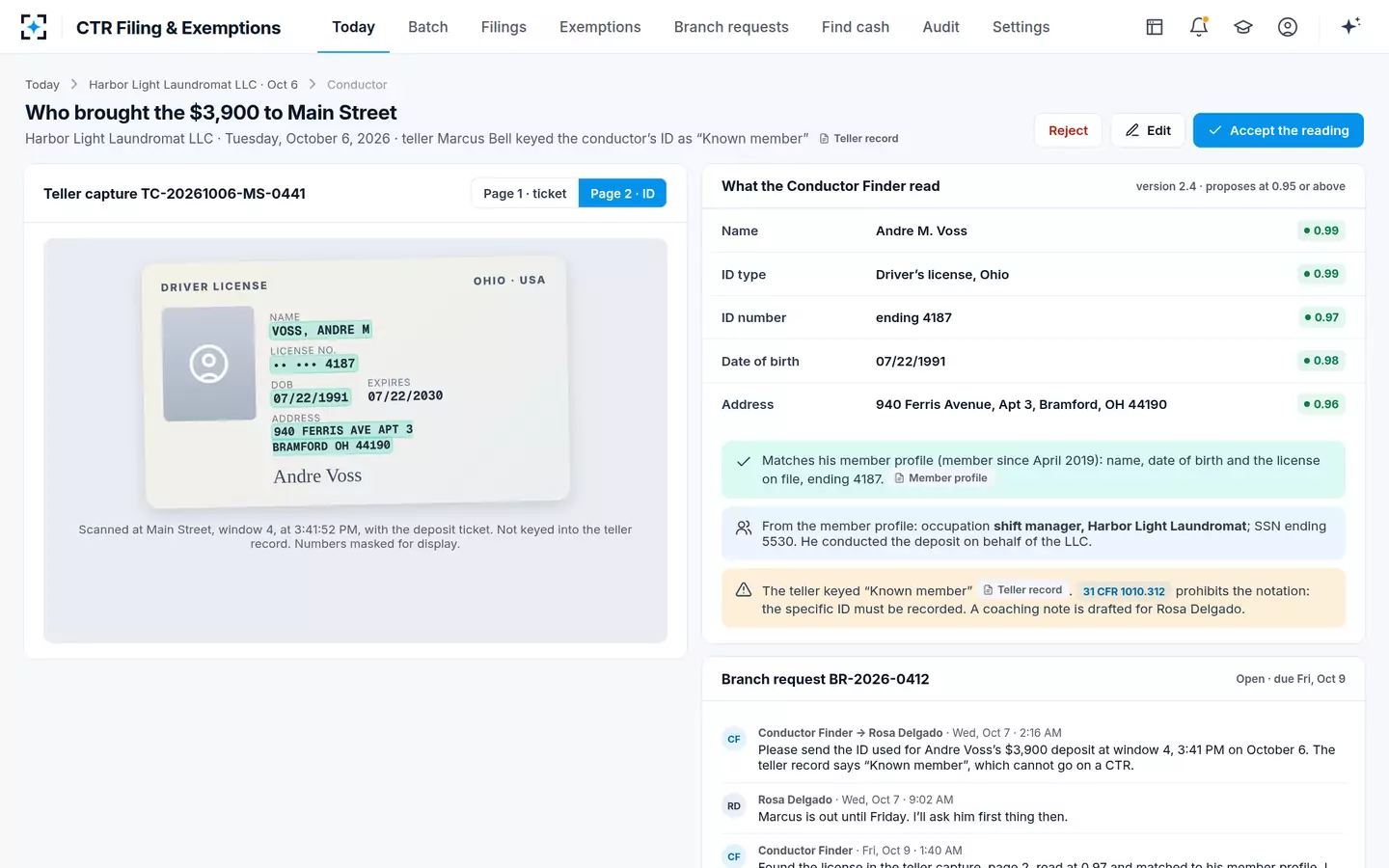
The branch request names the field, the transaction and the time, and a coaching note is drafted for the teller supervisor. The supervisor sees only her own branch.
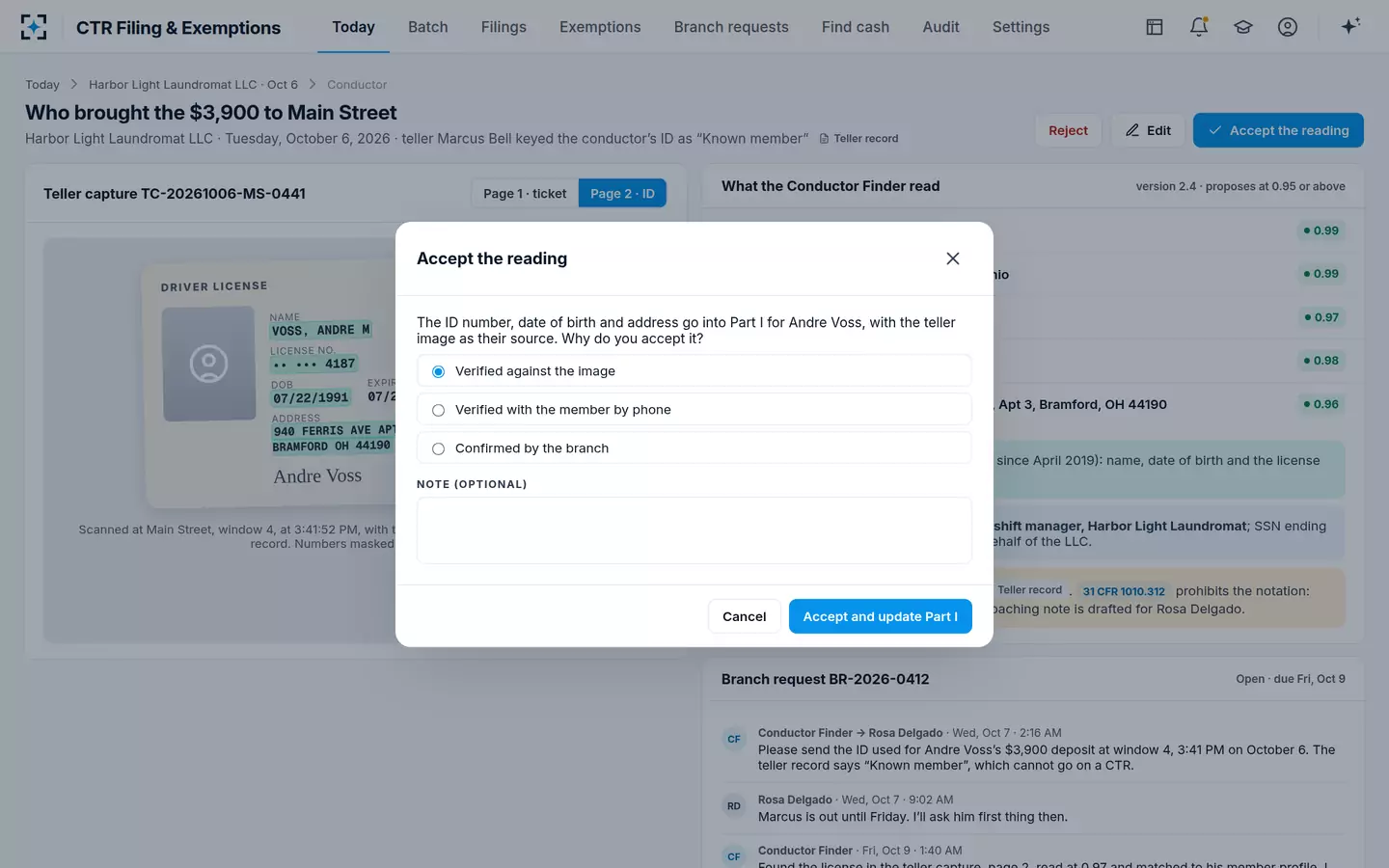
The agent does not file what it reads. The CTR specialist compares the reading with the image and accepts it, edits it or rejects it, choosing a reason: verified against the image, verified with the member by phone, or confirmed by the branch. The license number then enters Part I with the teller image as its source. The design target is that when the BSA officer approves a batch, no conductor field is blank or unexplained.
In CTR Filing & Exemptions, a person accepts every reading, with a reason
What happens if a customer refuses to give CTR information?
If the customer will not identify themselves, the transaction that needs the report cannot be concluded as the rule requires, because verification has to happen "before concluding any transaction" that needs a CTR. Banks write their own procedure for the moment: decline the transaction, or ask for the details again before the cash is accepted. What the teller must not do is complete the deposit and type "refused" in the ID field.
Refusals are common enough that GAO heard about them repeatedly. Bank representatives said people who are not customers, "such as an employee conducting a transaction on behalf of a business", sometimes "refuse to provide their information or leave without providing it". Others "will cancel a large transaction or break it up into smaller transactions to avoid triggering a CTR", behaviour GAO notes "may be considered structuring activity, a federal crime" (GAO-25-106500).
That is the point where the teller's report goes to the BSA team, not to the customer. Structuring is unlawful in any amount: no person may structure a transaction, "or assist in structuring" one, for the purpose of evading the reporting requirements (31 U.S.C. 5324). The October 2025 interagency SAR FAQs add a useful limit: cash at or near the $10,000 threshold is not, on its own, enough to require a SAR; one is required when the bank knows, suspects or has reason to suspect the transactions were designed to evade CTR reporting (FinCEN and agencies, SAR FAQs, October 2025). A customer who asks how to stay under the line has said something the teller should pass on.
The teller may explain the report. The teller may not explain how to avoid it, and may never mention a SAR.
Can a teller tell a customer about a CTR?
Yes. A CTR is a routine report required by law, and a teller can explain that cash over $10,000 in a business day is reported to FinCEN and why ID is needed. Two things are different. First, advising a customer how to split deposits to stay under the line is "assist[ing] in structuring" under the statute, whatever the teller's intent to be helpful. Second, anything about a suspicious activity report is closed: no bank employee may disclose a SAR, or anything that would show one exists (31 CFR 1020.320(e)).
The practical line for a branch is simple to train. The CTR is talked about openly; whatever the BSA team does with a pattern of near-threshold cash is never mentioned at the window. In the sample, when three deposits of $9,400, $9,600 and $9,500 on three business days went to alert triage, the member's online banking and the branch's teller screen showed nothing, and a guard log records what each of them saw.
A teller who gets it wrong: who is liable?
The bank answers for the report, but the statute reaches individuals too. Civil penalties for willful violations apply to "a partner, director, officer, or employee of a domestic financial institution" as well as to the institution itself (31 U.S.C. 5321(a)(1)). An honest mistake on a busy afternoon is a training and control question; a teller who knowingly records the wrong person, or who coaches a customer around the threshold, is in different territory. The TD Bank order cites both the gift cards and the employees' mistaken belief about naming the conductor.
Most errors are neither. They are habits: the same generic occupation for every self-employed customer, the account holder's ID entered for an employee who made the deposit, "known" for a regular. Habits are found by counting. When every gap the back office fixes is recorded against the branch and the teller who created it, the branch manager sees a pattern within weeks rather than at the next audit, and coaching goes to the two tellers who need it, not the forty who do not. For the cost of the gaps that are not found, the CTR penalties banks have paid are the measure.
Teller CTR training that examiners can see
Effective teller training is short, specific to the window and documented. The OCC's community bank BSA/AML examination procedures, which apply to exams beginning 1 February 2026, ask examiners to determine "whether the bank documents dates of training sessions and training and testing materials", with attendance records and "failures of personnel to take the requisite training in a timely manner as well as corrective actions" (OCC Bulletin 2025-37, attachment). TD Bank's order lists "improper training related to filing of CTRs" as a finding in its own right.
What a teller should be able to do without asking anyone
- Spot a reportable day, not just a reportable deposit
Know that cash in and cash out are added separately across the whole bank for one business day, and check today’s earlier activity for the same person.
- Verify before concluding
Ask for the document before the cash is accepted. A transaction finished without it is the one the back office has to chase.
- Record the number, never “known”
The ID type, issuer and number, every time, for regulars too. “Known customer” and “signature card on file” are prohibited on the report.
- Name the conductor and the owner
An employee depositing for a business, a relative paying into a joint account: both people go on the CTR, each in their own role.
- Use a specific occupation
“Coin laundry owner”, not “business owner”; “retired machinist”, not “retired”.
- Handle a refusal by procedure
Follow the bank’s written step for a customer who will not identify themselves, and report it to the BSA team the same day.
- Explain the report, never the way around it
Telling a customer a CTR is required is fine; suggesting smaller deposits is assisting structuring.
- Never mention a SAR or an alert
Nothing about a referral, an investigation or a SAR reaches the customer, in words or in a teller note.
Training works better when the feedback is about the teller's own work. A coaching note that names the transaction, the field and the right entry, sent the day after, teaches more than an annual module. That is why, in CTR Filing & Exemptions, every branch request carries the image the agent already checked and a note for the supervisor, and why the line between what the agents may do and what people still sign is drawn where the rule draws it.
Questions people ask
What is a CTR in banking?
A currency transaction report (FinCEN Form 112) is the report a bank files with FinCEN for cash in or cash out of more than $10,000 in one business day, by or for one person. It is due within 15 days and the bank keeps a copy for five years. Filers sent 21.5 million of them in fiscal 2025.
Do tellers file the CTR themselves?
Usually not. Tellers capture and verify the information; a CTR specialist or the BSA department completes, checks and files the report through FinCEN's BSA E-Filing System, often in a daily batch. The FFIEC manual notes that employees who complete CTRs generally should not also decide to file them.
Is a bank signature card enough ID for a CTR?
Only if it was issued after identity documents were examined and their details were written on the card. Even then, the report must carry the specific identifying information, such as a driver's license number, and the notation "bank signature card on file" on its own is prohibited.
What ID does a non-resident need for a CTR?
A passport, an alien identification card or another official document showing nationality or residence, such as a provincial driver's license that shows a home address. A document acceptable for a U.S. resident is not enough for someone who says they are not a resident.
Does a teller fill in a CTR for an exempt business?
Not for transactions the exemption covers, but the exemption has limits. A Phase II exempt business is exempt only for cash through its exemptible accounts, and cash it deposits as an agent for someone else is never exempt. The teller still records the transaction normally; the back office decides what is reportable.
Is a SAR filed every time someone deposits just under $10,000?
No. The October 2025 interagency FAQs say near-threshold cash alone does not require a SAR. One is required when the bank knows, suspects or has reason to suspect the deposits are designed to evade CTR reporting, for example after a customer asks how to stay under the line.