The CTR aggregation rules say that "multiple currency transactions shall be treated as a single transaction if the financial institution has knowledge that they are by or on behalf of any person and result in either cash in or cash out totaling more than $10,000 during any one business day" (31 CFR 1010.313(b)). Every domestic branch counts as part of one institution, deposits made at night, at weekends or on holidays count on the next business day, and cash in and cash out are added up separately, never netted. The rules fit in two sentences; applying them across teller windows, ATMs, night drops and armored cars, by person, every day, is the hard part. Botminds' CTR Filing & Exemptions has agents do that stacking overnight, showing each person's day climbing toward the $10,000 line with the source of every block.
Here is one day, worked through. It comes from a sample credit union in the solution, the fictional Norrell Federal Credit Union, and a member business, Harbor Light Laundromat LLC, on Tuesday 6 October 2026.
One member, one business day: the tally that decides a CTR
What are the CTR aggregation rules?
Three rules, read together. First, a bank must report "a transaction in currency of more than $10,000" (31 CFR 1010.311). Second, a financial institution "includes all of its domestic branch offices, and any recordkeeping facility, wherever located" (1010.313(a)), so a deposit in one town and a deposit in another are the same institution's. Third, multiple transactions become one when the bank knows they are by or for the same person and they take cash in, or cash out, over $10,000 in one business day (1010.313(b)).
The word that carries weight is "knowledge". The bank aggregates what it knows is by or on behalf of one person, which in practice means what its own records connect: the same account, the same customer number, the same identified conductor. Examiners expect the connections the bank's own records allow to be made, across every system that holds cash activity. Treasury added the aggregation requirement in 1987 to address transactions broken up to evade reporting, GAO notes, and it applies to the conductor and to the person the cash is for (GAO-25-106500).
Do multiple transactions count toward a CTR?
Yes, all of them, whatever their size or channel, once they are known to be for the same person in the same business day. FinCEN's answer is direct: "All the individual transactions a financial institution has knowledge of being conducted by or on behalf of the same person during a single business day must be aggregated" (FinCEN CTR FAQ 17). A $200 deposit counts toward the total as much as a $9,000 one.
The FFIEC manual lists the kinds of currency transaction that count, individually or by aggregation: "deposits and withdrawals, automated teller machine (ATM) transactions, denomination exchanges, loan payments, currency transactions used to fund individual retirement accounts (IRAs), purchases of certificates of deposit, funds transfers paid for in currency, monetary instrument purchases, certain transactions involving armored car services", and cash to or from prepaid access (FFIEC BSA/AML Manual, Currency Transaction Reporting). A process that reads only the teller system misses most of that list.
CTR Filing & Exemptions: one member’s business day, stacked to the line
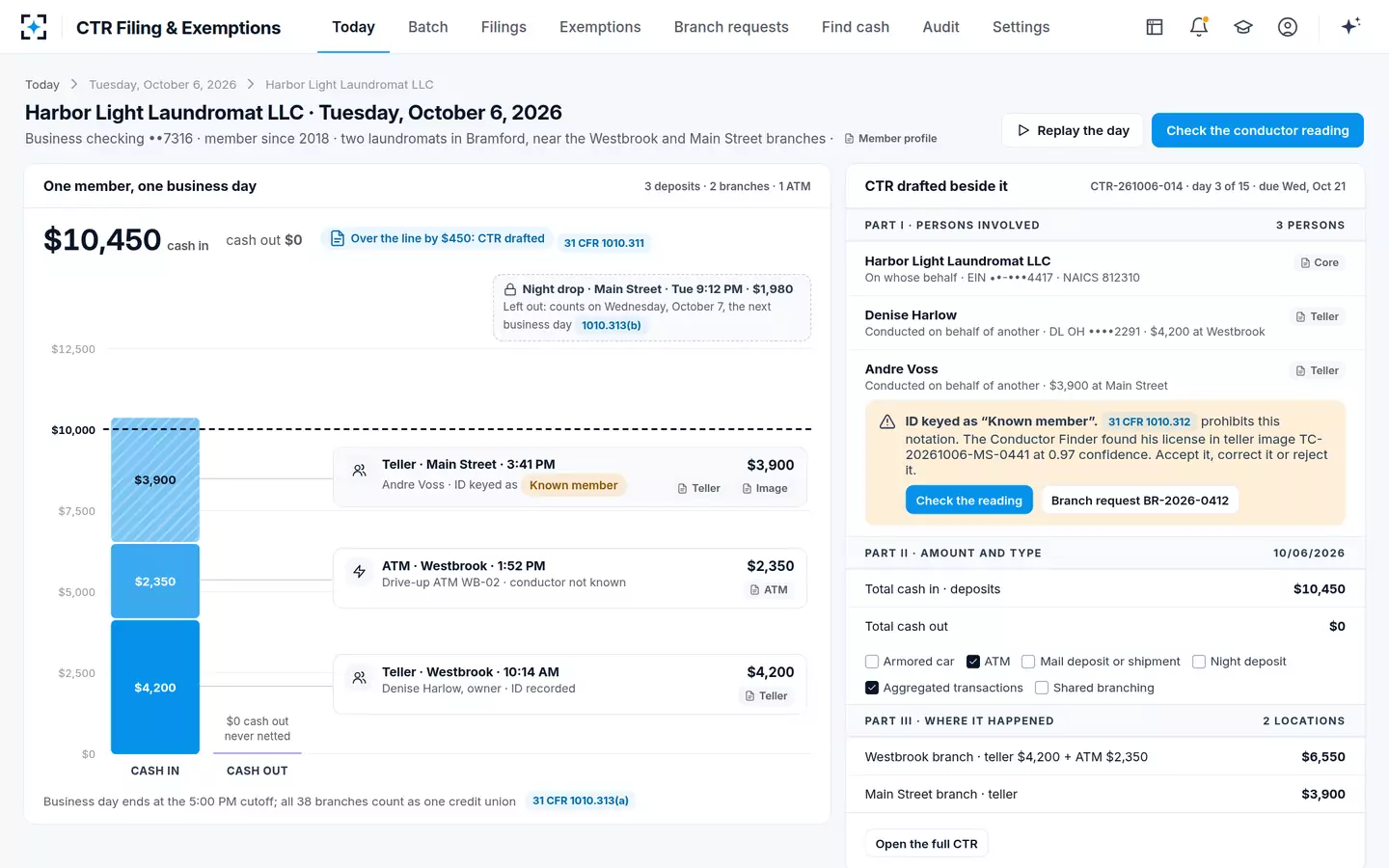
Part III carries one line per location: Westbrook's teller and ATM deposits together, $6,550, and Main Street's $3,900, adding up to Part II's $10,450.
Is CTR cash in and cash out combined?
No. Cash in is added to cash in and cash out to cash out, and a CTR is owed if either side tops $10,000. In FinCEN's words, "Debits must be added to debits, and credits must be added to credits", and institutions "should not off-set debits and credits against one another or reconcile for reporting purposes cash-in transactions with cash-out transactions". If both sides exceed $10,000, one CTR can report both (FAQ 17).
The sample credit union's Thursday has the textbook case. Calloway Auto Repair deposited $8,000 in cash and withdrew $6,000. Netting would give $2,000; adding would give $14,000. Neither is the rule. Each side is under $10,000, so no CTR is owed, and each side would have been reportable on its own had it crossed the line.
What is a business day for a CTR?
The bank's own business day, with one fixed adjustment: "Deposits made at night or over a weekend or holiday shall be treated as if received on the next business day following the deposit" (31 CFR 1010.313(b)). The regulation does not set a cutoff hour. Each bank sets it, often differently for branches, ATMs and Saturdays, and must apply the same cutoffs to aggregation that it uses for posting.
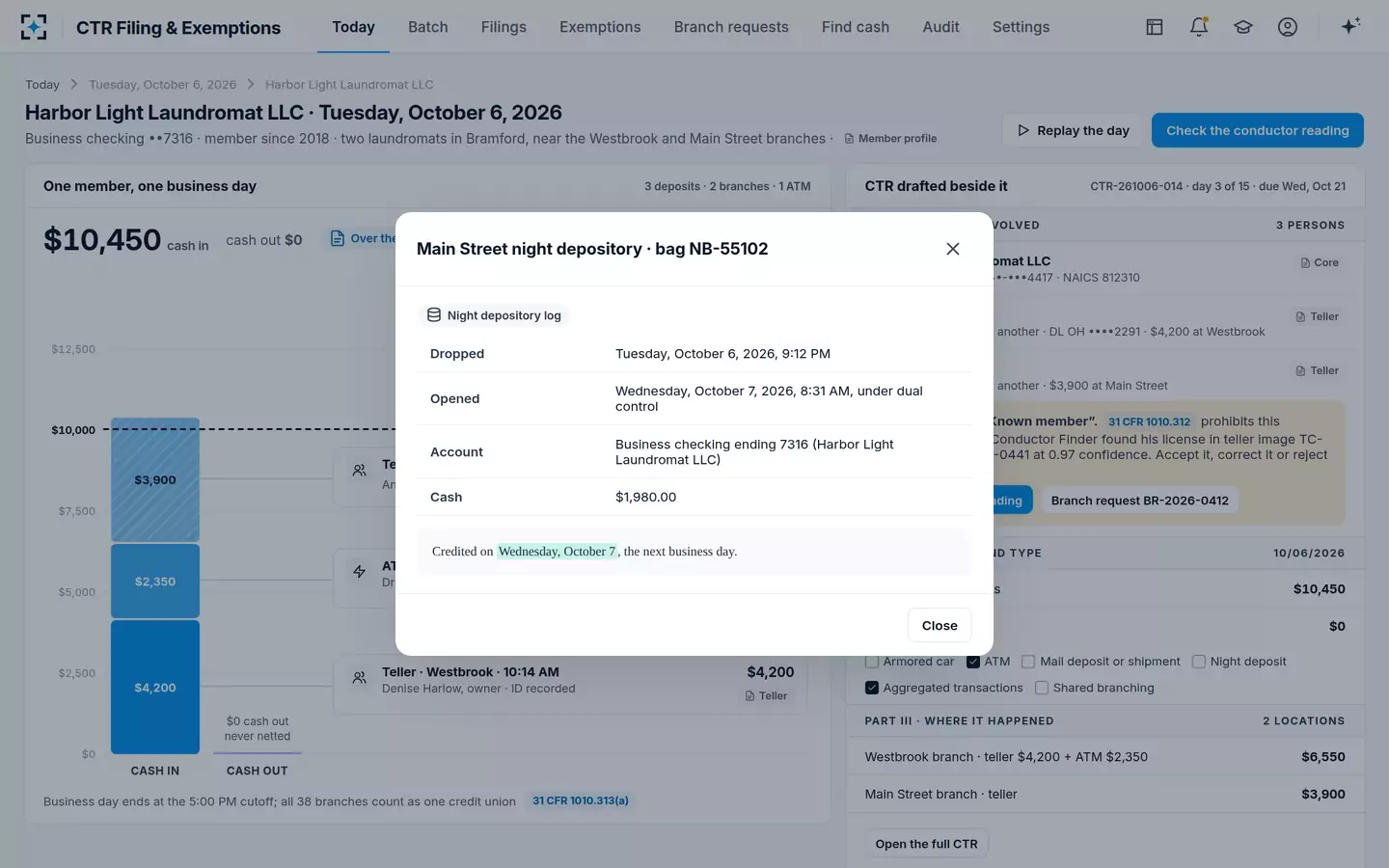
In the tally above, the night drop is the one that moves. The bag went into the Main Street night depository at 9:12 pm on Tuesday, after the 5:00 pm cutoff, and was opened under dual control at 8:31 am on Wednesday. It belongs to Wednesday's stack. Had it been counted on Tuesday, the CTR would have reported $12,430 and the wrong business day.
The night drop counts on the next business day
Do CTR thresholds aggregate across branches?
Yes. Because the institution "includes all of its domestic branch offices", a member's deposits at two branches are added as if at one. The FFIEC manual makes the operational point: "management must ensure that systems or practices appropriately aggregate currency transactions throughout the bank" (FFIEC).
The report then says where. A CTR carries a Part III "for each location where the reportable transactions took place", up to 999 of them, with the branch's own details when the cash moved at branch level (FAQ 31). In the sample, Westbrook's teller and ATM deposits share one Part III, and Main Street has its own.
What does "conducted on behalf of" mean on a CTR?
It is one of three roles a person can have in Part I: the person who conducted a transaction on their own behalf, the person who conducted it for someone else, and the person on whose behalf it was conducted. A business "cannot physically conduct a transaction", so an entity is always the third role (FAQ 15), and when one person has two roles in the same day, they get two Part I entries, one for each role with its own amount (FAQ 16).
Who goes in Part I, and in which role: four common cash days
| The day | Part I entries | Amounts |
|---|---|---|
| Two people deposit $6,000 and $8,000 into a hotel’s account | Each depositor: conducted for another. The hotel: on whose behalf, with “Multiple transactions” checked | Depositors $6,000 and $8,000; hotel $14,000 |
| Tom deposits $6,000 to his account; Jane deposits $5,000 to Tom’s account | Tom twice: on his own behalf, and as the person on whose behalf. Jane: for another | Tom $6,000 and $5,000; Jane $5,000 |
| John deposits $5,000 and Jane $7,000 to their joint account | Four entries: each of them on their own behalf and on whose behalf, because a joint deposit is presumed for all holders | John $5,000 and $7,000; Jane $7,000 and $5,000 |
| John withdraws $12,000 from a joint account | John on his own behalf; Jane only if the bank knows it was also for her | $12,000 for each person listed |
Multiple transactions and aggregated transactions: two boxes, two meanings
The CTR has two boxes that sound alike and are not. Item 3, "Multiple transactions", is checked on a Part I person whenever there were several cash-in or cash-out transactions of any amount for them that business day. Item 24e, "Aggregated transactions", is for one narrow case: no individual conductor was identified, every transaction was under the reporting threshold, and at least one was at a teller window (FAQs 18 and 27).
The difference between multiple and aggregated transactions on a CTR
Item 3: Multiple transactions: A Part I person who had more than one cash transaction that business day.
Item 24e: Aggregated transactions: The report, in Part II, as one of the transaction-type boxes.
Item 3: Multiple transactions: Any amounts, including transactions over $10,000.
Item 24e: Aggregated transactions: Only transactions each below the reporting threshold.
Item 3: Multiple transactions: Conductors may be known and listed.
Item 24e: Aggregated transactions: None of the individual conductors was identified.
Item 3: Multiple transactions: Any channel.
Item 24e: Aggregated transactions: At least one transaction at a teller window. Night deposits alone use the “Night deposit” box instead.
Item 3: Multiple transactions: Tom deposits $6,000 in the morning and $5,000 later: checked on Tom.
Item 24e: Aggregated transactions: Four $3,000 deposits to a restaurant, no conductor identified, one at a teller: checked. Identify the fourth depositor, and it is not.
When two businesses are one person
Common ownership alone does not join two companies for aggregation. FinCEN's 2012 guidance, as the FFIEC manual summarizes it, is that "the presumption is that separately incorporated entities are independent persons", and their cash "should not automatically be aggregated" because one person owns them. The bank decides on what it learns in the ordinary course of business (FFIEC, citing FIN-2012-G001).
The presumption breaks when the businesses are not run separately: the manual's examples include businesses where "the bank accounts of one business are repeatedly used to pay the expenses of another business", or "repeatedly used to pay the personal expenses of the owner". Once the bank concludes that, the transactions "should be aggregated going forward". Congress asked Treasury to look again at "whether there are ways to improve currency transaction report aggregation for entities with common ownership" (AML Act, section 6204(b)(2)(K)). Until it does, the decision is the bank's, documented and approved above the person who stacks the day; in the solution, the Cash Aggregator never joins two businesses as one without common-ownership evidence.
The rule is easy to state and hard to apply, because "one person" is a judgement and "one business day" is a setting.
Where structuring hides, and what aggregation cannot see
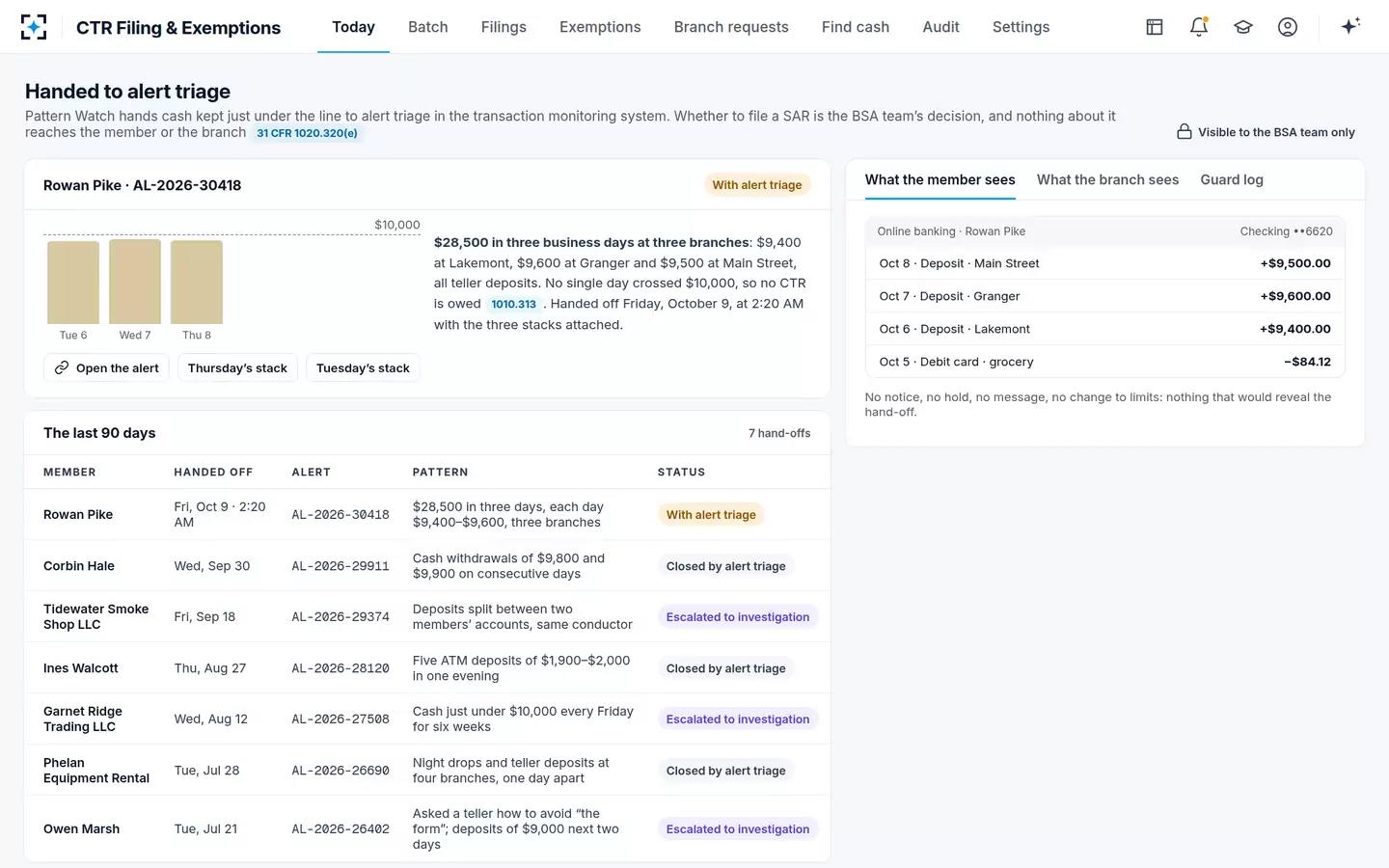
Aggregation catches a person's cash within one business day. Structuring is built to fall outside it: just under the line, across days, across branches, across people. The FFIEC manual's examples of monitoring reports include cash "between $7,000 and $10,000", and "multiple lower dollar transactions (e.g., $3,000) that over a period of time (e.g., 15 days) aggregate to a substantial sum of money (e.g., $30,000)" (FFIEC, Suspicious Activity Reporting). FinCEN's funnel-account advisory adds cash deposits under $10,000 made by unidentified people at branches far from where the account is held (FinCEN, FIN-2014-A005).
Those patterns belong to suspicious activity monitoring, not to the CTR. The October 2025 interagency SAR FAQs keep the two apart: proximity to $10,000 alone does not require a SAR, while a reasonable suspicion of evasion does (SAR FAQs, October 2025). Research is a useful reminder that the line itself is not secret: a peer-reviewed study of one large Danish bank's data found its method could detect smurfing when "as little as 0.1-0.5% of all transactions" were structured, and found "no evidence of smurfing" in the real data (Jensen, Ferwerda and Wewer, Journal of Quantitative Criminology, 2025). Its subject was confidential alert thresholds; the CTR threshold, by contrast, is published.
Three days under the line go to alert triage, and nowhere else
Where the aggregation rules are unclear, and what GAO asked for
The industry's main complaint about CTRs is aggregation. GAO found FinCEN's requirements "sometimes unclear to filers" and banks' interpretations inconsistent: some collected conductor details on every cash transaction, some from $500, some only above $10,000. Law enforcement had its own complaint: large aggregated CTRs "of unrelated parties do not provide useful information", and one large bank described CTRs "with more than 750 parties" (GAO-25-106500). GAO recommended that FinCEN "simplify and clarify aggregation requirements", and FinCEN agreed.
As of October 2026 the regulation is unchanged, so a bank's written interpretation is what examiners test against. Writing it down is the first step of any CTR software go-live, and getting it wrong at scale is how late and missing CTRs become penalties. For the threshold itself, and whether it will move, see what GAO and the AML Act say about the CTR threshold.
Questions people ask
Do cents count toward the $10,000?
The threshold is "more than $10,000", so $10,000.01 in one business day is reportable. On the form, FinCEN's instructions round amounts up to the next dollar, and its FAQ accepts small differences between the Part I and Part II totals that come from rounding each transaction separately.
Does a cash loan payment count toward a CTR?
Yes. The FFIEC manual lists loan payments in currency among the transactions subject to reporting individually or by aggregation. A customer who deposits $8,345 and pays $2,345 on a loan in cash the same business day has brought in more than $10,000.
Is a cashier's check bought with cash added to the day's total?
Yes; monetary instrument purchases with currency are reportable cash in. FinCEN's FAQ shows such a purchase reported as cash in under "Purchase of negotiable instrument(s)", including when the bank's policy requires the cash to be deposited first and the check drawn on the account.
Do deposits by one person into several accounts aggregate?
Yes, on the conductor's side. FinCEN's FAQ gives the example of an individual depositing more than $10,000 in total into several business accounts in one day: a CTR is owed, listing the conductor and each business on whose behalf the deposits were made.
Does an ATM deposit with no known conductor still count?
Yes. A deposit into a customer's account is made on that customer's behalf, so it counts toward the customer's business day even when the bank cannot say who stood at the machine. In the sample day above, the $2,350 drive-up ATM deposit is part of the $10,450, with its conductor shown as not known.