CTR late filing penalties are civil money penalties under the Bank Secrecy Act. A negligent failure to file a currency transaction report on time can cost up to $1,430 per violation at FinCEN's January 2025 rates, plus up to $111,308 more for a pattern of negligent violations; a willful failure can cost the greater of the amount involved, capped at $286,184, or $71,545 (FinCEN, 90 FR 5629). Those amounts sound modest next to the hundreds of millions in the headline cases, and that gap is the lesson: CTR failures rarely travel alone. Botminds' CTR Filing & Exemptions is designed around the deadline and the evidence, so that a missing report is found on day 1, not in a lookback.
A CTR is due "within 15 days following the day on which the reportable transaction occurred" (31 CFR 1010.306(a)(1)). Every report filed after that is late; every one never filed is a violation that can be counted. The two cases below show how counts become nine and ten figures.
The penalty follows the program failure, not the count of late CTRs
What is the penalty for filing a CTR late?
It depends on the bank's state of mind. A negligent violation, such as a late CTR caused by a missed step, carries a statutory maximum of "not more than $500" per violation, and a bank that "engages in a pattern of negligent violations" can be charged up to $50,000 on top (31 U.S.C. 5321(a)(6)). A willful violation, which in BSA enforcement includes reckless disregard and willful blindness, carries the greater of the amount involved, up to $100,000, or $25,000 (5321(a)(1)).
Those statutory figures are adjusted for inflation every year. FinCEN's January 2025 adjustment, the most recent we found in the Federal Register as of October 2026, set them as follows.
BSA civil penalty maximums for CTR violations, as adjusted in January 2025
$1,430
per negligent violation, such as one late CTR
31 U.S.C. 5321(a)(6)(A); $500 in the statute
$111,308
added for a pattern of negligent violations
5321(a)(6)(B); $50,000 in the statute
$286,184
the cap for one willful violation: the amount involved up to this cap, or $71,545 if that is greater
5321(a)(1); $100,000 and $25,000 in the statute
Program failures are priced differently. For a willful failure to maintain an AML program, a "separate violation" occurs for each day it continues; in the TD Bank order FinCEN cited up to $69,733 per day (FinCEN, TD Bank consent order). When late CTRs are a symptom of an inadequate program, as in both cases on this page, the day count dominates the arithmetic.
What is the CTR filing deadline?
Fifteen calendar days after the day of the transaction, with no extension for batch filers. FinCEN is explicit, because an old practice lingered: a 25-day window existed when CTRs were shipped on magnetic media, and FinCEN let some filers keep it until 31 March 2013. "As of April 1, 2013, all FinCEN CTRs must be filed within 15 calendar days of the reported transaction(s)" (FinCEN CTR FAQ 12). Cash deposited at night, on a weekend or on a holiday counts as received on the next business day, which moves day 0 but not the 15.
Filed means accepted, not sent. When a discrete filing is accepted, BSA E-Filing shows a confirmation page; within 48 hours FinCEN formally acknowledges that the report was processed and gives it a BSA ID (FAQ 14). A batch that never arrives is a batch of late CTRs, and the bank finds out only if someone matches acknowledgments to reports.
Fifteen days, with a margin: the clock in the sample settings
- Draft, check, file by day 5days 0–5
- BSA officer alertedday 7
- Chief executive’s office alertedday 10
- Last days before the deadlineto day 15
- Stacked, drafted, ID read, approved, acceptedday 3
- Unused margin12 days
Capital One: 50,000 CTRs that one accounting code hid
Capital One's case is the plainest example of a CTR failure built into a system. Its Check Cashing Group served check cashers who received cash by armored car, and the shipments were booked under an accounting method that never reached the bank's CTR reporting. FinCEN found that the bank "negligently failed to timely file currency transaction reports", and that the failure "exhibited a pattern of negligence with respect to CONA's legal obligation to file CTRs" (FinCEN, assessment 2021-01). The unreported shipments came to about 50,000 transactions and more than $16 billion over more than three years.
The bank found the problem itself. Its remediation, which FinCEN said "formed a significant part" of its assessment, included "self-reporting and backfiling over 50,000 unfiled CTRs" in 2011, a voluntary lookback, exiting the business, and "more than tripling its AML budget and staff since 2014". FinCEN still assessed $390 million for the program, SAR and CTR violations together. The order also shows how small the CTR line was on its own: FinCEN's statement of the law cites "a civil money penalty not to exceed $500" per negligent CTR violation, "and an additional $50,000 civil money penalty for a 'pattern of negligent activity'".
TD Bank: late, incomplete and misleading CTRs
TD Bank's 2024 order lists two CTR deficiencies: "late filings caused by a combination of longstanding and known technological issues", and "willfully filing more than 1,000 inaccurate CTRs". FinCEN identified "more than 4,000 late-filed CTRs covering more than $150 million in cash transactions filed weeks after the required deadline" (FinCEN, TD Bank consent order). An internal report in October 2018 credited recent improvements with bringing monthly late filings down from "300+ and in some [months] the 1,000 range".
The cause FinCEN quotes from the bank's own management is the one most banks would recognise: the inability to "track all cash transactions to reconcile what should have been filed compared to what was filed". Some reports were outstanding "roughly six months after the filing deadline", and one batch-filing issue was left "unidentified for months, resulting in hundreds of late CTRs". The FinCEN penalty of $1.3 billion, the largest it had imposed on a depository institution, came with a four-year independent monitorship (FinCEN, October 2024).
Neither bank was fined for one late CTR. Both were fined for not knowing which CTRs were late.
Each failure, its cause, and the control that would have caught it
| What failed | Why | The control |
|---|---|---|
| Capital One: armored car cash never reported | A cash type coded outside the field the CTR system read | Reconcile every cash source, by channel, against reported CTRs each day |
| TD Bank: 4,000+ CTRs filed weeks late | Vendor and batch-filing problems, unnoticed for months | Match each acknowledgment and BSA ID to its CTR; escalate any open clock |
| TD Bank: 1,000+ CTRs with missing identifiers | The CTR application did not check that an ID was collected | Block a report with a blank or generic ID until a person resolves it |
| TD Bank: 500+ CTRs naming the wrong conductor | Staff recorded the account holder, not the person at the window | Train, sample, and compare conductor details with the teller image |
What happens if a bank fails to file a CTR?
It files them, late, and decides whether it needs FinCEN's view first. The FFIEC manual says that once a bank finds unfiled or erroneous CTRs, "through self-identification or through an examination", it "must begin complying with CTR requirements", and may ask FinCEN's Resource Center for a determination on backfiling or amending. "In most cases, the bank can submit late CTRs and/or amended CTRs without the need to contact FinCEN" (FFIEC BSA/AML Manual, Currency Transaction Reporting).
The manual names the cases where contacting FinCEN makes sense: when the regulator instructs it, when it is unclear whether backfiling is required, or when the bank wants relief from filing some or all of the reports. FinCEN also encourages a bank to tell its regulator about "a systemic issue or a large number of filings". A corrected CTR is filed with "Correct/amend prior report" checked and the earlier BSA ID; if that ID is unknown, the filer enters 14 zeros (FinCEN CTR FAQs 6 and 7).
A missed CTR found inside the 15 days is not a late CTR at all. That is the practical argument for stacking every channel overnight: a cash day that crossed $10,000 at three branches is found the next morning, while there are still 14 days left. The aggregation rules decide which days those are.
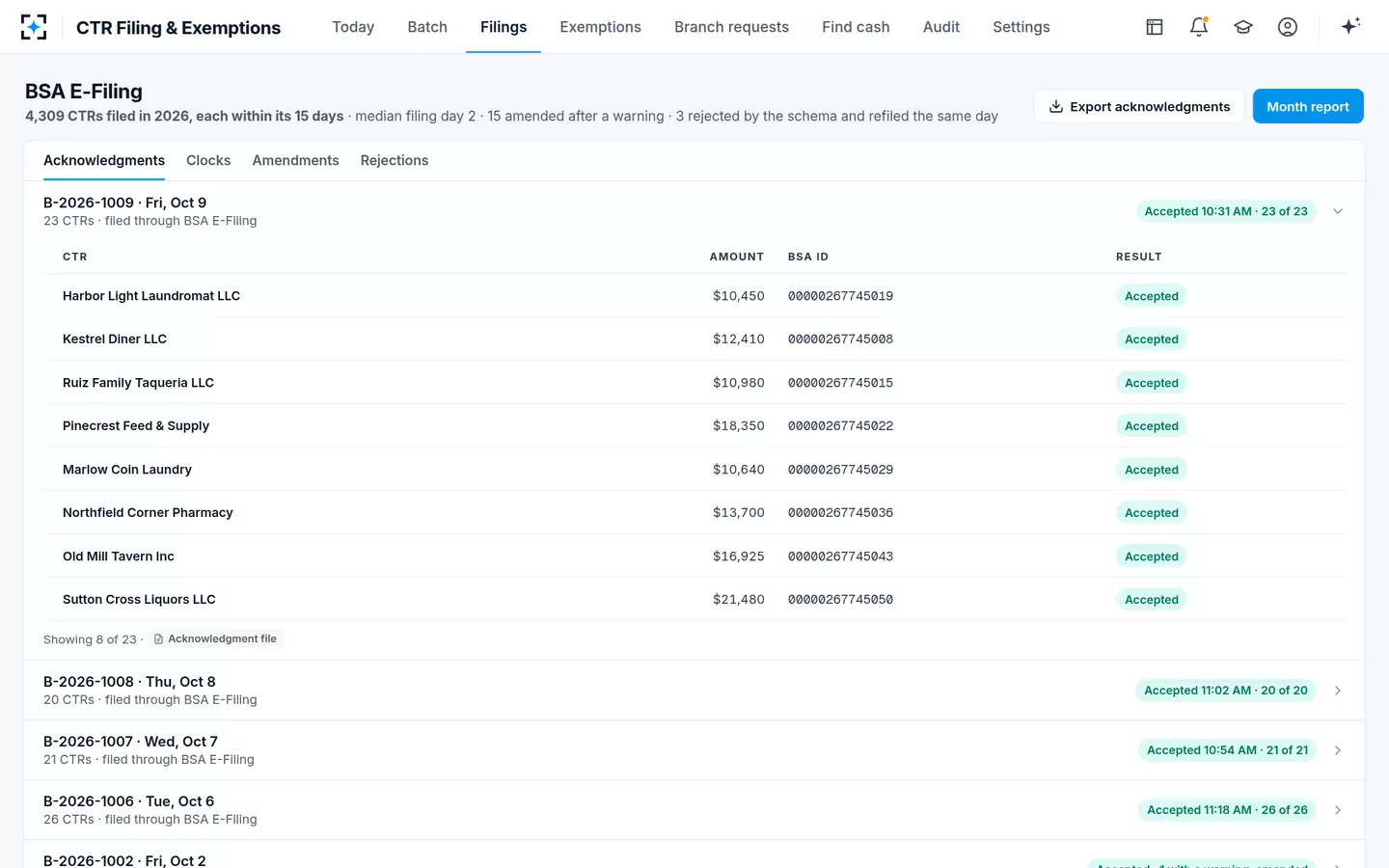
CTR Filing & Exemptions: every batch with its acknowledgment and BSA IDs
What are BSA civil penalties, and who pays them?
BSA civil penalties are the money penalties FinCEN, and the banking agencies under their own authority, impose for violations of the Act and its regulations: failures to file CTRs and SARs, AML program failures, recordkeeping failures and structuring. They reach institutions and, for willful violations, the people in them. The statute applies the willful-violation penalty to partners, directors, officers and employees of a financial institution as well as to the institution (31 U.S.C. 5321(a)(1)).
Structuring is separate, and it applies to anyone. The Treasury "may impose a civil money penalty on any person who violates any provision of section 5324" (5321(a)(4)), and section 5324 forbids causing a bank to fail to file a CTR, causing a CTR with "a material omission or misstatement of fact", or structuring a transaction to evade the report (31 U.S.C. 5324). An employee who helps a customer stay under the line is exposed on both counts.
The cost that is not in the penalty
A penalty is a single number; the remediation that follows a CTR failure is a project. Capital One backfiled 50,000 reports and ran a lookback. TD Bank's order adds a four-year monitorship. Every backfiled CTR is still a CTR someone has to complete correctly, with conductor details that may now be years old, and the identifying information the teller did not capture at the time is rarely recoverable.
The ordinary cost is the hours. FinCEN costs a CTR at about eight minutes; GAO heard estimates of $10 to $81 per CTR from banks that disputed that figure (GAO-25-106500). A missed day costs more, because it is rebuilt after the fact. In the sample credit union, the CTR specialist is the one who chases the branch for what the teller did not record, and every request the agents can answer from a teller image is one fewer late CTR.
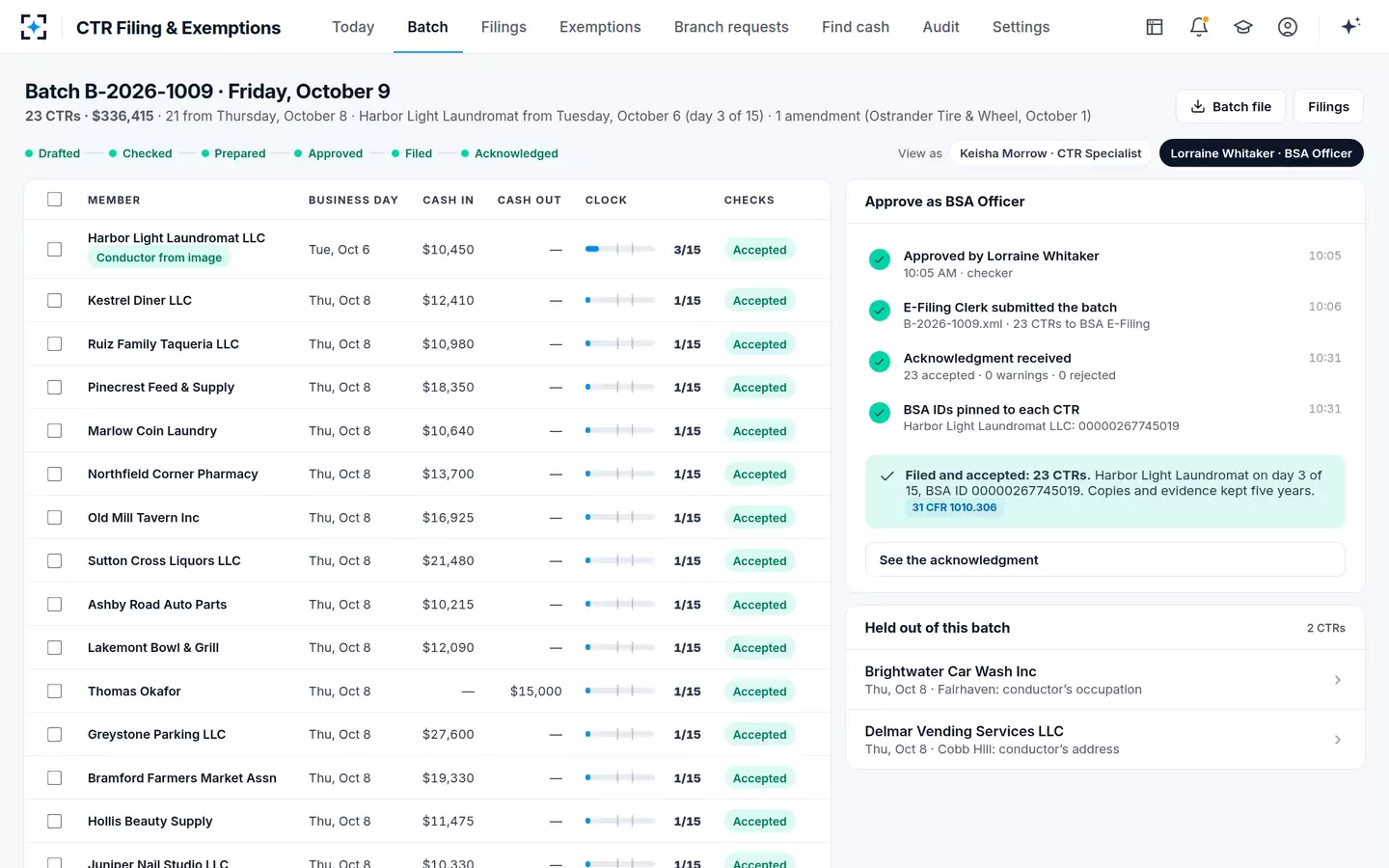
Approved, filed and acknowledged, with each BSA ID pinned
Can an individual be fined for CTR failures?
Yes, for willful violations and for structuring. A teller or officer who willfully causes a bank to file a false CTR, or helps a customer evade one, can face civil penalties personally, and the TD Bank order records branch staff accepting gift cards from the customer whose identity they left off the reports. An honest mistake at the window is the bank's problem to train and control, not a personal penalty.
For a BSA officer, the exposure is the program: whether late and missing CTRs would have been found by the bank's own controls before an examiner or a lookback found them. That is the question a CTR software go-live plan should answer before anything else.
Questions people ask
How much was Capital One fined for CTRs?
FinCEN assessed $390 million in January 2021 for AML program, SAR and CTR violations together, with $100 million paid to the OCC credited against it. The CTR violations were negligent: about 50,000 unreported cash transactions worth over $16 billion. FinCEN did not price the CTR violations separately.
Is a CTR filed on day 15 on time?
Yes. The rule requires filing within 15 days following the day of the transaction, so a report accepted on the 15th calendar day after it is on time. Filed means submitted and accepted through BSA E-Filing; a batch rejected on day 15 and refiled on day 16 is late.
Do late CTRs have to be reported to FinCEN separately?
No separate notice is required for an occasional late report; the bank files it. For a systemic problem or a large number of unfiled reports, the FFIEC manual says FinCEN encourages telling the bank's regulator, and the bank may ask FinCEN's Resource Center for a backfiling determination.
Are CTR penalties per report or per bank?
Per violation, so each missed or late CTR can count, with an extra amount for a pattern of negligence. AML program violations are counted per day they continue, which is why program cases produce far larger penalties than CTR counts alone.
Does a CTR exemption protect a bank from late filing penalties?
Only for the exempt person's covered transactions, and only while the bank complies with the exemption rules. A bank that has reason to believe the customer no longer qualifies, or that a deposit belongs to someone else, loses that protection for those transactions.