The CTR threshold has not increased. As of 26 October 2026, a bank must still report "a transaction in currency of more than $10,000" (31 CFR 1010.311), and we found no FinCEN proposal in the Federal Register to change the threshold for banks. The case for a threshold increase is strong on paper: GAO calculated in December 2024 that the $10,000 set in 1972 "would have been about $72,880" in 2023, and that an inflation-adjusted threshold "would have reduced the number of CTRs filed by at least 90 percent annually since 2014" (GAO-25-106500). Congress ordered Treasury to review it in the AML Act of 2020; the review was late, and law enforcement largely wants the line kept. Botminds' CTR Filing & Exemptions treats the threshold as a rule set by regulation, locked in its settings, so a change, if it comes, is one approved version, not a rebuild.
For a BSA officer the practical question is narrower: plan for $10,000, watch for a proposal, and know which parts of the cash reporting process a higher line would and would not change.
The $10,000 set in 1972, in later dollars
Is the CTR threshold increasing?
Not for banks, as of late October 2026. The regulation is unchanged, and the only 2026 actions near the CTR went the other way and applied elsewhere. FinCEN's renewed Southwest border geographic targeting order requires certain money services businesses in listed ZIP codes to report cash transactions "of $1,000 or more, but not more than $10,000", from 3 September 2026 to 1 March 2027 (FinCEN, 91 FR, 4 September 2026). The order does not apply to banks, and it exempts a covered business's transactions with a commercial bank.
Pages that say the threshold is about to rise usually cite the AML Act's review or GAO's report. Both are real; neither changed the rule. A change would come as a FinCEN proposed rule with a comment period before any final rule, which gives banks months of notice.
What is the CTR threshold?
Cash in, or cash out, of more than $10,000 in one business day, by or on behalf of one person, counting every branch of the bank as one. Exactly $10,000 is not reportable; $10,000.01 is. Several transactions count as one when the bank knows they are for the same person, so the threshold is a daily total, not a deposit size, which is why the aggregation rules matter as much as the number.
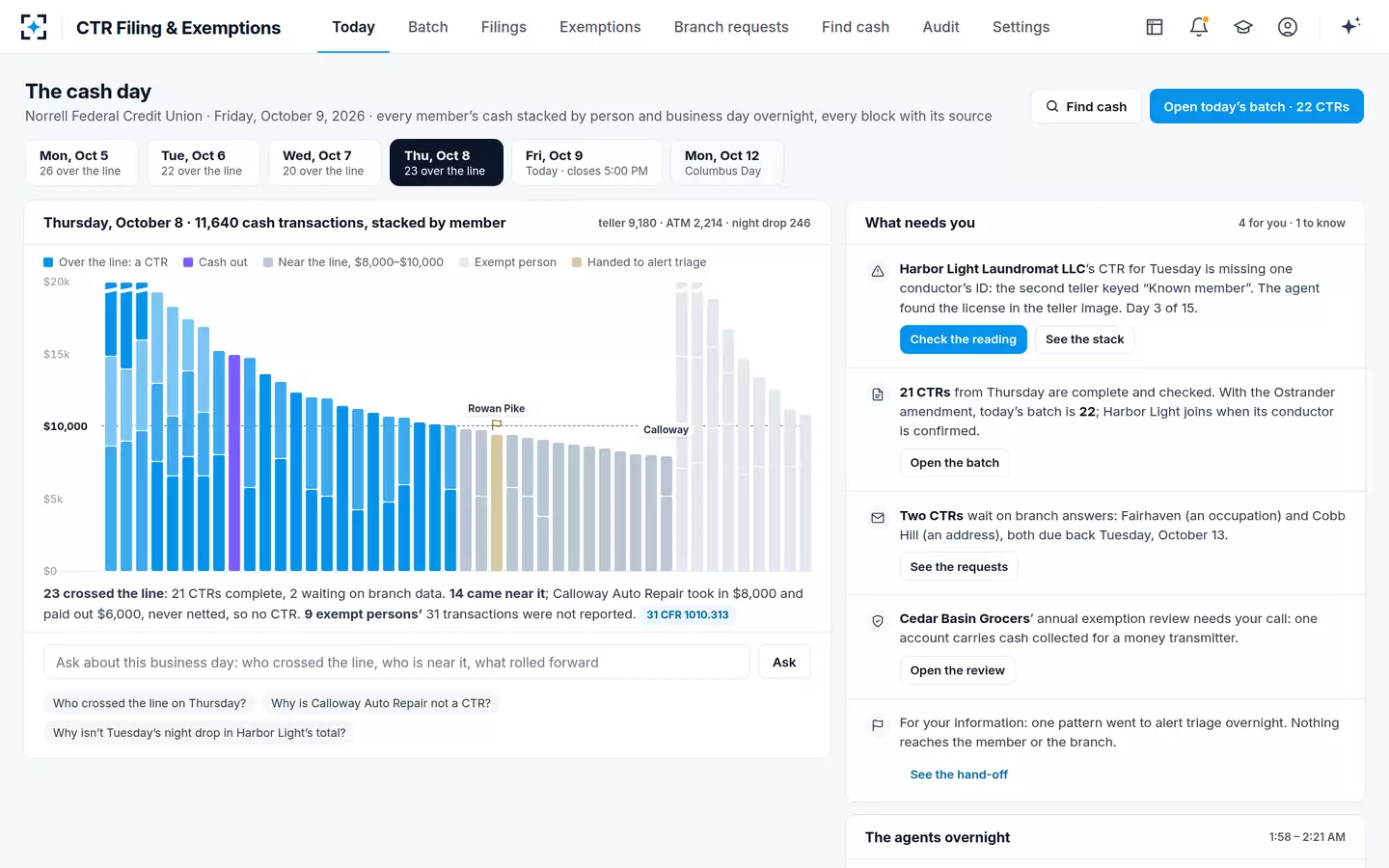
CTR Filing & Exemptions: every member’s day against one $10,000 line
Why is the CTR threshold $10,000?
Because Treasury set it there in regulation in 1972 and has not changed it. GAO's words are blunt: "The $10,000 threshold, set in regulation by the Department of the Treasury in 1972, has not been adjusted for inflation." Every review since has left it where it was.
What changed instead was everything around the number. GAO traces how the scope grew: Treasury added aggregation in 1987 to catch transactions broken up to evade reporting; Congress added suspicious activity reports in 1992; the 1994 Money Laundering Suppression Act required exemptions; the electronic FinCEN CTR, with its critical and non-critical fields, became mandatory in April 2013. "Although the CTR threshold has remained the same for over 50 years, the scope of CTR requirements has expanded significantly" (GAO-25-106500).
What would the CTR threshold be adjusted for inflation?
About $72,880 in 2023 dollars, on GAO's calculation, and the effect on volume would be dramatic. An inflation-adjusted threshold would have cut CTR filings by at least 90% in every fiscal year since 2014. Even a small move matters: on fiscal 2023 data, "a threshold of $20,000 would have reduced CTR filings by 65 percent".
The banks GAO interviewed wanted a higher line, though not all the way. Six of 13 suggested thresholds "between $15,000 and $30,000", two suggested $100,000 or more, and most other financial institutions favoured the inflation-adjusted figure or something between $20,000 and it. Seven of the 13 said fully replacing CTRs with SARs would cut their burden most (GAO-25-106500).
Has Congress asked for the CTR threshold to change?
Congress ordered a review, not an increase. The Anti-Money Laundering Act of 2020 told Treasury to "review and determine whether the dollar thresholds, including aggregate thresholds" for CTRs and SARs "should be adjusted", and to consider "whether currency transaction report thresholds should be tied to inflation" (AML Act, section 6205). It set a one-year deadline for a report and any proposed rules, then required an evaluation "not less frequently than once every 5 years during the 10-year period" after enactment. A companion section, 6204, ordered a broader streamlining review that also covers wider use of CTR exemptions.
The deadline passed. GAO reported that Treasury's reports were due by January 2022 and that Treasury "was past the statutory deadline and had not issued its report as of July 2024". GAO's December 2024 report made four recommendations, including that FinCEN "take steps to reduce the number of unused CTRs", eliminate rarely used fields and "simplify and clarify aggregation requirements", and "FinCEN agreed with GAO's recommendations". As of late October 2026 none had produced a proposed rule for banks that we could find.
How the $10,000 line has been reviewed, and not moved
| When | What happened | Effect on the threshold |
|---|---|---|
| 1972 | Treasury sets the CTR threshold at $10,000 in regulation | Set |
| 1987 | Aggregation of multiple transactions per business day added | Unchanged; more transactions reach it |
| 1994–2009 | Exemptions required by statute, introduced, then simplified in a 2008 rule | Unchanged; fewer reports for exempt customers |
| 2004 and 2019 | FinCEN studies the threshold with its advisory group, then with users of BSA data | Unchanged |
| 2021 | The AML Act of 2020 becomes law and orders reviews of CTR thresholds and streamlining, due within a year | Under review |
| July 2024 | GAO: Treasury past the deadline, report not issued | Unchanged |
| December 2024 | GAO recommends fewer unused CTRs and clearer aggregation; FinCEN agrees | Unchanged |
| September 2026 | Geographic targeting order lowers reporting to $1,000 for certain money services businesses | Unchanged for banks |
How many CTRs are filed each year?
About 21 million. FinCEN's year-in-review figures are 20.6 million CTRs in fiscal 2022, 20.9 million in 2023, 20.5 million in 2024 and 21.5 million in 2025 (FinCEN, Year in Review FY2025). Over the ten fiscal years 2014 to 2023, filers sent about 167 million. Annual filings rose about 62% between fiscal 2002 and 2023, from 12.9 million to 20.9 million, which GAO links in part to inflation pushing ordinary cash activity over a fixed line.
CTRs filed with FinCEN, by fiscal year
Most come from banks and credit unions. In fiscal 2023, depository institutions filed about 84% of CTRs, casinos about 10% and money services businesses about 4%, and "the top three individual filers, all large banks, accounted for nearly 30 percent of annual filings" in fiscal 2022 and 2023.
Who files CTRs: shares by filer type, fiscal 2023
CTRs filed, fiscal 2023
- Banks and credit unions · 84%
- Casinos · 10%
- Money services businesses · 4%
- Other · 2%
Do law enforcement agencies use CTRs?
Some, heavily; most CTRs, never. GAO found that "law enforcement agencies accessed about 5.4 percent of CTRs filed in FinCEN's BSA Portal" from 2014 through 2023, and that counting agencies' own systems, CTRs accessed in 2023 were "less than 3 percent" of those filed over the decade. Yet the agencies that use them value them: an estimated 76% of surveyed agencies thought raising the threshold would hurt their ability to fight crime.
Rarely read, still wanted: CTRs and law enforcement
5.4%
of CTRs filed in 2014–2023 accessed through FinCEN’s BSA Portal
GAO
76%
of surveyed law enforcement agencies said a higher threshold would hurt
GAO survey, estimate
9.2%
of IRS Criminal Investigation cases opened from a BSA filing in FY2025 began with a CTR
FinCEN, Year in Review
66.8%
of IRS-CI investigations opened in FY2025 had a primary subject linked to a CTR
FinCEN, Year in Review
The investigators' reasons are specific. Homeland Security Investigations told GAO that "a higher threshold could hinder money laundering investigations by making it harder to prove a suspect's knowledge of the threshold". IRS-CI said a higher line would reduce the leads it reviews. Access data also favour larger reports: in fiscal 2023 agencies looked at just over 3.4% of CTRs over $50,000 and about 2.2% of those under it, though the far greater number of smaller CTRs meant more of them were read in total.
Could the CTR threshold go down instead?
It is not impossible, and part of law enforcement would like it. GAO's survey found that "an estimated 52 percent of law enforcement agencies thought a lower threshold would benefit their agency", and that 67% of those that named an ideal level picked an amount below $10,000. One of the 11 federal agencies GAO interviewed, and one of seven compliance consultants and think tanks, argued for lowering it. Others pointed to the cost: the Executive Office for United States Attorneys noted that prosecutors "primarily focus on CTRs with high dollar values".
The 2026 targeting order shows what a lower line looks like in practice: a temporary $1,000 reporting level for money services businesses in named border ZIP codes. GAO's data show those filers' reports are read more often than banks': in fiscal 2023, law enforcement accessed nearly 10% of the CTRs money services businesses filed in 2019–2023, against under 3% of those filed by depository institutions. For banks, the realistic range of outcomes runs from no change to a higher line, with targeted orders at the edges.
A higher line would remove most CTRs. It would not remove the conductor, the business day or the exempt list.
What a higher threshold would and would not change for a bank
It would shrink the queue: at $20,000, roughly two in three of today's reports would disappear, on GAO's 2023 figures. It might reduce structuring SARs too, since GAO notes FinCEN "reported over 500,000 structuring SARs in 2023 related to transactions below the threshold". It would not change the work on each report that remains: adding up the day across channels, naming the conductor, applying exemptions, filing within 15 days. Nor would it change the suspicious-activity duty for cash kept just under whatever the new line is.
That is why the sensible plan is to run the process well at $10,000. In the sample credit union's settings, the threshold is locked as "set by regulation", while the near-line band and the internal filing target are the credit union's own. A new threshold would be a new version of one locked rule, approved by the BSA officer. The cost of the current line is set out in why banks file CTRs on businesses they could exempt, the one lever banks already have, and in the go-live plan for CTR software.
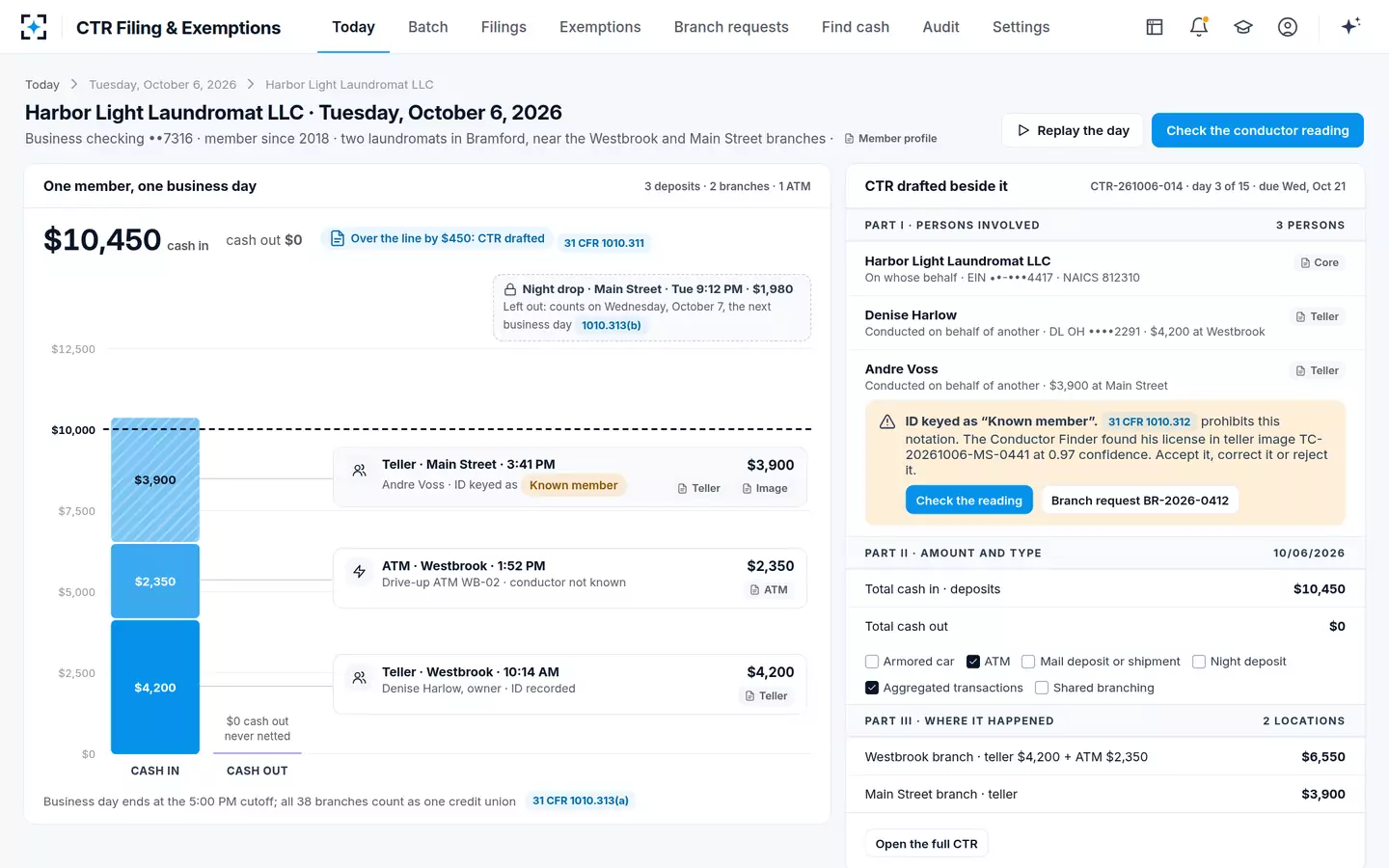
Over the line by $450: the threshold applied to one member’s day
Questions people ask
Is the CTR threshold the same for credit unions?
Yes. The CTR rule applies to every financial institution other than casinos on the same terms: cash in or cash out of more than $10,000 in a business day. Casinos follow parallel rules of their own, and money services businesses in certain ZIP codes face a $1,000 threshold under the 2026 targeting order.
Did the threshold change for money services businesses?
Only temporarily and only in listed places. The Southwest border targeting order requires covered money services businesses to report cash transactions from $1,000 up to $10,000 between 3 September 2026 and 1 March 2027. The standard $10,000 rule continues for everyone else.
Would raising the threshold make structuring legal?
No. Structuring is breaking up cash in any amount to evade a reporting requirement, and it would remain a federal crime under any threshold. A higher line would move where structuring happens, not whether banks must watch for it.
Why don't regulators just index the threshold?
Indexing would cut CTRs by at least 90%, on GAO's figures, and most law enforcement agencies surveyed oppose any increase. The AML Act asked Treasury to weigh both sides, including whether to tie the threshold to inflation, and that review has not yet produced a proposal.
When did anyone last review the CTR threshold?
The most recent public review is GAO's December 2024 report, with FinCEN's agreement to its recommendations. The AML Act also requires Treasury to re-evaluate its findings at least every five years during the ten years after the Act, so another evaluation is due before the end of that period.