CTR exempt businesses are customers a bank has chosen to designate, on FinCEN Form 110, so that their routine cash deposits and withdrawals no longer need a currency transaction report. No business is exempt on its own say: the bank decides, the business must fit a category in the rule, and most need a two-month account history, five or more reportable cash transactions a year and no more than half their revenue from ineligible activities (31 CFR 1020.315). GAO found that "about 60 percent of CTRs that were filed included businesses", yet banks use the exemptions sparingly: larger banks find them costlier and riskier than filing, and smaller ones find their customers do not qualify (GAO-25-106500). Botminds' CTR Filing & Exemptions takes on the part that makes exemptions expensive: the evidence for each test, every year, ready for the BSA officer to decide.
The trade-off is worth working out for each customer, because the CTRs on a cash-heavy business arrive every week and the exemption's paperwork arrives once a year.
Most CTRs name a business, and few businesses can be Phase I exempt
CTRs filed, fiscal 2014–2023
- Included a business · 60%
- Individuals only · 40%
What businesses are exempt from CTR reporting?
Only those a bank designates, in three groups. Listed companies on the NYSE, the American Stock Exchange or the NASDAQ National Market, and their 51%-owned subsidiaries, are Phase I and can be exempted at once. Other commercial enterprises, called non-listed businesses, are Phase II: they qualify after two months with a transaction account, with "frequent" cash over $10,000, meaning five or more reportable transactions a year, and with no more than 50% of gross revenue from ineligible activities. Payroll customers that regularly withdraw over $10,000 to pay staff in cash are Phase II for those withdrawals only. Banks and government bodies are exempt too, but they are not businesses in this sense.
Some businesses cannot be non-listed exempt persons at all: financial institutions and their agents, car and boat dealers, law, accounting and medical practices, auctioneers, charter operators, gaming, investment advisers, real estate brokers, pawnbrokers, title and closing companies and trade unions, among others. The full sorting is in Phase 1 or Phase 2 exempt person under the BSA.
Why don't banks use CTR exemptions?
Because, for most banks, filing feels cheaper and safer than exempting. GAO interviewed 13 institutions and heard two different reasons by size. "Representatives for large and regional banks generally said their institutions used minimal exemptions because they are more time-consuming, costlier, and pose greater compliance risk than filing CTRs." Representatives of "credit unions, community banks, or mid-sized banks" said "many of their business customers did not qualify for exemptions based on the restrictive eligibility criteria" (GAO-25-106500).
Two specific frictions came up. One is documentation: FinCEN's 2008 rule said banks did not need separate files for determinations already supported by other BSA work, but "some bank representatives we interviewed believed additional steps were necessary to support Phase II exemptions". The other is the 50% test. Banks are "reluctant to exempt non-listed businesses that engage in some ineligible business activities because it is difficult or time-consuming to determine and monitor the scope of these activities", and GAO points to grocery stores and gas stations, which file many CTRs and often offer money transmission on the side.
Filing every CTR against exempting the business: what each costs a bank
Keep filing CTRs: A CTR every reportable day: aggregation, conductor details, review, filing, acknowledgment.
Exempt the business: One annual review: each test re-checked with evidence, plus monitoring of each exempt account.
Keep filing CTRs: None.
Exempt the business: A Form 110 within 30 days of the first reportable transaction to be exempted.
Keep filing CTRs: A late or wrong CTR is a violation for each report.
Exempt the business: An exemption that should have ended leaves unfiled CTRs, unless the bank is inside the safe harbor.
Keep filing CTRs: Filed CTRs against the large cash report.
Exempt the business: Whether each exempt customer still qualifies, from its annual reportable cash.
Keep filing CTRs: Monitoring as for any customer.
Exempt the business: Monitoring as for any customer, and reviewed at each annual review for Phase II.
How many CTRs could be exempted?
Nobody has a count, and GAO is careful about it: "not all of these businesses may be eligible for exemption", but "there is potential to identify and expand exemptions to capture some portion of cash intensive businesses that have routine cash transactions that are considered low-risk for money laundering". GAO's data also show which reports law enforcement reads least: CTRs on grocery stores, gas stations and convenience stores were accessed "proportionally less than other industries", which GAO says indicates they "may be relatively less useful".
The investigators GAO spoke to agree on direction. "Officials from IRS-CI, Secret Service, and Homeland Security Investigations supported expanding CTR exemptions to include more cash businesses that banks determine to be low-risk for money laundering, such as well-established restaurants or gas stations." Congress had asked for the same review in 2020, listing "the increased use or expansion of exemption provisions to reduce currency transaction reports that may be of little or no value to the efforts of law enforcement agencies" among its subjects (AML Act, section 6204(b)(2)(E)). No rule change has followed, so expansion today means banks using the exemptions that already exist.
The exemption gap in four numbers
~60%
of CTRs filed over ten years included a business
GAO, fiscal 2014–2023
~11M
business customers identified in CTR filings in fiscal 2023
GAO
5
reportable cash transactions a year make a business “frequent” for Phase II
FinCEN, since 2009
21.5M
CTRs filed in fiscal 2025, by all filers
FinCEN, Year in Review
What is a CTR exempt customer?
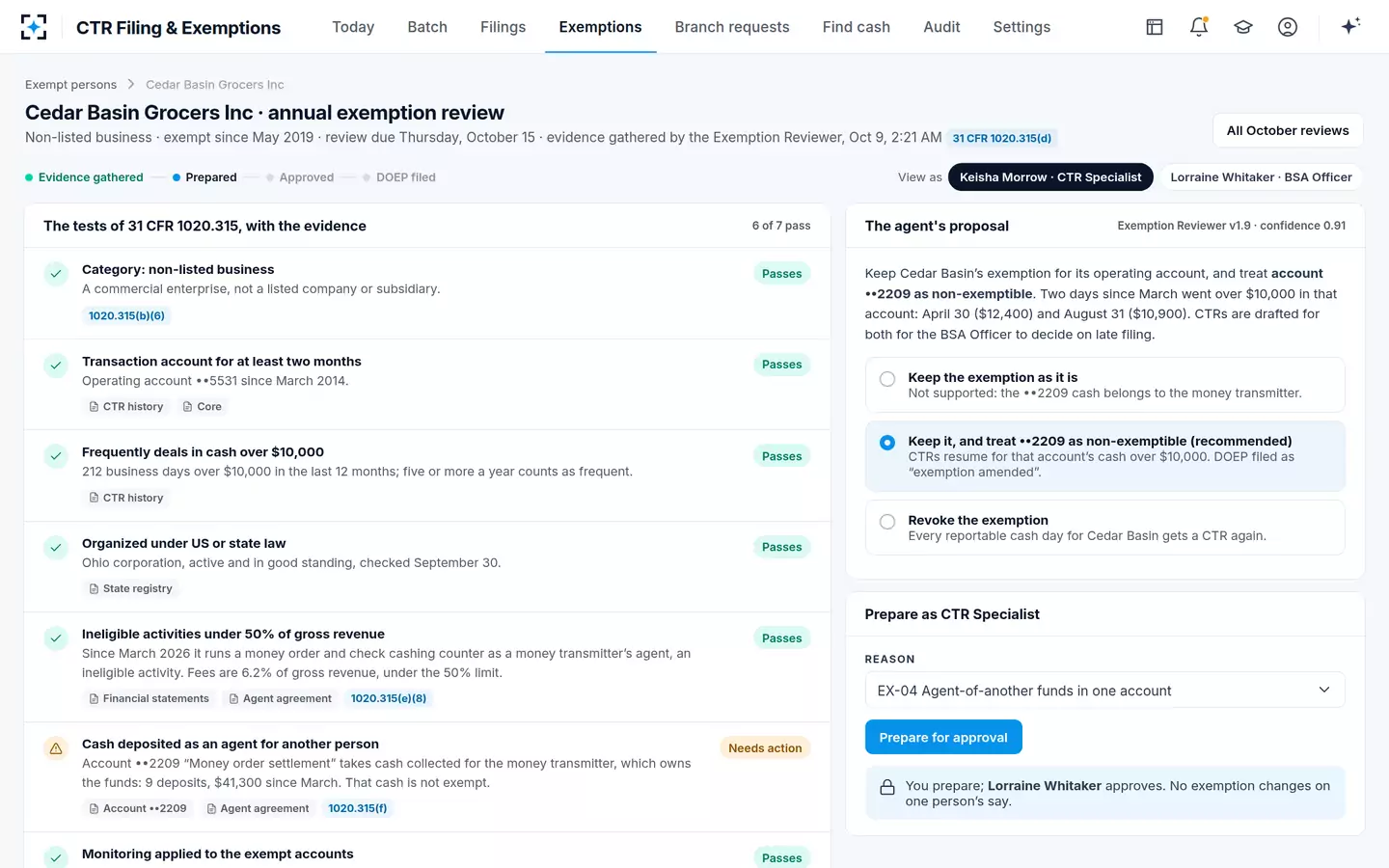
It is a customer whose qualifying cash transactions the bank need not report, because the bank has designated it under the exemption rule and keeps it qualified. For a Phase II business the exemption is narrow: only "transactions conducted through its exemptible accounts", only its own cash, and only while it passes the tests. Cash an exempt customer deposits on behalf of someone else who owns the funds is reportable as if no exemption existed (31 CFR 1020.315(f)).
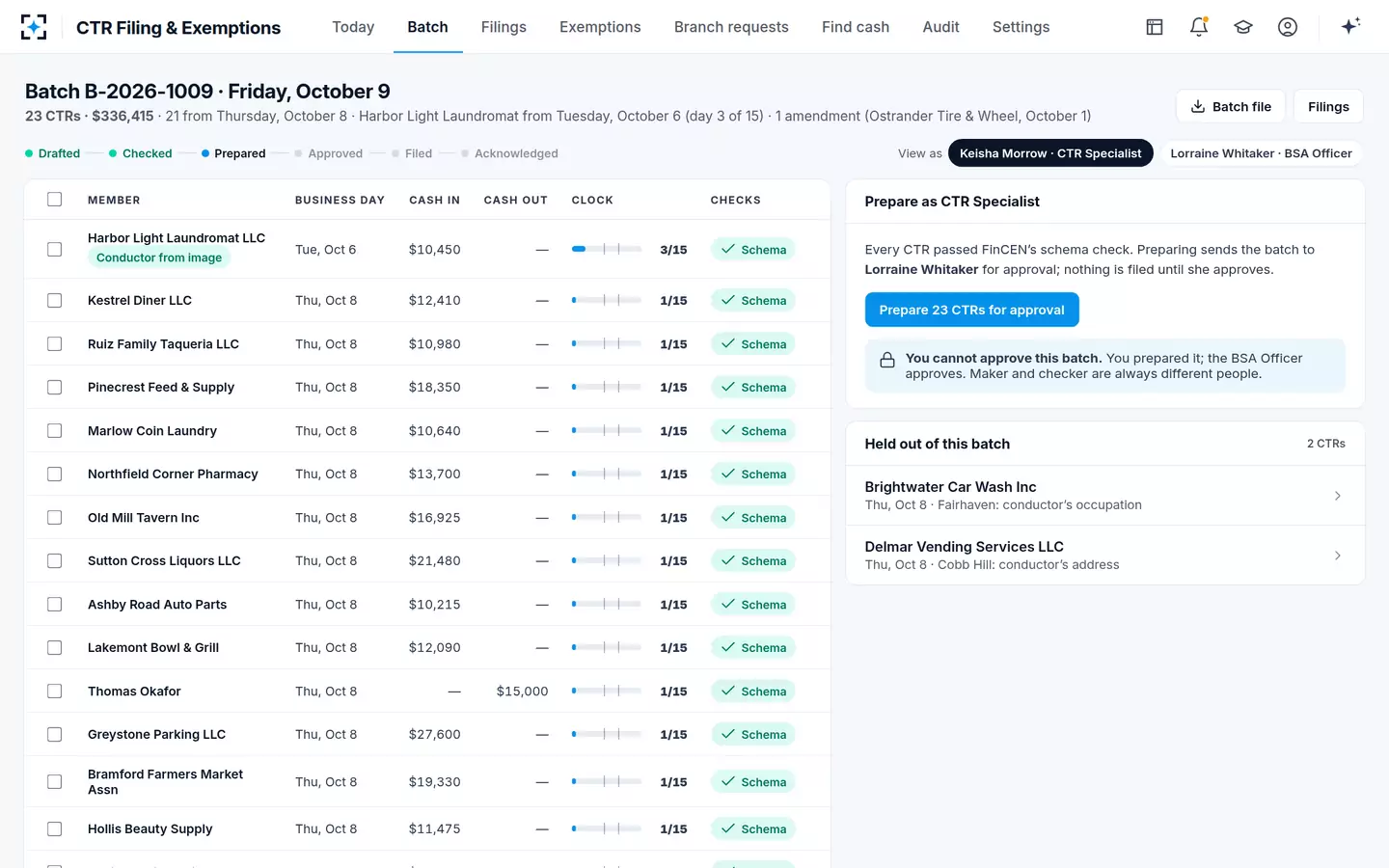
That narrowness is why exempt customers still show up in a well-run cash process. In the sample credit union in CTR Filing & Exemptions, nine exempt persons made 31 cash transactions on one Thursday; none was reported, and every one was still stacked and counted, so the annual review knows how many reportable days each customer had.
Is it risky to exempt customers from CTR reporting?
It is a managed risk, and the rule includes a safe harbor. A bank is not penalized for a CTR it did not file on an exempt person's transaction "with respect to which the requirements of this section have been satisfied", unless it knowingly files false or incomplete information or "has reason to believe that the customer does not meet the criteria" (31 CFR 1020.315(g)(1)). Absent specific knowledge to the contrary, the bank may keep treating the customer as exempt until the next required annual review.
So the risk is concentrated in two places: an exemption that should not have been granted, and one that should have ended. Both are failures of evidence, which is why the annual review, as a file an examiner can test, matters more than the designation. The suspicious-activity duty never changes: nothing in the exemption rule relieves a bank of its SAR obligations.
The arithmetic of exempting one business
The case for one exemption is simple arithmetic, with numbers a bank already has. Take a sample customer in the solution: Cedar Basin Grocers, a fictional grocer that is an exempt non-listed business. It had 212 business days over $10,000 in cash in the last twelve months. Without the exemption, that is 212 CTRs a year, each naming the grocer and whichever employee made the deposit.
What exempting one cash-heavy business returns, term by term
CTRs not filed
Reportable days a year × time per CTR
212 days × FinCEN’s 8 minutes ≈ 28 hours a year; at the $10 to $81 per CTR banks gave GAO, about $2,100 to $17,200.
BSA operations
Branch requests not sent
CTRs not filed × share needing a branch request
Botminds’ estimate at a credit union of the sample’s size: about 4% of multi-transaction CTRs need one.
CTR specialist
The designation
One Form 110, within 30 days
Filed once, with the evidence behind each test.
CTR specialist prepares, BSA officer approves
The annual review
Hours per review × 1 a year
Botminds’ estimate by hand: about 2 hours, most of it gathering evidence.
CTR specialist and BSA officer
On those figures, the exemption costs a few hours a year and saves dozens of hours, before counting the branch requests and the risk of a late CTR. A customer with only six or eight reportable days a year is a different calculation, and may not be worth the review. The useful output is a ranked list: business customers by reportable days, with the ones that obviously fail a test removed.
CTR Filing & Exemptions: one day’s batch, and how many lines name a business
How do you become CTR exempt?
A business cannot apply; its bank decides. The bank checks the business against the rule, and if it qualifies and the bank wants to exempt it, files FinCEN Form 110 within 30 calendar days after the customer's first reportable cash transaction (31 CFR 1020.315(c)(1)). Each bank that treats the customer as exempt designates it separately, though a holding company may file once for all its banks if it lists them.
For a new customer the wait is two months, or less if the bank documents a risk-based assessment. FinCEN's 2008 rule cut that wait from twelve months and the "frequent" test from eight transactions a year to five, with the stated aim to "make it easier for financial institutions to take better advantage of exemptions from CTR filing requirements for certain classes of customers, while continuing to report valuable information to law enforcement" (FinCEN, December 2008).
An exemption kept defensible: each test with its evidence
What are CTR exemption ineligible businesses?
They are the businesses that cannot be Phase II non-listed exempt persons because they are "engaged primarily" in an activity on the rule's list: financial services or acting as an agent of a financial institution, selling vehicles, vessels, aircraft, farm equipment or mobile homes, law, accountancy or medicine, auctions, charter and transport operations, gaming other than licensed race-track betting, investment advice or banking, real estate brokerage, pawn brokerage, title insurance and closings, and trade union activities (31 CFR 1020.315(e)(8)).
The word "primarily" is the opening most banks overlook. A business with several lines qualifies "so long as no more than 50% of its gross revenues are derived from" ineligible activities. A grocer with a money order counter, a convenience store with a check-cashing window, a gas station that sells lottery tickets: each can be a non-listed business if the bank can show, with reasonable evidence, that the ineligible part is less than half its revenue.
Which business customers to start with
Start where the arithmetic is strongest and the tests are easiest to evidence. The list below is how a BSA team can turn GAO's general point into its own short list.
Choosing business customers to test for a CTR exemption
- Rank by reportable days, not by deposit size
A business over $10,000 on 200 days a year is worth an exemption review; one over the line six times is probably not.
- Drop the obvious ineligibles first
Dealers, practices, pawn, gaming and financial businesses whose main line is on the list.
- Check the 50% question early
For grocers, gas stations and convenience stores, get the revenue split and any agency agreement before anything else.
- Map the accounts
Which are transaction or business money market accounts, and which carry someone else’s cash, such as a settlement account for a transmitter.
- Look for common ownership and restructuring
Several companies run as one, or a DBA that became an LLC, change who the exempt person is.
- Confirm monitoring covers the account
An exempt account must stay under suspicious-activity monitoring; check that it does before designating.
- Separate the preparer and the decider
One person prepares the Form 110 with evidence; the BSA officer or a delegate decides.
None of this replaces judgement about the customer. A business the bank considers high-risk can stay outside the exemption, and a business that was the subject of a SAR may still be exempt, at the bank's discretion under its own policies (FIN-2012-G003). What changes with evidence ready is that the decision gets made, rather than avoided. For the cost of the reports that remain, see CTR late filing penalties.
Questions people ask
Can a customer ask to be CTR exempt?
A customer can ask, but only the bank can designate, and it has no obligation to. The bank must be satisfied the customer fits a category in 31 CFR 1020.315, document its basis, and file Form 110 within the 30-day window.
Is a money services business ever CTR exempt?
Not as a non-listed business: serving as a financial institution or an agent of one is an ineligible activity. A listed company that is a non-bank financial institution can be a Phase I exempt person, but only for its domestic operations.
Does an exemption cover all of a business's cash?
No. A Phase II exemption covers the business's own cash through its exemptible accounts. Cash it deposits for someone else, and cash that does not pass through an exemptible account, such as a cashier's check bought over the counter and run through the bank's general ledger, is reported.
Do exemptions mean law enforcement loses information?
Less than it might seem. GAO found law enforcement accessed CTRs on grocery stores, gas stations and convenience stores proportionally less than others, and federal investigators supported exempting more low-risk cash businesses. The bank's suspicious-activity monitoring and SAR duties continue for every exempt customer.
How many CTR exemptions can a bank have?
There is no limit. Each one needs a qualifying category, a Form 110 where required, and for listed companies and Phase II customers an annual review, so the practical limit is the bank's capacity to keep the evidence current.