CTR software is the system a bank or credit union uses to find every currency transaction report it owes and file it on time: it adds up cash from teller, ATM, night-drop and armored-car channels by person and business day, fills FinCEN Form 112 with the right people in the right roles, files it through FinCEN's BSA E-Filing System, tracks the acknowledgment and keeps a copy for five years. Most CTR software also manages exempt persons. The part that decides whether a go-live succeeds is not the e-filing screen; it is whether the bank's cash rules and exemption list are written down and loaded correctly before the first batch. That is the order this plan follows, and the order we use to bring Botminds' CTR Filing & Exemptions live on a bank's own past cash days.
Every filer faces the same arithmetic. FinCEN received 21.5 million CTRs in fiscal 2025 (FinCEN, Year in Review FY2025), each due within 15 days. A go-live that gets one rule wrong does not fail once; it fails every business day until someone notices.
Eight weeks either way: what changes is when the rules are found
- Install and e-filing connectionwk 1–3
- Feeds from core and tellerwk 4–5
- Cash rules found in the parallel runwk 6–8
- Cash rules and cutoffswk 1–2
- Exempt listwk 3
- Back-test on past dayswk 4–5
- Parallel runwk 6–7
- E-filing cutoverwk 8
What is CTR software?
CTR software is any system that turns a bank's cash activity into filed currency transaction reports. At one end it is a report out of the core system listing cash over $10,000, from which staff key CTRs one at a time. At the other it reads every cash channel, aggregates continuously, drafts each report, validates it against FinCEN's schema and files batches. The regulation does not care which: the FFIEC manual asks only that the bank's systems or practices add up currency transactions correctly across the whole bank (FFIEC BSA/AML Manual, Currency Transaction Reporting), and that each report is filed, accurate and kept.
What the software does not do matters as much. It does not verify identity at the window: that is the teller's job, "before concluding" the transaction. It does not decide that a pattern is suspicious, and it does not designate an exempt person. A buyer comparing products should ask where each of those decisions sits, which is the subject of CTR automation and what people still sign.
What does CTR software need to do?
It needs to find every reportable day, fill every report correctly, file it on time and prove it. The list below is what a bank should see working on its own data before it signs anything.
What CTR software must do, on your data
- Read every cash channel
Teller, ATM, night depository, armored car, loan payments in cash, monetary instruments bought with cash, prepaid access. A channel coded outside “cash” is where Capital One lost 50,000 reports.
- Add up by person and business day, bank-wide
All domestic branches are one institution; cash in and cash out are totalled separately and never netted; night, weekend and holiday deposits move to the next business day.
- Put each person in the right role
Conductor on own behalf, conductor for another, person on whose behalf: a separate Part I for each role, with the amount for that role.
- Stop prohibited and generic entries
“Known customer”, “signature card on file”, “self-employed” without a trade: flag them before the report leaves the bank.
- Fill and validate Form 112
Critical fields filled or “Unknown” checked, one Part III per location, amounts that add up, valid NAICS codes for batch files.
- File through BSA E-Filing and read the answer
Batch or discrete, then match every acknowledgment and BSA ID to its report.
- Amend correctly
Corrections filed as amendments with the prior BSA ID, never as a second original.
- Apply exemptions narrowly
Only the exempt person’s own cash through exemptible accounts; cash deposited as an agent for another person is reported.
- Run the annual exemption reviews
Each listed company and Phase II customer, every year, with evidence for each test.
- Keep the copy and the trail
Each filed report, its supporting records and who did what, kept five years and retrievable in a reasonable time.
How do banks file CTRs electronically?
Through FinCEN's BSA E-Filing System, which has been mandatory for CTRs since 1 July 2012 (FFIEC, citing 77 FR 12367). A bank files either discretely, one CTR at a time in FinCEN's online form, or in batches, as an XML file built to FinCEN's specification. Access is role-based: a supervisory user grants general users roles such as "FinCEN CTR Filer", "FinCEN CTR Batch Filer" and "FinCEN DOEP Filer" (FinCEN CTR FAQ 3).
Two facts about BSA E-Filing shape any go-live. First, it keeps nothing for the bank: "The BSA E-Filing System is not a record keeping program; consequently, filers are not able to access or view previously filed reports", and "FinCEN does not provide copies of filed reports to filers" (FAQ 8). The bank's own system holds the five-year copy the rules require (31 CFR 1010.430). Second, the software has to be able to file every field. FinCEN "expects financial institutions to have the capability to submit information for any of the data fields", and if a product cannot, the bank should file those reports discretely "until the software is updated", then amend; "such software updates should be implemented within a reasonable period of time" (FAQ 2). A product that cannot carry a field you collect is a compliance problem, not a feature request.
Can CTRs be batch filed?
Yes, and most banks with more than a handful of CTRs a day do. A batch file carries many CTRs at once, and each CTR can list up to 999 locations, one for each branch where part of the day's cash moved (FAQ 31). Batch filers must use FinCEN's approved three- or four-digit NAICS codes rather than free text (FAQ 19), and the 15-day deadline applies to every report in the batch, not to the batch.
The risk in batches is silent failure: a file rejected or never received is many late CTRs at once. Matching the acknowledgment to each report, every day, is part of the go-live, not an afterthought.
Weeks 1–2: write down the cash rules before loading them
The first two weeks belong to the BSA operations lead, and they produce a page of rules, not software. Each rule is one the regulation leaves to the bank or one the bank has interpreted, and each must be the same in the new system as in the procedures examiners will read.
The business day. The rule counts cash "during any one business day" and moves night, weekend and holiday deposits to the next business day (31 CFR 1010.313(b)), but each bank sets its own cutoffs: per branch, per ATM network, on Saturdays and around holidays. In the sample settings of CTR Filing & Exemptions, branches close the business day at 5:00 pm and ATMs at 8:00 pm, and two branches close at 4:00 pm on Saturdays.
Who counts as one person. Separately incorporated businesses with a common owner are presumed independent, unless the bank finds they are not operated separately, for example "staffed by the same employees and are located at the same address" (FFIEC, citing FIN-2012-G001). The policy, and who may override it, is written in week 1.
When tellers capture conductor details. GAO found banks split three ways: some collect conductor information on every cash transaction, some from $500, some only above $10,000 (GAO-25-106500). The software has to match the policy, and the policy decides how often the back office chases a branch. The aggregation rules, worked through, cover each of these in detail.
The go-live, week by week: owner, work and the test that closes each step
| Weeks | Owner | Work | Done when |
|---|---|---|---|
| 1–2 | BSA operations lead | Business-day cutoffs, holidays, channels, common-ownership policy, conductor capture policy | Every rule written, approved by the BSA officer, and matched to the procedures |
| 3 | CTR specialist | Exempt list loaded with each DOEP, category, exemptible accounts and next review date | Every exempt person on the list has a filed DOEP and a review date inside 12 months |
| 2–4 | IT and core vendor | Feeds from core, teller, ATM and night depository, and access to teller images | Daily cash totals in the new system tie to the general ledger cash accounts |
| 4–5 | CTR specialist and internal audit | Back-test: run three months of past cash days and compare with the CTRs actually filed | Every difference explained: a missed CTR, a wrong person, or a rule to fix |
| 6–7 | CTR specialist | Parallel run: both processes daily, one files | Two clean weeks with no unexplained difference |
| 8 | BSA officer | E-filing roles, first live batch, acknowledgment matching, five-year storage | First batch acknowledged, every BSA ID matched, old process retired |
Week 3: load the exempt list with its evidence
The exempt list is a set of legal decisions, and it should arrive in the new system with its paper. For each exempt person: the DOEP filing and its date, the category it was designated under, the accounts the exemption covers and the date of the last annual review. A customer on the list without a DOEP, or with a review more than a year old, is a finding waiting for an examiner, and the go-live is the cheapest time to find it.
The list also sets what the software must not hide. Exempt persons' cash should still be stacked and counted, so the annual review can show the year's reportable days and a sharp rise is visible. The review itself is described in the CTR exemption annual review, as a file an examiner can test.
Weeks 4–7: back-test on your own past cash days, then run in parallel
The back-test is the go-live's real acceptance test. Load three months of past cash activity, let the new system decide which CTRs were owed and what they should have said, and compare that with what the bank filed. Examiners do a version of the same thing: the OCC's community bank procedures list, among examples of transaction testing, a comparison of the CTRs a bank filed with the reportable transactions on its own large cash report (OCC Bulletin 2025-37, attachment). A go-live that has already run that comparison on three months knows its answer.
Expect three kinds of difference. Reports the new system finds that were never filed, usually from a channel or a person split the old process missed. Reports filed with a different person or amount, usually a conductor or an on-behalf party. And reports filed that the new system says were not owed, usually a rule the bank wrote differently. Each needs an owner and an answer; the first kind may need late filing. Then two weeks of parallel running, both processes daily, show the rules hold on live days.
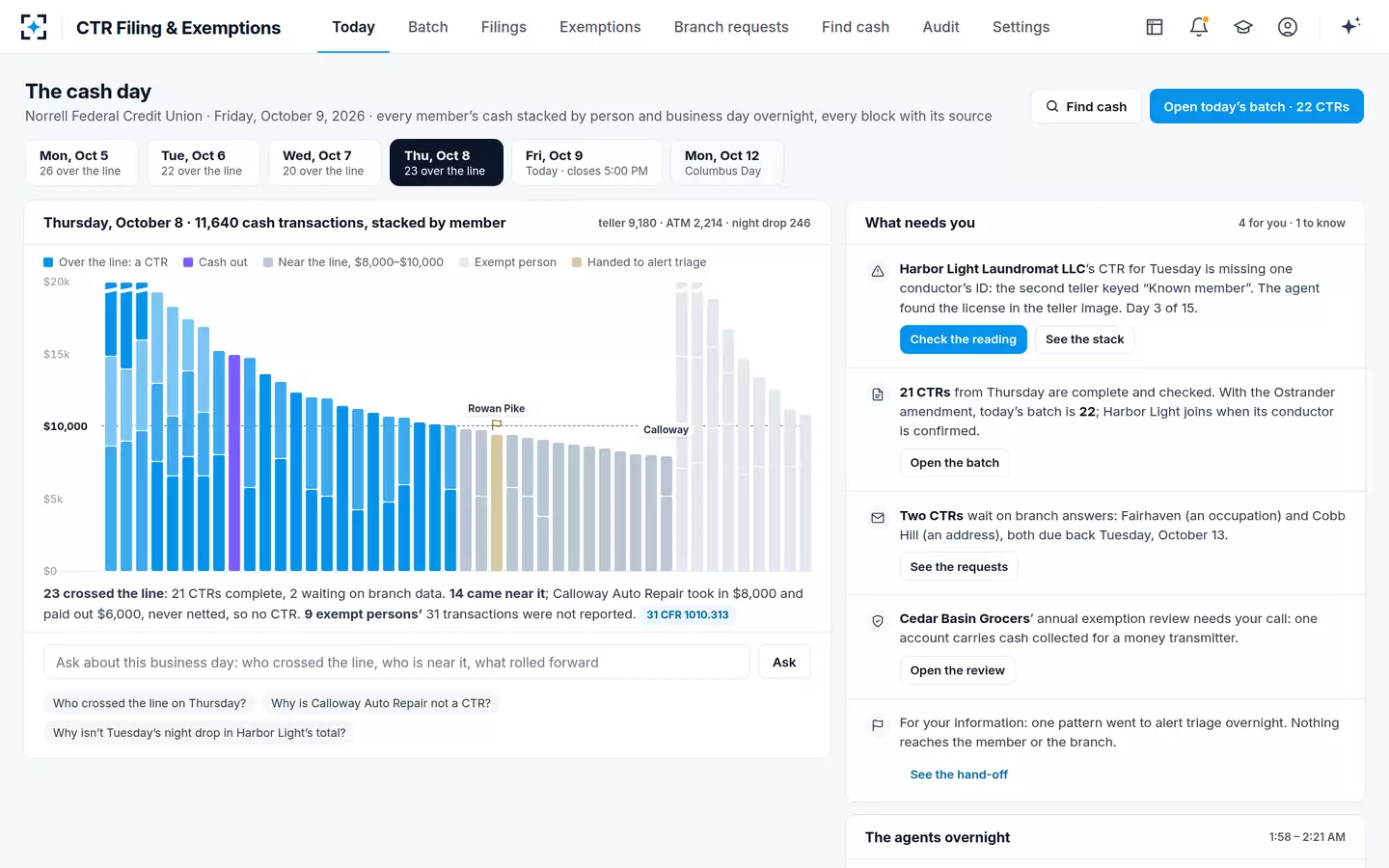
CTR Filing & Exemptions on day one: every member’s business day against the line
Week 8: e-filing cutover
The last week is the shortest because everything before it worked. The supervisory user assigns batch-filer roles; the first live batch goes out after the BSA officer approves it; the acknowledgment is read and every BSA ID matched to its report; filed copies land in storage the bank controls. The old process stops only when the first week of acknowledgments has been reconciled.
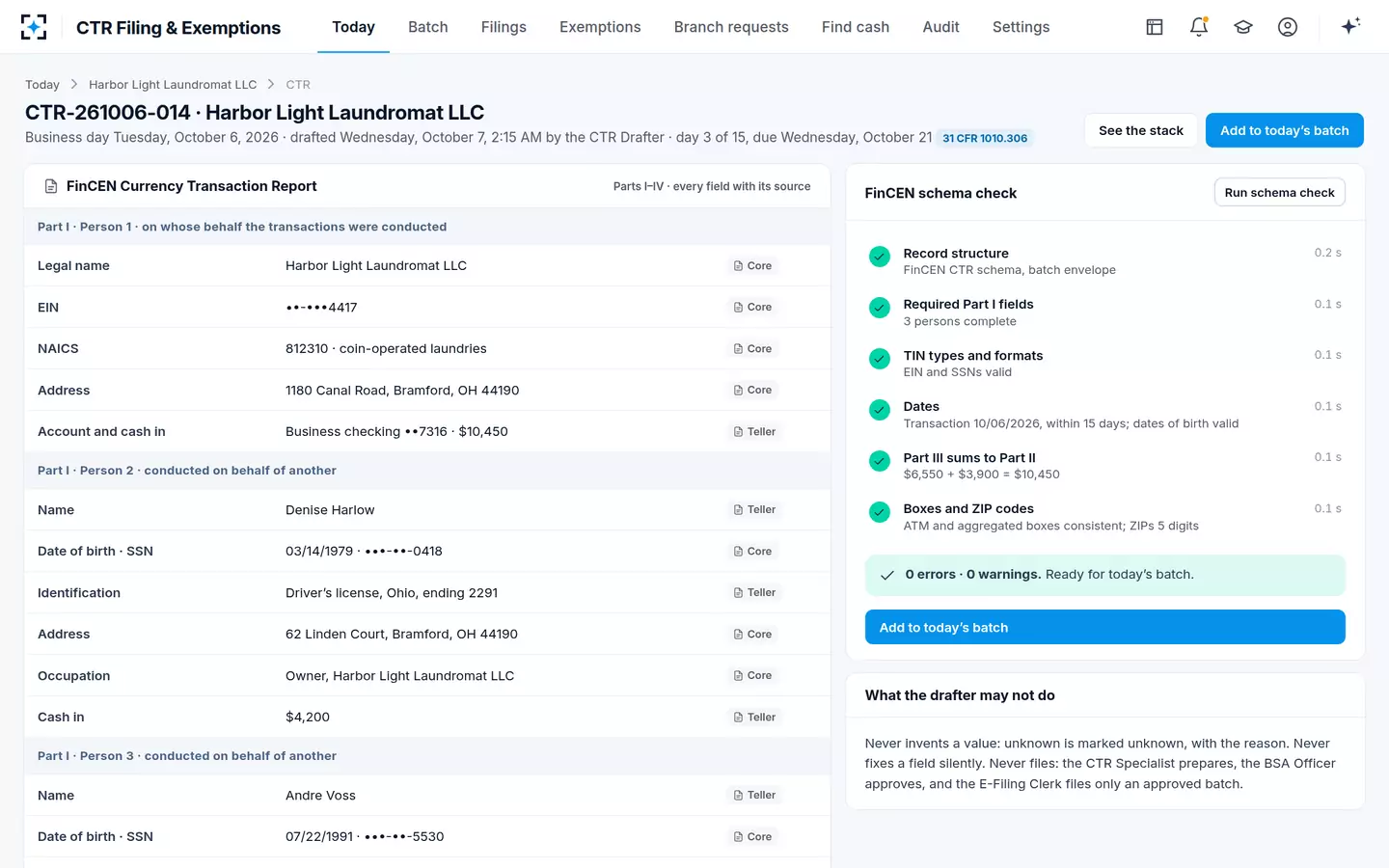
Each CTR checked against FinCEN’s schema before it can join a batch
How long does it take to implement CTR software?
For a bank or credit union with clean feeds, about two months is realistic; the plan above is eight weeks. What lengthens it is rarely the software. It is a feed nobody owns, teller images stored where the new system cannot read them, an exempt list without its DOEPs, or a business-day rule that differs by branch and was never written down. Each of those is found in weeks 1 to 3 or not until the parallel run.
That is our estimate from the plan, not a promise for any product. A bank should ask any vendor for its plan in this shape, with owners and a test that closes each step, and should insist that the back-test runs on the bank's own past cash days rather than on a demonstration data set.
What CTR software is worth, against eight minutes a CTR
FinCEN costs a CTR at about eight minutes of filer time: 2,741,963 hours a year across 20,564,724 CTRs in its last estimate (FinCEN, 89 FR 7767). The industry thinks that is low. GAO calculated about $3.40 per CTR from FinCEN's figures, while bank and credit union representatives gave estimates "ranging from $10 to $81 per CTR", and one said "the branch manager review alone can take about 45 minutes" (GAO-25-106500).
What one CTR costs, depending on who is counting
8min
FinCEN’s estimate of filer time per CTR
Federal Register, 2024
$3.40
per CTR, GAO’s calculation from FinCEN’s own cost estimate
GAO-25-106500
$10–$81
per CTR, the range banks and credit unions gave GAO
Including manual review
45min
for the branch manager’s review alone, at one bank
GAO-25-106500
The value of CTR software is therefore less the eight minutes than the review time around them, and the failures that cost far more: a channel never read, a batch never acknowledged. Botminds estimates that the CTR specialist's morning on one day's batch of about 22 CTRs at a credit union the size of the sample falls from about 215 minutes to about 32, with most of the saving in adding up the day and checking conductor fields. That is our arithmetic on sample data, kept modest, and it leaves out the time a branch takes to answer.
Where the solution does not fit is just as plain. It does not replace the teller system, the core or the transaction monitoring system: it reads the first two and hands near-line patterns to the third. A bank whose only CTR problem is the e-filing screen does not need it. A bank whose problem is the morning of stacking, chasing and checking, or an exempt list it cannot defend, is the case it was built for; the tests BSA/AML software should pass on cash reporting are a way to check.
Questions people ask
What are the CTR filing instructions, and where are they?
FinCEN publishes the electronic filing requirements for the CTR, with item-by-item instructions, on the BSA E-Filing site, and the discrete form shows instructions field by field. FinCEN's CTR FAQs answer the common cases, such as joint accounts, several conductors and rounding.
What is BSA E-Filing?
FinCEN's online system for filing Bank Secrecy Act reports, including CTRs, SARs and FinCEN Form 110 designations, either one at a time or as batch files. It returns an acknowledgment with a BSA ID for each accepted report, but it does not keep copies for the filer.
Does CTR software need to handle amendments?
Yes. A correction is filed as a complete amended CTR that references the prior report's BSA ID, and it receives a new BSA ID of its own. Software that can only file originals forces corrections into a manual process at exactly the time the bank is under pressure.
Should CTR software run before or after the teller transaction?
Both, ideally. Identification has to be verified before the transaction is concluded, so the teller system needs to show the day's earlier cash for the same person; aggregation and drafting run after the business day closes, across every channel.
Can a credit union use the same CTR software as a bank?
Yes; the CTR rules are the same. One difference shows up in Part III: FinCEN's FAQ notes that a credit union's branches often share the institution's RSSD number, and says to report that number for each branch.