Whether a customer is a Phase 1 or Phase 2 exempt person under the BSA depends on what the customer is. Phase I covers five kinds of entity defined by status: banks, U.S. and state government departments and agencies, bodies exercising governmental authority, companies listed on the New York Stock Exchange, the American Stock Exchange or the NASDAQ National Market, and their 51%-owned subsidiaries (31 CFR 1020.315(b)(1)–(5)). Phase II covers everyone else who can qualify by behaviour: a non-listed business that has had a transaction account for two months, frequently deals in cash over $10,000 and is not mainly in an ineligible line of business, and a payroll customer that regularly withdraws more than $10,000 to pay its staff in cash ((b)(6)–(7)). Botminds' CTR Filing & Exemptions applies those tests to each exempt person, every year, with the evidence beside each one, and leaves the decision to the BSA officer.
The sorting matters because the phases differ in almost everything that follows: whether a designation must be filed, whether the exemption covers every transaction or only some accounts, and whether it must be reviewed each year. The comparison below is the whole difference, test by test.
Phase 1 vs Phase 2 CTR exemptions, test by test
Phase I exempt persons: Banks; federal, state and local government departments and agencies; bodies exercising governmental authority; listed companies; their 51%-owned subsidiaries.
Phase II exempt persons: Non-listed businesses: any other commercial enterprise, including a sole proprietorship. Payroll customers: firms that withdraw cash to pay U.S. employees.
Phase I exempt persons: Not for banks, government bodies or the Federal Reserve Banks. Required for listed companies and subsidiaries.
Phase II exempt persons: Always, within 30 calendar days after the first reportable transaction the bank wants to exempt.
Phase I exempt persons: None: an eligible entity may be treated as exempt at once.
Phase II exempt persons: A transaction account for two months, or less after a documented risk-based assessment.
Phase I exempt persons: No test.
Phase II exempt persons: Non-listed business: five or more reportable cash transactions a year. Payroll customer: frequent withdrawals over $10,000 for payroll.
Phase I exempt persons: Do not apply.
Phase II exempt persons: A non-listed business may earn no more than 50% of gross revenue from them.
Phase I exempt persons: Any cash transaction with the entity, to the extent of domestic operations.
Phase II exempt persons: Only transactions through exemptible accounts; payroll customers only for payroll withdrawals.
Phase I exempt persons: Listed companies and subsidiaries only: confirm the listing or the 51%.
Phase II exempt persons: Always: eligibility, plus the monitoring applied to each exempt account.
What is a Phase 1 CTR exemption?
A Phase 1 CTR exemption is the exemption a bank may apply to a customer because of what the customer is. The five categories are set out in the rule: "a bank, to the extent of such bank's domestic operations"; "a department or agency of the United States, of any State, or of any political subdivision of any State"; an entity "that exercises governmental authority"; a company whose stock is listed on the named exchanges; and a subsidiary at least 51% owned by a listed company (31 CFR 1020.315(b)). Listed companies and subsidiaries that are financial institutions other than banks are exempt only for their domestic operations.
The government categories have practical tests. A bank may treat a body as governmental if its name "reasonably indicates" it is, or if it is "known generally in the community" to be a state, a tribal government or a political subdivision. An entity exercises governmental authority only if its powers include "one or more of the powers to tax, to exercise the authority of eminent domain, or to exercise police powers"; the rule's examples are the New Jersey Turnpike Authority and the Port Authority of New York and New Jersey (31 CFR 1020.315(e)(2)).
Phase I is also broader in scope. The FFIEC manual notes that "exemption of a Phase I person covers any transaction in currency with the exempted person, not only a transaction in currency conducted through an account" (FFIEC BSA/AML Manual, Transactions of Exempt Persons). And because the ineligible-business list applies only to non-listed businesses, FinCEN's guidance says "a Phase I customer may be treated as exempt regardless of their involvement in such activities" (FinCEN, FIN-2012-G003).
The seven exempt-person categories: paperwork, scope and review
| Category | Phase | Form 110 | Annual review | What is exempt |
|---|---|---|---|---|
| Bank (domestic operations) | I | No | No | All cash transactions |
| Government department or agency | I | No | No | All cash transactions |
| Body exercising governmental authority | I | No | No | All cash transactions |
| Listed company | I | Yes | Yes | All cash transactions, domestic operations |
| 51%-owned subsidiary of a listed company | I | Yes | Yes | All cash transactions, domestic operations |
| Non-listed business | II | Yes | Yes, with monitoring | Transactions through exemptible accounts |
| Payroll customer | II | Yes | Yes, with monitoring | Withdrawals for payroll from exemptible accounts |
What is a Phase 2 CTR exemption?
A Phase 2 CTR exemption is earned by behaviour, and it has to keep being earned. A non-listed business qualifies if it "maintains a transaction account ... at the bank for at least two months", "frequently engages in transactions in currency with the bank in excess of $10,000", and is incorporated, organized or registered to do business in the United States or a state, and it is not an ineligible business (31 CFR 1020.315(b)(6)). A payroll customer qualifies "with respect solely to withdrawals for payroll purposes" if it has had the account for two months and "operates a firm that frequently withdraws more than $10,000 in order to pay its United States employees in currency" ((b)(7)).
"Frequently" has a number. Since the 2008 rule, FinCEN's guidance has defined it as "five transactions per year instead of the current eight" (FinCEN, December 2008). FinCEN's 2012 guidance restates it as five or more reportable cash transactions within a year.
What is a non-listed business for CTR exemption?
It is any commercial enterprise that is not a listed company or subsidiary and is not engaged primarily in an ineligible activity, exempted only "to the extent of its domestic operations and only with respect to transactions conducted through its exemptible accounts". Exemptible accounts are transaction accounts and money market deposit accounts held in connection with the business (31 CFR 1020.315(e)(9)). A sole proprietorship can be a non-listed business, and a bank may treat all of a customer's exemptible accounts as one when testing it, as long as it does so consistently.
The account limit has teeth. FinCEN's example is a convenience store that is exempt and makes cash deposits over $10,000 to its account without a CTR. If it brings in more than $10,000 in cash for a cashier's check, the answer depends on the posting: no CTR if the cash went into the account and the check was drawn on it, but a CTR if the cash and the check ran through the bank's general ledger, because that transaction did not "result in a line item entry into the customer's transaction account statement" (FIN-2012-G003, section H).
What businesses are ineligible for CTR exemption?
The rule lists them: a business "engaged primarily" in "serving as financial institutions or agents of financial institutions of any type; purchase or sale to customers of motor vehicles of any kind, vessels, aircraft, farm equipment or mobile homes; the practice of law, accountancy, or medicine; auctioning of goods; chartering or operation of ships, buses, or aircraft; gaming of any kind (other than licensed parimutuel betting at race tracks); investment advisory services or investment banking services; real estate brokerage; pawn brokerage; title insurance and real estate closing; trade union activities", and any activity FinCEN adds (31 CFR 1020.315(e)(8)). FinCEN has added marijuana-related businesses, which the FFIEC manual notes are not eligible.
"Primarily" is measured by revenue: a business with several lines can still qualify "so long as no more than 50% of its gross revenues are derived from" ineligible activities. FinCEN reads some categories broadly. On medicine, "any entity that derives more than 50% of its gross revenues by offering medical services is ineligible", which "would likely exclude most privately-owned hospitals, doctors' offices, or other medical practices" (FIN-2012-G003, section D).
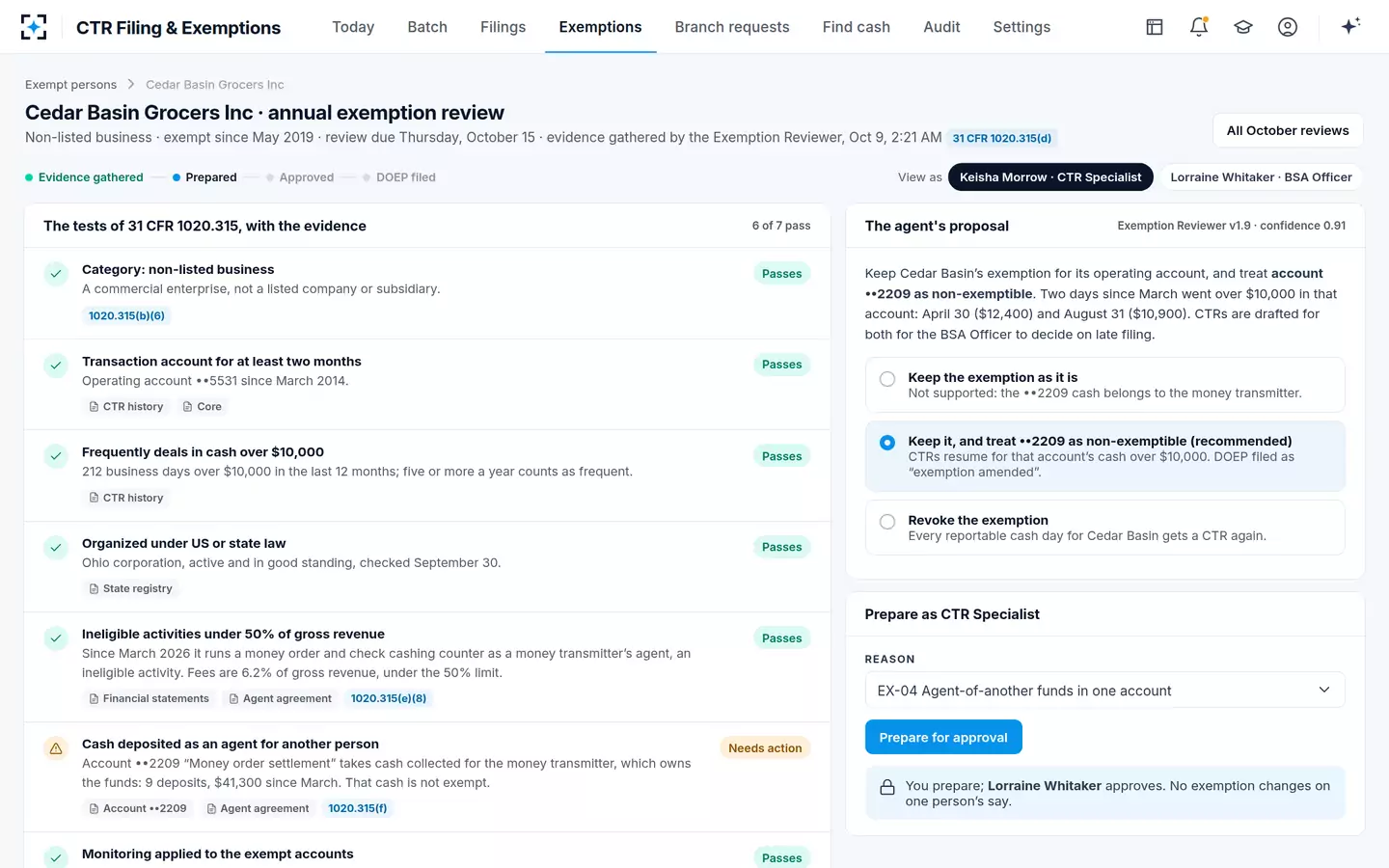
CTR Filing & Exemptions: a non-listed business tested line by line
How long must an account be open for a Phase 2 exemption?
Two months, or less if the bank documents a risk-based reason. The rule lets a bank designate a non-listed business or payroll customer earlier "if the bank conducts and documents a risk-based assessment of the customer and forms a reasonable belief that the customer has a legitimate business purpose for conducting frequent transactions in currency" (31 CFR 1020.315(c)(2)(ii)). Before 2009 the wait was twelve months.
FinCEN's examples of when the shorter path fits are customers the bank already knows: "returning customers that reopen a previously maintained exempt transaction account", and a listed company that goes private and is otherwise eligible for Phase II. The flexibility is about timing only. Asked whether a bank may exempt a business with fewer than five transactions under the risk-based approach, FinCEN's answer is "No": "None of the other criteria necessary for Phase II exemption can be adjusted" (FIN-2012-G003, sections A and B).
What is a designation of exempt person?
It is the report, FinCEN Form 110, that tells FinCEN a bank is treating a customer as exempt. It "must occur by the close of the 30-calendar day period beginning after the day of the first reportable transaction in currency with that person sought to be exempted", and it is filed "separately by each bank that treats the customer as an exempt person" (31 CFR 1020.315(c)(1)). A bank holding company, or one of its banks, may file one designation for all its banks if it lists each one.
The DOEP is a one-time filing. The annual review that follows it is kept in the bank's own files, which is what the annual review, as a file an examiner can test lays out. For customers the bank wants to exempt but has not, the economics are in why banks file CTRs on businesses they could exempt.
Do Phase 1 exemptions need renewal?
No Phase I or Phase II exemption needs renewal; the biennial renewal for Phase II ended with the 2008 rule. Listed companies and their subsidiaries still need the annual review, because their status can change: a listed company's exemption ends when it is delisted, and a subsidiary's once its listed parent owns less than 51% (31 CFR 1020.315(i)). Banks and government bodies need no review at all.
A company that leaves Phase I can sometimes enter Phase II. FinCEN's guidance is that a former listed company "is ineligible for a Phase I exemption", but the bank "could evaluate the customer for potential exemption as a non-listed business", applying the 50%, frequency and other tests (FIN-2012-G003, section C).
Why Phase I rarely covers business customers
~6,000
companies listed on the New York Stock Exchange and the Nasdaq
GAO count
~11M
business customers identified in CTR filings in fiscal 2023
GAO analysis of FinCEN data
~60%
of CTRs filed over ten years included a business
Fiscal 2014–2023
Franchises, subsidiaries and restructured businesses
The 51% test is strict. FinCEN's example: "a privately-owned restaurant franchise operating under the corporate name of a listed fast food company would not be eligible for Phase I exemption", while a location at least 51% owned by the same listed company would be (FIN-2012-G003, section C). A franchise may still be a non-listed business under Phase II if it passes those tests. The rule names the evidence a bank may rely on for a subsidiary: an authenticated officer's certificate, IRS Form 851, or the parent's annual report or Form 10-K.
Restructuring can quietly break a Phase II designation. FinCEN's example is a sole proprietor with a DBA account who forms a limited liability company: the new business "would likely need reevaluation", and a new DOEP if it qualifies. The signs to look for include a new taxpayer number, new names on the account, and "the addition or removal of signors or controllers of an account" (FIN-2012-G003, section C).
Sorting a customer: Phase 1 or Phase 2 in six questions
The questions below sort almost every customer a bank will consider. They run in order, and the first "yes" decides the category.
Is this customer a Phase 1 or Phase 2 exempt person?
- Is it a bank, a federal reserve bank, or a government department or agency?
Phase I. No Form 110, no annual review. Exempt for all cash transactions (a bank, for its domestic operations).
- Does it have the power to tax, take property by eminent domain, or police?
Phase I, as a body exercising governmental authority. No Form 110, no annual review.
- Is its common stock listed on the NYSE, NYSE American or NASDAQ National Market?
Phase I, as a listed company. File Form 110 within 30 days; review the listing each year.
- Does a listed company own at least 51% of it?
Phase I, as a subsidiary. File Form 110; keep the officer’s certificate, Form 851 or 10-K; review each year.
- Is it a commercial enterprise, mostly outside the ineligible list, with five or more reportable cash transactions a year?
Phase II, as a non-listed business, after two months or a documented risk-based assessment. Form 110; annual review with monitoring.
- Does it withdraw more than $10,000 frequently to pay U.S. employees in cash?
Phase II, as a payroll customer, for payroll withdrawals only. Form 110; annual review with monitoring.
Whatever the answer, two limits apply to every exempt person. Cash deposited as an agent for someone else is not exempt, and the bank's SAR duty is untouched. In the sample review above, the grocer passes every Phase II test, yet one of its accounts carries a money transmitter's cash, which is reported. The phase decides the paperwork; it never decides that cash goes unwatched.
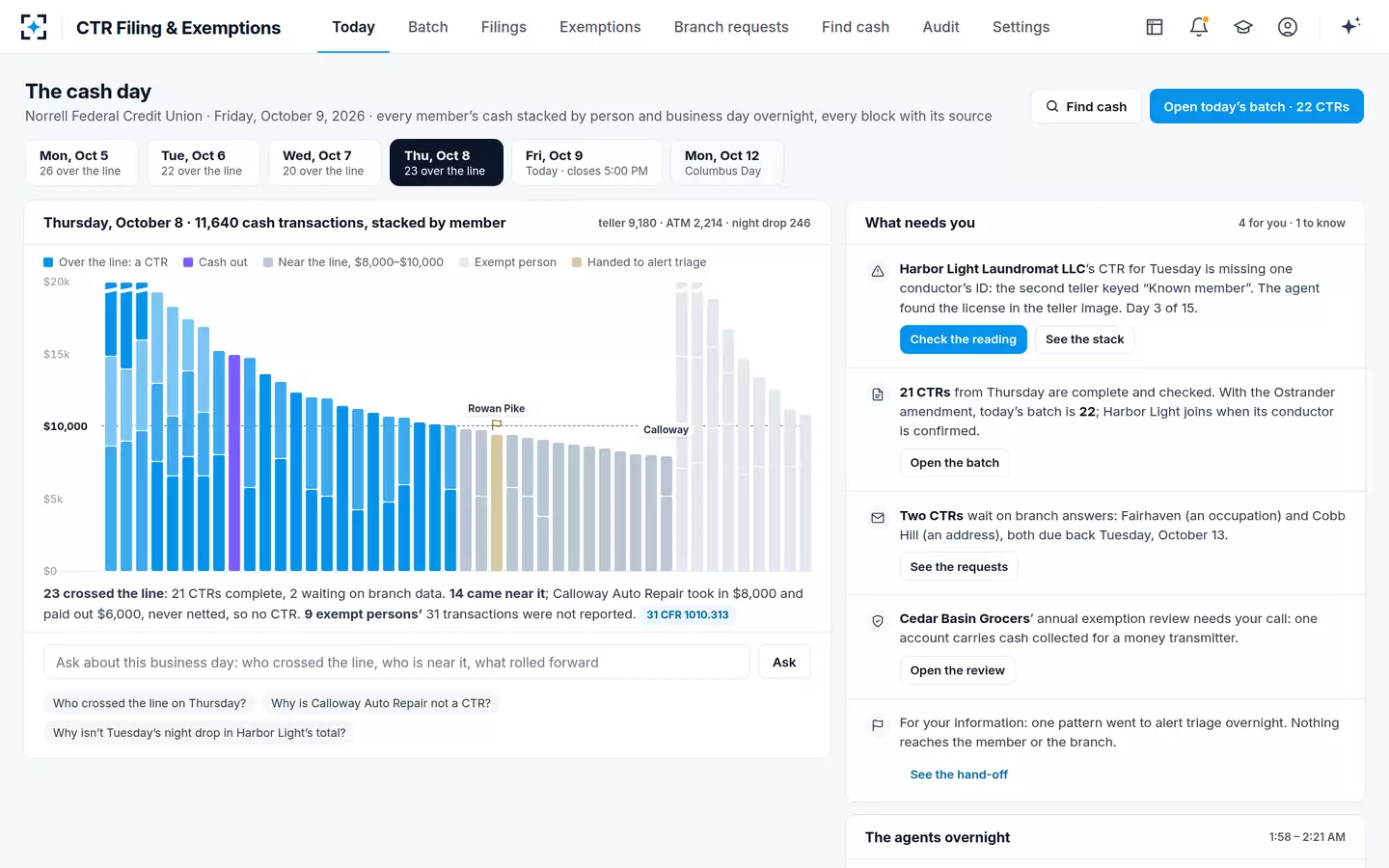
Exempt persons on the cash day: not reported, still stacked
Questions people ask
Is a credit union a Phase I exempt person?
Yes. Phase I covers "a bank, to the extent of such bank's domestic operations", and the BSA definition of a bank includes "a credit union organized under the law of any State or of the United States" (31 CFR 1010.100(d)). Its cash transactions with another bank can be exempt without a Form 110 or an annual review.
Can a restaurant be a Phase 2 exempt business?
Yes, if it has had a transaction account for two months, makes five or more reportable cash transactions a year, and earns no more than half its gross revenue from ineligible activities. GAO reported that law enforcement officials supported extending exemptions to well-established, low-risk cash businesses such as restaurants.
Is a car dealership eligible for a CTR exemption?
Not as a non-listed business if it is engaged primarily in selling motor vehicles to customers, which is on the ineligible list. A listed company that sells cars, or its 51%-owned subsidiary, is a different case: the ineligible list does not apply to Phase I.
Does a Phase II exemption cover cash withdrawals?
For a non-listed business, yes, for cash in and cash out through its exemptible accounts. For a payroll customer, only withdrawals made to pay U.S. employees in cash are covered; its other cash transactions are reported as usual.
What if one customer qualifies under two categories?
Choose one and document why. A listed company's subsidiary that also passes the Phase II tests is usually better treated as Phase I, because the exemption then covers all its cash transactions and the ineligible list does not apply; the bank still files Form 110 and reviews the ownership each year.