Unclaimed property priority rules decide which state may take custody of property a holder can no longer return, and for a bank's dormant accounts they come down to two. The first priority goes to the state of the owner's last known address as shown on the bank's books and records; the Supreme Court set that rule in Texas v. New Jersey in 1965. The second priority, where the books show no address or the address state does not take that kind of property, goes to the state where the holder is incorporated, until the address state proves its claim. A federal statute adds a third rule for money orders, traveler's checks and similar instruments, which go to the state where they were bought. Bad address data therefore sends money to the wrong state, and the wrong state's report is an audit finding waiting for the right state to discover it. Botminds' Dormant Account & Escheatment Management applies the rules account by account: its Jurisdiction agent assigns each account's state from its address history and cites the address it used.
How Dormant Account & Escheatment Management assigns a state
Agent
Jurisdiction agentAssigns the state by the owner’s last known address on the bank’s books, and cites the rule-table row it used
Never: Uses a rule-table version deposit counsel has not approved
Agent
Jurisdiction agentWhere the address is foreign or missing, assigns the bank’s home state and records why
A person decides
Unclaimed Property AnalystDecides the accounts the agent was unsure of, such as conflicting addresses in the history
Agent
Outreach agentWhen mail comes back, runs an address search and drafts the letter to the old and the newly found address
Never: Sends anything
A person decides
Unclaimed Property ManagerConfirms the dormancy date and state before the account joins a letter run
What are the unclaimed property priority rules?
Two rules, applied in order. First, property goes to the state of the owner's last known address as shown by the holder's books and records. Second, if the books show no address, or the address state's law does not provide for taking the property, it goes to the holder's state of incorporation, which keeps it only until the address state proves a better claim. State statutes write both rules in, Delaware's among them, and the Revised Uniform Unclaimed Property Act adds detail on what counts as an address and what happens with several (RUUPA §§ 301–305).
For a bank the first rule almost always decides. Deposit accounts carry an address; the questions are which address, and whether it is the owner's or one the bank's systems produced. The second rule matters for accounts opened long ago with incomplete records, accounts of owners abroad, and accounts whose address fields were lost in a conversion or merger.
Texas v. New Jersey: why the owner's address won
Because it was the simplest rule that was fair to the creditor. The case concerned money the Sun Oil Company "has owed to approximately 1,730 small creditors who have never appeared to collect them", and "Four different possible rules are urged upon us by the respective States which are parties to this case" (Texas v. New Jersey, 379 U.S. 674 (1965)): Texas argued for the state with the most significant contacts, New Jersey for the state of incorporation, Pennsylvania for the state of the company's principal offices, and Florida for the state of the creditor's last known address.
The Court chose Florida's rule, reasoning that a debt is the creditor's property, not the debtor's, and that the rule "involves a factual issue simple and easy to resolve, and leaves no legal issue to be decided". It also chose the word "address" deliberately: "by using a standard of last known address, rather than technical legal concepts of residence and domicile, administration and application of escheat laws should be simplified." The Court admitted the case "could have been resolved otherwise", and said "It is fundamentally a question of ease of administration and of equity."
We therefore hold that each item of property in question in this case is subject to escheat only by the State of the last known address of the creditor, as shown by the debtor's books and records.
Texas v. New Jersey, 379 U.S. 674 (1965)
What if the owner's address is unknown? The second priority rule
Then the holder's state of incorporation takes custody, but only as a placeholder. The Court adopted its Special Master's suggestion that "where there is no last known address" the property "be subject to escheat by the State of corporate domicile, provided that another State could later escheat upon proof that the last known address of the creditor was within its borders", and applied the same rule where the address state does not provide for escheat of that property (Texas v. New Jersey).
The state statutes repeat it. Delaware takes custody as the holder's domicile where another state "is not entitled to the property because there is no last-known address", where the address state does not provide for custodial taking, or where "The last-known address of the owner is in a foreign jurisdiction, and that foreign jurisdiction does not provide for custodial taking of the property" (Del. Code tit. 12 § 1141). For a bank chartered in one state with owners everywhere, the second rule sends the address-less accounts home.
Which state do I report unclaimed property to? Worked examples
To the state of the owner's last known address on your books, unless one of the exceptions applies. The cases below are the ones a bank's analysts meet every cycle.
Which state gets a dormant deposit
| The account | Goes to | Why |
|---|---|---|
| Owner’s last address on file is in Pennsylvania; branch in New Jersey | Pennsylvania | First priority: the owner’s address, not the branch |
| Owner moved to Delaware and told the bank in writing | Delaware | The change is on the books and is the owner’s own act |
| A search finds a newer address in Florida; the books still show New York | New York | A found address can receive the letter but does not change the books |
| No address at all in the records | Ohio, the bank’s state | Second priority, until another state proves the address |
| Address in a country that takes no custody | Ohio, the bank’s state | Second priority, under statutes such as Delaware’s |
| A money order the bank sold, purchase state on record | The state of purchase | Federal Disposition Act, not the address rule |
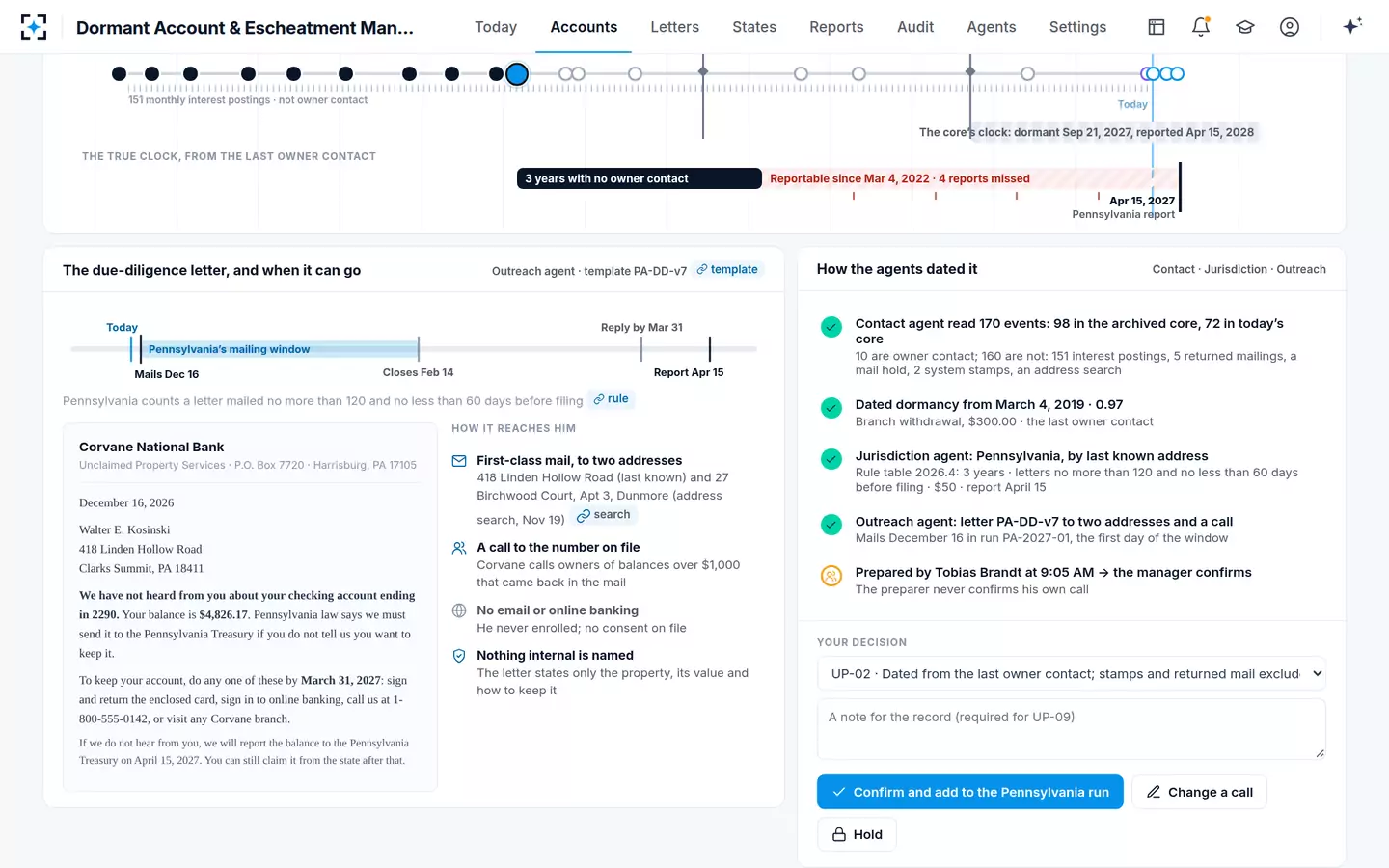
The third row surprises analysts most. New York's Comptroller tells holders that an address validation service may be used to send the notice to a new address, but that the original address should stay on the report and the books. The owner's letter goes where the owner is likely to be; the money goes where the books say. The guide to unclaimed property due diligence letter requirements covers the letter side.
Two addresses for the letter, one for the state
What counts as a last-known address?
Less than a mailing address. Delaware defines it as "a description, code, or other indication of the location of the owner on the holder's books and records which identifies the state of the last-known address of the owner" (§ 1139(a)). The uniform act goes further and says it counts "even if the description, code, or indication of location is not sufficient to direct the delivery of first-class United States mail to the apparent owner" (RUUPA § 301). A state abbreviation in an old record, with no street, is an address for priority purposes.
The uniform act also settles two common conflicts. A ZIP code for a post office in a state makes that state the address state "unless other records associated with the apparent owner specifically identify the physical address of the apparent owner to be in another state". And where the records show several addresses, the most recent counts unless it appears to be temporary, in which case the next most recent permanent one does (RUUPA §§ 301, 303). A seasonal address in Florida does not move a New Yorker's account to Florida.
Money orders and official checks: the federal exception
Money orders, traveler's checks and similar instruments follow a federal statute, not the address rule. In the Supreme Court's own words, "Congress passed the FDA two years after our decision in Pennsylvania", the 1972 case in which the Court applied the address rule to Western Union money orders whose records often held no creditor address (Pennsylvania v. New York, 407 U.S. 206). Under the 1974 Act, where a sum is payable on "a money order, traveler's check, or other similar written instrument (other than a third party bank check)", the state where the instrument was purchased, if the books show it, "shall be entitled exclusively to escheat or take custody"; if they do not, the state of the issuer's principal place of business takes custody until the state of purchase proves its claim (12 U.S.C. § 2503).
The Supreme Court tested the edge of that category in 2023. MoneyGram had sent the proceeds of unclaimed "Agent Checks" and "Teller's Checks" sold through banks to Delaware, its state of incorporation, because it kept no creditor addresses. The Court held the instruments sufficiently similar to money orders to fall under the federal Act, so they belonged to the states where they were bought (Delaware v. Pennsylvania, No. 145, Orig., decided February 28, 2023). For a bank, the lesson is to keep the state of purchase on every official check and money order it sells, and to know which of its instruments are "third party bank checks" outside the Act.
Two priority systems a bank runs side by side
Deposit accounts: Texas v. New Jersey and state statutes
Money orders and similar instruments: 12 U.S.C. § 2503
Deposit accounts: State of the owner’s last known address on the books
Money orders and similar instruments: State where the instrument was purchased
Deposit accounts: Holder’s state of incorporation
Money orders and similar instruments: Issuer’s principal place of business
Deposit accounts: The owner’s address history
Money orders and similar instruments: The state of purchase for each item
Deposit accounts: —
Money orders and similar instruments: Delaware v. Pennsylvania (2023)
Owners abroad and the bank's home state
An owner with a foreign last known address is still an owner the bank must report, but usually to its own state. Under the second priority rule, property of an owner whose address is in a country that does not take custody goes to the holder's state. New York reminds its banks that "the law requires you to report to us when the rightful owner is a resident of another country" (N.Y. OSC banking reference sheet).
In Dormant Account & Escheatment Management, the holder's state for foreign and missing addresses is a setting the administrator keeps and the manager approves, with every change recorded. Each account assigned that way says so, so that if another state later proves an address, the bank can show why the account went where it did.
How bad address data becomes an audit finding
By sending money to the wrong state, which the right state then claims. A conversion that drops address history, a branch address copied into the owner's field, or a found address written over the original all move accounts between states. The wrong state was paid; the right one was not, and it charges interest from the date the report was due.
The statutes soften this when the holder acted in good faith. Delaware, if another state later claims property a holder paid to Delaware in good faith, "shall defend the holder against the claim and indemnify the holder against any liability on the claim, up to the value of the property at the time of escheatment", though not against penalties or interest "imposed by or awarded to another state" (§ 1153(c)). Good faith is easier to show when every account carries the address the decision rested on and the source of that address.
One account, one state, and the reason, in Dormant Account & Escheatment Management
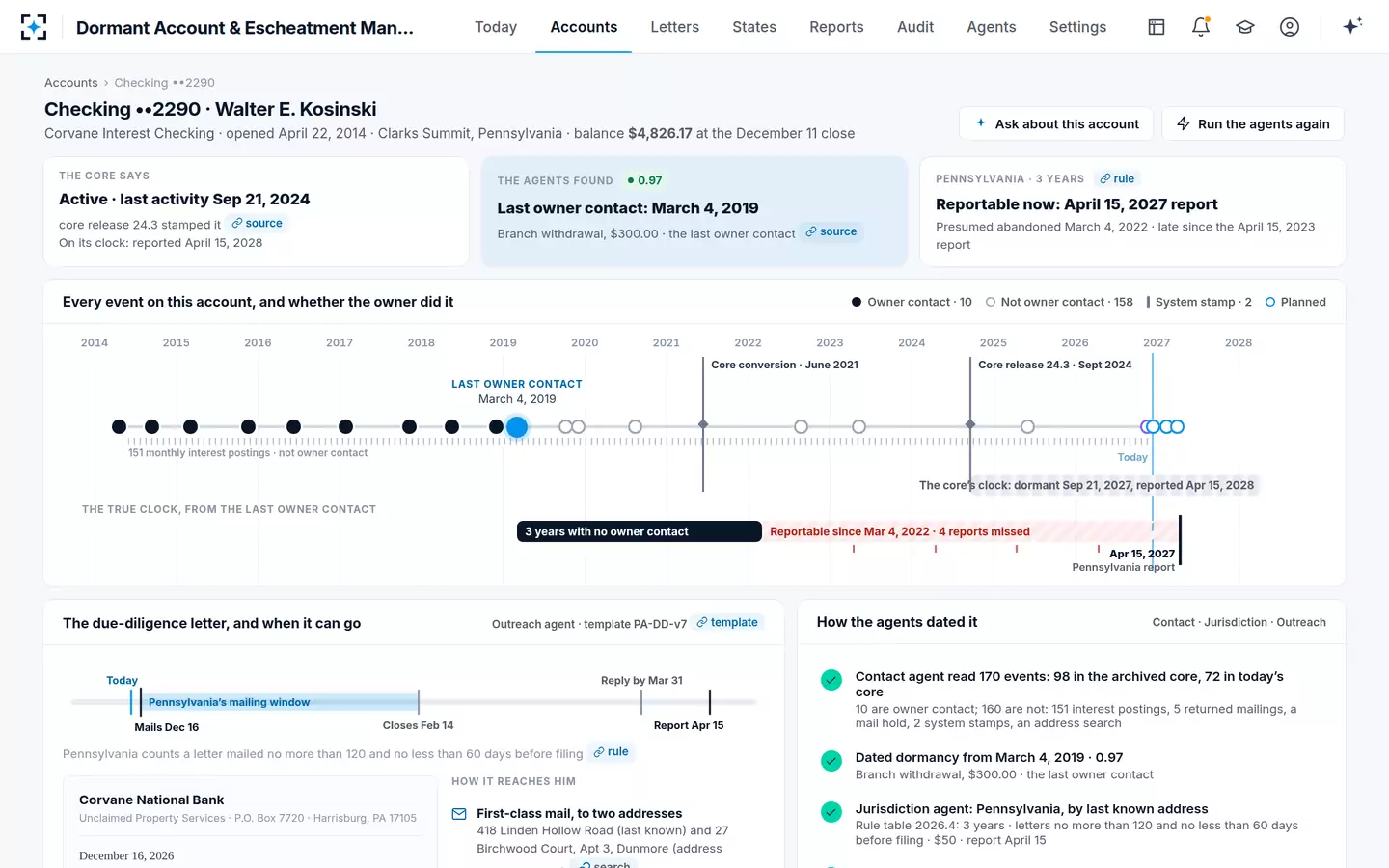
Address checks before a state report
- Last known address taken from the books, not from a search
Found addresses get letters; they do not move the account.
- Owner-made changes kept with their dates
The most recent permanent address decides under the uniform act.
- Temporary and seasonal addresses flagged
They should not move an account to another state.
- Address history carried across conversions
A missing history turns first-priority accounts into second-priority ones.
- Accounts with no address listed separately
They go to the bank’s state, with the reason recorded.
- State of purchase recorded on official checks and money orders
The federal Act depends on it.
State periods, cut-offs and report dates follow from the assignment; they are set out in the guide to escheatment dormancy periods by state, and the solution is described on the Dormant Account & Escheatment Management page.
Questions people ask
What did Texas v. New Jersey decide about unclaimed property?
That intangible property such as an unpaid debt may be escheated only by the state of the creditor's last known address as shown on the debtor's books, and that where there is no address, or the address state does not take the property, the debtor's state of incorporation may take it until the address state proves its claim.
Where should unclaimed property be reported as a first priority?
To the state of the owner's last known address in the holder's records. A state code or ZIP code is enough to identify it, even without a deliverable street address, under the uniform act.
Does the bank's branch location decide the state?
No. The owner's last known address does, whatever branch opened the account. Location of purchase matters only for money orders, traveler's checks and similar instruments under the federal Act.
What was Delaware v. Pennsylvania about?
Whether MoneyGram's unclaimed "Agent Checks" and "Teller's Checks", which it had sent to Delaware as its state of incorporation, were covered by the federal Act for money orders. In February 2023 the Supreme Court held they were similar enough to money orders, so they belong to the states where they were bought.
What is the Federal Disposition Act?
The 1974 federal statute, at 12 U.S.C. §§ 2501–2503, that gives the state of purchase the exclusive right to escheat sums payable on money orders, traveler's checks and similar instruments, other than third-party bank checks, with the issuer's principal place of business as the fallback.