Unclaimed property due diligence letter requirements come down to five elements, and each state sets them in its own statute. Who: an owner whose property is worth $50 or more in the states this guide covers, at an address the bank's records do not show to be bad. How: first-class mail, with certified mail for larger balances in New York and Florida and email where the owner agreed to it. When: inside a window counted back from the report date. What: a statement that the property will go to the state unless the owner acts, with the property, its value and how to keep it, and in some states a prescribed heading. Proof: a statement in the report that the notices went out. Botminds' Dormant Account & Escheatment Management drafts each letter from an approved template for the owner's state, schedules it inside that state's window and shows its checks to the Unclaimed Property Manager before any run is released.
The letter matters more than its cost suggests. It is the bank's last chance to keep the deposit and the customer, and Delaware, Pennsylvania and Florida each require the report to state that the notices went out. Pennsylvania's Treasury tells holders that an owner who answers may recover the property before it is remitted, and that the property then is not reported at all.
What an unclaimed property due diligence letter must contain
- A heading in the state’s prescribed words
Delaware, Florida and the uniform act require one, with a contact-by date at least 30 days after the notice.
- What the property is
Its type and nature: a checking account ending in four digits, for example.
- Its value, where it has a fixed one
Pennsylvania asks for the value “if known”.
- Whose it is
Pennsylvania requires a description of the ownership: joint owners, a business, a custodian.
- That it will go to the state
New York: it will be reported and remitted to the Comptroller unless claimed.
- That a claim is needed afterwards
And, in Delaware and Florida, that property other than cash may be sold.
- How to keep it, and by when
Each statute cited here asks for the steps that stop the report.
- Nothing the owner should not see
No internal restriction, investigation or hold; the letter states only property, value and the way to keep it.
What are the unclaimed property due diligence letter requirements by state?
Every state that requires a letter sets a threshold, an address condition, a mail class and a timing rule, and most set the content. The table compares the states a bank most often meets; the windows themselves, and how they fit around each report date, are laid out in the guide to unclaimed property reporting deadlines by state.
Due-diligence letter rules a bank works to
| State | Threshold | How | When |
|---|---|---|---|
| Delaware | $50; securities at any value | First-class mail | 120 to 60 days before filing |
| Pennsylvania | $50 | First-class, or electronic if the owner agreed | 120 to 60 days before April 15 |
| North Carolina | $50; securities $25 | Written notice | 120 to 60 days before the due date |
| New York (banks) | All named owners; certified over $1,000 | First-class, then certified; newspaper notice for $50+ | First-class 90, certified 60 days before |
| Florida | $50; certified over $1,000 | First-class or email if elected; then certified | 180 to 90 days before; certified 60 days before |
| Texas | — | Mail or email | No later than 60 days before July 1 |
| California | — | 6 to 12 months before reportable | |
| RUUPA model | $50 | First-class; email too if consented | 180 to 60 days before filing |
Who must receive a due diligence letter? Thresholds and addresses
An owner whose property meets the state's value threshold and whose address the bank has no reason to think is wrong. Delaware requires the letter where the holder's records hold an address that first-class mail could reach and nothing in them shows it to be invalid, and the value is $50 or more, except that securities need a letter at any value (Del. Code tit. 12 § 1148). That is a higher bar than the address that decides which state receives the property, where a state code alone can be enough, as the guide to unclaimed property priority rules explains. North Carolina adds a duty of care: the holder "shall exercise reasonable care to ascertain that it is sending the written notice to the apparent owner's correct address" (N.C. holder FAQ).
The address condition is where returned mail comes in. A statement returned as undeliverable tells the bank its address is invalid, which can excuse the letter; it also tells the bank the owner may be findable elsewhere. Florida lets the notice go to the last known address "as shown in the holder's records or from other available sources" (Fla. Stat. § 717.117(2)), and New York's Comptroller says a holder using an address validation service "may send the notice to the new address, but you should not change the original address on your report or books and records" (N.Y. OSC banking reference sheet). The original address still decides which state gets the money.
One more recipient is easy to miss. Florida requires notice to the beneficiary named in the documents of a deposit, where the documents give the beneficiary's address and the account holds at least $50 (Fla. Stat. § 717.106(5)).
Three numbers in these states' due-diligence letter rules
$50
the usual value at or above which a letter is owed
DE, PA, NC, FL and the uniform act
30days
at least, between the notice and the contact-by date in its heading
Delaware, Florida, uniform act
$1,000
over which New York and Florida add a certified letter
First-class, certified or email?
First-class mail everywhere, certified mail on top for large balances in some states, and email only where the owner agreed to it. New York requires a first-class notice at least ninety days before the report and, for property "in excess of one thousand dollars", a second notice "by certified mail, return receipt requested not less than sixty days prior to the applicable reporting date" (N.Y. APL § 1422). Florida does the same above $1,000 and adds a useful rule: "A signed return receipt received in response to the certified mail notice constitutes an affirmative demonstration of continued interest" (§ 717.117(3)).
Email is allowed in addition to mail, not usually instead of it. The uniform act says that where an owner has consented to email, the holder sends the notice "both by first-class United States mail to the apparent owner's last-known mailing address and by electronic mail" (RUUPA § 501(b)). Pennsylvania accepts electronic notice where "the owner has previously agreed to a method of electronic notice that remains valid to contact the owner" (72 P.S. § 1301.10a(b)), and Texas lets notices go "by mail or email". Beyond the statutory letter, a bank can add online banking messages and calls where its policy and the owner's consent allow; they are good practice, not a substitute.
What each channel does for a due-diligence notice
First-class or certified letter: Yes, in every state with a notice rule
Email, online banking message, call: Only as an addition, and only with the owner’s consent
First-class or certified letter: Yes, if mailed inside the window
Email, online banking message, call: Email where the state allows it; messages and calls do not replace the letter
First-class or certified letter: Proof of mailing; for certified, the return receipt
Email, online banking message, call: Delivery logs, call notes
First-class or certified letter: A signed reply card or return receipt
Email, online banking message, call: A login, a reply from the email on file, a verified call
First-class or certified letter: The legal notice
Email, online banking message, call: Reaching owners whose mail comes back, before the window closes
What must an unclaimed property due diligence letter say?
That the property will go to the state unless the owner acts, what the property is and is worth, and exactly how to keep it. Delaware prescribes the opening line: “Notice. The State of Delaware requires us to notify you that your property will be transferred to the custody of the State Escheator if you do not contact us before [insert date that is 30 days after the date of this notice.]” (§ 1149(a)). Florida's heading is close, with a date "at least 30 days after the date of notice", and its list ends with a statement that the property is still with the holder and that the owner "may prevent transfer of the property by contacting the holder before the deadline stated in the notice" (§ 717.117(4)).
Pennsylvania prescribes no heading but four contents: a description of the property, a description of its ownership, its value if known, and "Any information necessary to contact the holder to prevent the reporting of the property to the State Treasurer" (§ 1301.10a(b)). New York's statute asks the notice to "advise the owner that the property to which the owner appears to be entitled will be reported as abandoned property and will be remitted to the state comptroller unless such property is claimed by an entitled party before the required remittance date" (§ 1422(3)).
What the letter must not say matters as much. It goes to an address that may no longer be the owner's, so it should give the last four digits of the account rather than the number, and nothing about any restriction or internal review on the account. Pennsylvania also forbids passing the cost on: "No cost or fee shall be imposed upon an owner associated with any notice under this section".
An unclaimed property due diligence letter example, element by element
The letter below comes from a sample bank, Corvane National Bank, which is fictional, for a Pennsylvania account. It is short because Pennsylvania's list is short; a Delaware or Florida letter would add the prescribed heading and the statements about claims and sale.
A Pennsylvania letter, mapped to the statute
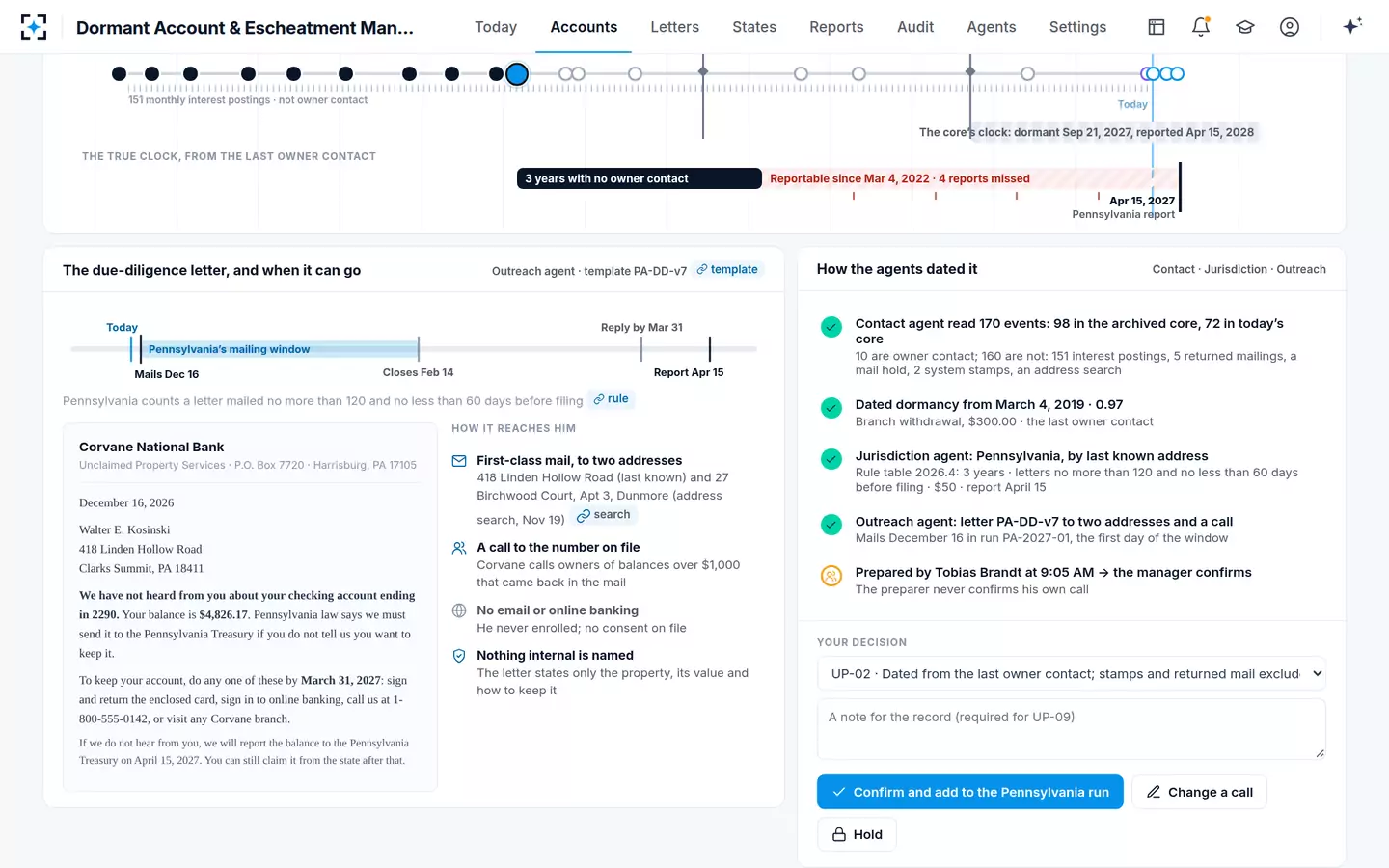
'Nothing internal is named': the letter states only property, value and how to keep it
Read against Pennsylvania's four elements, the letter names the property ("your checking account ending in 2290"), the ownership (it is addressed to the sole owner), the value ($4,826.17 at the last close) and the way to stop the report: sign and return the enclosed card, sign in to online banking, call a stated number, or visit any branch, by March 31, 2027. It adds what the statute does not require but an owner needs: the report date and the fact that the money can still be claimed from the state afterwards. It mails on December 16, the first day of the window for the April 15 report, to the last known address and to a newer one an address search found.
Does a due diligence letter count as owner contact?
No. Sending a letter is the bank's act, and every definition of an owner's indication of interest is about what the owner does. A letter that is not returned proves only that the post office did not return it; North Carolina's guide rejects unreturned statements as evidence of positive owner contact, and the same reasoning applies to a letter the owner never answered.
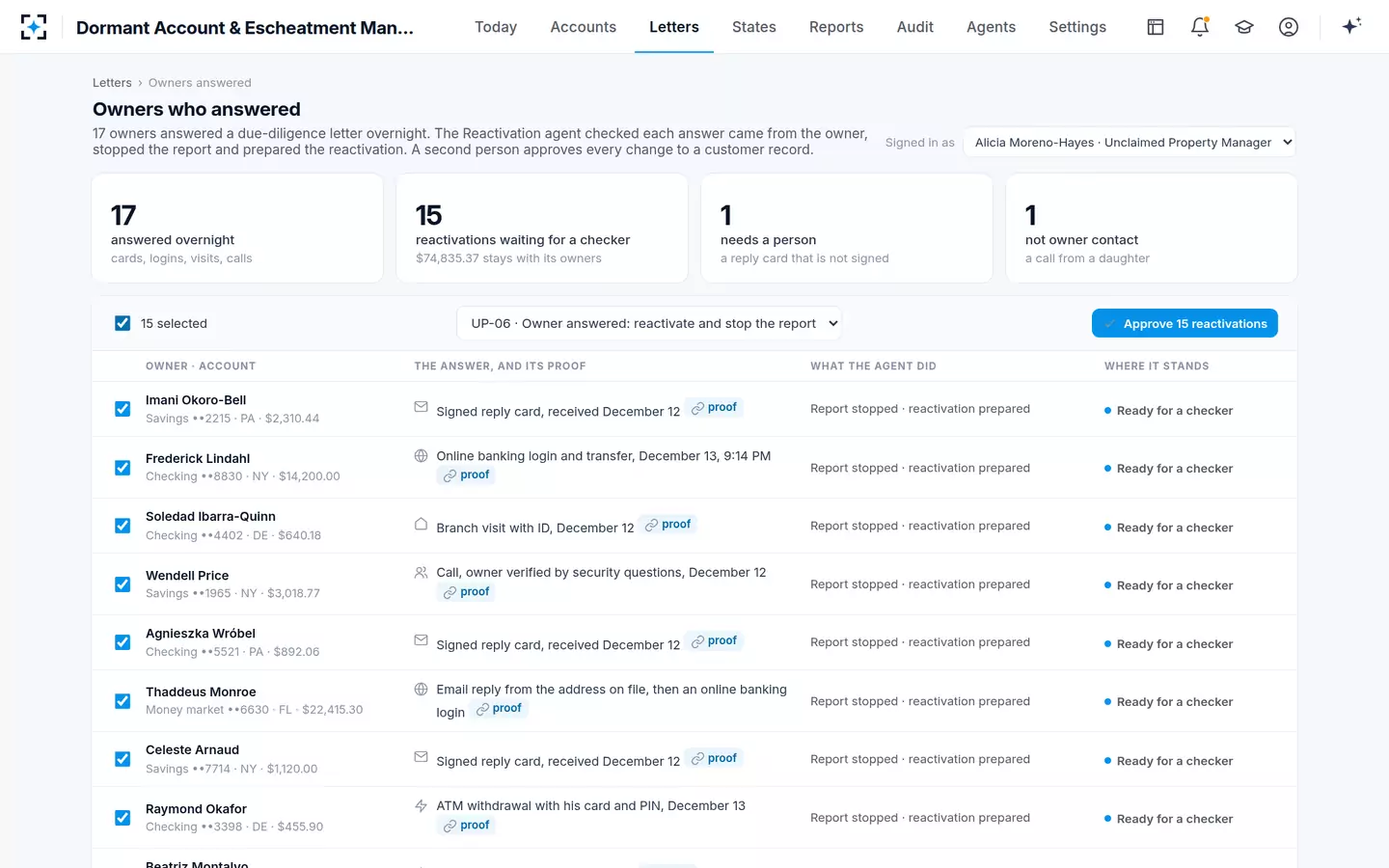
The owner's answer is what counts. New York's Comptroller says "Customer contact during any part of the due diligence process precludes the necessity of further due diligence" (N.Y. OSC), and Florida treats a signed certified-mail receipt as a demonstration of continued interest. In Pennsylvania, if an owner recovers the property or indicates an interest before remittance, the Treasury's holder book says the property is not reportable at all (Pa. Treasury holder book). That is why the answers need a desk of their own: each one must be checked as coming from the owner, the report stopped and the account taken out of any draft file.
Answers that stop the report in Dormant Account & Escheatment Management
How does a bank prove the letters went out?
With proof of mailing kept for each letter, and a statement in the report. Delaware's report must "State that the holder has complied with the notice requirements of § 1148 of this title" (§ 1143(a)(6)); Pennsylvania and Florida require the holder's own affirmation that it gave the notices. The signature on that statement is a person's, and it should rest on a list: every owner owed a letter, the date each was mailed, the window it fell in, and what came back.
New York adds a note of caution about what a missed letter does and does not change: "The failure of any holder of abandoned property to comply with the requirements of this section shall not in any way affect the reporting of abandoned property" (§ 1422(4)). The property is still reported; the bank has simply failed a duty, and an owner who would have answered has lost the chance.
The checks Dormant Account & Escheatment Management runs on 1,313 letters
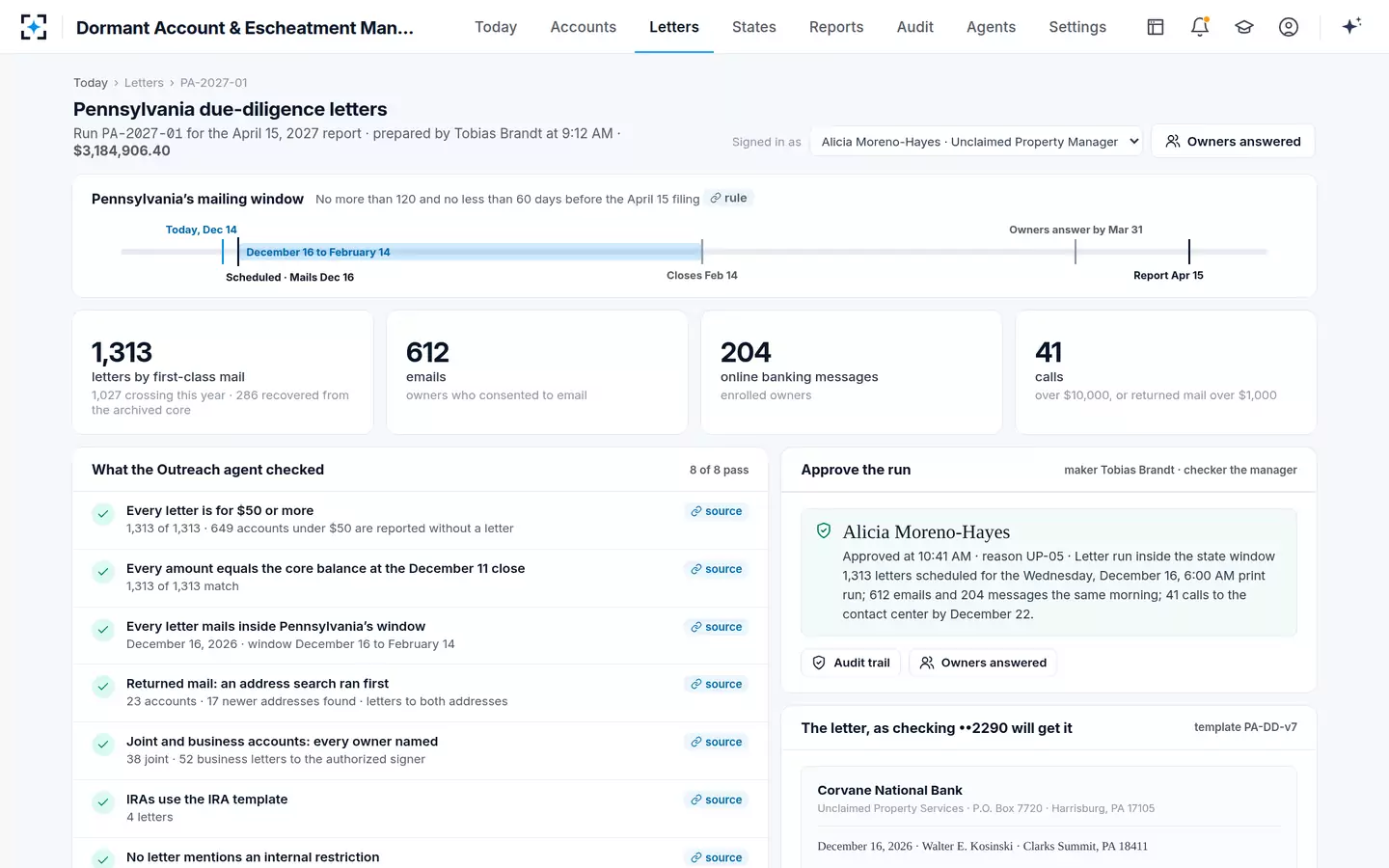
In Dormant Account & Escheatment Management the Outreach agent never sends and never mails outside a window; it drafts from templates the bank approved for each state, and the manager releases each run. The solution is described on the Dormant Account & Escheatment Management page, and the rules on which owner actions reset the clock are in the guide to what counts as activity on a bank account.
Questions people ask
What is an escheatment letter?
It is the due-diligence notice a bank must send an owner before reporting dormant property to the state: it says the property will be transferred to the state unless the owner contacts the bank by a date, and how to keep it. Delaware, Pennsylvania, North Carolina, Florida and the uniform act require it for property worth $50 or more.
When do you send unclaimed property due diligence letters?
Inside the window each state counts back from its report date: 120 to 60 days before in Delaware, North Carolina and Pennsylvania, 180 to 60 days under the uniform act, 180 to 90 days in Florida, and at least 90 days before in New York. California is earlier still: six to twelve months before the property becomes reportable.
Is there an unclaimed property due diligence letter template?
Some states publish sample letters; California's Controller offers one on its reporting page. A bank's own templates should be built per state from the statute's list of contents, approved by counsel, and versioned, so that an examiner can see which wording went to which owner.
Do you need to send a letter for property under $50?
In the states covered here, no: Delaware, Pennsylvania, North Carolina, Florida and the uniform act set $50. Delaware still requires a notice for securities at any value, North Carolina for securities of $25 or more, and New York's first-class notice applies to every owner named in the report.
What if the due diligence letter is returned as undeliverable?
The returned letter is evidence the address is invalid, which can excuse further letters to it, and New York does not require the certified follow-up when the first-class mailing comes back. It is also a reason to search for a newer address before the window closes; New York allows a notice to a found address while the original address stays on the report.
Can a bank charge the owner for the letter?
Not in Pennsylvania, which forbids any cost or fee for the notice. New York lets a holder deduct the cost of certified mail, but not of the first-class mailing, from the property as a service charge.