A mutual fund transfer agent keeps the fund's shareholder register, processes purchases, redemptions and exchanges at the next computed net asset value, pays dividends and capital gains distributions, sends statements and tax forms, and answers shareholders' questions. A fund company has two ways to provide it: run its own registered transfer agent, or appoint a third-party one; and a third choice has appeared beside both, keeping the transfer agent of record while agents answer the investor questions that take most of the people time. No regulator publishes transfer agency prices, and the fees are negotiated. What the SEC did publish, in its September 2026 transfer agent proposal, is an itemised estimate of what the new rules would cost each firm, and that list, combined with a fund company's own account and query volumes, is enough to build an honest total cost for each option. Botminds' Investor Relations AI covers only the answering part: it answers shareholder and LP questions from each investor's own records and the fund documents, cited, for a person to approve, and leaves the register, the dealing and the payments where they are.
The cost figures below are the SEC's estimates, in 2026 dollars, for a proposal whose comments are due by 3 November 2026; where the solution appears, it is on fictional sample data.
Where the SEC expects the 2026 proposal's monetised costs to land
One-time · $78.1m
- Lost-holder written procedures, Rule 17ad-17(d) · 63%
- Turnaround, Rule 17ad-2 · 14%
- Compliance policies, Rule 17ad-30 · 13%
- All other rows · 10%
Every year · $27.8m
- Lost-holder written procedures · 46%
- Turnaround · 10%
- Compliance policies · 9%
- Legend removal, Rule 17ad-31 · 10%
- All other rows · 25%
What does a mutual fund transfer agent do?
It is the fund's shareholder record keeper and, for most investors, its operations desk. The SEC describes transfer agents serving mutual funds as administrators and service providers that calculate the purchase and sale prices investors receive, handle enrolment and account servicing, and do paying-agent work for the fund (91 FR 56946). A fund's transfer agent must be registered, because the law reaches the transfer agent of any registered investment company's shares even though those shares are exempt from Exchange Act registration (15 U.S.C. 78q-1(c)(1)).
The job has changed shape. Much of the account-level work now sits with brokers and retirement plan record keepers who hold fund shares in omnibus accounts and keep the underlying investors' records themselves. The SEC said in 2015 that this movement to omnibus sub-accounting has "resulted in a fundamental shift in the roles and responsibilities of traditional shareholder servicing and recordkeeping" (80 FR 81948). For a cost model that matters: the shareholders a fund's transfer agent answers directly are its registered holders, and the questions from investors behind an omnibus account go to the intermediary first.
Scale varies enormously. For some of the larger mutual fund transfer agents, SEC staff understand that gross purchases and redemptions have run from $3.5 trillion to nearly $10 trillion for a single firm in a single year; at the other end, more than half of the transfer agents in the SEC's issuer data set serve no fund at all. What a transfer agent does, seat by seat lays out the jobs and the rule behind each.
Who pays the mutual fund transfer agent?
The fund, as the issuer. The SEC notes that issuers "negotiate directly with transfer agents for services and bear primary contractual responsibility for transfer agent fees" (91 FR 56946), and it expects compliance costs from new rules may be passed on to issuers. In an open-end fund the issuer's costs are, in the end, the shareholders', which is why a fund board reviews the transfer agency arrangement and why every option below should be costed per shareholder account as well as in total.
No regulator or independent study publishes transfer agency prices, per account or per transaction, so a fund company cannot benchmark a quote against a public figure. What it can do is price the work itself: the people, the systems and the compliance the rules require, then compare that with what a provider charges for the same scope.
Should a fund company run its own transfer agency?
Only if it has the scale to carry a registered business with its own compliance programme, examinations and technology, and wants the control that comes with it. Outsourcing turns most of that into a contract and a fee, but not the fund's responsibility: the board still oversees the provider, and a breach of shareholder data at the provider is still the fund's problem under Regulation S-P.
In-house or outsourced transfer agency: what the fund company carries in each case
Own registered transfer agent: Registers on Form TA-1, files Form TA-2 each year, is examined by the SEC
Third-party transfer agent: The provider registers and is examined; the fund oversees it
Own registered transfer agent: Bears the new policies, turnaround, records and safeguarding costs directly
Third-party transfer agent: Bears them through the fee, if the provider passes them on
Own registered transfer agent: Platform, staff, compliance officer, independent accountant's annual report
Third-party transfer agent: Mostly variable: priced per account or per transaction
Own registered transfer agent: Full control of the register, service levels and investor experience
Third-party transfer agent: Through the contract and service-level reporting
Own registered transfer agent: Answered by the firm's own desk
Third-party transfer agent: Answered by the provider's contact centre, or split with the fund's own IR team
Own registered transfer agent: The firm is the covered institution
Third-party transfer agent: The provider is a service provider; the fund's programme must oversee it
What would the 2026 SEC proposal add to transfer agent costs?
On the SEC's own numbers, about $103,000 of one-time cost and about $41,000 a year for a registered transfer agent caught by every row, before any change to its systems. The biggest single items are the new one-business-day turnaround policies and the board-approved compliance programme. For fund transfer agents the turnaround cost is new money: today fund shares are exempt from the turnaround and processing rules (17 CFR 240.17Ad-4(a)), and the proposal would rescind that exemption.
The SEC's one-time cost estimate per firm, by proposed rule
These are mostly paperwork costs, priced largely in lawyers' hours, and the SEC says plainly that other costs, such as system changes, are harder to quantify. A fund company should treat them as the floor. The proposal and its turnaround, safeguarding and records changes are examined in full in the SEC transfer agent proposal; for a cost model, the question is simply which of these each option makes the fund company pay for directly.
Where do the hours go in shareholder servicing?
Mostly into answering, and the only reliable figure is your own. No regulator publishes how many questions a fund's shareholders send or how long each takes. Two numbers from your own operation build the model: questions per month by type, from an export of the mailbox, the portal and the contact centre's call reasons; and minutes per question by type, from a timed sample of a normal week. Multiply, add the approval time, and price the hours at your own loaded cost.
A shareholder-servicing cost model you can fill in from your own records
| Input | Where it comes from | Sample value | Why it matters |
|---|---|---|---|
| Questions per month | Mailbox, portal and call-reason exports | 14,812 in September | The volume every option must carry |
| Share answerable from approved wording | Sort a month's questions against your existing standard answers | 61.4% sent from approved templates | What can go out without a person |
| Questions left for people | Volume × (1 − approved share) | About 5,700 | The people cost that stays |
| Minutes per question, by type | A timed sample of one normal week | Your own | Lookups and translation dominate |
| Approval minutes per reply | The same sample | Your own | Never falls to zero for non-template replies |
| Loaded hourly cost | Payroll and overhead | Your own | Turns hours into money |
| Written inquiries under Rule 17Ad-5 | Your inquiry log | Your own | Answered in 5, 10 or 20 business days by rule |
The solution's own estimate for one translated, two-part reply that no approved wording covers is about eight hours by hand and about an hour and a half with the agents, most of the remainder being a person reading and approving. Treat that as an estimate on sample work, not a benchmark: the model above, filled with your own minutes, is the number a board can rely on.
The query side of transfer agency: what came in overnight, and what still needs a person
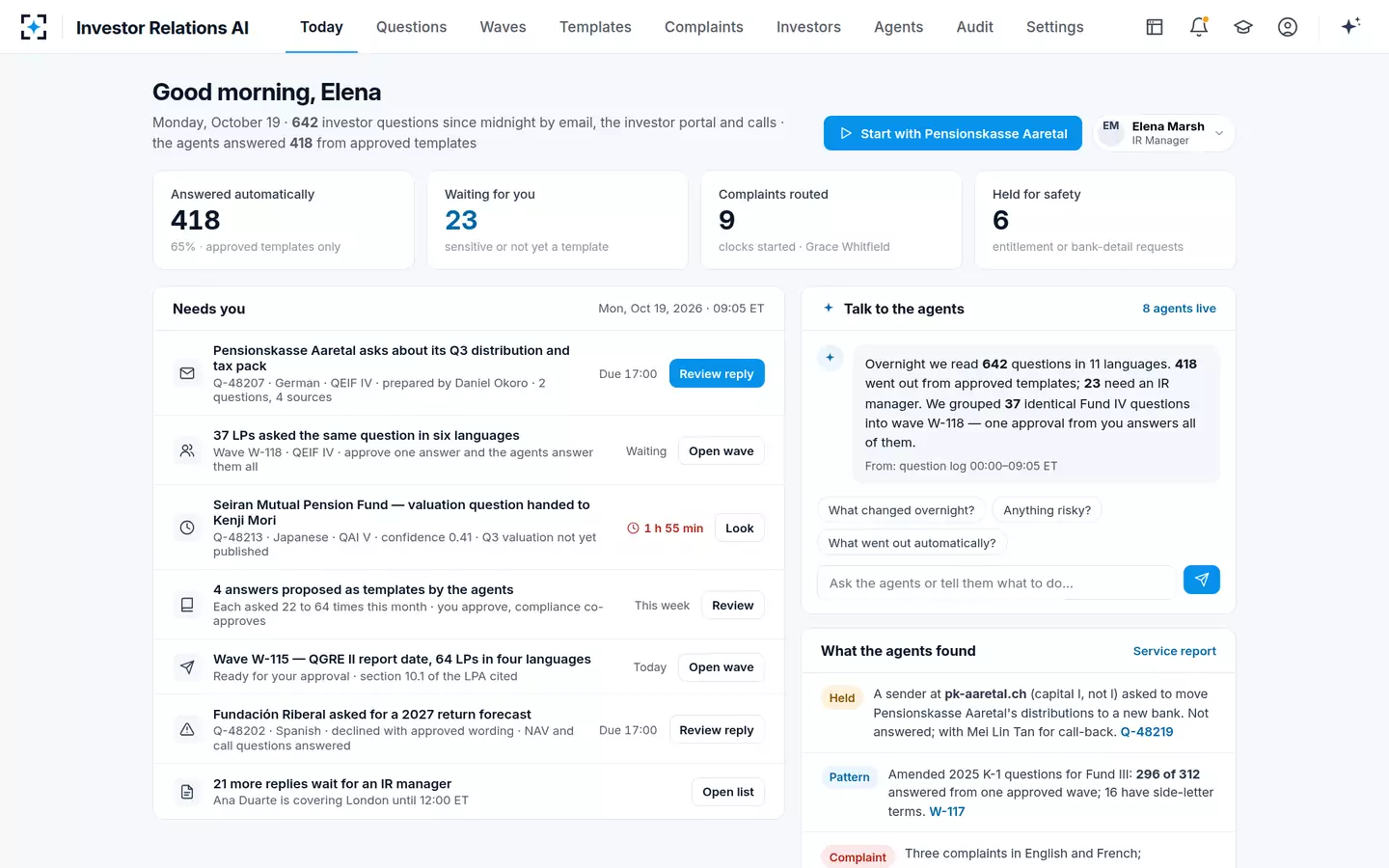
What can agents take on without changing the transfer agent of record?
The reading and the drafting; not the register, the dealing or the money. A fund company can keep its transfer agent, in-house or outsourced, and put agents in front of the questions: reading each one in any language, checking the sender against the authorized contacts and the register, pulling the investor's own figures, finding the governing document and drafting a cited reply for a person. Nothing in that work changes a register entry or moves money, so it needs no change to the transfer agent of record or its registration.
Three ways to run shareholder servicing, and what each leaves with people
| In-house transfer agent | Outsourced transfer agent | Either, with agents answering | |
|---|---|---|---|
| Register, dealing, payments | Own staff and platform | Provider | Unchanged: the transfer agent of record |
| Routine questions | Own desk, by hand | Provider's contact centre | Sent from wording an IR manager and compliance approved |
| Non-routine questions | Own desk | Provider, escalating to the fund | Drafted, cited and checked by agents; approved by a person |
| Complaints | Own complaints officer | Provider, then the fund | Found by an agent in any language; answered only by people |
| Bank-detail and address changes | Own controls | Provider's controls | Held with nothing read; call-back and two people |
| Main cost driver | Fixed platform and staff | Per-account or per-transaction fees | Approval time and the share covered by approved wording |
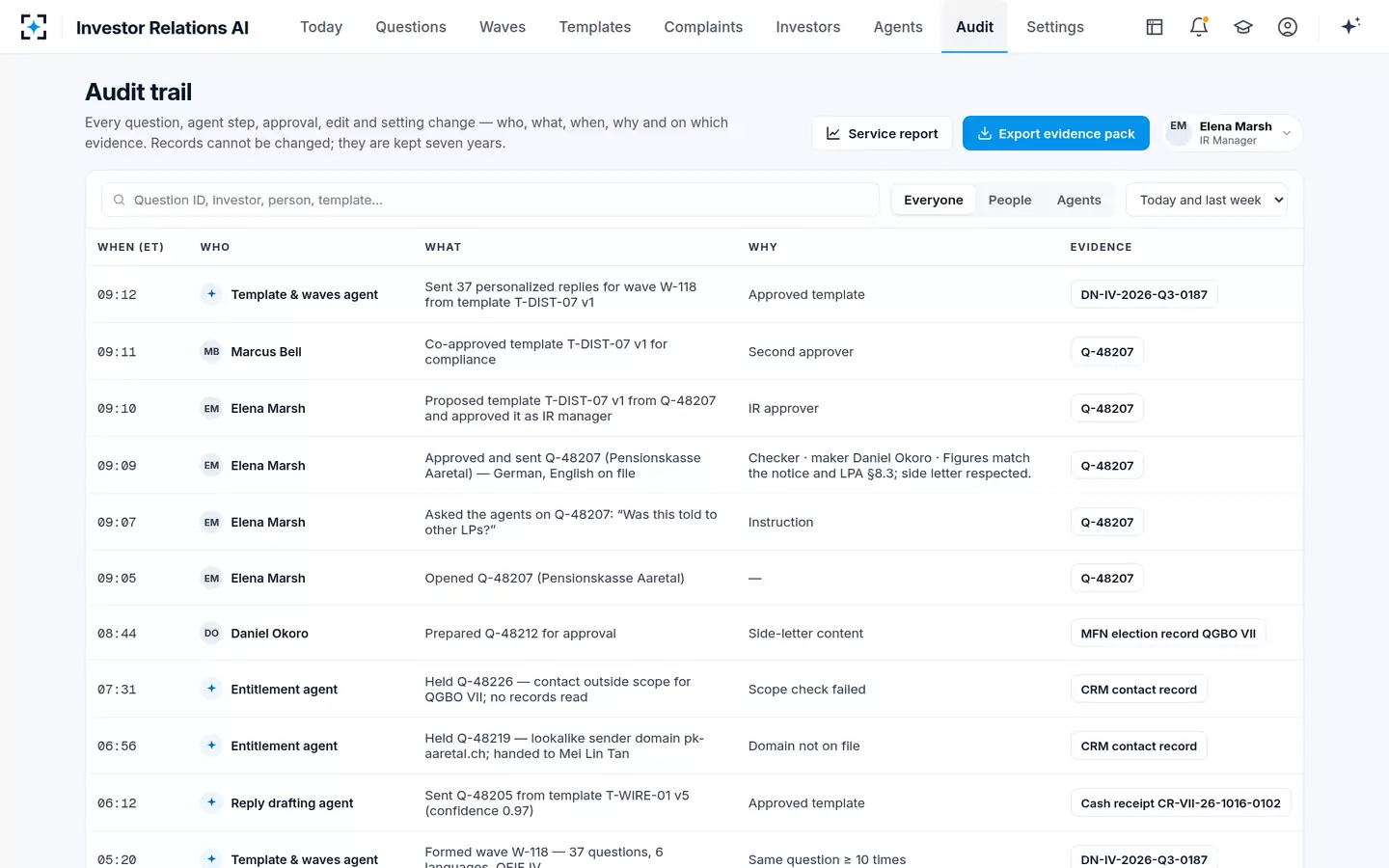
The audit trail is part of the cost case. Each answer is logged with who prepared it, who approved it and which records it used, and that log is what an examiner, a board or an outsourced provider's oversight review asks for.
Every answer logged with its approver and its evidence
How to choose: the questions that decide the cost
Three questions decide most of the answer. How many registered accounts and direct shareholders does the fund complex have, after omnibus accounts are counted as one? How many questions arrive a month, and what share already has an approved answer? And what would the 2026 rules, if adopted, cost the firm that holds the registration? A small complex with few direct holders rarely justifies its own registered transfer agent; a large one with a high direct share may; either can cut the people cost of answering without touching the registration. Launching investor relations software one approved answer at a time shows how the approved share grows. To see the answering layer on your own questions, start from Investor Relations AI.
Questions people ask
What is a mutual fund transfer agent?
The registered firm that keeps a mutual fund's shareholder register and processes its shareholders' purchases, redemptions, exchanges and distributions. It may be an affiliate of the fund's sponsor or a third party, and it must be registered with the SEC or a bank regulator.
How much does transfer agency cost a mutual fund?
No regulator or independent study publishes transfer agency prices; fees are negotiated, often per account or per transaction. The SEC's 2026 proposal estimates new compliance costs of about $78 million one-time and $28 million a year across affected firms, which a provider may pass on to its fund clients.
Are mutual fund transfer agents subject to the turnaround rules today?
Not for fund shares. Rule 17Ad-4(a) exempts redeemable securities of registered investment companies, limited partnership interests and dividend reinvestment plan interests from the turnaround and related processing rules. The SEC's 2026 proposal would rescind the exemption; it is a proposal, with comments due by 3 November 2026.
Do mutual fund transfer agents have to answer shareholder letters within a deadline?
Yes, for the written inquiries Rule 17Ad-5 covers, which the fund-share exemption does not reach: five business days for items presented for transfer, ten for current dividend claims, twenty for aged claims and account transcripts.
Can a fund use AI agents if its transfer agent is outsourced?
Yes, for answering, if the agents can read the records they need and the fund oversees them as a service provider. The agents draft and check; the transfer agent of record keeps the register, the dealing and the payments, and people approve anything that is not approved wording.