The SEC transfer agent proposal is a package of amendments to the Exchange Act rules for registered transfer agents, published in the Federal Register on 4 September 2026 as Transfer Agent Rules, 91 FR 56946, with a comment deadline of 3 November 2026. It would rescind the 1977 rule that exempts fund shares, limited partnership interests and dividend reinvestment plans from the turnaround, processing and recordkeeping standards; require policies that turn around every routine item within the shorter of one business day or the T+1 settlement cycle, with no noon cut-off; require every redemption to be posted to the master securityholder file within the same period; segregate client money in "for the benefit of" accounts; and add a compliance rule approved by the board each year. It is a proposal, not a rule, and its effect on redemption desks depends partly on a question the SEC has asked rather than answered. Botminds' Redemption Processing is an agentic solution for the desks it would touch: its agents read, check and cite every redemption request, and people release them, so turnaround and accuracy can be measured request by request.
The industry the SEC transfer agent proposal would rewrite
327
registered transfer agents on 30 June 2026; the SEC is the regulator for 272 of them
194
transfer agents, up to, that would newly have to meet the turnaround and recordkeeping rules
253
Form TA-2 filers in 2025, down from 287 in 2016
$319M
estimated present value of the proposal's monetised costs over ten years, at a 3% discount rate
What is in the SEC transfer agent proposal?
It is the first substantive rewrite of rules the SEC "first adopted ... in the late 1970s and early 1980s", when most investors held paper certificates (91 FR 56946). The release lists amendments to Forms TA-1 and TA-2, to the registration and annual reporting rules and to eleven of the processing, recordkeeping and safeguarding rules, the rescission of Rule 17ad-4, and two new rules: Rule 17ad-30 on compliance and Rule 17ad-31 on restrictive legends. The SEC frames the whole package around one premise: transfer agents are "a critical component of the national clearance and settlement system", and failures in turnaround and recordkeeping can "expose issuers, investors, securities intermediaries, and the securities markets as a whole to significant financial loss".
For a fund redemption desk, seven changes matter. The exemption for fund shares would end. Routine items would have to be turned around within one business day, and the noon convention for when an item counts as received would go. Transfer agents would have to tell a presentor in writing, within one business day, why an item was rejected. Every redemption would have to be posted to the shareholder file within one business day. Client money would sit in segregated accounts with new cyber and operational safeguards. Records would be kept for six years. And a board would approve the compliance policies every year. The release also reaches further, into tokenised securities, lost securityholders and restrictive legends, which this page leaves aside.
Would fund-share redemptions be subject to the turnaround rules?
The exemption that keeps them out would go, but whether a redemption counts as a "routine item" is a question the SEC asked rather than settled. Today Rule 17Ad-4(a) says the turnaround, processing and key recordkeeping rules "shall not apply to interests in limited partnerships, to redeemable securities of investment companies registered under section 8 of the Investment Company Act of 1940, or to interests in dividend reinvestment programs" (17 CFR 240.17Ad-4). The proposal would rescind that rule outright.
The release explains why the exemption existed. Commenters in 1977 said the work transfer agents do for fund shares "involve[s] for the most part the redemption of fund shares which is governed by Section 22(e) of the Investment Company Act", and the Commission thought it "desirable to study further" the right standards (91 FR 56946, section III.F). Its conclusion now is blunt: "After nearly half a century of further experience, it is no longer necessary or appropriate to exempt transfer agents from the minimum performance standards and related recordkeeping provisions, regardless of the size of the transfer agent, the volume of securities it processes, or the nature of those securities."
The catch is in the definitions. Under existing Rule 17Ad-1, an item is not routine if it involves "a transfer in connection with a reorganization, tender offer, exchange, redemption, or liquidation" (17 CFR 240.17Ad-1(i)(5)). Non-routine items get "diligent and continuous attention" rather than a deadline. The proposal does not change that paragraph; its request for comment asks whether, "in light of the proposed rescission of Rule 17ad-4", paragraph (i)(5) "be amended so that redemptions or exchanges of investment company shares would be considered routine items" (question 33). It also asks whether the rules should "separately address certain activities that investment company transfer agents conduct, such as ensuring that transacting shareholders receive the correct net asset value or processing shareholder exchange transactions" (question 65).
So the honest reading for a fund transfer agent is two-sided. As proposed, a fund redemption would still be non-routine for turnaround, but the transfer agent would lose its exemption from the processing and recordkeeping rules, and the posting rule would apply a one-day clock to every redemption regardless. If the SEC adopts the change it asked about, redemptions and exchanges would join the one-day turnaround standard too.
The SEC transfer agent proposal, read line by line for a fund redemption desk
The rules today: Exempt from Rules 17Ad-2, 17Ad-3 and 17Ad-6(a)(1)–(7) and (11) since 1977 (Rule 17Ad-4(a)).
As proposed, 4 Sept 2026: Exemption rescinded; fund transfer agents meet the same processing and recordkeeping standards as others.
The rules today: 90% of routine items within three business days of receipt, measured monthly.
As proposed, 4 Sept 2026: Written policies to turn around all routine items within the shorter of one business day or T+1.
The rules today: Before noon counts as noon that day; after noon, as noon the next business day.
As proposed, 4 Sept 2026: Received on the business day it arrives, at any time of day.
The rules today: No: transfers in connection with a redemption are non-routine (Rule 17Ad-1(i)(5)).
As proposed, 4 Sept 2026: Unchanged in the text; the SEC asks whether fund redemptions and exchanges should become routine.
The rules today: Five business days for fund transfer agents (Rule 17Ad-10(a)(2)(iii)).
As proposed, 4 Sept 2026: The shorter of one business day or T+1 for every security purchased, redeemed or transferred.
The rules today: No duty to tell the presentor why.
As proposed, 4 Sept 2026: Written notice within one business day: the item, the reasons, and what the presentor must do.
The rules today: When fewer than 90% are turned around on time in a month.
As proposed, 4 Sept 2026: When more than 3% of applicable items miss the new time frames.
The rules today: Protected "against misuse", in light of all facts and circumstances.
As proposed, 4 Sept 2026: Held in a bank account designated "for the benefit of" clients, apart from operating accounts, with cyber and operational safeguards.
The rules today: Two years for most processing records, longer for some; tiered "easily accessible" windows.
As proposed, 4 Sept 2026: Six years for all required records, the first two easily accessible.
The rules today: No transfer-agent-specific compliance rule.
As proposed, 4 Sept 2026: Rule 17ad-30: written policies, reviewed and approved by the board at least annually.
What does one-business-day turnaround mean?
It means a transfer agent would need written policies "reasonably designed to ensure that the transfer agent turns around all routine items received for transfer within the shorter of one business day or the time period specified by Rule 15c6-1(a)" (proposed Rule 17ad-2(a)). Rule 15c6-1(a) is the T+1 settlement cycle for broker-dealer trades, so under today's cycle both limbs give one business day.
Three features make it stricter than it first looks. It covers all routine items, not 90% of them. It removes the noon convention: under the current rule items "received at or before noon on a business day shall be deemed to have been received at noon on that day", and later items at noon the next business day (17 CFR 240.17Ad-2(a)); under the proposal "an item received at any point on a business day would be considered to be received on that day". And it moves the reporting trigger: a transfer agent would notify the SEC when it misses the time frames on more than three percent of items, a threshold the SEC calls reasonable because "the vast majority of transfer agents regularly turn around and process nearly 100% of all applicable items within one business day or less".
Two clocks the SEC transfer agent proposal would shorten
- Deemed receiptto noon next day
- Turnaround window, 90% of items3 business days
- All items1 business day
- Posting, fund transfer agents5 business days
- One day1 business day
The posting change is the one a fund transfer agent cannot argue its way around. The release says that under the amended Rule 17ad-10, all recordkeeping transfer agents would post debits and credits for "every security transferred, purchased, redeemed, or issued within one business day" after the transaction, whether the security is certificated or not. For a redemption, that is the shareholder's position updated by the next business day, which is only possible if the request was read, checked and accepted on the day it was priced.
What would a written rejection notice require?
Every rejected item would get a written notice to the presentor within one business day, saying what was rejected, why, and what to do. Proposed Rule 17ad-2(e)(2) would require a notification "that identifies the rejected item, the reasons for rejection, and the specific actions the presentor must undertake for the item to be accepted by the transfer agent for processing or turnaround to be completed", sent "within one business day of receipt" (91 FR 56946). Existing Rule 17ad-2 does not require transfer agents to notify a presentor at all.
For redemption desks this is the not-in-good-order letter, made a rule. A return that says only "NIGO" would not meet it; one that says "the signer is not on the authorised-signatory list; re-send signed by two of the persons named in Schedule A" would. The SEC also asks whether transfer agents should "track and retain data on rejected items, including the reasons for rejection and the time taken to notify presentors" (question 63), which would turn the reason codes many desks keep informally into examinable data. How to measure a desk's returns and holds against those standards on a closed quarter is the subject of redemption processing, replayed on last quarter's requests.
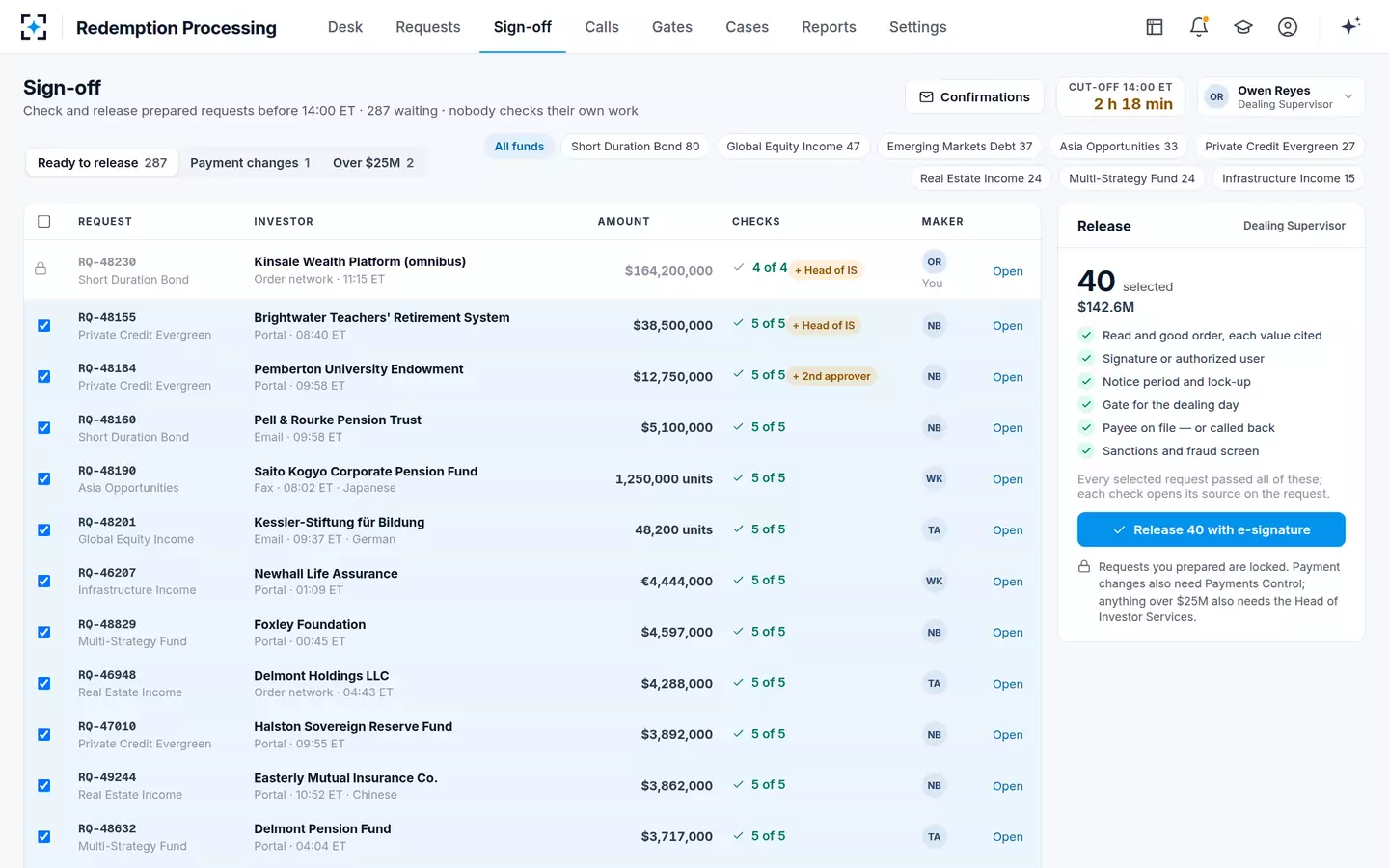
A desk that already sees every check behind a release
What is a "for the benefit of" account?
It is a bank account held for clients and labelled as theirs, kept apart from the transfer agent's own money. Today Rule 17Ad-12 requires funds in a transfer agent's possession to be "protected, in light of all facts and circumstances, against misuse" (17 CFR 240.17Ad-12). The proposal would require issuer, securityholder and other third-party funds to be "maintained in a bank account designated as a 'for the benefit of' account, distinct from any transfer agent operating accounts", so they are not treated as the transfer agent's general assets in an insolvency, and would extend safeguarding to misappropriation, damage and unauthorised access to electronic records (91 FR 56946, section III.J).
The SEC's exam staff had seen the problem. A 2019 risk alert on 75 examinations of transfer agents acting as paying agents found "the comingling of shareholder funds with TA operating funds without an adequate reconciliation process", and transfer agents where one person could move issuer money without a second confirming it (SEC OCIE Risk Alert, 13 Feb 2019). The release points to cyber losses as well: in a settled 2024 case the SEC found that Equiniti Trust Company's control failures cost clients more than $6.6 million, one incident beginning when an intruder took over an existing email thread, and the firm agreed to an $850,000 penalty (SEC press release 2024-101). Redemption proceeds are exactly the money these rules are about, and the payee check before it moves is covered in the change of bank details on a fund redemption.
The compliance rule, the board and six-year records
Proposed Rule 17ad-30 would make compliance a board matter. Every registered transfer agent would need written policies reasonably designed to achieve compliance with the federal securities laws that apply to it and to "identify and remediate instances of non-compliance" in a timely manner, reviewed and approved by its board or similar body "no less frequently than annually" or after material changes (proposed Rule 17ad-30). Fund boards already see their own Rule 38a-1 programmes; this rule would give the transfer agent's board a parallel duty for processing, posting and safeguarding.
Record retention would be simplified upwards. The current rule keeps many processing records for "not less than two years, the first six months in an easily accessible place" (17 CFR 240.17Ad-7(a)); the proposal would keep all of them for six years, the first two easily accessible, because "a six-year standard will more appropriately balance operational practicality with the needs of oversight and enforcement". A redemption desk's evidence, the request, its checks, its approvals and the time of each, would sit inside that six-year window.
What about AI and automated processing?
The release does not regulate AI separately, but it states the expectation plainly: transfer agents "adopting AI or automated technologies must ensure proper controls, accurate representations of system capabilities, and effective oversight of automated processes" (91 FR 56946, section I). It also asks whether the new definition of electronic recordkeeping systems captures "AI-driven recordkeeping tools". The SEC's Division of Examinations, in its fiscal 2027 priorities, says it will keep examining transfer agents' use of emerging technology alongside "perennial risk areas, including processing of items", and its priorities use the term "super intelligence" for the technology (SEC, FY2027 examination priorities).
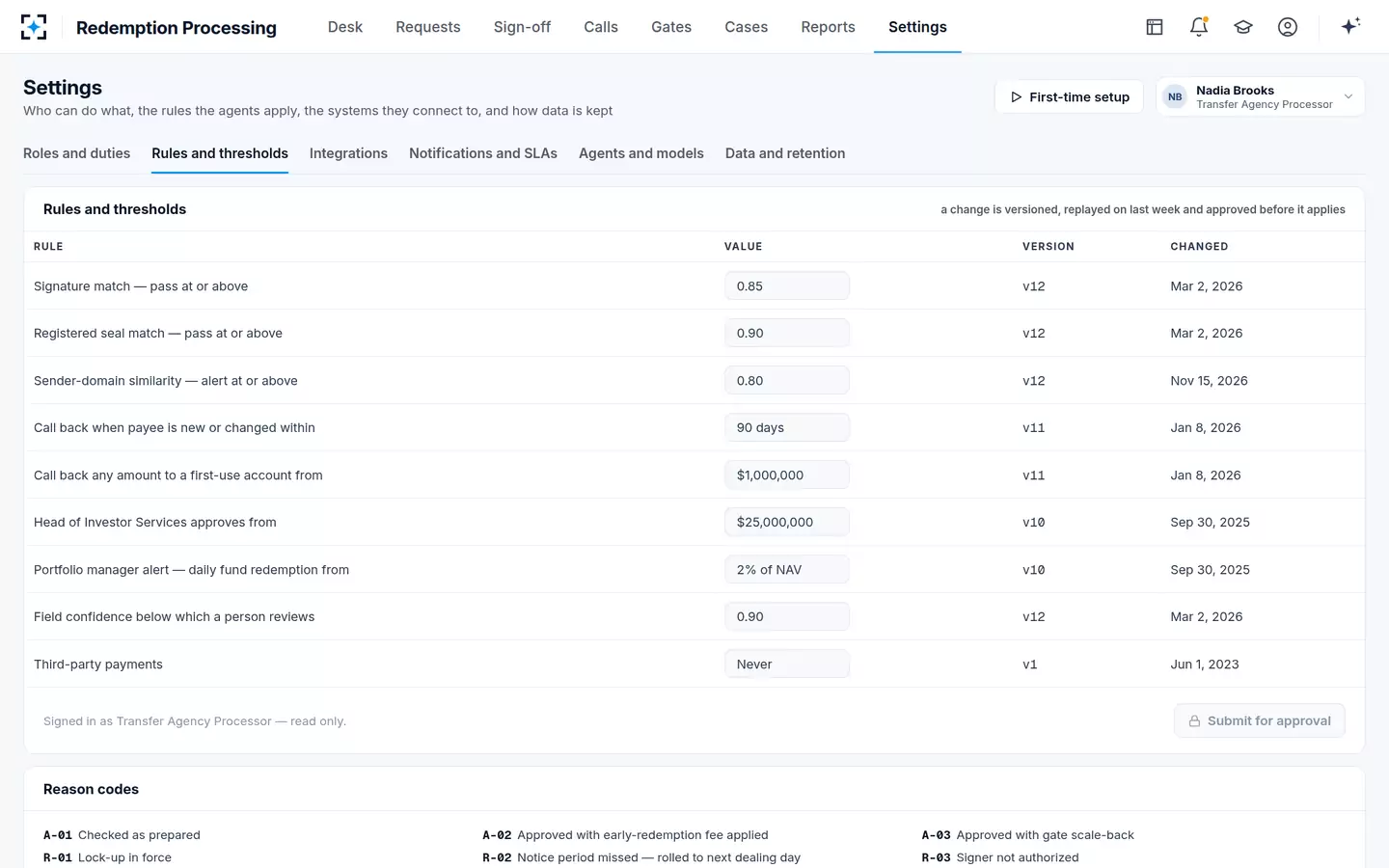
For a desk using agents that means three things the solution is built around: every value an agent extracts is cited to its source, no agent releases a payment or clears its own alert, and the thresholds the agents apply are versioned settings that a person approves. Who does which task once agents are involved is the subject of transfer agency services with agents.
Thresholds as versioned settings, approved before they apply
What happens to LP-interest transfers?
They lose the same exemption. Rule 17Ad-4(a) names "interests in limited partnerships" in the same breath as fund shares, and the SEC estimates that "up to 194 registered transfer agents that process interests in limited partnerships, DRIPs, and Fund Shares, and certain small transfer agents" would newly have to comply with the turnaround, processing and recordkeeping rules (91 FR 56946, section V). Its 2019 risk alert had already found paying-agent policies that did not address "periodic redemption requests for limited partnerships" (OCIE, 2019). Where a registered transfer agent handles transfers of partnership interests, the transfer itself raises tax and consent questions that sit outside this rule; the steps from request to consent are in the LP transfer process.
How should a redemption desk prepare while it is still a proposal?
By measuring now what the proposal would measure, without changing anything that depends on its final text. Nothing in it is in force, the comment period runs to 3 November 2026, and the SEC has asked over a hundred questions, several of them about investment company transfer agents. But the measurements a desk would need under any version are the same, and they can be taken from last quarter's requests.
Seven things to measure before the SEC adopts anything
- Time from receipt to acceptance, per request
Logged by the system at arrival, not keyed later; split by channel, because fax, email, portal and order network behave differently.
- Time from pricing to posting on the shareholder file
Today's rule allows five business days for fund transfer agents; the proposal would allow one.
- Which items you treat as non-routine, and why
Redemptions, exchanges, estates, guarantee issues: if the SEC makes fund redemptions routine, these move onto the one-day clock.
- Every rejection, with its reason and how fast the presentor heard
The proposed notice must name the item, the reasons and the fix, within one business day.
- The share of items that miss your own deadline
The proposed SEC notification starts above 3%.
- Where client money sits between pricing and payment
Account titles, reconciliation frequency and who can move it, against a "for the benefit of" standard.
- How each automated step is supervised
Who set its thresholds, who can change them, and how you would show an examiner that people oversee it.
Firms that want to influence the outcome can still comment; after the deadline, the next public step is a final rule or a re-proposal, and adoption dates and compliance periods would be set then. Re-check the status on the day you act. The requests themselves, read, checked and timed as they arrive, are what Redemption Processing produces.
Questions people ask
When are comments on the SEC transfer agent proposal due?
The release, published in the Federal Register on 4 September 2026, asked for comments "on or before November 3, 2026". After that the SEC may adopt the rules as proposed, adopt them with changes, or re-propose; it has not set compliance dates, and it asks commenters what transition periods would be appropriate.
What are the current transfer agent rules?
They are Exchange Act Rules 17Ac2-1 and 17Ac2-2 (registration and annual reports on Forms TA-1 and TA-2) and the 17Ad series of rules from Rule 17Ad-1 onwards, which set turnaround standards, recordkeeping, posting, safeguarding of funds and securities, signature guarantees and lost-securityholder searches. Most were adopted between 1977 and the early 1980s.
Does the proposal require fund redemptions to be paid in one day?
No. Payment to a redeeming shareholder is governed by section 22(e) of the Investment Company Act, which allows up to seven days, and by the fund's prospectus. The proposal's one-day standards concern the transfer agent's turnaround of routine items and the posting of each redemption to the shareholder file.
How many transfer agents would the proposal affect?
All 327 registered transfer agents would face the new compliance, safeguarding and records rules. The SEC estimates that up to 194 that process limited partnership interests, dividend reinvestment plans and fund shares, together with certain small transfer agents, would for the first time have to meet the turnaround and recordkeeping standards.
Is this the same as the SEC's 2015 transfer agent concept release?
No. In December 2015 the SEC published a concept release and an advance notice of proposed rulemaking asking how to modernise the rules, and proposed no rule text. The September 2026 release is a proposal with rule text, cost estimates and specific questions.
Would private funds' administrators be covered?
Only where they act as registered transfer agents. The rules apply to transfer agents registered under the Exchange Act; an administrator that keeps a private fund's investor register without being registered is outside them, although its contracts and its clients' regulators may expect similar controls.