A medallion signature guarantee is a stamp and signature from a financial institution that belongs to one of three medallion programmes, certifying that the signature on a securities instruction is genuine; by giving it, the institution accepts liability if the signature later proves forged. Transfer agents and funds ask for one on transfers and on redemptions they consider high risk, such as large written requests or proceeds sent somewhere other than the address or account on file, because the guarantee shifts the cost of a forgery away from them, and the SEC's rules for transfer agents, in Rule 17Ad-15, govern which guarantees they may reject and how fast they must say why. What the stamp does not do is prove that the bank account in the request belongs to the investor, that the instruction reflects the investor's current wishes, or that an email carrying a scanned form came from the investor at all. Those are the checks behind most redemption fraud today. Botminds' Redemption Processing is an agentic solution for the desks that receive these requests: its agents match every signature, seal and signer against the specimens and lists on file, and check the payee separately, before a person releases the payment.
What is a medallion signature guarantee?
It is a guarantee of a signature, issued by an eligible financial institution that participates in a recognised medallion programme. The SEC's investor site puts it in one line: the programme "protects you by making it harder for people to steal your securities by forging your signature on your securities certificates and related documents" (Investor.gov, SEC). It names three programmes: the Securities Transfer Agents Medallion Program (STAMP), "whose participants include more than 7,000 U.S. and Canadian financial institutions"; the Stock Exchanges Medallion Program (SEMP); and the New York Stock Exchange Medallion Signature Program (MSP).
The legal frame is the SEC's Rule 17Ad-15, adopted in 1992, which defines a guarantee as "a guarantee of the signature of the person endorsing a certificated security, or originating an instruction to transfer ownership of a security or instructions concerning transfer of securities" (17 CFR 240.17Ad-15(a)(3)). The rule lists the institutions eligible to give one: banks, brokers and dealers of several kinds, credit unions, national securities exchanges, registered securities associations and clearing agencies, and savings associations.
Transfer agents insist on medallion signature guarantees because they limit their liability and losses if a signature turns out to be forged.
Investor.gov, U.S. Securities and Exchange Commission
That sentence is the honest summary of what a guarantee is for. It is a risk transfer between institutions, written in favour of the transfer agent, and its protection for the investor is indirect: a guarantor that stands to pay for a forgery has a reason to check who is in front of it.
Medallion signature guarantee vs notary: what is the difference?
A notary confirms identity and witnesses a signature; a medallion guarantor guarantees the signature and stands behind it financially. Notaries public are not among the eligible guarantor institutions listed in Rule 17Ad-15, so a notarised form is not a signature guarantee, and a transfer agent whose standards require a medallion stamp will not accept a notary's seal instead.
Medallion signature guarantee vs notary, for a redemption or transfer
Medallion signature guarantee: A bank, broker-dealer, credit union, savings association or other eligible guarantor institution in STAMP, SEMP or MSP.
Notary's acknowledgement: A notary public, commissioned by a state.
Medallion signature guarantee: That the signature on the instruction is genuine, from the person who signed.
Notary's acknowledgement: That the signer appeared, was identified and signed or acknowledged the document.
Medallion signature guarantee: The guarantor: the guarantee limits the transfer agent's losses if the signature is forged.
Notary's acknowledgement: No financial guarantee of the signature to the transfer agent.
Medallion signature guarantee: Under each transfer agent's written standards, which Rule 17Ad-15 requires it to keep.
Notary's acknowledgement: Not as a signature guarantee; a fund may ask for notarisation for other documents.
Medallion signature guarantee: Usually only a customer of the institution; non-customers are likely to be refused.
Notary's acknowledgement: Generally anyone with identification.
Medallion signature guarantee: That the payee account belongs to the investor, or that the request is the investor's current wish.
Notary's acknowledgement: The same.
The last row is the one that matters for fraud. Both instruments are about the signature. Neither says anything about where the money goes, which is why a fund that relies on either for a redemption to a new bank account has checked the wrong thing.
Why does a fund ask for a medallion signature guarantee?
To move the risk of a forged signature to an institution that has seen the signer. A fund or its transfer agent processing a written instruction cannot meet the investor, so it asks someone who can. The SEC describes the classic case: an investor holding physical certificates must sign them and a securities power, and "will need to get your signature guaranteed on all documents before a transfer agent will accept the transaction instructions" (Investor.gov).
For fund redemptions the triggers are set by each fund's prospectus or offering documents, not by an SEC rule. They typically turn on the size of a written request and on whether proceeds go anywhere other than the registered owner at the address and account on file, which are the cases where a forged signature would pay a thief. The guarantee requirement also changes how the transfer agent treats the item: under Rule 17Ad-1 an item that requires "additional certificates, documentation, instructions, assignments, guarantees" before transfer is not routine, while "signature, or other common and ordinary guarantees" do not by themselves make an item non-routine (17 CFR 240.17Ad-1(i)).
Can a transfer agent reject a medallion signature guarantee?
Yes, but only on its own written standards, applied equally to every kind of eligible guarantor. Rule 17Ad-15 requires every registered transfer agent to keep "written standards for the acceptance of guarantees of securities transfers from eligible guarantor institutions", and procedures to apply them, and forbids standards that "treat different classes of eligible guarantor institutions inequitably" (Rule 17Ad-15(c)). A transfer agent may not reject a request because of an unacceptable guarantee "unless the transfer agent determines that the guarantor, if it is an eligible guarantor institution, does not satisfy the transfer agent's written standards or procedures" (paragraph (d)(1)).
The rule then sets a clock and a record. After rejecting a transfer because the guarantor fails its standards, the transfer agent must tell the guarantor and the presentor, with reasons, "within two business days" (paragraph (d)(2)). It must give a copy of its standards to anyone who asks, within three days, and keep for three years a record of each rejected transfer with the reason and the guarantor (paragraph (e)). And it keeps the right to reject for reasons unrelated to the guarantor, or because the person who signed for the guarantor "is not authorized by that institution to act on its behalf", provided it keeps a list of the people authorised to sign for that institution (paragraph (f)).
The SEC's September 2026 proposal would add a general duty on top: a written notice to the presentor of any rejected item within one business day, naming the reasons and what to do. It is a proposal; the details are in the SEC transfer agent proposal.
What does a medallion signature guarantee prove in a redemption, and what not?
It proves the signature on the document; it does not prove the instruction, the payee or the channel. A redemption request has at least five things that can be false: the signer, the signer's authority, the amount, the destination and the sender. A guarantee addresses the first, and partly the second where the guarantor checked authority to sign for an entity. The others need checks of their own, and on a request that arrives by email or fax with a new bank account, they are the ones that matter.
What a guaranteed redemption request still has to pass
Agent
Check the guarantee itselfThe stamp is legible, from a medallion programme, and the guarantor is an eligible institution under the transfer agent's written standards.
Never: treat a notary's seal as a guarantee
Agent
Match the signature and signersSignatures and registered seals are compared with the specimens on file, and each signer with the authorised-signatory list and the signing rule, one signature or two.
Never: pass a score below the threshold
Agent
Check the amount and the termsUnits or value against the holding; notice period, lock-up, fees and the redemption gate from the fund's own clauses.
Agent
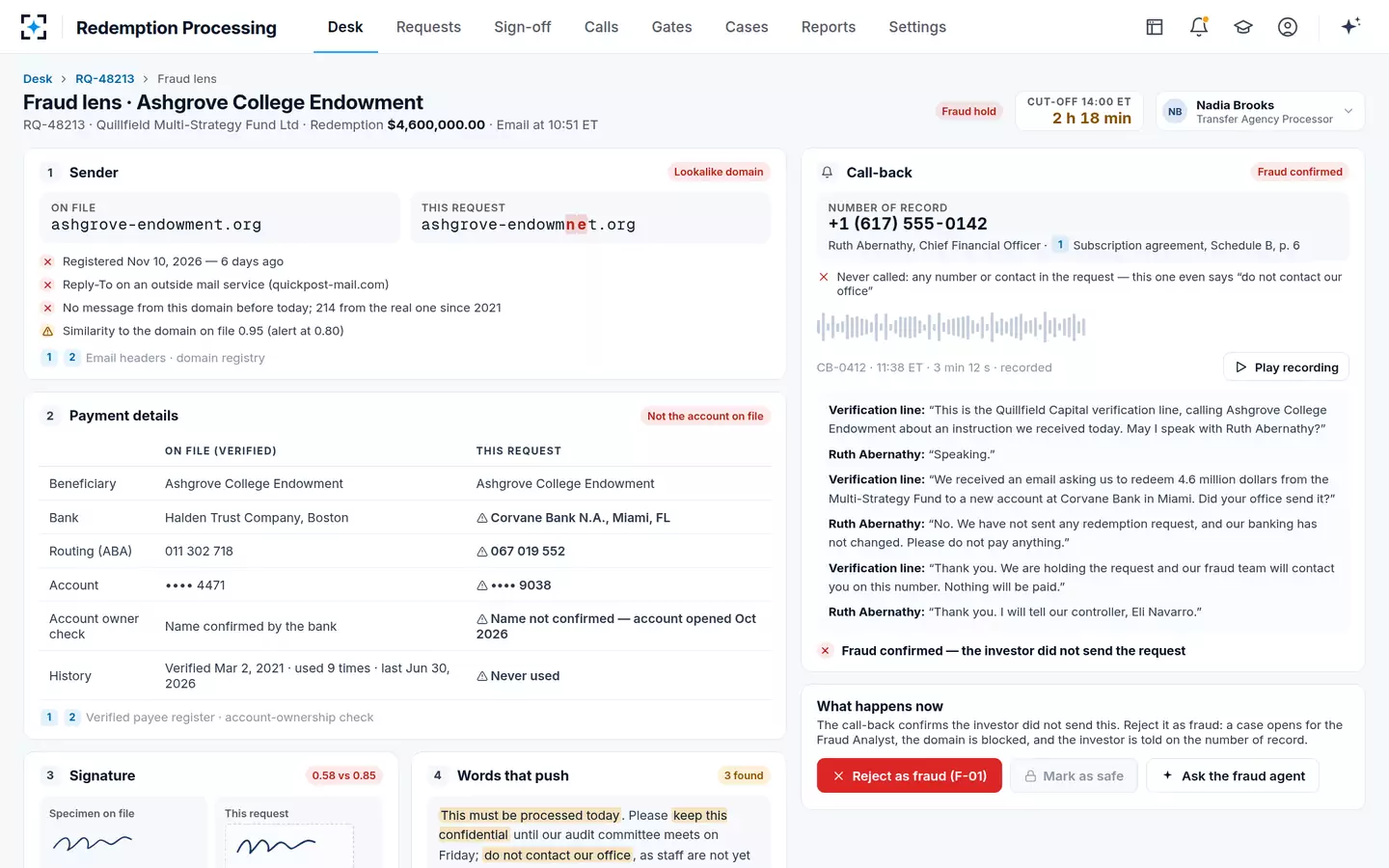
Check the payee and the senderThe bank account against the verified payee on file; the sender's domain, reply-to path and age; a new or changed payee triggers a call-back to the number on file.
Never: dial a number taken from the request
A person decides
Approve a payee changePayments control, not the preparer or the checker, approves any change of payment details, with the call-back attached.
A person decides
ReleaseA dealing supervisor who did not prepare the request releases it, seeing every check behind it.
Does a medallion signature guarantee stop fraud?
It stops one kind: a forged signature on a document a thief presents in the investor's name. It does little against the frauds that dominate redemption losses now, which change the instruction rather than the signature. Business email compromise, in which a fraudster takes over or imitates an email conversation and asks for a payment to a new account, accounted for $3,046,598,558 of reported losses in 2025, according to the FBI's Internet Crime Complaint Center (IC3, 2025 report). A guaranteed form attached to a hijacked email thread still sends the money to the fraudster.
The SEC's case against Equiniti Trust Company shows both modern routes. In one incident an intruder took over an existing email thread and posed as an employee of an issuer client; in another, accounts opened with real accountholders' stolen Social Security numbers were linked automatically to real accounts because the numbers matched, and the real holders' securities were liquidated. The SEC found the failures cost clients more than $6.6 million, and the firm agreed to an $850,000 penalty (SEC press release 2024-101). Neither route needed a forged signature.
The controls that work against these are about identity and destination, and the SEC's Regulation S-ID already expects them: a fund's identity theft programme should check that change-of-address requests on existing accounts are genuine, and covered accounts include any mutual fund account from which money can be wired or paid to someone else (17 CFR 248.201 and Appendix A). The payee check, and why it has to use the number on file, is the subject of the change of bank details on a fund redemption.
A pasted signature, scored against the specimen
When is a signature guarantee needed for a redemption?
When the fund's documents say so, and the transfer agent's written standards say what it accepts. There is no SEC rule that sets a dollar threshold for redemptions; the rule governs how transfer agents accept or reject guarantees once they ask for one. In practice the requirement is attached to the cases where a forged signature would move money away from the registered owner: larger written redemptions, payments to a third party or a new address or account, changes of registration, and transfers of ownership.
Desks should note what this implies for electronic channels. A redemption placed through an authenticated investor portal, or through an order network from an intermediary, relies on that channel's authentication instead of a wet signature, and its weak point is account takeover rather than forgery. A redemption arriving by email or fax relies on a signature image, which can be pasted, and on a sender address, which can be spoofed. The checks should follow the channel's weak point, not the presence of a stamp.
Where do investors get a medallion signature guarantee, and what should the desk tell them?
From a bank, credit union or broker they already do business with that participates in a medallion programme, and a desk that says so in its rejection letter saves a second round trip. The SEC's guidance to investors is direct: a non-customer will likely be refused ("it is likely the financial institution will not guarantee your signature"), so "the best source of a medallion signature guarantee is a bank, savings and loan association, brokerage firm, or credit union with which you do business" (Investor.gov). Investors abroad may be able to use an overseas branch of a US or Canadian bank, broker or credit union with which they do business.
If none of those works, the SEC tells investors to ask the transfer agent or issuer that requires the guarantee for help, so the desk needs an answer ready. Some transfer agents accept alternatives for particular transactions under their written standards; that is their decision, and it should be in writing before the investor relies on it.
Eight checks on a redemption request that carries a medallion signature guarantee
- The stamp is from a medallion programme and the guarantor is eligible
Under your written standards, applied equally to every class of eligible guarantor institution.
- The person who signed for the guarantor is authorised
Rule 17Ad-15(f) lets you reject if not, provided you keep the list of authorised signers.
- The signer matches the registration
Name and capacity, for an individual, a trustee or an entity's officers.
- The signature matches the specimen on file
A guarantee does not replace your own comparison, and a stamp next to a pasted image is a red flag.
- The signers meet the signing rule
One signature or two, from the authorised-signatory list for entity investors.
- The amount fits the holding and the fund's terms
Units, lock-up, notice period, fees and the redemption gate for the dealing date.
- The payee is the account on file, or the change is verified separately
A call-back to the number on file and a second approver for any new or changed account.
- A rejection goes back fast, with reasons
Within two business days for a guarantor that fails your standards, and in time for the investor to re-send before the cut-off.
How Redemption Processing checks signatures, seals and signers
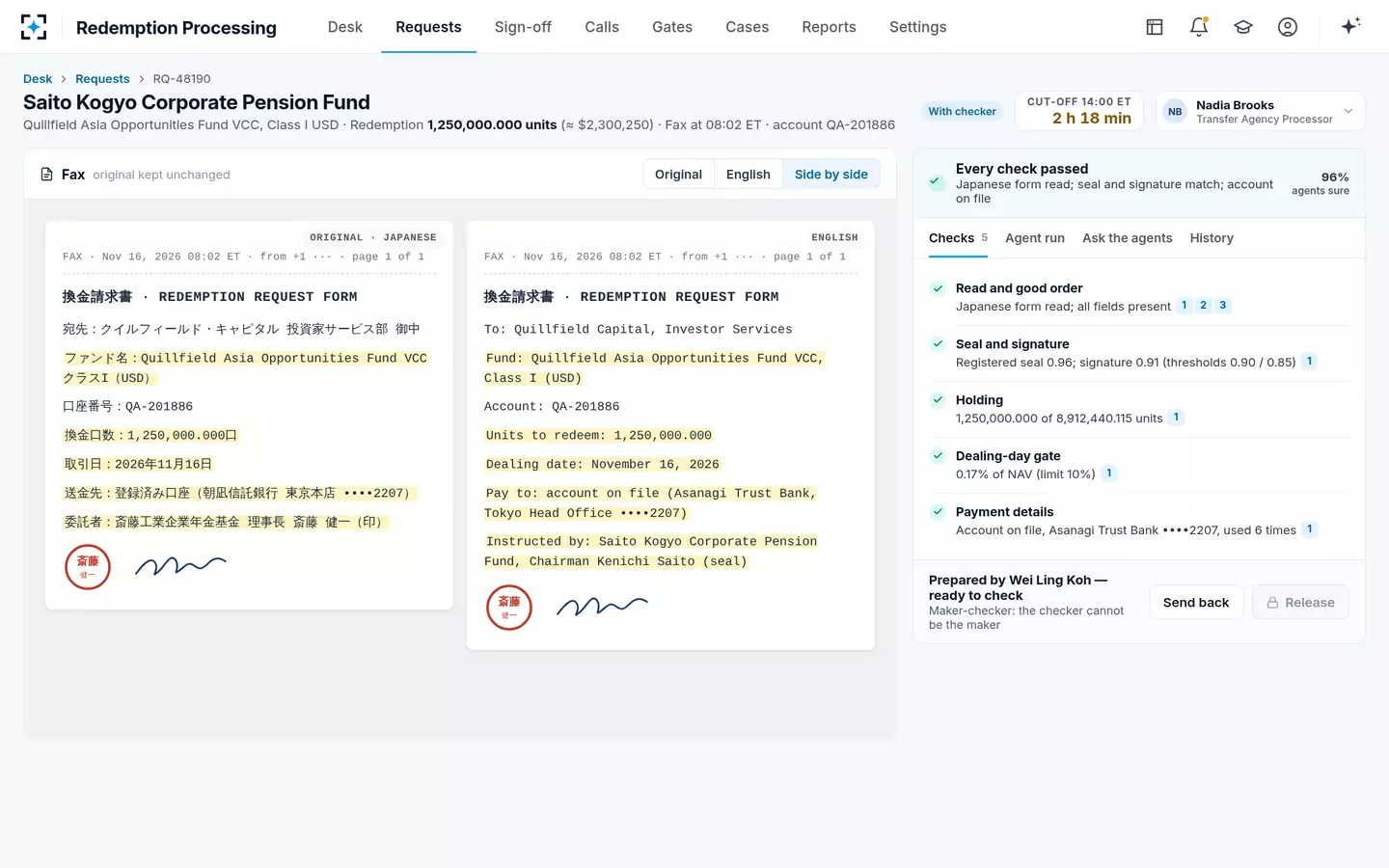
The signature agent compares every signature and registered seal with the specimens on file and checks each signer against the authorised-signatory list and the signing rule, and it never passes a score below the threshold, which in the sample is 0.85 for signatures and 0.90 for seals, each a versioned setting. Below the threshold, or below 0.90 confidence on any field, the request goes to a person. A guarantee stamp, where the fund requires one, is read and checked as part of the same request.
On the sample notice-deadline day, a Japanese pension fund's faxed redemption form is read in Japanese, its registered seal matches the specimen at 0.96 and its signature at 0.91, and its payee is the account on file, so it goes to the checker; a request from another investor signed by someone not on the authorised-signatory list is returned the same morning so the investor can re-send before the cut-off. The rest of the desk's controls are on the Redemption Processing page, and the same checks measured on a closed quarter are in redemption processing, replayed on last quarter's requests.
A seal and a signature, matched to the specimens, beside the original
Questions people ask
What is the difference between a signature guarantee and a medallion signature guarantee?
A signature guarantee is any guarantee of a signature by an eligible guarantor institution under Rule 17Ad-15; a medallion signature guarantee is one given under a medallion programme, with the programme's stamp. Transfer agents' written standards commonly require the medallion stamp, and the SEC notes that an institution that is not a member of a recognised programme "will not be able to provide medallion signature guarantees".
May a transfer agent accept a medallion signature guarantee given online?
The SEC's guidance points investors to a bank, broker or credit union with which they already do business, because institutions usually refuse non-customers. Whether a remote or electronic guarantee is acceptable is up to the transfer agent's written standards, so the standards should say so before the desk relies on one.
Will a notary stamp do instead of a medallion signature guarantee?
Usually not. A notary public is not one of the eligible guarantor institutions listed in Rule 17Ad-15, and a notary does not guarantee the signature financially. A transfer agent may accept other documents for some transactions under its own standards, but that is its decision.
What must a transfer agent tell an investor when it rejects a guarantee?
Either the guarantor did not meet the transfer agent's written standards, the person who signed for the guarantor was not on its list of authorised signers, or the request failed for a reason unrelated to the guarantee. If the guarantor was the problem, Rule 17Ad-15 requires the transfer agent to tell the presenter and the guarantor why within two business days, and to provide its standards within three days of a request.
Does a medallion signature guarantee protect against business email compromise?
Not by itself. Business email compromise changes the instruction, usually the bank account, inside a conversation that looks genuine; the signature can be real or a pasted image. The protection is a call-back to the number already on file and a second approver for any new or changed payee.
Does every mutual fund redemption need a medallion signature guarantee?
Only where the fund's prospectus requires one for that kind of request. Funds often require it for larger written redemptions or when proceeds go to someone or somewhere other than the registered owner on file; a redemption through an authenticated online account or a broker usually does not involve one.