A redemption notice period is the minimum advance notice an investor must give before a dealing date to redeem on it: a quarterly fund with 45 days' notice will redeem on December 31 only those requests it has received by November 16. Hedge funds, real estate, private credit and infrastructure funds use notice periods because their managers need time to raise cash without selling at a discount, and the fund documents usually pair them with a lock-up, a redemption gate and a settlement period of weeks after the dealing date. The operational consequence is that a quarter's requests arrive in the days before a single deadline, so the people who check them face double the volume on the day when a missed signature check or an unverified bank account does the most damage. Botminds' Redemption Processing is an agentic solution for that day: agents read and check every request as it lands, and the processor, dealing supervisor, fraud analyst and payments control keep the decisions.
The desk on this page is sample data on a fictional manager, Quillfield Capital, on Monday, November 16, 2026: the notice deadline for its December 31 quarterly dealing day.
Five people carry a notice-deadline day, and each keeps a decision
Today
Starts at 7:00 with more than 2,000 requests, re-keying faxes and emails and looking up each fund's notice clause, lock-up and fees by hand.
With agents
Opens a desk where each request is already read, checked and cited, and works first on the few that can hurt the fund before the cut-off.
Still theirs: Preparing each request, returning those not in good order, rejecting fraud with a reason
Today
Releases batches before the cut-off and totals each fund's redemption gate for the dealing date in a spreadsheet.
With agents
Sees what was checked on every request, approves the pro rata allocation when a redemption gate binds, and releases with one e-signature.
Still theirs: Release, and never on their own work; the decision to apply a redemption gate
Today
Works call-backs and fraud holds from inboxes and a call log, with the evidence in several places.
With agents
Receives every hold as a case with the call recording, transcript and a look-across to other investors.
Still theirs: Deciding fraud; the referral to the financial crime officer
Today
Approves changes of payment details, often without seeing the call that verified them.
With agents
Approves payment changes in a lane of their own, locked for the preparer and the checker, with the call-back attached.
Still theirs: Second approval of any new or changed payee
Today
Owns the service level and has to show each fund board how every redemption gate and late notice was handled.
With agents
Signs a daily dealing report in which every figure opens the requests behind it.
Still theirs: Approval above $25 million; the account to the boards
What is a redemption notice period?
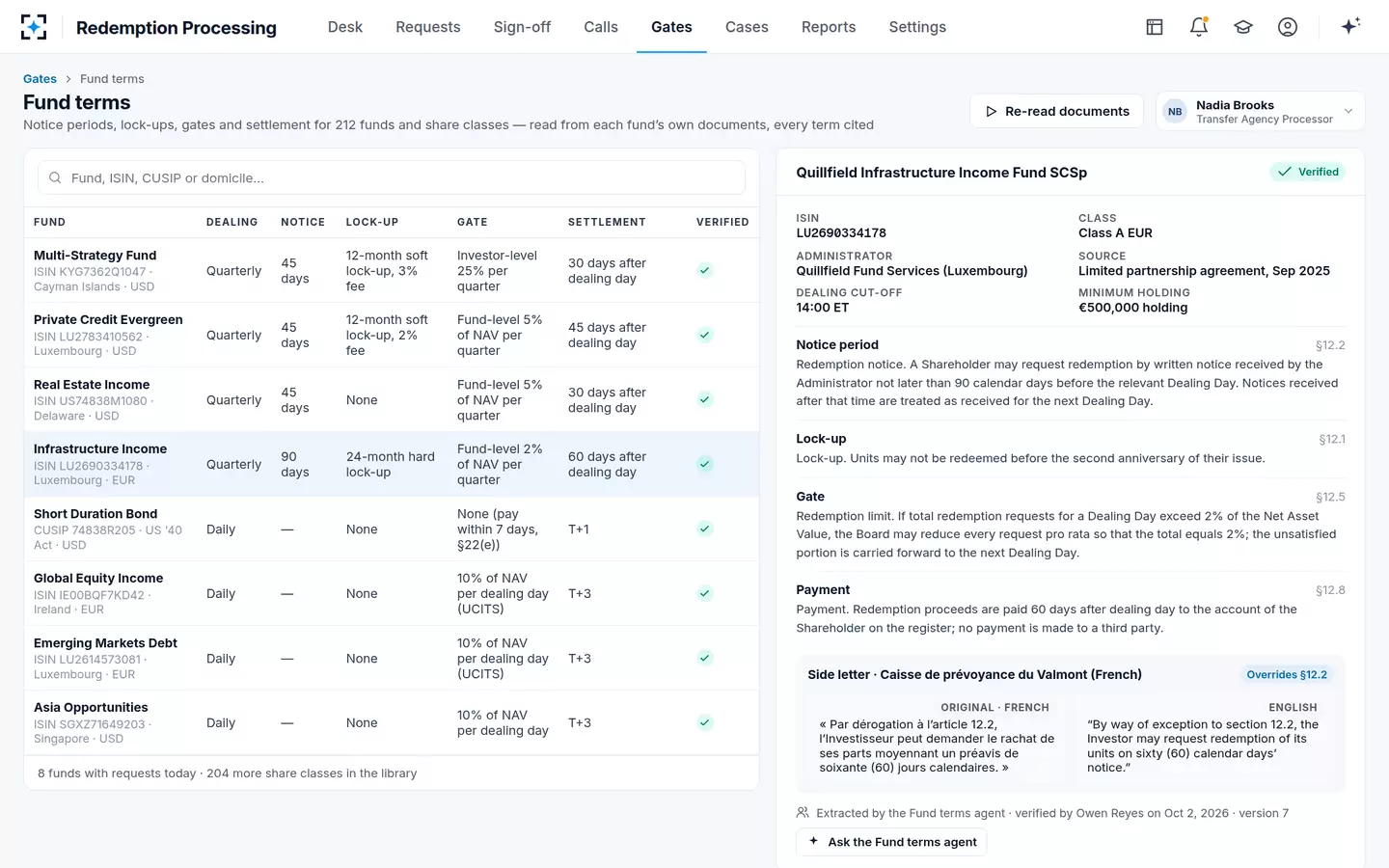
It is a clause in the fund's offering documents setting how far ahead of a dealing date a redemption request must be received to be executed on that date. Its wording matters more than its length. The sample infrastructure fund's clause reads: a shareholder "may request redemption by written notice received by the Administrator not later than 90 calendar days before the relevant Dealing Day. Notices received after that time are treated as received for the next Dealing Day." Three words do the work: written, received and calendar.
"Received by the Administrator" means the clock stops when the administrator's systems receive the notice, not when the investor sends it or when a relationship manager hears about it. "Calendar days" means weekends count, so the deadline for a December 31 dealing date falls on a fixed date whatever day of the week it is. And "treated as received for the next Dealing Day" removes discretion from the desk: a late notice is not rejected, it rolls, which in a quarterly fund moves the investor's exit by three months.
Notice periods are a feature of funds whose assets need time to sell. A US mutual fund cannot use one: it must price each redemption at the next NAV and pay within seven days under section 22(e) of the Investment Company Act. European UCITS and open-ended AIFs can apply an extended notice period as one of their liquidity tools, discussed below.
What is a hedge fund redemption notice period, and how does a lock-up differ?
A hedge fund redemption notice period is the same clause in a hedge fund's documents, commonly paired with a lock-up that bars or penalises redemptions for a fixed time after each subscription. A hard lock-up forbids redemption until it ends; a soft lock-up allows it on payment of a fee to the fund. The two are often confused with the notice period, but they answer different questions: the lock-up says whether an investor may leave yet, the notice period says how early they must ask, and the settlement period says how long after the dealing date they wait for cash.
Four sample funds, four sets of exit terms
| Fund (sample) | Dealing | Notice | Lock-up | Redemption gate | Paid |
|---|---|---|---|---|---|
| Multi-Strategy Fund, Cayman Islands | Quarterly | 45 days | 12-month soft lock-up, 3% fee | Investor-level, 25% of holding per quarter | 30 days after dealing day |
| Private Credit Evergreen, Luxembourg | Quarterly | 45 days | 12-month soft lock-up, 2% fee | Fund-level, 5% of NAV per quarter | 45 days after dealing day |
| Real Estate Income, Delaware | Quarterly | 45 days | None | Fund-level, 5% of NAV per quarter | 30 days after dealing day |
| Infrastructure Income, Luxembourg | Quarterly | 90 days | 24-month hard lock-up | Fund-level, 2% of NAV per quarter | 60 days after dealing day |
The table shows why a desk cannot work from memory. Four funds managed by one firm have three different notice periods, two kinds of lock-up and four different payment dates, and a side letter can change any of them for one investor: in the sample, a French pension fund's side letter shortens its notice period on the infrastructure fund from 90 days to 60. An investor who redeems from two funds on the same day is subject to two clocks.
Why do redemption requests spike before the notice deadline?
Because the notice period turns a quarter of decisions into one deadline. Investors who are reviewing an allocation wait for the latest information they can get, which means the last days before the deadline, and those who are certain they want out still tend to send the request close to it. Nothing in the rules spreads the requests out.
On the sample desk the effect is concrete. By 11:42 on deadline day, 2,146 redemption and switch requests worth $1.84 billion have arrived since midnight, about double a normal day for the same team, by portal, email, fax and order network. Most arrive between 7 a.m. and noon. Done by hand, at roughly 12 minutes of a person's time per request, that is about 54 person-days of work before a 14:00 cut-off.
Where a notice-deadline day's person-days go, by hand and with agents
By hand: about 54 person-days for 2,146 requests
- Logging and re-keying · 33.3%
- Good order, signatures, signers · 25%
- Notice, lock-ups, fees, redemption gates · 25%
- Fraud checks and call-backs · 8.4%
- Four-eyes check and release · 8.4%
With agents preparing: about 6.6 person-days
- Logging and re-keying · 19.7%
- Good order, signatures, signers · 19.7%
- Notice, lock-ups, fees, redemption gates · 19.7%
- Fraud checks and call-backs · 13.6%
- Four-eyes check and release · 27.3%
The shape of the second bar is the argument. With agents doing the reading and matching, the largest share of the remaining human time is the four-eyes check and release, followed by the fraud work, which is where a person's judgement adds most. The first bar's problem is not only its size: under deadline pressure, the 8.4% spent on fraud checks is the part most easily cut.
A quarter on the notice clock
A notice deadline is one date in a longer sequence, and the sequence is what a desk has to plan. For a quarterly fund with 45 days' notice and payment 30 days after the dealing date, an investor who decides in October waits until the end of January for cash; with 90 days' notice and 60-day payment, the same decision is paid at the start of March. If a redemption gate binds, part of the request rolls to the next quarter and the clock starts again.
From notice deadline to cash: two sample funds, one December 31 dealing date
- Nov 16 to Dec 3145 days
- To payment30 days
- Oct 2 to Dec 3190 days
- To payment60 days
- Carried90 days
- To payment30 days
Who decides whether a late redemption notice is accepted?
The fund documents decide, and where they leave discretion it belongs to the fund's directors or general partner, not to the desk. A clause like the sample's, under which late notices "are treated as received for the next Dealing Day", leaves nothing to decide: the desk rolls the request and tells the investor. Some documents allow the directors to waive the notice period, and any waiver then raises a fairness question, because accepting one investor's late notice on a dealing date when a redemption gate binds reduces what every other redeeming investor receives.
In Europe the uniformity point is explicit for redemption gates, which "shall apply ... uniformly to all investors" (Delegated Regulation (EU) 2026/465, Article 2), and ESMA tells managers to treat incoming orders so that no investor benefits from information on whether a liquidity tool is likely to be activated (ESMA guidelines, paragraph 18). A late notice accepted for a well-placed investor on the day the redemption gate binds is the case both texts are written to prevent.
On the desk, the practical rule is a reason code and a name. In the sample, a request that misses its notice period is rolled to the next dealing day with reason R-02, and any exception the directors grant is entered as an override with its reason code and the approver's e-signature, so the board can see each one at the end of the quarter.
Can a fund extend the notice period?
In the EU, yes: the extension of notice periods is one of the liquidity tools a UCITS or open-ended AIF may select, and its mechanics are now in law. The delegated regulation for AIFs says the extended notice period "shall cover the period between the receipt of the redemption order by the AIFM and its execution", "shall not include the time required for the settlement process", and leaves the fund's redemption frequency unchanged (Article 3). A quarterly fund stays quarterly; investors simply have to ask earlier.
ESMA's guidelines say which funds should consider it: those "whose liquidity is particularly susceptible to deterioration in times of market stress" and AIFs in less liquid assets, "particularly, for real estate and private equity funds" (paragraph 28). They also warn about the side effect a dealing desk would feel first: managers should calibrate the length "in order to avoid prompting an increase of redemptions requests" (paragraph 31). For UCITS, which deal daily, managers should "carefully assess whether the activation of the extension of notice periods is appropriate ... under normal market conditions" (paragraph 30). How the two required tools fit together is covered in the Risk Management guide to AIFMD II liquidity management tools.
What happens when a redemption gate binds on the notice date?
On the notice deadline the desk knows, for the first time, the total requested for the dealing date, and so whether the redemption gate binds; what it does not yet know is the dealing-date NAV the limit is measured against. In the sample, Real Estate Income's requests reach $251.2 million, 7.9% of the last struck NAV against a 5% limit, so the gating agent proposes paying 63.30% of every request. Private Credit Evergreen reaches 4.2% of its 5% limit and pays in full.
The proposal is an estimate until December 31's NAV is struck, and it changes the day's priorities. Requests for a fund whose redemption gate binds must all be in, checked and correct before the factor means anything, because a single wrong amount changes every other investor's payment. That is why the sample desk works the gated fund's exceptions first. How the factor is calculated and what happens to the carried amounts is set out in what is a redemption gate.
Where deadline days fail: the checks that get skipped
Deadline days fail where the volume meets the controls. SEC exam staff, reviewing 75 transfer agents that acted as paying agents, found some where no second person had to confirm a movement of issuer money, and written policies that said nothing about periodic redemption requests from limited partnerships (SEC OCIE Risk Alert, 2019). Those are the controls a stretched team is tempted to waive at 13:30.
Fraudsters know the calendar too. A redemption to a new bank account, arriving on the busiest day with a request to keep it quiet, is the pattern of business email compromise, which the FBI's Internet Crime Complaint Center recorded as $3,046,598,558 of reported losses in 2025, from 24,768 complaints (FBI IC3, 2025 Internet Crime Report). On the sample desk, a lookalike-domain request for $4.6 million arrives at 10:51 on deadline day; how it is caught is the subject of the change of bank details on a fund redemption.
How to staff a notice deadline without skipping checks
Plan the deadline from the last one, and protect the checks that need a person. Five preparations make the biggest difference, and each can be done in the weeks before the date.
Forecast by fund, not in total. Last quarter's requests by fund and by hour show where the peak will fall and which funds are near their redemption gate limits. A fund at 4% of a 5% limit last quarter needs its exceptions worked first this time.
Clear the payees before the day. Any investor whose bank details changed in the last 90 days, the sample's call-back window, can be called on the number on file the week before, so a deadline-day request to that account is already verified.
Set an escalation ladder. Fixed times before the cut-off at which anything unprepared goes to a named person, rather than a general push at the end. The sample uses 60, 30 and 15 minutes.
Keep the second approver free. Payments control and the head of investor services sign the largest and riskiest items; their afternoon should not be spent on volume.
Log every late notice and exception. The board will ask how many requests rolled, how many were waived and on whose authority. A list kept on the day answers it in minutes.
The staffing answer is not more people for one day; it is moving the reading and matching off people so that the checks that need judgement still get done at full volume. That is the design choice behind the agents.
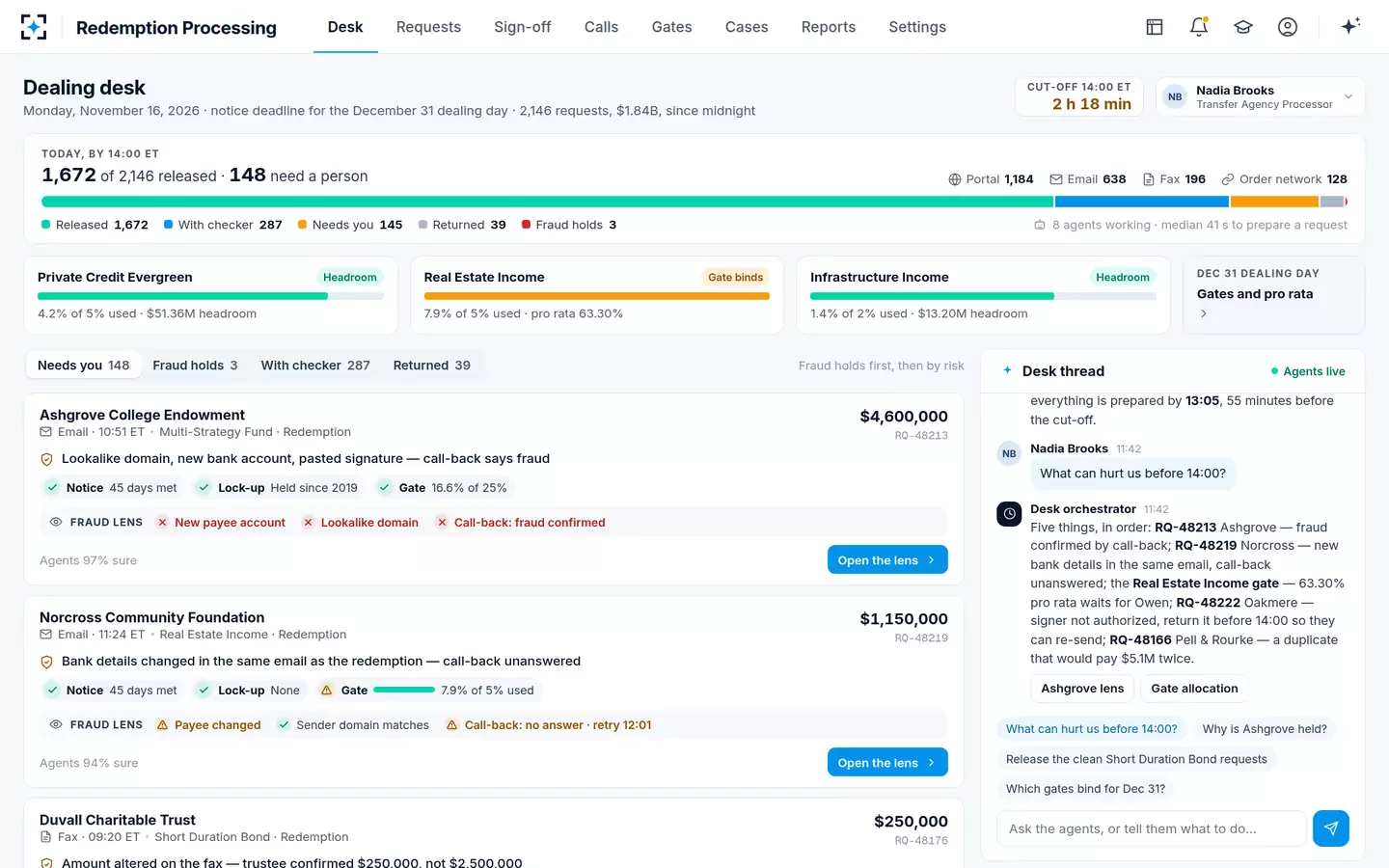
One question at 11:42: what can hurt us before 14:00?
How Redemption Processing works the deadline day
The agents take the reading and matching; people take the decisions. The intake agent reads each request by fax, email, portal or order network, in the investor's language, and finds duplicates across channels. The fund terms agent applies the notice period, lock-up, fees and any side letter from the fund's own clauses, rolling late requests to the next dealing date with the clause cited. The gating agent keeps each fund's headroom current. The fraud and call-back agents look at the sender and payee and ring the number on file for any new account. The desk orchestrator watches the 14:00 clock and escalates anything not prepared at 13:00, 13:30 and 13:45.
On the sample day that leaves 145 requests that need a person and 3 fraud holds, out of 2,146, and the processor's question at 11:42 is answered with the five things that matter. The same desk, seen from the transfer agent's cut-off rather than the investor's notice, is in the mutual fund redemption cut-off time, and the full day is on the Redemption Processing page.
Notice periods and lock-ups, read from each fund's documents
Questions people ask
What does a redemption notice period of 45 days mean?
It means the fund must receive your written request at least 45 days before the dealing date on which you want to redeem. For a December 31 dealing date that is November 16 if the clause counts calendar days. A request received later is usually treated as a request for the following dealing date.
Is the notice period the same as the settlement period?
No. The notice period runs before the dealing date; the settlement period runs after it, until the cash is paid. The EU's delegated regulation keeps them separate: an extended notice period covers receipt to execution and "shall not include the time required for the settlement process". In the sample funds payment follows 30 to 60 days after the dealing date.
What is the average hedge fund lock-up period?
No regulator or independent study publishes a current average. Lock-ups, notice periods and redemption gates are negotiated fund by fund and often varied by side letter, so the only reliable figure is the one in the documents of the fund in question. The sample funds on this page use 12-month soft lock-ups with 2% or 3% fees and a 24-month hard lock-up.
Can a redemption notice be withdrawn?
Only if the fund documents allow it, so the clause is the first thing to read; where the documents are silent, treat a withdrawal as a question for the directors rather than the desk. Either way, a withdrawal is an instruction like any other: verify the sender through the contact details on file and record who approved it.
Do mutual funds have redemption notice periods?
US mutual funds do not; they price each redemption at the next NAV and must pay within seven days. EU UCITS deal daily or weekly but may select the extension of notice periods as a liquidity tool, which ESMA says should be assessed carefully for UCITS under normal market conditions.
Why do funds pair notice periods with redemption gates?
Because the notice period tells the manager how much is leaving, and the redemption gate caps how much can leave on one date. Together they give the manager time and a limit. The notice deadline is also the first moment the desk can tell whether the redemption gate will bind.