Redemption processing software reads incoming fund redemption and switch requests, checks each one against the fund's terms, the investor's signatures and the payee on file, and routes it to people for release; it sits beside the transfer agency system of record rather than replacing it. The best redemption processing software for a given desk is the one that is right on that desk's own requests, and the only way to know is to test it on them: first by replaying a closed quarter, then by running it in shadow beside the live desk, through a notice deadline, without releasing a payment. The measures that decide are catches, false holds and turnaround, judged by the dealing supervisor who will live with the result. Botminds' Redemption Processing is an agentic solution built to be proved this way: it replays the previous week's requests before go-live, and its agents prepare requests while people release them.
Sample figures on this page come from fictional data in the solution; rules come from the SEC.
What is the best redemption processing software?
There is no independent ranking, and vendors' own accuracy figures are measured on their data, not yours. No regulator or independent study publishes error rates, good-order rates or costs for redemption processing, so the comparison a buyer can trust is one run on its own files. What can be fixed in advance is what any candidate must do, and what it must never do.
Twelve things to require of redemption processing software before a pilot
- Reads every channel you receive
Fax, email, portal and order network, in the languages your investors write in, with the original kept unchanged.
- Cites every value to its source
Each field and each statement links to the page, line or clause it came from, so a person can check it in seconds.
- Sends low-confidence fields to a person
A stated threshold, applied field by field, not a single score for the request.
- Matches signatures, seals and signers
Against specimens and the authorised-signatory list, with the signing rule; never passing below the threshold.
- Applies terms from the fund's own documents
Notice periods, lock-ups, fees, side letters and the redemption gate, each with its clause, verified by a person when first read.
- Finds duplicates across channels
The same request by fax and email must be paid once.
- Holds every new or changed payee
And calls back only the number on file, never one in the request.
- Cannot release, approve or clear its own alerts
Maker-checker and second approvals enforced by the system, with the preparer locked out of release.
- Prices to the right time
Receipt time captured by the system, so the request gets the NAV next computed after receipt under Rule 22c-1.
- Keeps a record that cannot be edited
Who, what, when, why and the evidence, for every action by people and agents.
- Versions its thresholds and replays changes
A change is tested on past requests and approved before it applies.
- Can be replayed and shadow-run before go-live
On your requests, without access to payment systems.
What should redemption processing software check?
Everything a careful processor checks, in the same order, with the evidence shown. Intake: time of receipt, channel, every field, duplicates. Good order: signatures, seals, signers and the signing rule; the amount against the holding; any required guarantee. Fund terms: notice period, lock-up, fees, side letters and the redemption gate for the dealing date. Payee and sender: the account against the verified payee, the sender's domain against the one on file, sanctions screening, and a call-back for anything new. Release: maker-checker, approval limits, the cut-off.
The checks that most separate software are the payee and sender checks, because they are where losses happen and where a system that only reads documents adds least. Business email compromise cost $3.05 billion in reported US losses in 2025 according to the FBI, and a request with perfect paperwork and a fraudulent bank account passes every document check. Ask each candidate to show its handling of a lookalike sender domain and a payee change on the same request; the anatomy of that fraud is in the change of bank details on a fund redemption.
Six requests to bring to the first demonstration
Before agreeing a pilot, bring six requests of your own, with personal data removed, and watch each one go through. They test the behaviours that separate software that prepares work from software that only reads it.
A fax in another language. Ask to see each value beside the original, with its citation, and what happens to a field the software is unsure of. The same request twice. Send it by fax and by email and see whether it is flagged before either copy is prepared for release. A payee change from a lookalike domain. Ask which signals the software shows, and which number it would call; the only right answer is the one on file.
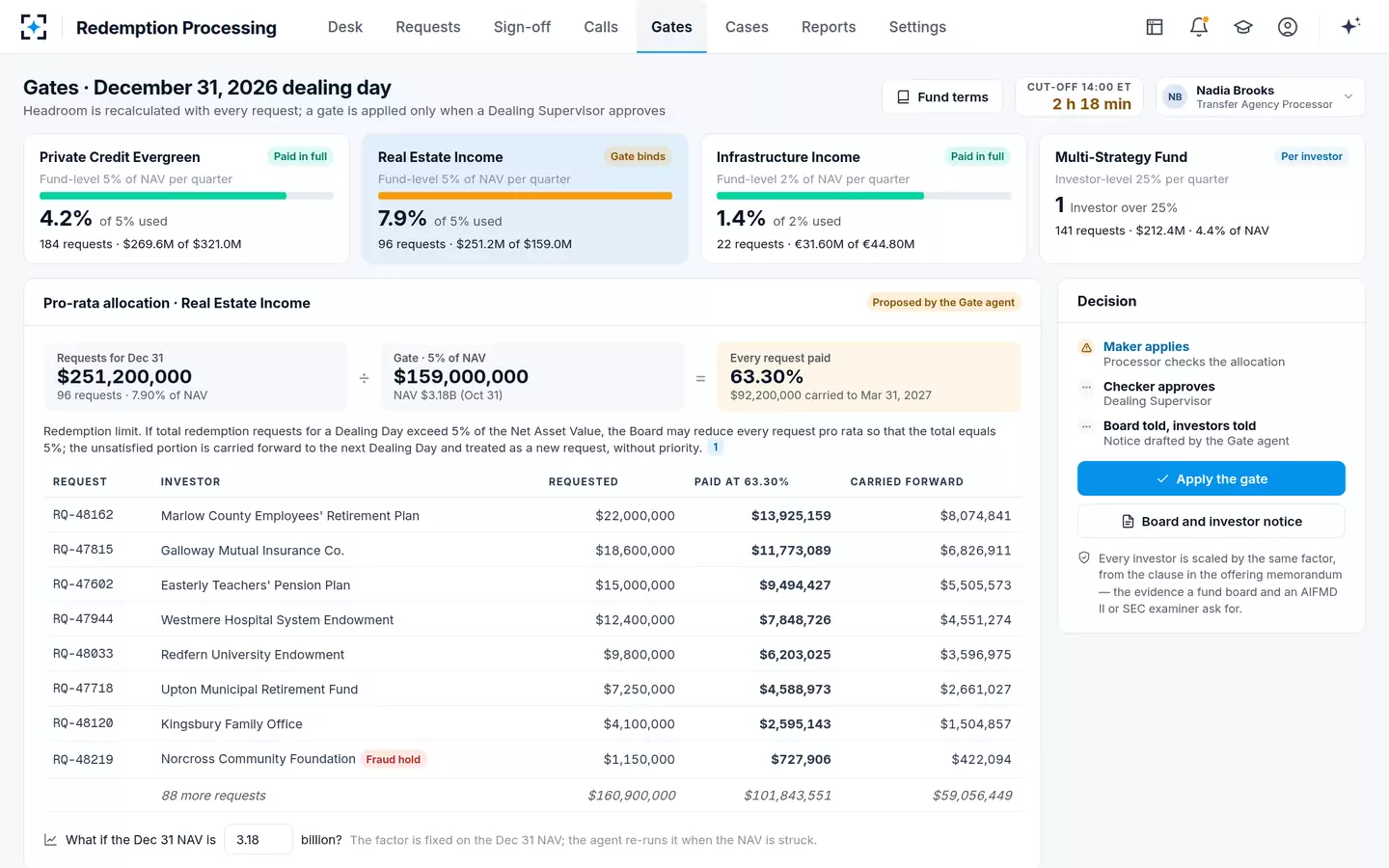
A request for more units than the holding. It should be returned with a reason the investor can act on, not silently scaled. A late notice on a dealing date when a redemption gate binds. It should roll to the next date with the clause cited, and the factor for everyone else should not change. A request prepared by the person trying to release it. The release should be refused by the system, not by a warning.
Any candidate that cannot show these six on your own files in a demonstration is unlikely to show them in a pilot. Those that can have earned the replay.
How do you pilot redemption processing software safely?
In three stages, none of which moves money until the last: replay a closed quarter, run in shadow beside the live desk, then go live with people releasing every payment. Each stage has an exit test agreed before it starts, and the dealing supervisor owns the decision to move on.
An eight-week pilot: replay, shadow through a notice deadline, then supervised go-live
- Feeds and terms2 weeks
- Wait
- Replay, rulings2 weeks
- Wait
- Shadow run3 weeks
- Wait
- Sign-off1 week
The replay stage is described in detail in redemption processing, replayed on last quarter's requests. Its value is that every request has a known outcome. The shadow stage adds what a replay cannot: today's timing, today's volume, and the pressure of the cut-off, so the software's turnaround is measured against the clock the desk actually works to.
What data does a redemption software pilot need?
The requests as received, with their receipt times; the offering documents, prospectuses and side letters in force at the time; specimen signatures and authorised-signatory lists; contacts of record and the verified payee register; holdings from the transfer agency system; NAVs from fund accounting; and, for the replay, the outcome of each request. The payment systems are not needed until go-live, and should not be connected during the pilot.
That data is investors' personal and financial information, and the 2024 amendments to Regulation S-P apply to it. They require covered institutions to have incident response programmes, to notify affected individuals of unauthorised access to their information within 30 days at most, and to ensure their service providers notify them within 72 hours of becoming aware of a breach; and the SEC stated that "transfer agents will be required to comply with the safeguards rule" (SEC, 89 FR 47688). Both compliance dates have passed. A pilot contract should say where data is held, who can see it, how it is deleted afterwards, and how fast the vendor will report an incident.
How do you measure a redemption software pilot?
With the same measures in both stages, agreed before the pilot starts. Catches: problems the software found that people also found, and problems it found that people missed. Misses: problems people found that the software did not. False holds: requests it stopped that were fine. Time: how long from receipt to a prepared request, and the share prepared before an internal deadline well ahead of the cut-off. Control coverage: every new payee held and called back, every release by someone other than the preparer.
Two of these deserve a threshold written down in advance. Misses on payee and fraud checks should be zero on the pilot sample, because a single one is the most expensive error a desk can make. False holds have no right number; they are the price of catching more, and the dealing supervisor should set the level the desk can absorb on a deadline day before seeing the results, so the decision is not made to fit them.
What the desk sees when the agents prepare a notice-deadline day
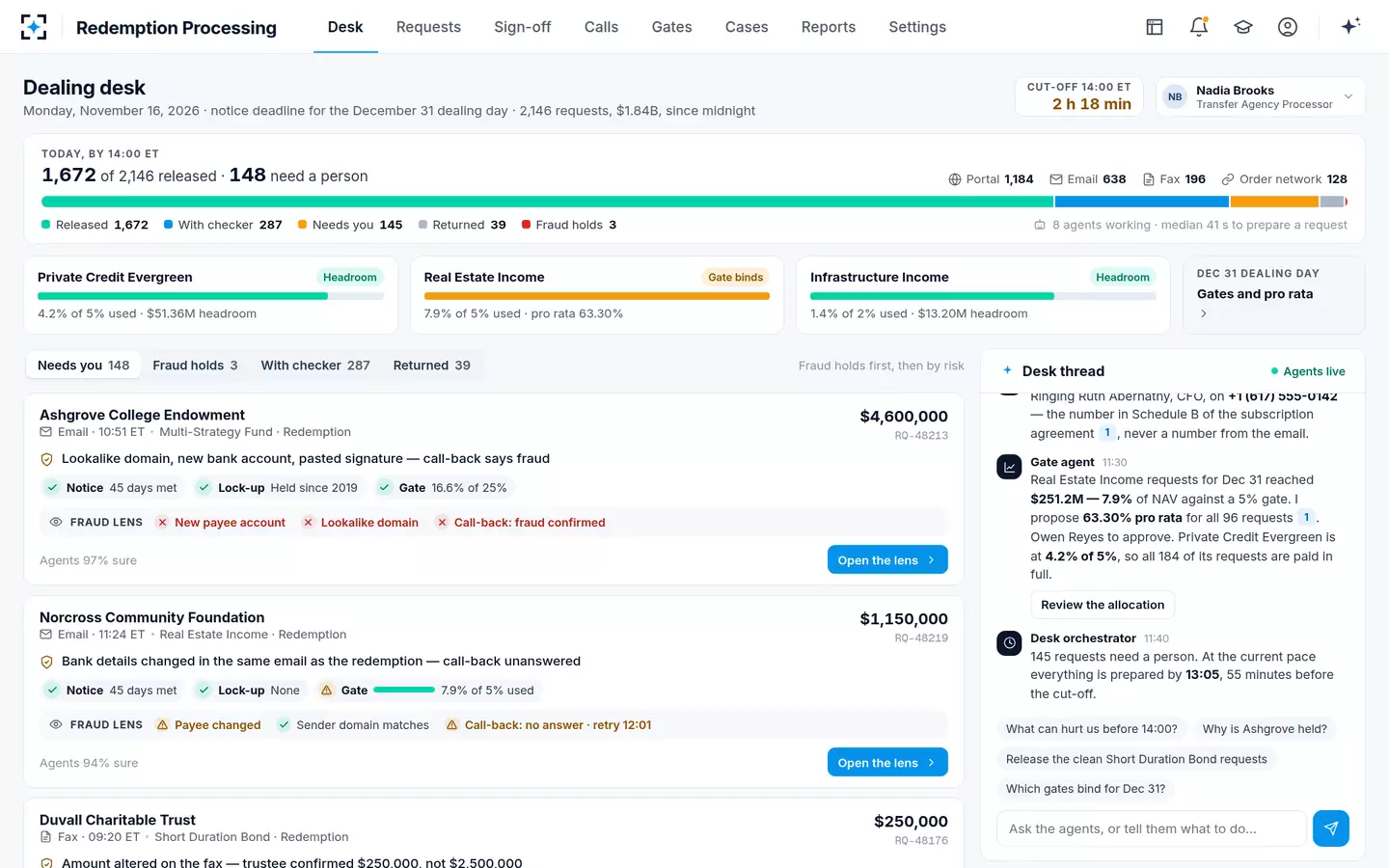
Sample deadline day at 11:42: 2,146 requests
- Released after maker-checker review · 77.9%
- Prepared, with the checker · 13.4%
- Exceptions for a person · 6.8%
- Returned not in good order · 1.8%
- Fraud holds · 0.1%
Can redemption processing software run beside the current system?
It should, and in a pilot it must. In a shadow run the software receives copies of the day's requests and read-only access to the register, holdings, documents and contact records; it prepares each request and records what it would have done, while the desk processes the same requests as usual in its existing system. Nothing it does reaches a payment. The comparison happens after the cut-off, request by request.
After go-live the relationship changes but the system of record does not. The transfer agency system remains the register; the software reads from it and writes prepared, released requests back to it, two ways, and the payments hub, sanctions screening and bank-account validation run after release as before. A product that wants to become a second register, or that needs payment credentials to function, is a different and riskier proposition.
The desk a shadow run produces, on the day it matters
Who signs off go-live?
The dealing supervisor, the head of investor services and compliance, on criteria written before the pilot began, with the fund boards told. The supervisor signs because they release every payment the software prepares and will know whether its false holds are workable on a deadline day. The head of investor services signs because they answer to the boards for the service level. Compliance signs because the controls the software enforces become the firm's controls.
Two developments make the sign-off more formal. The SEC's September 2026 proposal would require every registered transfer agent's compliance policies to be approved by its board "no less frequently than annually", and expects firms adopting AI to ensure "effective oversight of automated processes" (SEC, 91 FR 56946); it is a proposal. And the SEC's Division of Examinations says its fiscal 2027 work will include firms' use of "super intelligence" in back-office operations and fraud prevention (SEC, FY2027 examination priorities). A go-live memo that records the pilot's results, thresholds and approvers is the document an examiner will ask for.
Go-live criteria, set before the pilot
| Measure | How it is counted | Criterion to agree in advance |
|---|---|---|
| Payee and fraud misses | Problems people found that the software did not, on payee, sender and call-back checks | Zero on the pilot sample |
| Other misses | Good order, terms, redemption gate and duplicate checks the software passed wrongly | A maximum per thousand requests, set by the dealing supervisor |
| False holds | Requests stopped that were fine, per thousand | The level the desk can absorb on a deadline day |
| Preparation time | Receipt to prepared request, median and slowest 5% | All prepared before an internal deadline ahead of the cut-off |
| Control coverage | New payees held and called back on the number on file; releases by someone other than the preparer | All of them |
| Citations | Share of extracted values with a working link to their source | All of them |
Redemption processing software in the USA: the rules it has to fit
A US desk's software has to fit five sets of rules. Forward pricing under Rule 22c-1, which makes receipt time the decisive field. The seven-day payment limit of section 22(e) for registered funds, which rules out any redemption gate for them. Regulation S-ID, which covers mutual fund accounts that can pay out to third parties (17 CFR 248.201) and so the payee checks. Regulation S-P for the data. And, if adopted, the SEC's transfer agent proposal, whose one-day turnaround and posting clocks are set out in the SEC transfer agent proposal. Funds with European share classes add the EU liquidity tool rules, applied from 16 April 2026.
What redemption processing software costs
Vendors do not publish prices, and no regulator or independent study publishes the cost of processing a redemption, so the comparison has to be built from the desk's own figures. The useful ones are the person-time per request by stage, measured on a sample; the cost of last year's errors, NAV corrections, fees not charged and payments recovered; and the cost of a deadline day in overtime and temporary staff. Botminds' own estimate for the sample deadline day, about 12 minutes of a person's time per request by hand against about 1.5 minutes to confirm a prepared one, is an estimate on fictional data; a pilot replaces it with the desk's measured numbers. How to turn them into a case a board will accept is the subject of the KPIs that make the business case for transfer agency software.
Where Redemption Processing fits in a pilot, and its limits
It fits the work between a request arriving and a person releasing it, for registered funds and private funds alike, in any language and channel. It is built to be piloted as this page describes: first-time setup extracts the fund terms for people to verify and replays the previous week's requests before go-live, and every threshold change afterwards is replayed and approved. It does not replace the transfer agency system of record, fund accounting or the payments hub, and it does not decide anything a person should: no agent releases a request, applies a redemption gate without approval, or clears its own fraud alert. The full desk is on the Redemption Processing page.
Redemption gates and pro rata, proposed by the agent and approved by a person
Questions people ask
How long should a shadow run last?
Long enough to include at least one notice-deadline day and a full dealing cycle for each fund type in scope. For a desk with quarterly funds that usually means timing the shadow stage around a quarter-end deadline rather than fixing a number of weeks in advance.
Can we pilot redemption processing software on sample data?
Sample data shows how the software works; it cannot show how it performs on your requests, your funds' clauses, your investors' handwriting and your channels. Decide on a replay and a shadow run on your own files.
Does redemption processing software need access to our bank accounts?
It should not. Payments should leave through your payments hub after a person releases them. During a pilot the software needs no payment access at all, which is one reason a shadow run is safe.
What false-hold rate is acceptable?
No standard exists. False holds are the cost of catching more problems, and the right level is the one your desk can work through on a deadline day without missing the cut-off. Set it before the pilot, with the dealing supervisor, and keep payee and fraud misses at zero.
Is there free redemption processing software?
General document tools can read a form, but the controls that matter, citations, signature thresholds, payee holds, call-backs to the number on file, maker-checker and an audit trail that cannot be edited, are what a desk is buying. Whatever the price, test those on your own requests before relying on them.
Who should be on the pilot team?
A dealing supervisor who owns the go-live decision, two processors who know the funds, the fraud analyst, someone from payments control, compliance, and the people who run the transfer agency system feeds. Keep it small enough that every difference found in the replay gets a ruling within days.