The mutual fund redemption cut-off time is the moment after which a redemption order no longer receives that day's price, and the forward pricing rule, SEC Rule 22c-1, is what makes it a bright line the fund, its transfer agent and every authorised intermediary must enforce. For a US mutual fund it is the fund's pricing time, the time as of which the board has set the net asset value to be calculated, which for most funds is 4 p.m. Eastern; an order received before it is priced at that day's NAV and one received after it at the next day's. Brokers and other intermediaries can set an earlier cut-off for their own clients, but never a later one. The cut-off is hard because forward pricing is what keeps a fund from being traded against with information its price does not yet reflect. Botminds' Redemption Processing is an agentic solution for the transfer agency desks that live by that clock: its agents read, check and route every request as it arrives, so the people who release them spend the last hour before the cut-off on the requests that need judgement.
The rules here come from the SEC's own rules and releases; the example screens come from sample data on a fictional manager, Quillfield Capital, whose private funds deal quarterly with a 14:00 Eastern cut-off while its US bond fund deals daily.
What is the mutual fund redemption cut-off time, and who sets it?
The fund's board sets it, by setting the time or times each day at which the fund computes its net asset value. Rule 22c-1 under the Investment Company Act requires a fund, and anyone authorised in its prospectus to accept orders, to redeem only at a price based on the NAV next calculated after the order is received (17 CFR 270.22c-1(a)). The same rule requires the NAV to be computed at least once each weekday, at the time or times the fund's board sets (paragraph (b)(1)).
Nothing in the rule says 4 p.m. The time comes from practice: in its 2022 proposal the SEC wrote that "many mutual funds use prices as of 4 p.m. ET" to value their holdings for the day's NAV (SEC, 87 FR 77172), the close of the New York Stock Exchange. A fund discloses its pricing time in its prospectus, and that disclosed time is the cut-off a shareholder dealing directly with the fund's transfer agent works to.
The rule is called forward pricing because the price is always one the investor cannot yet know. That is the whole design. An investor who could redeem at a price struck before the news of the afternoon would be selling the fund's remaining shareholders an option for free.
When does a redemption order count as received?
It counts as received when it reaches the fund, its transfer agent, or an intermediary the fund has authorised to accept orders on its behalf, and that is where most of the complexity lies. The SEC described current practice plainly in 2022: an order is executed at a given day's NAV if an intermediary, "rather than solely the fund, its designated transfer agent, or a registered securities clearing agency", receives it by the pricing time, "unless an intermediary specifically established an earlier cut-off time for investor orders" (SEC, 87 FR 77172).
The consequence is that the fund often learns of an order hours after the price it will receive was fixed. The SEC's own account is that "the majority of mutual fund orders are placed with intermediaries, such as broker-dealers, banks, and retirement plan recordkeepers", that NAV dissemination "tends to occur between 6 p.m. ET and 8 p.m. ET", and that the transfer agent or clearing agency "often do not receive a significant portion of orders until after midnight--i.e., the next day" (same release). Retirement plan recordkeepers, it adds, typically wait for the NAV before processing participants' orders, so funds receive those orders the next morning.
One dealing day: the price is fixed at 4 p.m., the orders arrive until the next morning
- Accepted for today's price9 a.m.–4 p.m.
- NAV calculated4–7 p.m.
- Doneby 9 p.m.
- Accepted by the broker9 a.m.–4 p.m.
- Netted and sent on4 p.m.–midnight
- At fundnext day
- Accepted by the recordkeeper9 a.m.–4 p.m.
- Waiting for the NAV4–8 p.m.
- Processed overnight, sentnext morning
For the transfer agent this means two different cut-offs in one day. Direct orders must be time-stamped and checked against the pricing time as they arrive. Intermediary orders arrive after the price is known and are accepted on the intermediary's representation that its client placed them in time. The fund depends on every intermediary's own controls to keep that representation true.
Is the cut-off a tolerance or a bright line?
It is a bright line, and there is no grace period in the rule. An order that arrives one minute after the pricing time gets the next price, and giving it the current one is late trading. In its 2003 proposal the SEC defined late trading as "the illegal practice of permitting a purchase or redemption order received after the 4 p.m. pricing time to receive the share price calculated as of 4 p.m. that day" (SEC, 68 FR 70388).
The reason for the severity is the arithmetic of the advantage. A late trader "can exploit events occurring after 4 p.m., such as earnings announcements, by buying on good news" or "selling on bad news" (same release), taking a gain that comes directly out of the fund's remaining shareholders. In 2003 the SEC reported that its investigations and those of state authorities "suggest that late trading of fund shares is not isolated, nor is it limited to any one type of fund or intermediary". The SEC's 2022 release lists settled late trading cases from 2003 into 2005.
Under rule 22c-1, an investor who submits an order before the 4 p.m. pricing time must receive that day's price, and an investor who submits an order after the pricing time must receive the next day's price.
SEC, Amendments to Rules Governing Pricing of Mutual Fund Shares, 68 FR 70388 (Dec. 17, 2003)
For a desk the practical rule is a time-stamp it can defend. A fax that arrives at 3:58 p.m. and is logged at 4:06 p.m. was received at 3:58; an email held in a shared mailbox that nobody opens until 4:20 was received when the fund's system received it, not when it was read. Both are questions an examiner can test from the fund's own logs, which is why the time of receipt has to be captured by the system, not keyed by a person.
Why late trading and stale prices cost long-term holders
Every trade at a price the market has already moved past transfers value from the holders who stay to the trader who leaves or arrives. Late trading is the illegal form. Its legal cousin, market timing, exploits a fund whose NAV uses stale prices, such as an international fund valued on closing prices from markets that shut hours before New York. A peer-reviewed study by Eric Zitzewitz found that trading on this predictability could earn "35–70% per year in international funds", and that the resulting dilution of long-term shareholders "has grown in international funds from 56 basis points in 1998–99 to 114 basis points in 2001" (Journal of Law, Economics, and Organization, 2003).
Stale-price trading doubled the yearly cost to long-term holders of international funds
Fair value pricing, redemption fees and swing pricing are the fund's defences against timing. The cut-off is the defence against late trading, and it only works if every party that may accept an order applies it. That is the gap the SEC has twice tried to close.
The hard close: proposed in 2003 and 2022, adopted neither time
A hard close would give an order the day's price only if the fund, its transfer agent or a registered clearing agency received it by the pricing time, removing the intermediary's ability to send in late what its client placed early. The SEC proposed exactly that in December 2003, with the stated aim "to prevent unlawful late trading in fund shares" (68 FR 70388), and again in December 2022, alongside mandatory swing pricing.
The 2022 release explained the problem in one sentence: "a financial intermediary currently can submit an order that it received before 4 p.m. ET to a designated party after 4 p.m. ET for execution at that day's NAV", which creates a risk "that an intermediary could unlawfully alter orders using after-hours information" (87 FR 77172). It also noted that some intermediaries are not subject to SEC examination at all. When the SEC adopted its 2024 rule on fund reporting, it listed "requirements to use swing pricing and implement a hard close requirement" among proposed amendments "not being adopted at this time" (SEC, 89 FR 73764). The fuller history of that package, and where the liquidity rule stands now, is set out in the mutual fund liquidity rule in 2026.
So the US cut-off remains a soft close for intermediaries and a hard one for everyone else. Outside the US, the SEC observed, a hard close is common where funds use swing pricing, and in some jurisdictions the required time of receipt is "several hours before the time as of which the fund values its holdings" (87 FR 77172, note 225), one reason funds there can see their flows before they price.
How long does a fund have to pay a redemption?
A redemption is priced on the day it is received in time, and the law allows up to seven days to pay. Section 22(e) of the Investment Company Act bars a registered fund from holding back payment longer than seven days after the shares are tendered, outside market closures, emergencies and SEC orders (15 U.S.C. 80a-22(e)). Each fund's prospectus states how quickly it normally pays, and that promise, not the seven-day limit, is what shareholders hold it to.
Cut-off, price and payment: the US, UK and EU rules side by side
| When the price is set | Latest payment the rule allows | Where the cut-off comes from | |
|---|---|---|---|
| US mutual fund | NAV next computed after receipt; at least once each business day, at times the board sets | Seven days after tender (section 22(e)), outside listed emergencies | Pricing time in the prospectus, typically 4 p.m. ET; intermediaries may set an earlier one |
| UK authorised fund | No later than the end of the business day after receipt and acceptance, or the next valuation point if later | Close of business on the fourth business day after the later of the valuation point or receipt of all duly executed instruments | Dealing day and valuation points in the prospectus (COLL 6.2) |
| EU UCITS or AIF | Dealing frequency and cut-off set in the fund rules and prospectus | Set in the fund rules; longer if a redemption gate or a notice-period extension is activated | Fund rules and prospectus |
| US private fund | Dealing date in the offering documents (quarterly in the sample funds) | Set by the documents (30 to 60 days after the dealing date in the sample funds) | Notice deadline in the documents (45 or 90 days before the dealing date in the sample funds) |
The UK rule shows how tightly a regulator can specify the clock. An authorised fund manager must redeem at a price determined "no later than the end of the business day immediately following the receipt and acceptance of an instruction", and must pay by the close of business on the fourth business day after the later of the valuation point or the time the manager "has all the duly executed instruments and authorisations" (COLL 6.2.16R). The second limb is where incomplete paperwork, a missing signature or an unverified payee, moves the payment clock.
Switches and exchanges: two legs, one cut-off
A switch from one fund to another is a redemption and a purchase that must both meet the cut-off, and the second leg usually cannot be sized until the first is priced. The SEC's 2022 release describes it: when an exchange is initiated "two transactions are created--a redemption of securities and a purchase", and exchanges "often are processed as a single transaction so that both the redemption and purchase components of the exchange receive same-day pricing" (87 FR 77172). An order to switch 100 shares of one fund into another cannot say how many shares of the second it buys until the first fund's NAV is struck.
For the desk that means a switch is in good order only if both legs are: the source holding, the target share class open to that investor, any minimum investment in the target, and the same signatories. A switch that is valid on the redemption side and blocked on the purchase side leaves an investor in cash they did not ask for. In the sample, a German foundation's email switching 48,200 units from an Irish equity fund into a Luxembourg debt fund is read in German, both share classes are checked as open to the investor, and the request goes to the checker as one item with two legs.
What the cut-off means at the transfer agent
At the transfer agent the cut-off is a production deadline: every request must be logged, checked for good order and either accepted or returned in time for the investor to fix it before the price is struck. A request that is not in good order when it arrives is priced, at the earliest, when the corrected one is received, under the fund's own terms. Returning it at 9 a.m. leaves the investor the day; returning it at 3:50 p.m. costs them a day's price.
The transfer agent's own performance rules use a different clock. Today, Rule 17Ad-2 treats anything that arrives by noon on a business day as received at noon that day, and later arrivals at noon the next business day (17 CFR 240.17Ad-2(a)), and fund-share redemptions have been exempt from its turnaround standards since 1977. The SEC's September 2026 proposal would drop the noon convention, treat an item as received on the business day it arrives, and end that exemption (SEC, 91 FR 56946). It is a proposal; what it would and would not change for redemptions is worked through in the SEC transfer agent proposal.
A desk that runs on the cut-off clock
Private funds: when the cut-off is a notice deadline
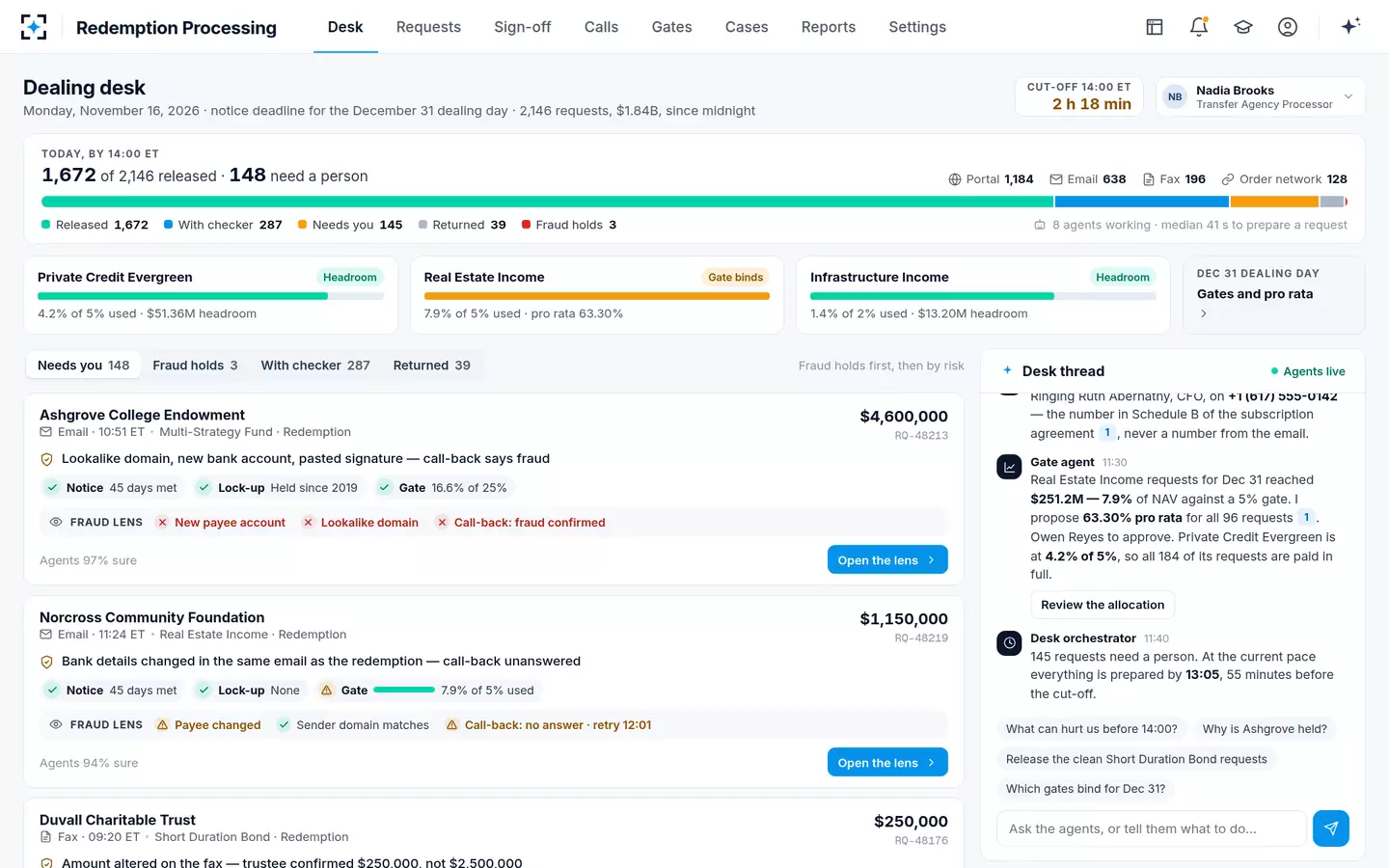
For a fund that deals monthly or quarterly, the cut-off that matters is the notice deadline, often weeks before the dealing date. In the sample, the real estate and private credit funds require 45 days' written notice for a quarter-end dealing date, so the December 31 cut-off falls at 14:00 Eastern on November 16, and a request that arrives at 14:01 is treated as received for the next quarter. One fund requires 90 days.
The bright-line logic is the same as a daily fund's, with higher stakes: missing the deadline by a minute moves the investor's exit by a quarter, not a day. That is why notice-deadline days bring roughly double the usual volume to the same team, and why the day itself, seen by the people who staff it, is the subject of the redemption notice period on a fund dealing desk.
Requests by hour on a notice-deadline day: the peak arrives before the cut-off
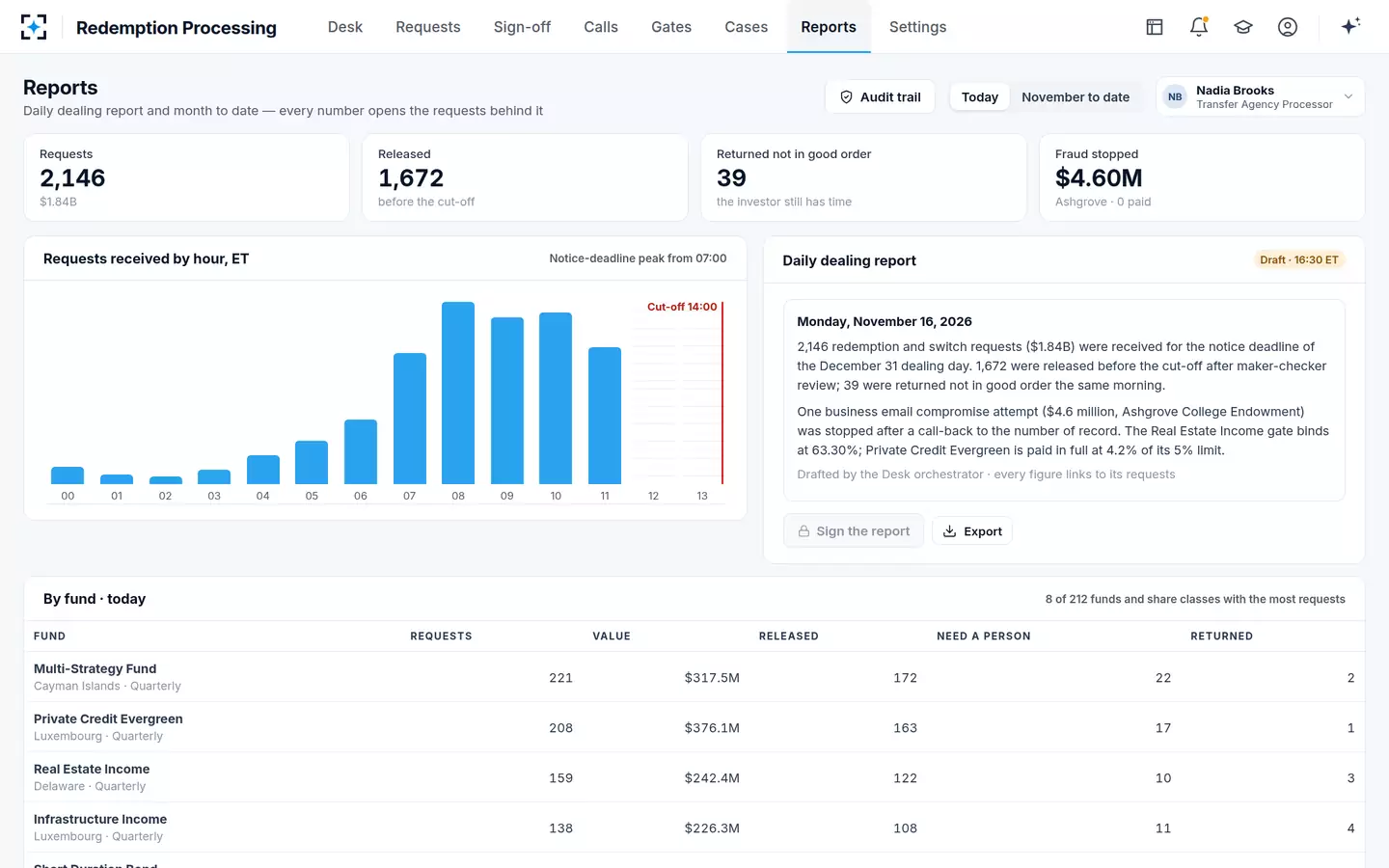
Working to the clock, the solution's agents read each request as it lands, check its signature, terms and payee, and route it, so that the dealing supervisor's last hour is spent releasing prepared work and deciding the exceptions. The rest of the desk's day is on the Redemption Processing page.
Questions people ask
Is the mutual fund cut-off time always 4 p.m.?
No. The board sets the pricing time, and the fund discloses it in the prospectus; 4 p.m. Eastern is the common choice because it is the close of the New York Stock Exchange. Some funds price more than once a day, and brokers, banks and retirement platforms often set earlier cut-offs for their own clients so they can process orders in time.
What is the mutual fund cut-off time for same-day NAV?
An order receives the same day's NAV only if the fund, its transfer agent or an intermediary authorised to accept orders for it receives the order before the fund's pricing time. For an order placed through a broker or plan, the broker's or plan's own cut-off is the one that applies to the investor, and it may be earlier than the fund's.
What is forward pricing?
Forward pricing is the rule that every purchase and redemption is priced at the next NAV calculated after the order is received, never at one already published. It is set by SEC Rule 22c-1, and it stops investors from trading at a price that does not yet reflect news the market has already absorbed.
What is the difference between late trading and market timing?
Late trading is accepting an order after the pricing time at that day's price; it is illegal under Rule 22c-1. Market timing is frequent trading in and out of a fund to exploit stale prices in its NAV; it is not illegal in itself, but it dilutes long-term holders, by 114 basis points a year in international funds by 2001 in one peer-reviewed study, and funds police it with fair value pricing and redemption fees.
What happens if a redemption request arrives at 4:01 p.m.?
It is priced at the next day's NAV. Giving it the current day's price would be late trading. For a fund with a notice period, a request that misses the notice deadline moves to the following dealing date, which may be a month or a quarter later.
Does the SEC's transfer agent proposal change the cut-off?
Not the pricing cut-off, which is set by Rule 22c-1. It would change the transfer agent's own clock, dropping the noon convention for when an item counts as received and ending the 1977 exemption of fund shares from turnaround rules. It was published on 4 September 2026 with a comment deadline of 3 November 2026 and is a proposal, not a rule.