The mutual fund liquidity rule is SEC Rule 22e-4 under the Investment Company Act of 1940. It requires every open-end fund except a money market fund to run a written liquidity risk management program: classify each investment into one of four liquidity buckets at least monthly, never buy an illiquid investment that would take illiquid holdings above 15% of net assets, keep a highly liquid investment minimum if the fund is not mostly highly liquid, and report to its board. The rule's text has not changed since December 2020 (17 CFR 270.22e-4). The work is hard because the buckets are judgements about markets that move daily, made for thousands of holdings, and the SEC has spent 2024 to 2026 telling funds how it reads them. Botminds' Liquidity Risk Management Program is an agentic solution for that work: agents propose each bucket, write each override reason from its source and watch the limits every day, and named people approve.
What has changed is everything around the text. In September 2024 the Commission declined to amend the rule but issued guidance on how often to classify, what "cash" means and how to set a minimum. In April 2025 it pushed back the monthly public N-PORT reporting that came with that guidance, and in February 2026 it proposed cutting that reporting back. The 2022 package of swing pricing, a hard close and stricter buckets is still neither adopted nor withdrawn. The table below sorts each of these by what it means for a fund today.
Where the mutual fund liquidity rule stands in October 2026
| Date | What | Status today |
|---|---|---|
| Oct 2016 | Rule 22e-4 adopted (Release IC-32315); compliance dates ran into 2019 | In force |
| Nov 2018 | Optional swing pricing under Rule 22c-1 becomes available | In force, optional |
| Dec 2020 | Form N-LIQUID retitled Form N-RN; In-Kind ETF wording amended | In force |
| Nov 2022 | Proposal: mandatory swing pricing, hard close, 10% stressed trade size, no "less liquid" bucket, 10% floor on the minimum | Not adopted (Sept 2024); not on the June 2025 withdrawal list |
| Sept 2024 | Guidance: intra-month reviews, cash means US dollars, setting the minimum | Current guidance |
| Nov 2025 | Form N-CEN names each liquidity service provider | In force |
| Feb 2026 | Proposal: 15 more days to file, quarterly publication restored | Proposed; comments closed 24 Apr 2026 |
| Nov 2027 / May 2028 | Monthly N-PORT filed within 30 days and made public monthly (adopted 2024, delayed 2025) | Delayed (larger / smaller fund groups) |
What is the mutual fund liquidity rule, and who does it cover?
The rule covers open-end management investment companies, which means mutual funds and most ETFs, and leaves out two groups. Money market funds sit outside it entirely because Rule 2a-7 governs their liquidity. In-Kind ETFs, those that meet redemptions in kind "other than a de minimis amount of cash" and publish holdings daily, must adopt a program and obey the 15% limit, but they do not classify holdings or keep a minimum. Unit investment trusts get a single duty: the depositor confirms at deposit that the trust's illiquid holdings suit its redeemable shares.
The risk the rule manages is defined narrowly. Liquidity risk is "the risk that the fund could not meet requests to redeem shares issued by the fund without significant dilution of remaining investors' interests in the fund" (Rule 22e-4(a)(11)). The question is never whether an asset is attractive or volatile; it is whether selling it to pay a leaving shareholder would cost the ones who stay. That is why every test in the rule is a number of days to cash at a size the fund would actually trade.
The SEC estimates that 12,183 funds and 705 newly registered funds are subject to the rule, and puts the paperwork at 16 hours a fund a year (Federal Register, 10 April 2026). That figure counts only the collection of information, not the classification work itself; the cost of a program by complex size sets out what the full bill looks like.
The rule in four numbers
12,183
funds subject to Rule 22e-4, plus 705 newly registered
SEC estimate, April 2026
15%
of net assets: the most a fund may hold in illiquid investments before it stops buying them
1business day
to tell the board and file Form N-RN Part B once illiquid holdings pass 15%
5years
to keep program documents and board materials, the first two easily accessible
What are the four liquidity buckets under Rule 22e-4?
The four buckets are highly liquid, moderately liquid, less liquid and illiquid, and each is a statement about days and about value. A fund asks how long it would take to turn a reasonably anticipated trade size of the holding into cash, sold and settled, without significantly changing its market value. Days are counted in two conventions, business days for the first bucket and calendar days for the rest, and the rule's own note settles ties: an investment that is highly or moderately liquid depending only on the day convention is highly liquid.
The four liquidity buckets, in the rule's own words
| Bucket | The test | What usually lands there |
|---|---|---|
| Highly liquid | Cash, or convertible into cash within three business days without significantly changing market value | US Treasuries, large-cap US equities, US dollars |
| Moderately liquid | Convertible into cash "in more than three calendar days but in seven calendar days or less" | Emerging-market bonds with offshore bids, foreign equities around market closures |
| Less liquid | Can be sold in seven calendar days or less, "but where the sale or disposition is reasonably expected to settle in more than seven calendar days" | Bank loans, bonds that only settle locally |
| Illiquid | "cannot be sold or disposed of in current market conditions in seven calendar days or less" without significantly changing market value | Restricted private placements, suspended securities, currency behind capital controls |
Two words in the moderately liquid test trip people up. The rule says "more than three calendar days", not business days, so a bond that turns to cash in four business days over a weekend is moderately liquid only if that is also within seven calendar days. And "less liquid" is not a softer word for illiquid: it is a settlement category for things that sell fast and pay slowly. The Commission proposed abolishing it in 2022 and treating those holdings as illiquid (87 FR 77172); that proposal was not adopted, so the four buckets stand.
A fund may classify by asset class, but it "must separately classify and review any investment within an asset class" when it knows something that would significantly affect that investment's liquidity. It must also ask whether selling the sizes it would reasonably anticipate trading would itself change the answer (Rule 22e-4(b)(1)(ii)(A)–(B)). The staff's answers on what those words mean in practice, from asset-class exceptions to market holidays, are worked through in the Rule 22e-4 FAQs, question by question.
What changed in 2024 without a rule change?
In September 2024 the Commission adopted Form N-PORT and N-CEN amendments, declined to adopt the 2022 liquidity rule changes, and gave guidance on three topics instead. The guidance did not alter a word of the rule, but it told funds how the staff reads it, and examiners read the same text.
While the Commission is not adopting amendments to the liquidity rule at this time, we are providing guidance for funds subject to the liquidity rule to address questions raised through outreach and monitoring.
SEC, Release IC-35308, September 2024
Intra-month reviews. The rule already required a review "more frequently" than monthly when market, trading or investment-specific changes could materially affect a classification. The guidance reported that staff "observed in fund outreach multiple instances where, at the time of outreach, funds were not prepared to review classifications intra-month", and said a fund's procedures "generally should identify" the information it will use to spot such changes and how timely that information is. It added portfolio changes to the list: a fund that substantially increases a position may need to reclassify it at the larger trade size, and should consider classifying a new investment intra-month if buying it materially changes the fund's liquidity profile (89 FR 73764, 11 September 2024).
The highly liquid investment minimum. The Commission reiterated that a fund heavy in less liquid assets, "such as a bank loan fund", and a fund with volatile flows should generally set a higher minimum, and that a credit line may count but the portfolio itself should carry most of the liquidity. Setting and testing the minimum works through a fund's numbers.
Cash means US dollars: the international-fund trap
The third topic changed classifications at international funds overnight. The guidance restated that "cash" in the rule means US dollars only, not foreign currencies or cash equivalents, so every foreign holding's clock runs until the proceeds are in dollars, not until the local trade settles. Staff had seen international funds counting the time to some other currency, and funds treating any currency as highly liquid because the definition mentions cash.
Where a currency cannot be turned into dollars within seven calendar days, "because of currency controls or otherwise", the currency is illiquid, and so is everything in that market that would be sold for it, because a sale only converts one illiquid holding into another (89 FR 73764). A fund pushed above 15% this way may sell into the illiquid currency as a step toward getting out without being treated as acquiring an illiquid investment, as long as it takes reasonable steps to convert or redeploy the currency into liquid investments.
Cash means dollars in Liquidity Risk Management Program: sold in six days, paid in nine to twelve
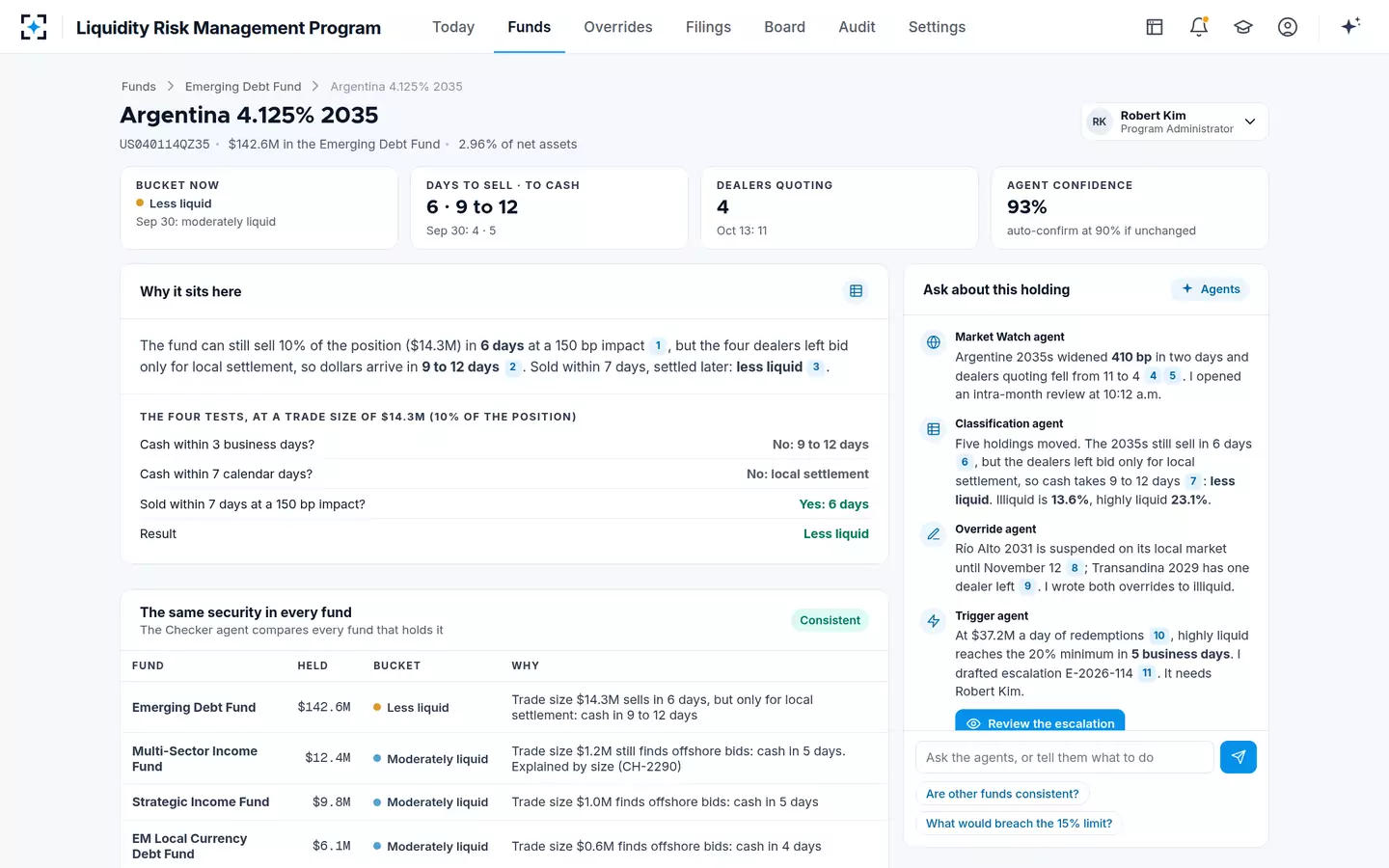
The same security in four other sample funds sits in moderately liquid because their smaller trade sizes still find offshore bids. That is the rule working as written, and the agent records why.
What happened to monthly public N-PORT reporting?
It has not started. The 2024 amendments would have had funds file Form N-PORT within 30 days of each month end and made every month public, from 17 November 2025 for larger fund groups and 18 May 2026 for smaller ones. In April 2025 the Commission delayed them: larger groups now comply from 17 November 2027 and smaller groups from 18 May 2028 (90 FR 16812). The liquidity fields themselves, each holding's bucket and the fund's minimum, stay confidential in every month under either version.
On 23 February 2026 the Commission went further and proposed to give funds "an additional fifteen days to file monthly reports" and to "restore the quarterly publication frequency that had been in place for over two decades" (91 FR 8582). Comments closed on 24 April 2026. No final rule has followed, and the SEC's August 2026 agenda still lists it at the proposed rule stage, so the November 2027 date is still the legal one. A fund that builds its monthly close around a 30-day filing will not waste the work: the monthly classification review is a requirement of Rule 22e-4 either way.
One 2024 change did take effect on time. Since 17 November 2025, Form N-CEN asks each fund to name every liquidity service provider, say whether it is affiliated, list the asset classes it classified, and report whether it was hired or terminated in the period (89 FR 73764). Who supplies a fund's buckets is now a matter of public record.
Was swing pricing adopted for US mutual funds?
No. Swing pricing has been optional for US mutual funds since 19 November 2018 under Rule 22c-1 (81 FR 82084). The November 2022 proposal would have made it mandatory, with a hard close that executes an order at the day's price only if it reaches the fund, its transfer agent or a clearing agency before the pricing time (87 FR 77172). In September 2024 the Commission said it would not amend the underlying rules for now (what swing pricing is, and what the SEC said). The proposal is also absent from the list of proposals the SEC formally withdrew on 17 June 2025 (90 FR, 17 June 2025): neither adopted nor withdrawn.
What swing pricing does, who pays without it, and how stress tests feed the tools European funds must now hold are questions for liquidity stress testing; Botminds covers them in its Liquidity Stress Testing solution, starting with the EU's liquidity management tools rules.
The 2022 package that never arrived, against the rule that stands
What the 2022 proposal would have required: A stressed trade size of 10% of each investment
What applies in October 2026: A "reasonably anticipated" trade size the fund sets; the staff say near zero is not reasonable
What the 2022 proposal would have required: Three: "less liquid" folded into illiquid
What applies in October 2026: Four, with less liquid for fast-selling, slow-settling holdings
What the 2022 proposal would have required: At least 10% highly liquid for every fund
What applies in October 2026: A fund-set minimum for funds not primarily highly liquid
What the 2022 proposal would have required: Mandatory swing pricing and a hard close
What applies in October 2026: Swing pricing optional since 2018; no hard close
What the 2022 proposal would have required: Monthly N-PORT, public, within 30 days
What applies in October 2026: Quarterly public N-PORT until at least Nov 2027; cut-back proposed
What examiners look for under the mutual fund liquidity rule now
Exams test governance first and models second. The SEC's November 2024 risk alert on investment companies listed deficiencies in "derivatives and liquidity risk management programs" among policies that were not reasonably designed or not implemented, boards that had not adopted written policies fitted to their funds, a liquidity program among them, and minutes that did not record the board's approval of the program (SEC Division of Examinations, 4 November 2024; who signs).
The fiscal 2027 priorities, published on 23 October 2026, keep liquidity in view: the Division will keep watching funds that hold complex products and less liquid or illiquid investments, private credit included, and the valuation, redemption and disclosure issues that follow (SEC, FY2027 examination priorities). A fund with private credit sleeves inside a daily-dealing fund should expect its classifications of those holdings to be read line by line. Who signs what in a program that passes that reading is the subject of who classifies and who signs.
What a fund owes under the mutual fund liquidity rule in 2026–27
- Classify every investment at least monthly
And review intra-month when market, trading or investment-specific changes could materially affect a bucket, with named triggers and timely data.
- Count days to US dollars
Foreign holdings run their clock to dollars; a currency that cannot reach dollars in seven calendar days is illiquid, and so is what sells into it.
- Stop buying illiquid above 15%
Board report within one business day with a plan; Form N-RN Part B; board reassessment every 30 days while above.
- Set and review the minimum
At least annually; higher for bank loan, less liquid and volatile-flow strategies; never lowered during a shortfall without the board.
- Report the shortfall on time
Next regular board meeting; if it lasts more than 7 consecutive calendar days, the board within one business day and Form N-RN Part D.
- Give the board its annual report
Operation of the program and an assessment of its adequacy and effectiveness, including the minimum and material changes.
- Name your liquidity vendors
On Form N-CEN since November 2025, including asset classes covered and any hiring or termination.
- Plan for 30-day monthly N-PORT
From 17 November 2027 (larger groups) or 18 May 2028 (smaller), unless the February 2026 proposal is adopted first.
How Liquidity Risk Management Program runs the 2026 rule
Botminds' Liquidity Risk Management Program builds the rule's 2026 reading into its daily routine rather than into a month-end spreadsheet. A Classification agent proposes a bucket for every holding from days to cash at the program's trade size and value impact, counting days to dollars; a Market Watch agent watches spreads, dealer quotes, halts, closures and capital controls and opens an intra-month review when the written program's triggers fire; a Trigger agent checks the 15% limit and every minimum each business day and drafts, but never files, Form N-RN.
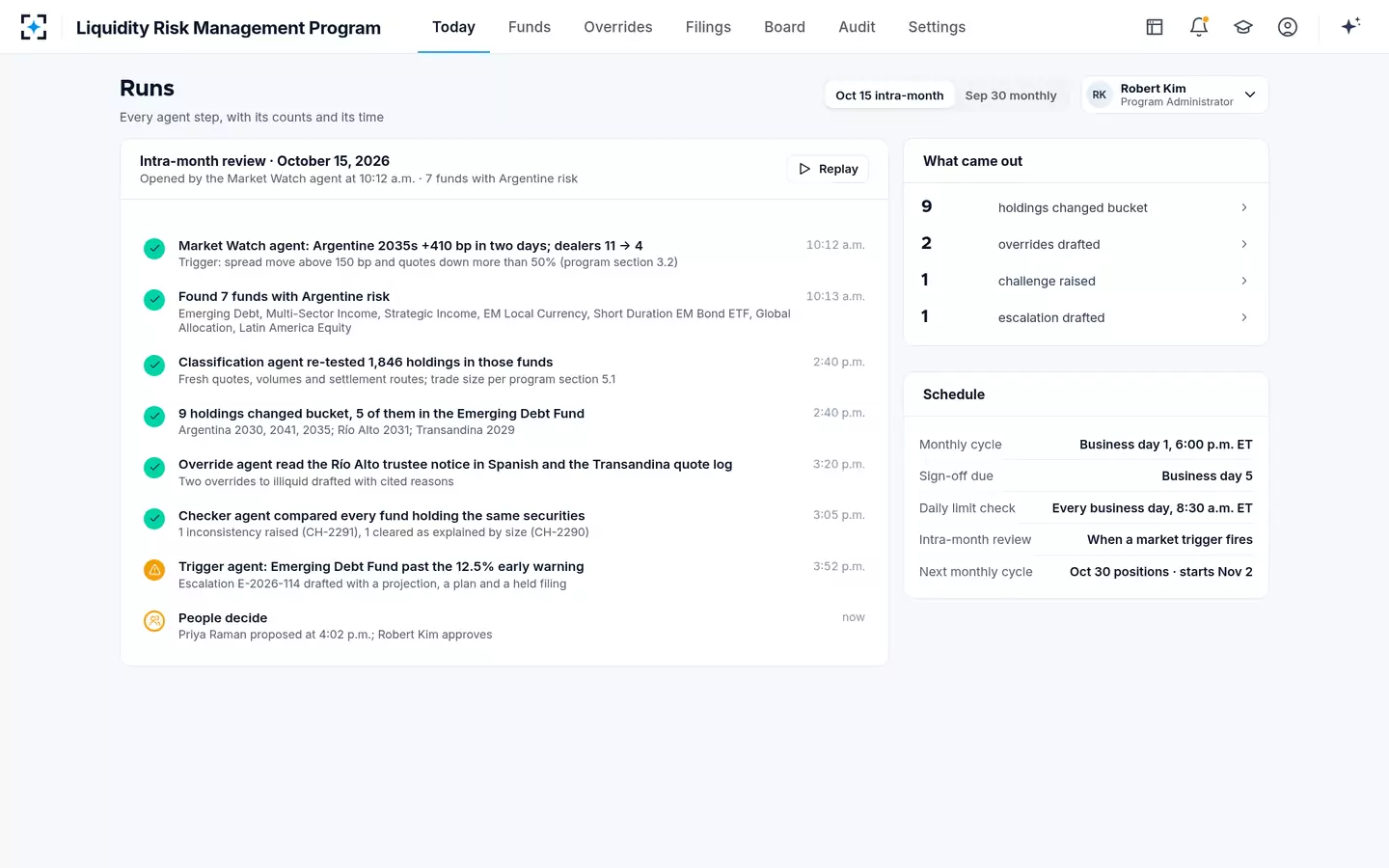
In the solution's sample data, a fictional 90-fund group, an Argentine sell-off moved one bond's spread 410 basis points in two days and cut its dealers from eleven to four. That crossed the program's triggers, and the Market Watch agent opened a review of the seven funds with Argentine risk at 10:12 a.m. The Classification agent re-tested 1,846 holdings, nine changed bucket, and by 4:10 p.m. the Program Administrator had approved a plan for the fund nearest its limit. Every step carried its source and every decision a named person.
An intra-month review that starts itself when the program's triggers fire
The Pinnacle case, the first liquidity rule case, which the SEC dropped with prejudice in July 2025, shows what the rule's board clock looks like when nobody starts it; SEC v. Pinnacle Advisors, read for boards, separates what was alleged from what was found.
Questions people ask
Does the mutual fund liquidity rule apply to ETFs?
Yes, with one carve-out. An ETF that is not an In-Kind ETF classifies its holdings, keeps a minimum if needed and obeys the 15% limit like a mutual fund. An In-Kind ETF, one that redeems in kind apart from a de minimis amount of cash and publishes holdings daily, must still adopt a program and obey the 15% limit, but it does not classify holdings or set a minimum.
Did the 2024 guidance change Rule 22e-4?
No. The rule's text is unchanged since December 2020. The September 2024 release offered guidance on intra-month classification, the meaning of cash and the minimum, and the Commission said it was not adopting amendments to the rule "at this time". Guidance does not bind like a rule, but exams read the program against it.
When does monthly Form N-PORT reporting start?
Under the April 2025 delay, larger fund groups must file monthly reports within 30 days, with each month public, from 17 November 2027 and smaller groups from 18 May 2028. A February 2026 proposal would add 15 days to the filing deadline and keep public disclosure quarterly; it is still a proposal. Liquidity classifications stay confidential either way.
Is a fund's liquidity classification public?
No. Funds report each holding's bucket to the SEC on Form N-PORT, but liquidity information "remains confidential for all months of a quarter". The SEC's staff publish aggregated statistics instead, and what that N-PORT data shows is set out separately.
Where is the Rule 22e-4 adopting release?
The rule was adopted on 13 October 2016 in Release IC-32315 and published at 81 FR 82142 on 18 November 2016. Its economic analysis holds the SEC's original cost estimates and the vendor price range of $50,000 to $500,000 a year quoted at the time. The rule's own note points readers to that release for the factors relevant to classification.
Can a fund breach the 15% limit without buying anything?
Yes. The limit stops new illiquid purchases; it does not force sales. A fund can pass 15% because markets moved, because redemptions shrank its net assets, or because a holding was reclassified. The obligations then are a board report within one business day with a plan, Form N-RN Part B, and a board reassessment of the plan every 30 days.