SEC v. Pinnacle Advisors was the SEC's first case enforcing Rule 22e-4, the liquidity rule for mutual funds. Filed on 5 May 2023 in the Northern District of New York, it charged a fund's adviser, two of its officers and two independent trustees with aiding and abetting the fund's violations; a third trustee settled the same day. On 11 July 2025 the SEC dropped the case against all five with prejudice, and the court closed it on 14 July 2025 (SEC Litigation Release 26347; court docket). Its allegations were never proved and never decided. They still matter to boards because they trace the exact points where a liquidity program fails: a restricted holding classified as sellable, a 15% breach nobody reported, and a board that did not ask. Botminds' Liquidity Risk Management Program, an agentic solution for running a program under the rule, is built so that each of those steps leaves a cited, signed decision.
This page keeps three kinds of statement apart. What the SEC's complaint alleged is labelled as an allegation. What the settled order against the third trustee found is labelled as a finding of a settled order, made without admission or denial and not binding on anyone else. What the rule requires is quoted from the rule.
SEC v. Pinnacle Advisors: six years from the alleged breach to dismissal
- Alleged above 15%12 mo
- Fund wound up; complaint filed35 mo
- Motions to dismiss22 mo
- Dismissed4
What was SEC v. Pinnacle Advisors?
It was a civil action over one small fund's liquidity program. The SEC's press release called it "the first-ever case enforcing the Liquidity Rule" and charged the adviser, Pinnacle Advisors, "for aiding and abetting Liquidity Rule violations by a mutual fund it advised and whose Liquidity Risk Management Program it administered" (SEC press release 2023-90, 5 May 2023). The adviser was the program's administrator; two of its officers were officers of the fund; two independent trustees were charged for their oversight. The fund itself, by then a liquidating trust, was not charged.
The fund was tiny. The settled order records total assets of about $1.89 million in its July 2019 annual report and about $1.61 million in December 2019, and the adviser had about $517,000 under management in February 2022, with the fund as its only client (Release IA-6303). Nothing in the rule scales with size: a $2 million fund owes the same one-business-day board report as a $20 billion one.
The first liquidity rule case in four numbers
26%
top of the 21–26% of net assets the complaint alleged were illiquid, June 2019 to June 2020
Allegation, never proved
$1.6M
total assets of the fund in December 2019
Settled order
$20K
civil penalty ($20,000) in the one settled order, against a trustee
Not admitted or denied
0
findings against the adviser, its officers or the independent trustees
Dismissed with prejudice, July 2025
Why did the SEC drop the liquidity rule case?
The SEC gave a policy reason and no more. Litigation Release 26347 says the Commission filed a joint stipulation to dismiss the action against Pinnacle Advisors, its two officers and both independent trustees with prejudice, having decided in its discretion, as a policy matter, that dismissal was appropriate (LR-26347, 11 July 2025). The court's order of 14 July 2025 dismissed the case "with prejudice as to the conduct alleged in the Complaint", and the defendants waived any claim to recover their legal fees from the government (docket entry 50).
The decision "does not necessarily reflect the Commission's position on any other case."
SEC, Litigation Release No. 26347, 11 July 2025
The docket shows what was pending when the case ended. In March 2025 the court denied the defendants' motions to dismiss "at this time due to a recent change in the law" and allowed them to re-file, arguing that the SEC "lacked authority to promulgate the liquidity rule in question" after the Supreme Court's 2024 decision in Loper Bright Enterprises v. Raimondo. They filed those motions in April 2025; the SEC reported a resolution in principle in May (docket entries 42–47). No court ruled on them. Rule 22e-4 stands unamended, and every fund still owes everything it requires.
What did the SEC allege in Pinnacle Advisors, against what the rule requires?
The complaint's allegations line up, item by item, with four duties in the rule. That is why the case is worth reading after its dismissal: not as evidence that anyone did wrong, but as a list of the places a program can quietly stop working.
Each allegation sits on one duty in the rule
What the SEC alleged (2023, never proved): The adviser and its officers "classified the fund’s largest illiquid investment as a “less liquid” investment, ignoring restrictions, transfer limitations, and the absence of any market for the shares".
What Rule 22e-4 requires: Classify after reasonable inquiry, weighing the market, trading and investment-specific factors the rule lists; illiquid means it cannot be sold in seven calendar days without a significant change in value.
What the SEC alleged (2023, never proved): They did so "disregarding the advice of fund counsel and auditors".
What Rule 22e-4 requires: No rule text on advice; the classification must be reasonable on the information available.
What the SEC alleged (2023, never proved): They "did not present the fund’s board with a plan to reduce the fund’s illiquid investments to 15 percent or lower".
What Rule 22e-4 requires: Report to the board "within one business day of the occurrence" with the extent, causes and a plan; board reassessment every 30 days while above.
What the SEC alleged (2023, never proved): They did not "make required filings with the SEC".
What Rule 22e-4 requires: A confidential report, then Form N-LIQUID and now Form N-RN Part B, within one business day.
What the SEC alleged (2023, never proved): Two independent trustees aided and abetted "by recklessly failing to exercise reasonable oversight of the fund’s program".
What Rule 22e-4 requires: The board approves the program and the administrator, and reads an annual report on its adequacy and effectiveness.
The press release also stated that, according to the complaint, the officers and the settling trustee "misled the SEC's Division of Investment Management about the basis for the fund's liquidity classifications". That allegation, too, was dismissed with the rest.
The settled order that still stands
One part of the case was not dropped. On 5 May 2023 the third trustee, Joseph Masella, consented to an order without admitting or denying its findings: a cease-and-desist order, a $20,000 civil penalty and a six-month suspension from association with any investment adviser or registered investment company (SEC press release 2023-90). The order says its findings "are made pursuant to Respondent's Offer of Settlement and are not binding on any other person or entity in this or any other proceeding" (Release IA-6303).
Read with that limit, the order is the most detailed public account of how a classification can go wrong. It finds that the fund held "approximately 21% to 26.38% of its net assets in illiquid investments" from 1 June 2019 to at least 16 June 2020, and that its largest illiquid holding was 84,332 shares of a private company bought in private placements in 2007–2009, about 23.45% of net assets on 1 June 2019. It finds that fund counsel recommended an illiquid classification on 31 May 2019, that the trustee told the compliance officer on 7 June 2019 not to file the draft Form N-LIQUID "since it would be unnecessary in light of the “less liquid” classification", and that the auditors told him in June 2019 they did not believe the shares could be sold within seven days.
Twenty-eight business days against seven calendar days
The order's description of the shares shows why "less liquid" could not be right, and the arithmetic is worth doing for any restricted holding. The shares were restricted under the Securities Act of 1933, and the company's operating agreement gave the company fifteen business days to exercise a right of first refusal on any bona fide offer, three more business days to tell the other shareholders it would not, and the other shareholders ten business days of their own; a co-sale clause let every shareholder join the sale (Release IA-6303). The order also finds that the company's CEO had said, around 16 May 2019, that the company would not buy the fund's shares.
Days before a buyer could close, against the rule's seven
"Less liquid" requires that the fund can sell or dispose of the investment in seven calendar days or less; only settlement may take longer (Rule 22e-4(a)(10)). A holding that needs four weeks of contractual waiting before a sale can even be agreed fails that test on the face of its own documents. The control that catches this is not a model: it is reading the operating agreement, the subscription agreement and the lock-up, and writing the transfer terms into the classification reason.
A restricted private placement overridden to illiquid in Liquidity Risk Management Program
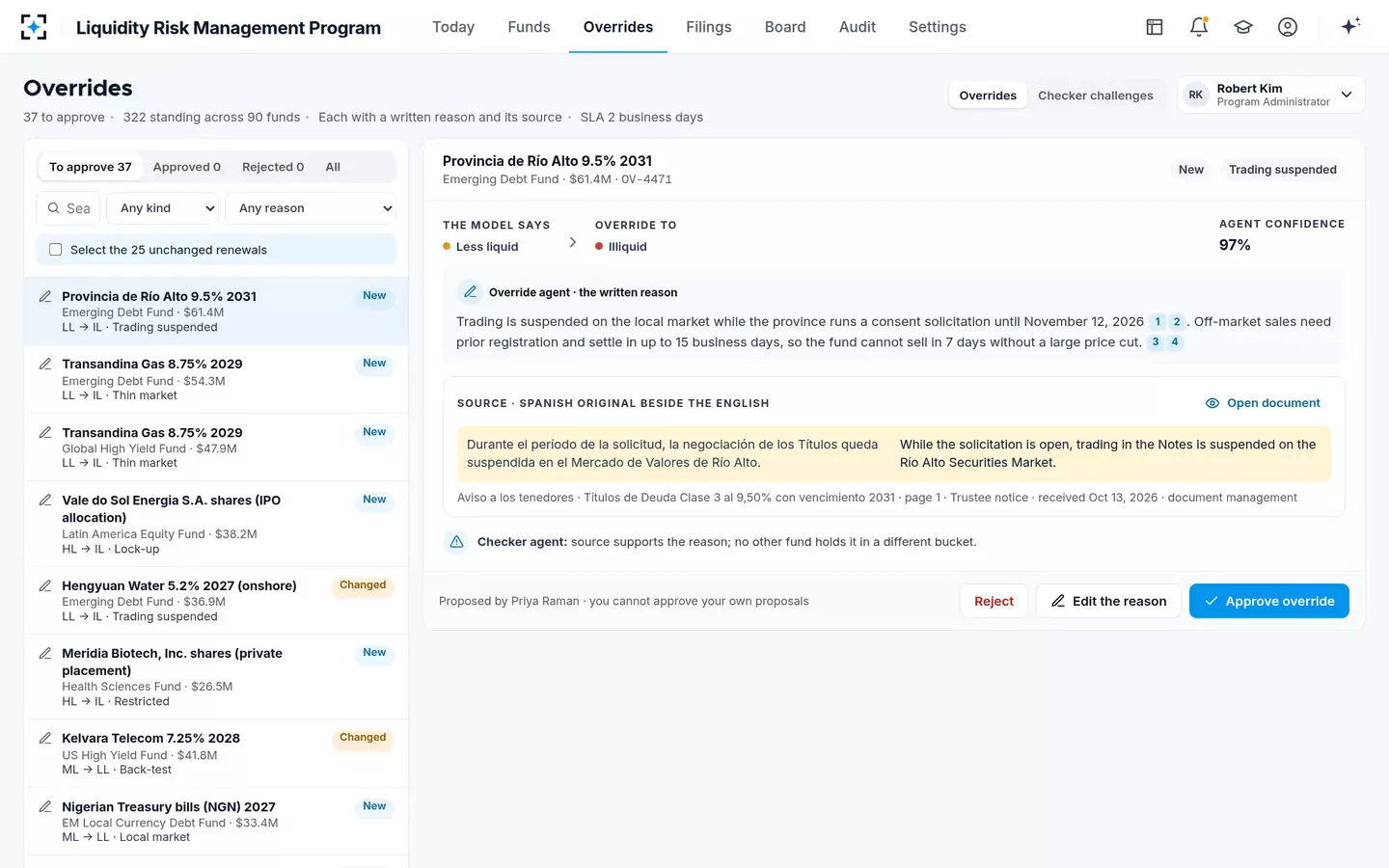
In the list, a sample private placement and an IPO allocation under lock-up are moved to illiquid; the reason names the restriction, not a belief that a buyer exists.
Can trustees be liable for a fund's liquidity program?
The case does not answer that, because the claims against the two independent trustees were dismissed before any court decided them. What it shows is that the SEC was willing to charge independent trustees under the rule: its 2023 release alleged they "knew that the shares were restricted and illiquid" and aided and abetted the violations "by recklessly failing to exercise reasonable oversight of the fund's program", and an SEC official said that "Trustees must exercise oversight on behalf of shareholder interests" (SEC press release 2023-90). The July 2025 release says the dismissal does not necessarily reflect the Commission's position on any other case.
The rule sets the board's duties narrowly, and the adopting release, quoted in the settled order, calls the board's role "one of general oversight" (Rule 22e-4 adopting release, 2016). The board approves the program and the administrator's designation, reviews a written report at least annually, and must assess every 30 days whether the plan for an above-15% fund is still in its best interest (Rule 22e-4(b)(1)(iv)(B), (b)(2)). Examiners look for the evidence of that oversight: the SEC's November 2024 risk alert found board minutes with no record of the program's approval (SEC risk alert, 4 November 2024).
What must a board receive when a fund passes 15% illiquid?
Within one business day, a report from the administrator "with an explanation of the extent and causes of the occurrence, and how the fund or In-Kind ETF plans to bring its illiquid investments that are assets to or below 15% of its net assets within a reasonable period of time" (Rule 22e-4(b)(1)(iv)(A)). The fund files Form N-RN Part B within the same business day, listing each illiquid investment and its share of net assets, and Part C when it is back at or below 15% (Form N-RN). If it is still above 15% after 30 days, and at every 30 days after that, the board, including a majority of independent directors, must decide whether the plan is still in the fund's best interest.
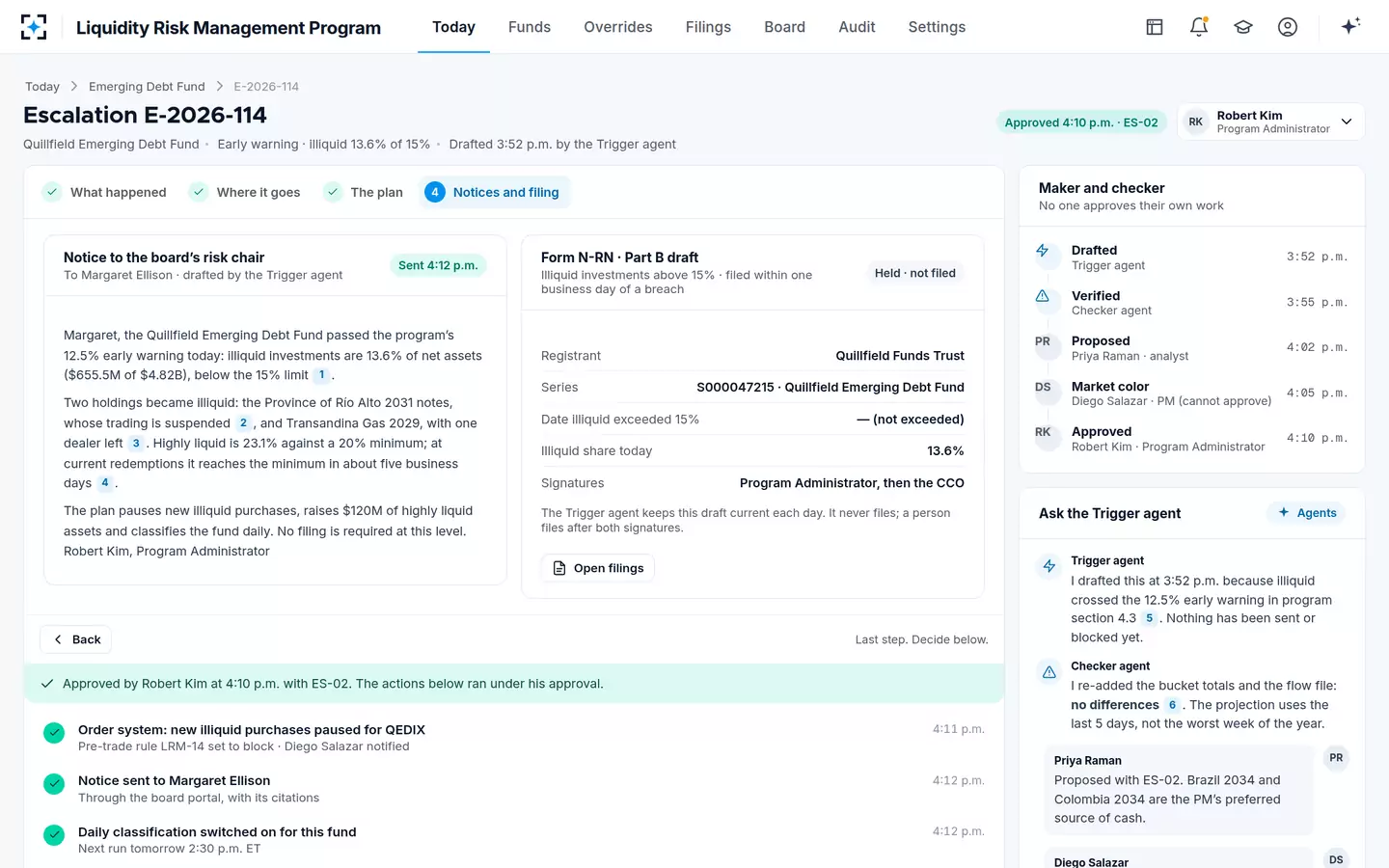
A good report lets a trustee answer three questions without a call: which holdings moved, on what evidence, and what the fund will sell or stop buying, by when. In Botminds' Liquidity Risk Management Program a Trigger agent drafts that notice and a Form N-RN Part B with the figures cited, and nothing goes out until the Program Administrator approves; the filing waits for a second signature from the chief compliance officer.
Liquidity Risk Management Program: the notice a board chair receives, and the filing held
Five controls SEC v. Pinnacle Advisors still tests
A board or chief compliance officer can turn the dismissed case into a test of its own program in an afternoon. Pick the fund's three least liquid holdings and ask for the evidence behind each step below. If any answer is "the portfolio manager believes", the control is missing.
Five controls the Pinnacle allegations map onto
- Restricted and private holdings read from their documents
Transfer restrictions, rights of first refusal, lock-ups and co-sale clauses written into the classification reason, with the clause cited.
- A "less liquid" call that names the buyer path
Sold in seven calendar days requires a market or a committed buyer; a belief that someone is interested is not one.
- Dissent recorded, not overruled in silence
When counsel, auditors or the checker disagree with a bucket, the disagreement and its resolution are signed and kept.
- The 15% clock started by the system, not by a person
Daily limit check; board report and Form N-RN Part B drafted within the business day; a second signature before filing.
- Board approval and oversight in the minutes
Program approval, administrator designation, the annual report and every 30-day reassessment minuted, as the 2024 risk alert expects.
The people who own each of those steps, and what each may never do, are set out in who classifies and who signs. How the rule has moved since the case was filed is in the mutual fund liquidity rule in 2026, and how to test whether a classification process would catch a mislabelled restricted holding is in the planted-error test.
Questions people ask
Did the SEC drop the liquidity rule case?
Yes. On 11 July 2025 the SEC filed a joint stipulation to dismiss SEC v. Pinnacle Advisors with prejudice against the adviser, its two officers and both independent trustees, and the court entered the dismissal on 14 July 2025. The SEC said the decision does not necessarily reflect its position on any other case.
Is a restricted private placement illiquid under Rule 22e-4?
It depends on the rule's test, not the label: whether the fund reasonably expects to sell it in seven calendar days or less without significantly changing its value. Contractual waiting periods, rights of first refusal and the absence of any market weigh against that. In the Pinnacle settled order, transfer terms alone added up to four weeks.
Was anyone found liable in SEC v. Pinnacle Advisors?
No court found anyone liable. The only findings are in the settled order against trustee Joseph Masella, who consented without admitting or denying them, paid a $20,000 penalty and accepted a six-month suspension; the order says its findings bind no one else. The claims against the other five defendants were dismissed with prejudice.
Was Rule 22e-4 struck down?
No. The defendants asked the court in April 2025 to find that the SEC lacked authority to adopt the rule, after the Supreme Court's Loper Bright decision, but the case was dismissed before the court ruled. The rule remains in the Code of Federal Regulations unchanged since December 2020.
Does the 15% limit force a fund to sell?
No. It forbids buying an illiquid investment that would take the fund above 15% and requires a board report with a plan within one business day once the fund is above. In the Pinnacle complaint the alleged failure was not the overage itself but the absence of that plan and of the filings.