Liquidity risk management for a mutual fund means running the written program SEC Rule 22e-4 requires: classifying every holding into four liquidity buckets at least monthly, keeping illiquid investments at or below 15% of net assets, keeping a highly liquid investment minimum where needed, and reporting to the board (17 CFR 270.22e-4). What it costs depends mostly on how many funds share the bill. The SEC's 2016 estimates put the set-up at $0.8 million to $10.2 million for a fund complex and the running cost at $40,000 to $3.3 million a year (Rule 22e-4 adopting release, 2016), and its method assumed a large fixed part. Rebuilt per fund, that makes a fund in a five-fund group carry about $181,000 of set-up cost against about $29,000 in a hundred-fund group. Botminds' Liquidity Risk Management Program, an agentic solution for the program's classification, overrides, limit watching and board reporting, is aimed at the part of that cost that is people's time.
Every figure from the SEC is dated: 2016 estimates are in 2016 dollars and were made before the rule took effect. Where we rebuild them, the arithmetic is shown and labelled as ours. Where no regulator or independent study publishes a figure, such as current vendor prices, the page says so and shows how to measure it yourself.
Set-up cost per fund, by size of fund group: the SEC's 2016 model, rebuilt
What does a liquidity risk management program cost?
There is no current published survey, so the honest answer starts from the SEC's estimates and your own hours. At adoption in 2016 the SEC estimated one-time costs "that range from approximately $0.8 million to $10.2 million, that the average cost per fund complex is $1 million, and the aggregate cost is approximately $855 million", and ongoing costs of "$40,000 to $3.3 million per fund complex" a year (81 FR 82142). Its proposal a year earlier had put set-up at $1.3 million to $2.25 million a complex and $1.3 billion in aggregate.
The ongoing estimate covers classification and the monthly reviews, the periodic review of liquidity risk and of the minimum, systems maintenance, staff training, and the board's approval, annual review and oversight, including preparing board materials and outside counsel. That list is close to the work a program actually does; what has changed since is the 2024 guidance, which asked for intra-month reviews, days to US dollars for every foreign holding, and a firmer basis for each minimum (89 FR 73764). None of that is in the 2016 figure.
What the SEC has estimated, and when
$0.8–10.2M
one-time cost per fund complex, 2016 estimate
Average $1M; aggregate about $855M
$40K–3.3M
ongoing cost per fund complex a year, 2016 estimate
16hours
a fund a year: the 2026 paperwork estimate for 12,183 funds
Plus $3,200 external cost a fund
$50–500K
yearly subscriptions to vendor liquidity classification services, 2016
What does the SEC estimate Rule 22e-4 costs per fund?
The most recent figure is a paperwork estimate, and it is easy to misread. In April 2026 the SEC estimated that 12,183 funds, 705 newly registered funds and 3 unit investment trusts are subject to the rule, with "16 hours for a fund" a year, 202,699 hours in total, and an external cost of "approximately $3,200 per fund" (91 FR 18520, 10 April 2026). Those numbers count the rule's collections of information: adopting the written program, reporting to the board, keeping the record of how each minimum was set and the shortfall procedures, the redemption-in-kind procedures and other records.
They do not count classifying sixty thousand holdings a month. The notice itself warns that its hours serve the Paperwork Reduction Act only and do not come from any survey of what Commission rules cost, and its own arithmetic shows the total moving with how funds are counted and how the sum is done.
The estimated burden hours associated with rule 22e-4 have increased by 9,458 hours from the current allocation of 193,241 hours. This increase is due to an increase in the estimated number of affected entities, as well as revisions in the manner of calculation.
SEC, Rule 22e-4 information collection notice, 10 April 2026
A finance team that budgets the program at 16 hours a fund has budgeted the filing cabinet. The useful SEC numbers for a budget are the 2016 ones, read with their method, and your own hours.
The SEC's 2016 cost model, rebuilt per fund
The SEC built its 2016 range from one commenter's estimate and published its method in enough detail to reproduce. It took a fund group of 87 funds that expected "$2 million in initial implementation costs and more than $650,000 in annual recurring costs for automating a classification process that would have to manage 63,000 different portfolio positions", assumed "fixed costs constitute 30%" of that estimate, scaled the rest linearly with the number of funds, and assumed classification is "approximately 75% of a fund's cost of complying" (81 FR 82142, footnotes 1098–1101). Ongoing costs were set at 5% to 32.5% of the one-time figure.
The method behind the per-fund costs, step by step
- Start from a real estimate. An 87-fund group: $2.0 million to build automated classification for 63,000 positions.
- Split fixed and variable. Fixed cost: 30%, or $0.6 million, the same for every complex. Variable: $1.4 million, scaled by funds in the complex ÷ 87.
- Gross up for the rest of the program. Classification is 75% of the total, so divide by 0.75.
- Add the running cost. 5% to 32.5% of the one-time cost, every year.
- Divide by the funds that share it. One fund: $821,000. Five: $181,000 each. Twenty-five: $53,000. A hundred: $29,000.
The model is crude and the SEC said so: changing the 30% fixed share "would compress the range of costs". But its shape is the point. With a fixed $0.6 million that every complex pays before it classifies a single holding, the per-fund cost falls by a factor of about six between a five-fund and a hundred-fund group, and by more than twenty-five between a one-fund complex and a hundred-fund one.
Is a small fund complex at a disadvantage?
Yes, on the SEC's own numbers. At the end of 2015 the SEC counted 847 fund complexes, 334 of them with only one fund, and estimated that 76 complexes were small fund groups subject to the program requirement (81 FR 82142). It noted that "funds within large fund complexes would incur fewer costs on a per fund basis than funds within smaller fund complexes, due to economies of scale". For a single-fund complex the running cost alone was estimated at $40,000 to $260,000 a year.
Running cost per fund, by size of fund group: the 2016 model's range
| Fund group | Running cost a year, whole group | Per fund, low | Per fund, high |
|---|---|---|---|
| 1 fund | $41,000–$267,000 | $41,000 | $267,000 |
| 5 funds | $45,000–$295,000 | $9,100 | $59,000 |
| 25 funds | $67,000–$434,000 | $2,700 | $17,400 |
| 100 funds | $147,000–$957,000 | $1,500 | $9,600 |
The rule gives a small group no relief on substance. It must classify every holding, review intra-month when markets move, keep the minimum, and report a breach to its board within one business day, exactly as a large group must. The first liquidity rule case the SEC filed concerned a fund with about $1.6 million of total assets, according to the settled order in that case, and the case against the rest of the defendants was dismissed in 2025; SEC v. Pinnacle Advisors sets out what was alleged and what was found.
What do liquidity classification vendors charge?
The only published range is the SEC's 2016 one: "annual costs to subscribe to the liquidity classification services provided by third-party data and analytics providers currently range from $50,000-$500,000" (81 FR 82142, footnote 1103). Vendors don't publish prices, and no regulator or independent study has published a newer range, so treat that figure as a 2016 floor for a market that has grown since.
What can be measured is who supplies the buckets. Since 17 November 2025, Form N-CEN asks each fund to name every liquidity service provider, whether it is affiliated, the asset classes it classified, and whether it was hired or terminated during the period (89 FR 73764). A subscription buys a bucket per security; it does not buy the overrides, the intra-month reviews, the cross-fund reconciliation or the board report, which is where the hours go. To price your own, add the subscription to the internal hours below at your own loaded rates.
How many hours does Rule 22e-4 take per fund? Where the hours go each month
Far more than 16 a year once classification is counted, and most of them go to preparation. The solution's estimate for one monthly cycle at a group of about 90 funds is six working days of a team's time by hand, about one with agents. That is our estimate, not a measured customer result, and the split is the useful part: overrides take the largest share by hand.
A monthly cycle's days, by hand and with Liquidity Risk Management Program
- Positions and vendor data1.5 d
- Buckets at trade size1 d
- Overrides2 d
- Checks0.5 d
- Review, sign-off1 d
- Data, buckets, overrides, checks and sign-off1 d
The costs no estimate counts
Three costs sit outside every published figure. The first is intra-month work: the 2024 guidance found funds "not prepared to review classifications intra-month" and expects procedures that identify the information and its timeliness (89 FR 73764), which means someone watching markets between month ends. The second is exam readiness: the SEC's 2024 risk alert found boards that had not adopted tailored programs or minuted their approval (SEC risk alert, 4 November 2024), and fixing that after an exam costs more than doing it before.
The third is the cost of a wrong bucket, which no estimate can price in advance: a fund that discovers at a redemption that a holding it called moderately liquid takes twelve days to reach dollars, or a breach reported late. A program that classifies faster but no better has cut the wrong cost. How to test whether a cheaper process still catches the errors that matter is in the planted-error test.
Pricing your own program, line by line
A finance team can build a defensible budget in an afternoon from four inputs it already has: the number of funds and holdings, the share of holdings that need a written override, the hours each monthly step takes today, and the loaded cost of the people doing it. The checklist below turns them into a number the board can compare year on year.
A liquidity risk management budget for a mutual fund group: eight lines
- Classification data
Vendor subscriptions and market data, per year; the 2016 SEC range was $50,000–$500,000 for classification services alone.
- Monthly cycle hours
Data pulls, buckets, overrides, checks and sign-off, per cycle, times twelve.
- Intra-month reviews
Hours per review times the number of trigger events last year.
- Override reading
Holdings with a written reason, times the minutes to read the source document.
- Limit watching and escalations
Daily 15% and minimum checks; escalations and board notices.
- Filings
N-PORT liquidity fields monthly; Form N-RN when needed, with two signatures.
- Board work
Annual report, minutes, 30-day reassessments, outside counsel.
- Fixed platform cost, divided by funds
The line that makes a small group’s per-fund cost high.
Liquidity Risk Management Program at 90 funds: one person's list, in order
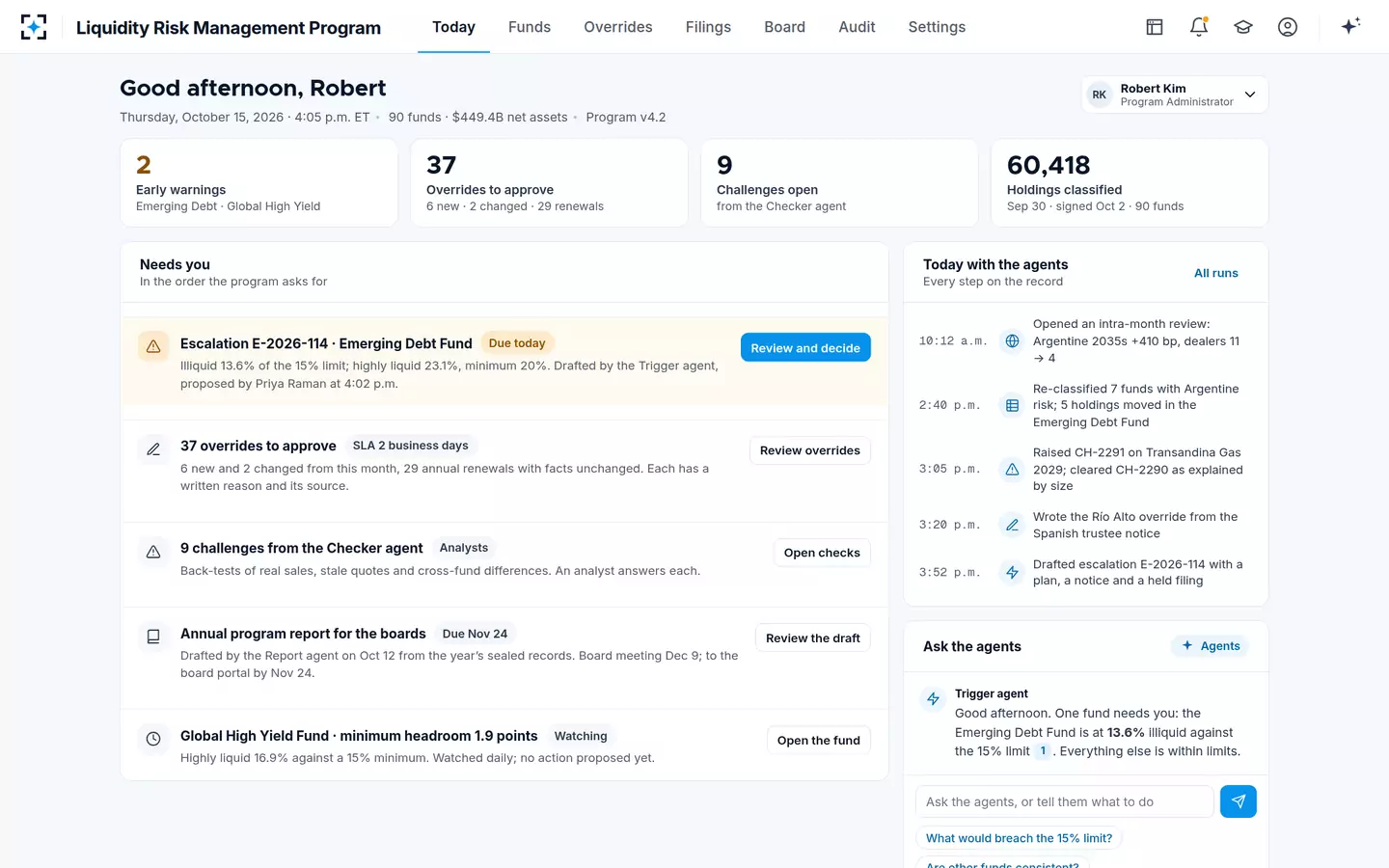
The cost argument for agents is strongest where the fixed cost is spread thin and the reading is heavy: a mid-size group with emerging-market, loan or private holdings and documents in several languages. It is weakest for a group whose funds all primarily hold highly liquid assets and rarely override a vendor bucket. Approaches side by side, on one fund, are in fund liquidity solutions compared.
Questions people ask
How much does a liquidity risk management program cost a mutual fund?
The SEC estimated in 2016 that setting one up cost a fund complex $0.8 million to $10.2 million, about $1 million on average, and running it $40,000 to $3.3 million a year. Per fund, that depends mainly on how many funds share the fixed part: on the SEC's own method, about $181,000 of set-up cost a fund in a five-fund group against about $29,000 in a hundred-fund group, in 2016 dollars.
Why is the SEC's 16-hour estimate so low?
Because it is a Paperwork Reduction Act estimate of the rule's collections of information, such as adopting the written program, reporting to the board and keeping records. The notice itself says it is not derived from a comprehensive or representative study of the cost of Commission rules, and it does not count the monthly classification work.
Do money market funds need a Rule 22e-4 program?
No. Money market funds are outside Rule 22e-4's definition of a fund and manage liquidity under Rule 2a-7, so they carry neither the program's classification cost nor its 15% limit.
Can fund groups share one liquidity program?
An adviser can run the programs of many funds, and the SEC staff say it is "under no obligation to reconcile the elements of those programs" where they differ; each fund's board-approved program governs. Sharing the people, systems and data across funds is how large groups get the per-fund cost down.
What is the fund liquidity regulation outside the US?
In the EU, liquidity rules for funds rest on liquidity stress testing and on liquidity management tools rather than on Rule 22e-4's four buckets; under rules that apply from 16 April 2026, EU funds must select at least two tools from a harmonised list. Botminds covers that side in its Liquidity Stress Testing solution; liquidity management tools under AIFMD II sets out what applies from April 2026.