Fund liquidity solutions for US mutual funds and ETFs are the tools and services used to run a Rule 22e-4 liquidity risk management program: classifying every holding into four liquidity buckets at least monthly, watching the 15% illiquid limit and the highly liquid investment minimum, and reporting to the board and the SEC (17 CFR 270.22e-4). There are three ways to do it: subscribe to a vendor's liquidity classifications, build an in-house model, or put agents to work on top of either. On an ordinary holding all three print the same bucket. They part company on the hard ones: restricted and suspended securities that need a document read, a market that moves mid-month, and a foreign bond whose dollars arrive after the sale settles. Botminds' Liquidity Risk Management Program is an agentic solution of the third kind, built to keep a fund's own market data and vendor feeds and add the reading, checking and drafting around them, with people approving every decision.
This comparison runs all three on one fictional fund and is written for a program administrator choosing or replacing an approach. It names no vendor. It is honest about where agents add little, and it ends with a switch plan that keeps monthly N-PORT reporting unbroken.
Fund liquidity solutions compared: three approaches, row by row
Vendor buckets: A bucket and days-to-liquidate figure per security, from the vendor’s model
In-house model: A bucket per holding from your own data and formulas
Agents on top: A proposed bucket per holding, with the sources and the four tests behind it
Vendor buckets: The vendor’s inputs, configured to yours where the service allows
In-house model: Yours, as coded
Agents on top: Yours, read from the written program’s settings
Vendor buckets: Only if the service models settlement and currency conversion for each market
In-house model: Only if someone built the conversion step
Agents on top: Counted for every foreign holding from settlement route and conversion
Vendor buckets: Done by your team, outside the feed
In-house model: Done by your team, often in a comment field
Agents on top: Reason drafted from the source document, cited, for a person to approve
Vendor buckets: A new feed when the vendor updates
In-house model: When someone reruns the model
Agents on top: Opened by the program’s own triggers; only affected holdings re-tested
Vendor buckets: Same bucket unless sizes differ
In-house model: Reconciled by hand
Agents on top: Compared every cycle; differences need a reason
Vendor buckets: Vendor methodology documents and your oversight file
In-house model: Your model documentation and spreadsheets
Agents on top: Each decision with who, when, why and the source
Vendor buckets: Your administrator, on the vendor’s proposal
In-house model: Your administrator
Agents on top: Your administrator; agents never approve or file
What fund liquidity solutions exist for Rule 22e-4?
The market sorts into the same three kinds the SEC has been watching since 2016. The adopting release put a year's subscription to a vendor's liquidity classification service at $50,000 to $500,000 in 2016 (81 FR 82142; the cost by fund size), and two commenters estimated what it would cost to build their own systems for 44,000 and 63,000 positions. In 2021 the SEC's examiners named "appropriate oversight of third-party vendors providing liquidity classifications of holdings" as an exam focus (SEC risk alert, 26 October 2021), and since 17 November 2025 Form N-CEN asks each fund to name its liquidity service providers, the asset classes each one classified, and any hired or terminated during the period (89 FR 73764).
The third kind is newer. Agents do not replace the market data that vendor services and in-house models compute; they read it, apply the written program to it, read the documents behind the exceptions, compare funds, watch limits and draft the reports. The question for a buyer is not which bucket is right on an average holding but which approach leaves the fewest unexplained decisions on the difficult ones.
What a buyer is choosing between, in published numbers
$50–500K
a year for vendor liquidity classification services, as the SEC reported in 2016
Nov 2025
since when Form N-CEN names each fund’s liquidity service providers
4
buckets, unchanged: the 2022 proposal to drop “less liquid” was not adopted
30days
to file monthly N-PORT from November 2027 for larger groups, unless the 2026 proposal changes it
One fund, three approaches: five holdings where they disagree
Take a fictional fund, the Okeford Emerging Debt Fund: $900 million of net assets, 280 holdings in hard-currency sovereigns, local-currency bonds and a few corporate notes. Most of its holdings land in the same bucket under all three approaches. Five do not, and each tests a different part of the rule.
Five holdings that separate fund liquidity solutions
| Holding (fictional) | What the rule needs | Where approaches split |
|---|---|---|
| A dollar sovereign whose remaining dealers bid only for local settlement | Days until US dollars arrive, not days to sell: sold in five, cash in ten, so less liquid | Depends on whether settlement route and currency conversion are modelled for that market |
| Local-currency bills in a market that has just imposed capital controls | If dollars cannot be had in seven calendar days, the currency and what sells into it are illiquid | A feed that classifies by local-market depth calls them liquid; the 2024 guidance says that over-estimates liquidity |
| A provincial note whose trading is suspended during a consent solicitation | The suspension notice decides the bucket, whatever the last quote says | Only an approach that reads the trustee’s notice, here in Spanish, catches it before month end |
| A corporate bond position the manager doubled mid-month | Reclassify at the larger trade size if it materially changes liquidity | Caught only if position changes are a trigger, not just market moves |
| A bond in a market closing for an eight-day holiday | Advance board notice; the staff would not object to no filing if illiquid solely for the closure | Caught only if a holiday calendar runs ahead of the cycle |
Vendor buckets vs in-house liquidity model
The choice between them is mostly about inputs and control. A vendor service brings market data a fund cannot easily assemble, trade and quote histories across thousands of securities, and a methodology document. Its weakness is that its trade size and value impact may not be the fund's, and the rule makes the fund ask whether selling the amounts it would expect to trade changes an investment's liquidity (Rule 22e-4(b)(1)(ii)(B)). The SEC observed in 2022 that some funds' and vendors' trade sizes and value-impact methods "tended to over-estimate a fund's liquidity in March 2020 because they considered relatively smaller trade sizes or used value impact methodologies with longer lookback periods" (87 FR 77172).
An in-house model fixes the inputs but costs build and upkeep, and it is only as complete as what was coded. The trap the 2024 guidance named is a model that stops at local settlement: staff saw international funds using the time to convert into some other currency, "even though the funds pay cash redemptions in U.S. dollars" (89 FR 73764). Both approaches share the same blind spot: neither reads a lock-up agreement or a trustee's notice, so overrides stay a manual job, which is where most of the hours go.
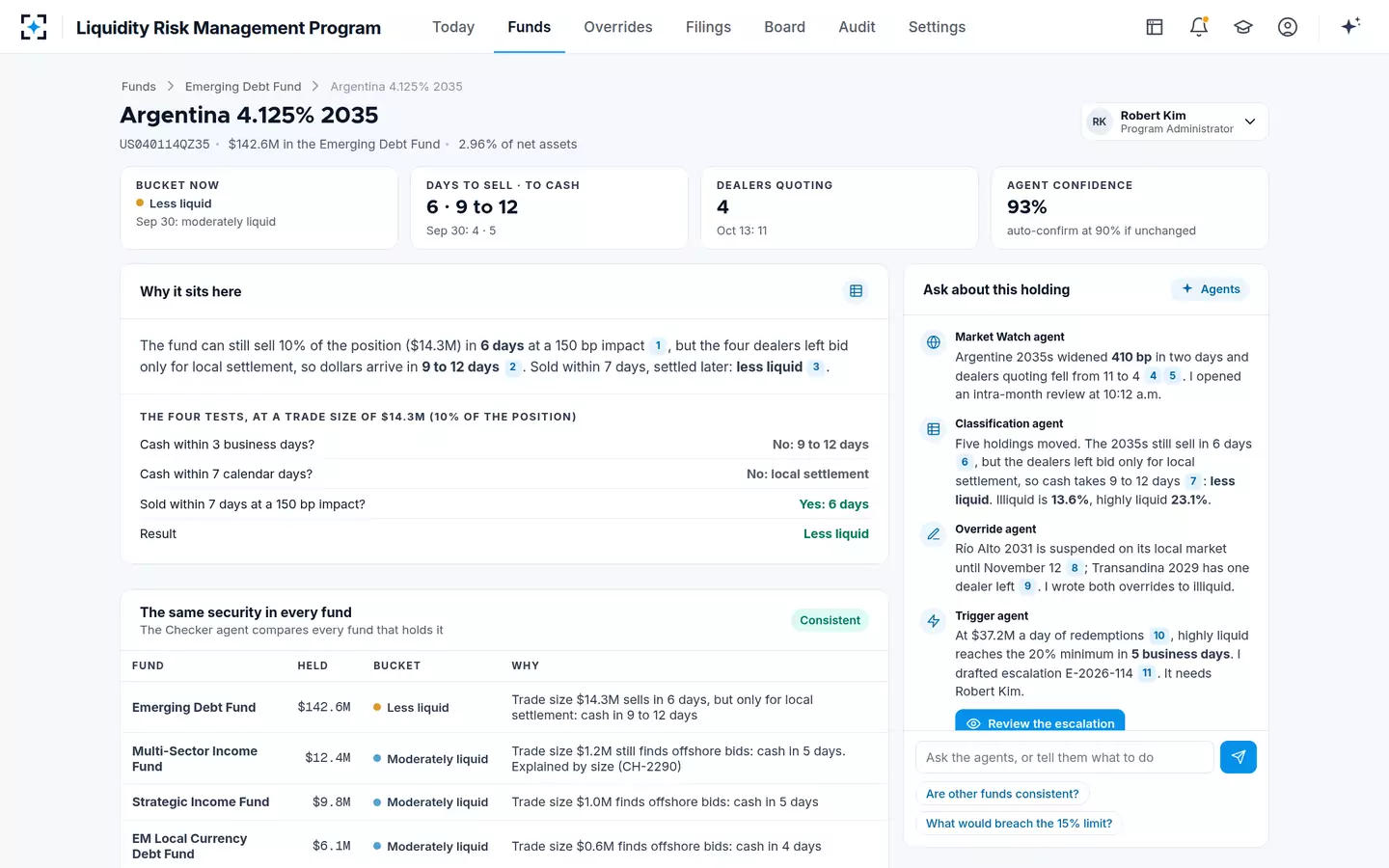
One holding in Liquidity Risk Management Program: four tests, every fund
Where they differ most: overrides
Overrides are where a program's judgement lives, and where an examiner looks first. A restricted private placement, a lock-up, a suspended security or a defaulted bond can have perfect market data and still be illiquid. The dismissed Pinnacle case turned on one: in a settled order, which the trustee neither admitted nor denied, the SEC found a restricted private placement classified "less liquid" against counsel's and auditors' advice; the case against the other defendants was dismissed with prejudice in 2025 (the case, read for boards).
A vendor feed and an in-house model leave the override to a person, typically as a one-line comment. Agents can draft the reason from the document, quote the clause, cite the page and put it in front of the administrator. In the solution's sample data there were 37 overrides waiting for approval in one cycle and 322 standing across 90 funds, each with its written reason and source.
Where they differ: intra-month triggers and cash in US dollars
The 2024 guidance made both of these exam questions. On timing, funds must review classifications "more frequently" than monthly when changes are reasonably expected to materially affect them, and staff found funds "not prepared to review classifications intra-month" (89 FR 73764). The SEC staff allow policies to limit triggers to events "that are objectively determinable" and to re-test only the investments affected (Q28–Q29). A vendor feed updates on the vendor's schedule; an in-house model updates when someone runs it; agents can open a review when the program's own trigger fires.
On cash, the rule now means US dollars only (the minimum, worked), and a local currency that cannot be converted within seven calendar days "because of currency controls or otherwise" is illiquid, along with what sells into it (89 FR 73764). Whatever approach a fund uses, it should be able to show, for each foreign holding, the number of days to dollars and where that number came from.
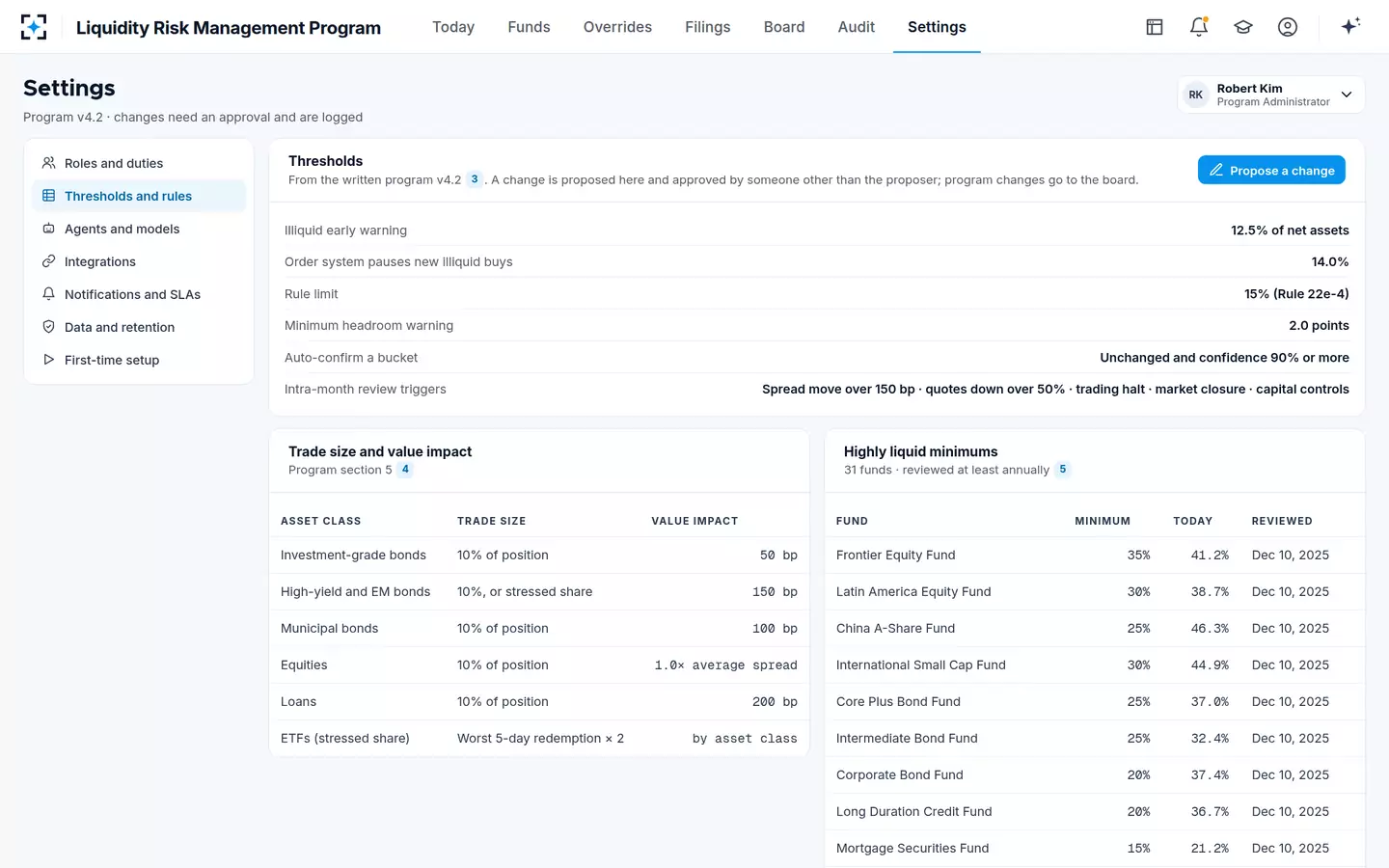
The program's assumptions, as settings two people must approve
What to ask a liquidity classification vendor
Ask questions an examiner would ask, and ask for answers on your own holdings. The SEC's oversight expectation from 2021 still frames it: a fund must be able to show it oversees the vendor, not merely that it subscribes.
Ten questions for any fund liquidity solution, vendor or agent
- Whose trade size and value impact?
Can it use yours, by asset class, and show where they are set?
- Days to US dollars?
For each foreign holding: settlement route, conversion time, capital controls.
- What happens on a restricted or suspended security?
Does it flag it, and does anyone read the document?
- How fast after a market event?
Daily feed, on request, or a trigger your program defines?
- Same security, different funds?
Does it compare them and record why buckets differ?
- What evidence does each bucket carry?
Inputs, sources and who approved it, kept at least five years.
- Can it approve, file or trade?
It should not; a named person approves and files.
- How is it tested?
Back-tests against real sales, and a seeded test with planted errors.
- How does it feed N-PORT?
One bucket per holding (Item C.7), the minimum (Item B.7), reconciled across sleeves.
- What changes if we leave?
Data you keep, and a hired-or-terminated entry on Form N-CEN.
How to run the seeded test, with forty planted errors and a scoring sheet, is in the planted-error test. Which of the program's tasks an agent should take and which must stay with people is in AI tools for mutual funds' liquidity programs.
Can we keep our vendor buckets and add agents?
Yes, and for most funds that is the sensible design. The vendor's market data stays the input; the agents apply the written program to it, read the documents behind exceptions, compare funds, watch the limits and draft the reports. Nothing in Rule 22e-4 prefers one source of buckets over another; it asks for reasonable inquiry and a program that is reasonably designed.
Vendor buckets with Liquidity Risk Management Program on top: keep the feed, add the checks
Vendor buckets alone: The vendor’s
Vendor buckets with agents on top: The vendor’s, unchanged
Vendor buckets alone: The service’s configuration
Vendor buckets with agents on top: Re-applied from the written program and shown per holding
Vendor buckets alone: Typed by an analyst
Vendor buckets with agents on top: Drafted from the source document, cited, approved by the administrator
Vendor buckets alone: When the feed changes
Vendor buckets with agents on top: When the program’s triggers fire, on the affected holdings
Vendor buckets alone: Checked at month end or by hand
Vendor buckets with agents on top: Checked every business day, projected forward
Vendor buckets alone: Assembled by hand
Vendor buckets with agents on top: Drafted with citations, signed by people
How do we switch without a gap in N-PORT reporting?
Run the new approach beside the old one for at least one full month, and cut over on a month end that has already been filed. N-PORT carries one liquidity classification per holding each month, and the SEC staff say a fund may report only one classification for each investment (Q8), so a cut-over mid-month leaves a month whose buckets came from two processes. The 2024 amendments, delayed to 17 November 2027 for larger fund groups and 18 May 2028 for smaller ones, would require each monthly report within 30 days of month end (90 FR 16812), which shortens the margin for a messy switch.
A switch with no reporting gap: dry run, parallel month, cut-over
- Settings from the written program2 wks
- Dry run on a filed month1 wk
- Parallel month, old process files4 wks
- Cut-over at a month end1 wk
Three things go to the board around a switch. A change in who supplies or produces classifications is likely to be a material change to the program, which the administrator's annual report must cover (Rule 22e-4(b)(2)(iii)). A vendor hired or terminated is reported on Form N-CEN. And the parallel month's differences, holding by holding, with the reason for each, are the best evidence the board will get that the new approach is at least as good. The SEC's fiscal 2027 priorities say examiners will look at how firms' "super intelligence (SI)" tools "influence outcomes" (SEC, FY2027 examination priorities); the parallel month is that evidence for a liquidity program.
Where agents fit least: a fund group whose funds all primarily hold highly liquid assets, with no minimum and few overrides, gets most of what it needs from a vendor feed and a disciplined monthly review. Where they fit best: many funds, many holdings needing judgement, documents in several languages, and markets that move between month ends. The cost side of that choice is in the cost by size.
Questions people ask
What is a liquidity risk management tool for funds?
Any system a fund uses to run its Rule 22e-4 program: a vendor's classification service, an in-house model, or an agent-based tool. At minimum it must produce one bucket per holding each month at the fund's own trade size and value impact; a full program tool also watches the 15% limit and the minimum, records overrides and drafts board reports.
Is a vendor liquidity classification enough to comply with Rule 22e-4?
It can be the main input, but the program remains the fund's. The fund must oversee the vendor, apply its own reasonable trade size and value impact, handle exceptions such as restricted securities, review intra-month when markets move, and report to its board. Since November 2025 it must also name the vendor on Form N-CEN.
Should we build an in-house liquidity model?
Build if the fund group has the data, the people to maintain it and holdings where control of inputs matters more than breadth of market data. Budget for upkeep and documentation as well as the build; the 2016 SEC estimates were based on a fund group expecting $2 million to automate classification for 63,000 positions and over $650,000 a year to run it.
Do agents replace market data vendors?
No. Agents need market data, dealer quotes, volumes and settlement information to work from, and they take it from the same vendors and systems a fund already uses. What they replace is the manual reading, comparing and drafting around the data.
How long does it take to switch liquidity solutions?
Plan for about two months: settings taken from the written program, a dry run on a month already filed, one parallel month, then a cut-over at a month end. The old process should keep filing N-PORT until the board-approved cut-over.