The Rule 22e-4 FAQs are the SEC Division of Investment Management staff's published answers to questions about running a liquidity risk management program, and the page was last updated on 9 March 2026 (SEC staff FAQ on investment company liquidity risk management programs). They cover sub-advised funds, In-Kind ETFs, classifying by asset class, provisional classification and compliance monitoring. The answers are the staff's views, not rules adopted by the Commission, but examiners read programs with them in hand, so a program that ignores them carries the burden of explaining why. Running a program is hard precisely where these questions sit: the same bond held by two funds, two managers disagreeing, a market that shuts for a week. Botminds' Liquidity Risk Management Program is an agentic solution that turns each answer into a check its agents run and a decision a named person signs.
What follows takes the staff's answers in the order a liquidity analyst meets them, quotes them where the exact words matter, and ends each with the control it implies. The figure maps all of them at once.
The SEC liquidity rule FAQ, mapped: question, staff position, control to test
Same investment, different buckets in two funds? (Q5)
Staff: Allowed: funds may use different methods and assumptions.
Control: Every cross-fund difference has a written reason (trade size, settlement route), or is fixed.
Adviser and sub-adviser disagree? (Q6–Q7)
Staff: The program may name who decides; the fund must reconcile for N-PORT.
Control: A named tie-break rule, applied the same way every month.
One investment, several sleeves on N-PORT? (Q8)
Staff: N-PORT takes one classification; pick a method and keep it.
Control: Largest position, weighted, or most conservative, stated in the program.
Classifying by asset class? (Q16–Q18)
Staff: Flag investments that depart significantly from the class; a framework may be automated.
Control: Exception rules tested periodically; false positives counted too.
What trade size? (Q19–Q21)
Staff: A reasonable assumed size; zero or near zero is not reasonable.
Control: Trade size per asset class written into the program and re-checked.
Classify before buying? (Q30–Q31)
Staff: Not required, but policies should limit illiquid purchases.
Control: A pre-trade screen on asset types likely to be illiquid.
Newly acquired investment? (Q27)
Staff: May wait for the next monthly review, with exceptions.
Control: Intra-month classification when a buy changes the fund’s liquidity profile.
Intra-month trigger: reclassify everything? (Q28–Q29)
Staff: No: only investments reasonably expected to be affected.
Control: Objectively determinable triggers, each mapped to the holdings it touches.
How often to check the limits? (Q24)
Staff: Regularly; values can follow the daily NAV using last verified buckets.
Control: A daily limit check against verified buckets.
When does a breach start? (Q32–Q33)
Staff: Verify within three business days; the period starts on the trade date.
Control: The clock is stamped with the trade date, not the verification date.
Long foreign market holiday? (Q34)
Staff: No filing needed if illiquid solely because of it; advance board notice suffices.
Control: A holiday calendar that pre-warns the board before the closure.
What are the Rule 22e-4 FAQs, and how much weight do they carry?
They are a living page of staff answers, grouped under five headings: sub-advised funds, ETFs, asset class liquidity classification, provisional classification and compliance monitoring, and a final question on ETFs that redeem in kind. Several answers use the form's old name, Form N-LIQUID, which the Commission retitled Form N-RN in December 2020 (85 FR 83162). Where an answer says "the staff would not object", it describes how the staff would treat a practice, not a safe harbour in the rule.
They matter because the rule is short and the hard questions are not in it. Rule 22e-4 says a fund must classify "each of the fund's portfolio investments" and review them "at least monthly" (Rule 22e-4(b)(1)(ii)); it does not say what happens when two sub-advisers disagree, or when a market shuts for a week. The SEC's examiners have asked about exactly those mechanics: their 2021 risk alert made the oversight of vendors that supply liquidity classifications an exam focus (SEC risk alert, 26 October 2021).
The staff's liquidity FAQ at a glance
35
questions answered on one SEC staff page
5
headings, from sub-advised funds to compliance monitoring
3business days
to verify a provisional classification that signals a breach
9 Mar2026
when the page was last updated
May different funds classify the same investment differently?
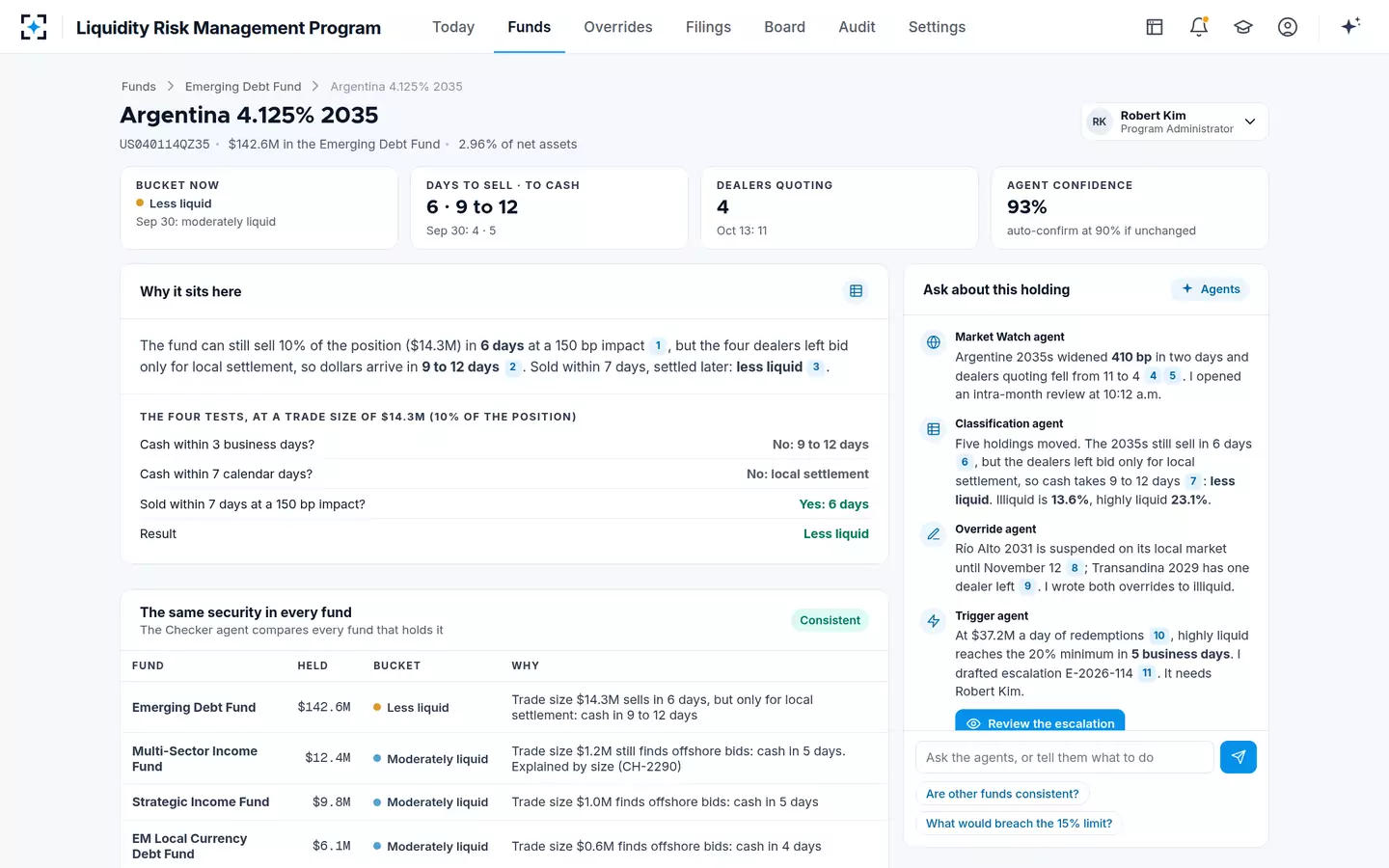
Yes. The staff answer quotes the Commission: "[T]he Commission recognizes that different funds may classify the liquidity of similar investments differently." Funds, including funds in the same complex, may use different methods and assumptions, so the same bond can sit in two buckets in two funds and both can be right (SEC staff FAQ, Q5).
The difference has to have a reason a reviewer can read. The most common legitimate one is size: the rule makes each fund ask whether selling the sizes it would expect to trade changes an investment's liquidity (Rule 22e-4(b)(1)(ii)(B)), and a $14 million block and a $1 million block of the same emerging-market bond do not find the same bids. The illegitimate one is drift: two analysts, two vendor feeds, two dates, and nobody comparing. The control is a cross-fund comparison every cycle that either writes down why the buckets differ or changes one of them.
The same security in every fund, with the reason each bucket differs
What if a sub-adviser and adviser classify a holding differently?
The program decides, and it should say how in advance. For a fund with an adviser and a sub-adviser, the staff list acceptable approaches, including giving one party final authority, using a factor analysis or hierarchy, or adopting the least liquid classification, so that "in the event of a classification difference, a specified party's determination" controls (Q6). In a manager-of-managers fund where several sub-advisers each run a sleeve, the staff do not require the differences to be resolved for compliance, but "a fund must reconcile such classification differences for purposes of reporting on Form N-PORT" (Q7).
That last step needs a fixed rule because "Form N-PORT does not permit a fund to report more than one liquidity classification of a single investment" (Q8). The staff mention the largest position's bucket, a weighted average rounded to a bucket, or the most conservative bucket, applied consistently. The weak point is consistency: a method chosen month by month to flatter the 15% figure is not a method.
Two managers, one bond: what the program must settle before month end
Without a written tie-break: Moderately liquid, $8M position
With one: Moderately liquid, $8M position
Without a written tie-break: Less liquid, $21M position
With one: Less liquid, $21M position
Without a written tie-break: Whichever the analyst entered last
With one: Less liquid: the program reports the largest position’s bucket
Without a written tie-break: Unaffected, but the reason is unrecorded
With one: Unaffected; method, inputs and result kept with the filing
Without a written tie-break: May flip if the analyst changes
With one: Same method, so a change in the bucket means a change in the market
Must a fund classify an investment before buying it?
No. "A fund is not required to classify an investment (or conduct any related compliance monitoring) prior to acquisition" (Q30). But the 15% limit applies at the moment of purchase, so the staff expect funds to "implement reasonably designed policies and procedures to appropriately limit illiquid investments" (Q31). One approach they describe is a preliminary evaluation of the asset classes likely to be illiquid, which may be automated and periodically tested, with tighter restrictions as illiquid holdings grow.
In practice that is a pre-trade rule in the order management system: private placements, restricted securities, loans in certain markets and anything in a jurisdiction under capital controls are held for a liquidity check when the fund is close to the limit. In Botminds' Liquidity Risk Management Program the order system pauses new illiquid buys at a threshold the written program sets, 14.0% in the sample settings, and an approved escalation can bring the pause forward once a fund passes its early warning.
When must a newly acquired investment be classified?
Usually at the next monthly review. "The rule does not specify when a fund initially must classify a newly acquired investment", and the staff would not object to classifying it, or a materially changed position, at the next scheduled monthly review, except where an intra-month review is required or the 15% limit is in play (Q27). The 2024 guidance narrowed that: funds "generally should consider classifying newly acquired investments intra-month if acquiring a particular investment is reasonably expected to result in material changes to the liquidity profile of a fund", and a substantial increase in a position can change its bucket because the fund may reasonably anticipate trading a larger size (89 FR 73764, September 2024).
The intra-month review itself is targeted. Funds need not reassess everything when a trigger fires: "[A] fund must review and determine whether to reclassify only those particular investments" reasonably expected to be materially affected (Q29), and policies may limit triggering events "to those that are objectively determinable" (Q28). That is a design specification for the triggers: a spread move above a stated number, dealer quotes down by a stated share, a trading halt, a market closure, capital controls, each mapped to the holdings it can touch.
How should a fund handle a foreign market holiday?
Plan for it and tell the board first. Some foreign markets close for seven or more calendar days. The staff say "an anticipated extended holiday closure presents liquidity risk to a fund", but that "the staff would not object if a fund does not file Form N-LIQUID" (now Form N-RN) when an investment becomes illiquid solely because of such a closure, and that "such advance board notification would satisfy the board notification requirement" (Q34). The fund must still manage the risk the closure creates.
An anticipated extended holiday closure presents liquidity risk to a fund.
SEC staff FAQ, Q34 (updated 9 March 2026)
The control is a holiday calendar that runs ahead of the classification cycle: for each market, the closure dates, the funds and holdings affected, the projected illiquid share during the closure, and a board notice drafted and sent before the market shuts. A fund that discovers the closure on the day its buckets move has missed the window the staff describe.
How often should a fund check its minimum and the 15% limit?
Regularly enough to catch changes in value, purchases and reclassifications, which in practice means every business day. The staff say existing investments can be valued "in conjunction with its daily computation of net asset value", and that a fund may use "the classifications that it last verified and determined" rather than reclassifying daily (Q24). A monitoring signal on its own does not start the reporting clock; the staff tie reporting to the fund verifying and determining a breach under its procedures, while the fund must comply with the limit and its minimum at all times (Q26).
The highly liquid investment minimum has its own clocks and its own arithmetic, from pledged collateral to the seven-day rule; the minimum, worked on one fund goes through them.
When does the liquidity reporting clock start?
On the trade date, not the day someone notices. Where a provisional classification suggests a breach, verification "should be completed within three business days or less", and the reporting obligation arises on verification (Q32). But the breach period that the fund reports runs from the date of the triggering event, "on the trade date of the event that led to the fund being out of compliance", with the days spent verifying included; the fund may note both dates in its filing (Q33).
Form N-RN itself is due one business day after the event (Form N-RN instructions), with a weekend or SEC holiday pushing the start to the next business day (Form N-RN, General Instruction A). A process that verifies on day three and files on day four has met the deadline; one that waits for the monthly cycle has not. The board report on a 15% breach runs on the same one-business-day clock (Rule 22e-4(b)(1)(iv)(A)).
Classifying by asset class: exceptions, trade sizes and value impact
The staff give funds room on method and ask for discipline on testing. Exceptions within an asset class are investments whose liquidity departs significantly from the class range, and the staff recognise that "more sensitive exception methodologies may result in numerous false positives" (Q16). A fund may rely on an automated exception framework without justifying each security, but "would conduct periodic testing of the framework and processes" (Q17). On trade size, a fund may use reasonable simplifying assumptions such as a pro rata sale, but "a zero or near zero reasonably anticipated trade size would not be a reasonable assumption" (Q21). On value impact, "what constitutes a significant change in market value may vary by fund, asset class, or investment" (Q22).
Each of these is an assumption the board should be able to see. In the sample settings of Liquidity Risk Management Program the trade size is 10% of the position and the value impact 50 basis points for investment-grade bonds, 150 for high-yield and emerging-market bonds, 100 for municipal bonds, 200 for loans and one average spread for equities, all taken from the written program and changed only by two people.
Turning the staff's answers into daily controls in Liquidity Risk Management Program
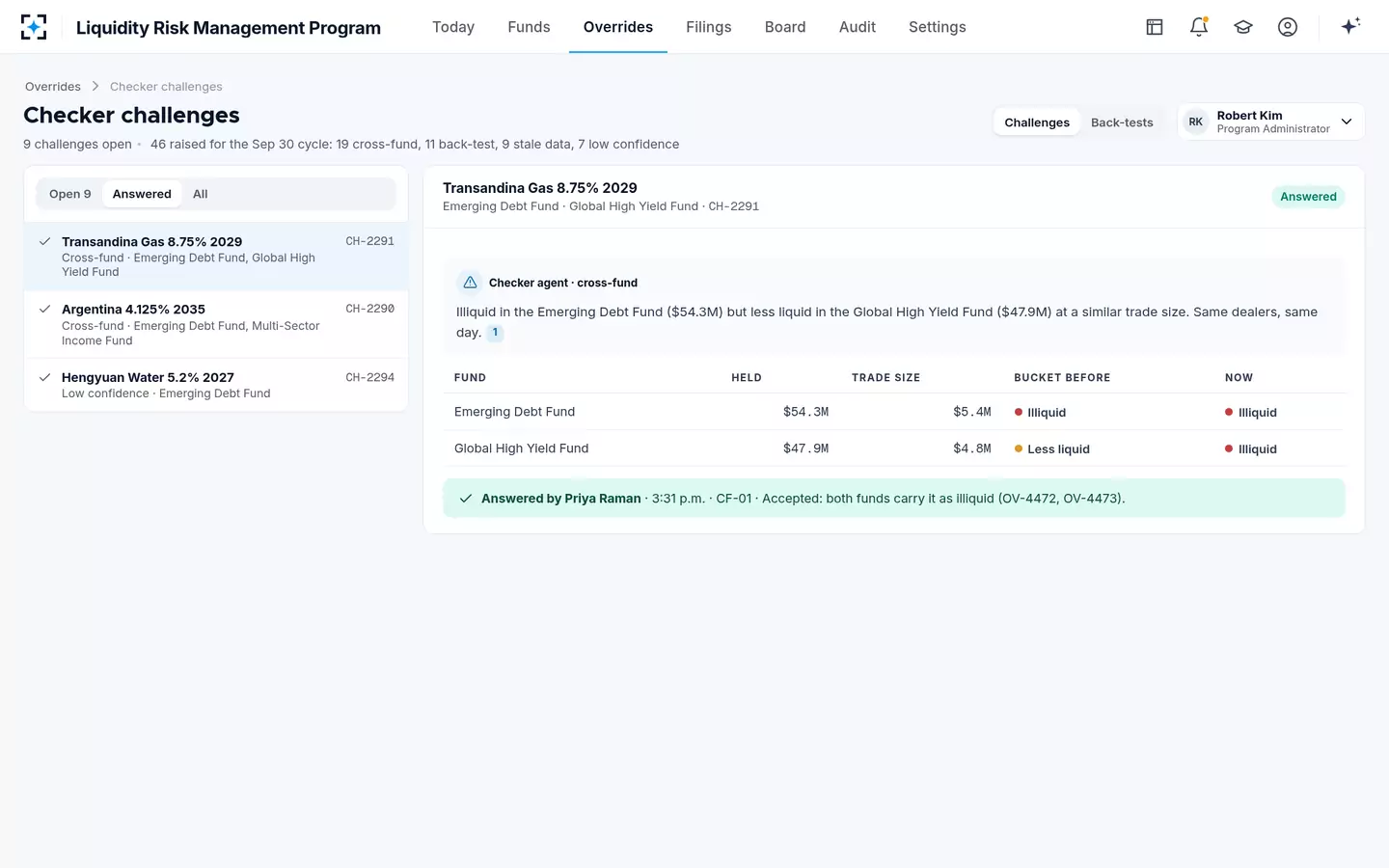
A control is an answer the program can check without asking anyone. In Botminds' Liquidity Risk Management Program, the Checker agent re-tests every proposed bucket: the same security across every fund, back-tests of real sales from the order system against the bucket each sale carried, stale data and low confidence. It raises a challenge it cannot close itself; an analyst answers it with a reason code.
A cross-fund challenge in Liquidity Risk Management Program: one bond, two buckets
Eight controls drawn from the Rule 22e-4 FAQs
- Cross-fund comparison every cycle
Different buckets for one security are allowed only with a written reason (Q5).
- A named tie-break between managers
Who decides, and the N-PORT method for multi-sleeve holdings, fixed in the program (Q6–Q8).
- A pre-trade illiquid screen
Asset types likely to be illiquid held for a check near the limit (Q31).
- Intra-month classification of material buys
New or enlarged positions that change the fund’s liquidity profile (Q27; 2024 guidance).
- Objective triggers mapped to holdings
Only the affected investments are re-tested when one fires (Q28–Q29).
- A holiday calendar with advance board notice
Closures of seven days or more flagged before they happen (Q34).
- Trade-date breach stamps
Verification within three business days; the breach runs from the trade date (Q32–Q33).
- Periodic testing of the exception framework
Including how many flags were false positives (Q16–Q17).
How the 2024 guidance and the delayed N-PORT changes sit around these answers is in the mutual fund liquidity rule in 2026; how to prove that a classification process actually catches what these controls look for, before relying on it, is in the planted-error test.
Questions people ask
Where is the SEC liquidity rule FAQ?
On the SEC's website, among the Division of Investment Management's staff guidance, under the title "Investment Company Liquidity Risk Management Programs Frequently Asked Questions". It was last updated on 9 March 2026 and answers questions on sub-advised funds, ETFs, asset-class classification, provisional classification and compliance monitoring.
Can a sub-adviser be the liquidity program administrator?
Yes. The staff say that "A fund's sub-adviser could thus be designated as program administrator", or given specific tasks such as classification under oversight, with the fund keeping ultimate responsibility for compliance. The rule's own limit still applies: the administrator may not be solely the fund's portfolio managers.
Does a fund need to reclassify all holdings when an intra-month trigger fires?
No. The staff say a fund must review and decide whether to reclassify only the particular investments reasonably expected to be materially affected. Policies may limit triggering events to those that are objectively determinable, such as a market closure or a stated price or spread move.
What is a reasonable de minimis cash amount for an In-Kind ETF?
The staff consider 5% or less of overall redemption proceeds paid in cash reasonable, and more than 10% unreasonable subject to permitted exclusions; between the two, the ETF evaluates its own circumstances. Cash matching the portfolio's own uninvested cash can be excluded from the test.
Are the Rule 22e-4 FAQs binding?
No. They are staff views on how the rule applies, not rules the Commission adopted, and several are framed as positions the staff "would not object" to. Examiners and funds use them as the working reading of the rule, so a program that departs from one should record why.