Form N-RN is a current report that registered funds and business development companies file with the SEC, non-publicly, when certain liquidity or leverage events occur. For a VaR breach, the instructions are short: if a fund subject to Rule 18f-4's relative or absolute VaR test "has not come back into compliance within 5 business days" after determining it failed, it files Part E or Part F "within one business day", listing each date over the limit with the VaR figures for that date, and files Part G when it is back in compliance. The SEC estimates the form itself at about four hours of work; the hard part is knowing, on the right day, that it is due. In an order dated July 27, 2026, the SEC found that one ETF's two breaches in April and May 2024 reached its board in August and its Form N-RN filings a day later. Botminds' Derivatives Risk Management Program counts the days, drafts the form from the run log and holds it, so that a derivatives risk manager approves it and a chief compliance officer files it on the day it falls due.
The instructions are those of the current Form N-RN (SEC 2941, revision 08/22). The case is told as the SEC's settled order told it; the firm consented without admitting or denying the findings, and the SEC does not describe it as the first case of its kind.
Fourteen business days over the limit, then 83 days before the board heard
- Over7 d
- Under
- Over again11 d
- Back within the limit84 d
- Desk only21 d
- Nobody else told83 d
- Told
What Form N-RN is, and who files it
Form N-RN is the SEC's "current report for registered management investment companies and business development companies". It is filed by registered open-end funds other than money market funds, registered closed-end funds and BDCs, under Rule 30b1-10 and Rule 18f-4(c)(7), electronically through EDGAR. Parts B to D cover liquidity events under Rule 22e-4; Parts E to G cover the VaR test. Part A identifies the fund and Part H allows explanatory notes.
It is rare and small. The SEC's September 2026 paperwork notice estimates "roughly 31 reports per year on Form N-RN on average" across every event the form covers, each taking "approximately 4 hours of a lawyer's and a computer programmer's time", which it prices at $2,420 a filing (91 FR 58935). The cost of the form is trivial; the cost of filing it late is not.
Form N-RN by the SEC's own numbers
31a year
reports expected across all N-RN events, liquidity and VaR
4hours
of lawyer and programmer time per filing
$2,420
estimated cost of preparing and filing one report
1business day
to file once the event has occurred
What triggers a Form N-RN filing for a VaR breach?
A breach that lasts. Part E applies when a fund on the relative VaR test "determines that it is not in compliance with the relative VaR test and has not come back into compliance within 5 business days after such determination"; Part F says the same for the absolute test. A one-day or three-day exceedance creates no filing, though it still has to be fixed promptly and reported inside the program.
The trigger is the same moment at which the rule turns to the board. Under Rule 18f-4(c)(2)(iii), if the fund "is not in compliance with the applicable VaR test within five business days", the derivatives risk manager must send the board a written report explaining "how and by when (i.e., number of business days)" the fund will come back, must analyse what kept it out, and must report again "within thirty calendar days of the exceedance" (17 CFR 270.18f-4). The SEC filing and the board report start on the same day.
When is Form N-RN due for a VaR breach? Counting the five business days
Within one business day of the event. General Instruction A(2) says a report "is required to be filed, as applicable, within one business day of the occurrence of the event specified in Parts B – G", and if the event falls on a weekend or a holiday on which the SEC is closed, "the one business day period shall begin to run on, and include, the first business day thereafter."
The counting question is when the event occurs. Read literally, "within 5 business days after such determination" could give a fund until the fifth business day after the day of the first failed test. The Simplify order does not take that reading. Its first episode ran from Friday, April 26 to Thursday, May 2, 2024, five business days over the limit, with the fund back below 200% by Friday, May 3. The SEC described both episodes as "extended for five business days or more" and treated both as reportable. The safe count, and the one the order supports, makes the day of the first failed test day one.
The Simplify breach beside the rule's clock, day by day
Thu Apr 11, 2024
At the fundThe portfolio manager opens a new options position in one stock, sized at $3.4 million of risk exposure: more than 13% of the portfolio.
The clockNo breach yet. The risk guidelines and internal reporting apply.
Fri Apr 26
At the fundThe VaR test fails: about 253% of the reference portfolio. The chief risk officer, who is also the derivatives risk manager, tells the portfolio manager.
The clockDay 1 of 5. Come back "promptly". Tell portfolio management "in a timely manner".
Apr 29 – May 1
At the fundThe ratio rises as high as 291%. The CRO urges the PM, daily, to reduce the position.
The clockDays 2 to 4. The board may be told "as appropriate".
Thu May 2
At the fundThe PM partly unwinds the position; the fund loses over 8% of its value that day.
The clockDay 5, still over. On the SEC’s count the event has occurred.
Fri May 3
At the fundBack below 200%.
The clockForm N-RN Part E due within one business day: today, on our count. Board report on how and by when.
May 6 – May 16
At the fundOver again, from about 224% to as high as 251%, for nine business days.
The clockA second event on its fifth business day, May 10: a second Part E due by Monday, May 13.
May 26 and Jun 5
At the fundNothing reaches the board.
The clockThirty calendar days from each exceedance: the second written reports to the board are due.
Thu Aug 8
At the fundThe CRO emails board members about both breaches.
The clock104 days after the first exceedance.
Fri Aug 9
At the fundForms N-RN filed.
The clock98 days after the first filing was due, on our count.
Fri Aug 23
At the fundA memo to the board describes the trades, the exceedances and the late filings in its annual program review.
The clockThe rule asks for an analysis and program updates; the SEC found the memo did not discuss the specific updates.
Item by item: what Parts E, F and G of Form N-RN ask for
The VaR parts ask for dates and numbers that a program already holds. Part E wants every date the fund's VaR exceeded 200% or 250% of its reference portfolio's VaR, the fund's VaR and the reference portfolio's VaR on each of those dates, and the name and identifier of the designated index, or a statement that the reference is the fund's securities portfolio. Part F wants the dates over 20% or 25%, the fund's VaR and its net assets on each date. Part G, filed when the fund is back in compliance, repeats the dates and gives the current VaR.
Form N-RN's VaR items, and where each figure comes from
| Item | What the form asks | Where the figure lives |
|---|---|---|
| Part A | Report date; registrant name, CIK and Securities Act file number; series name and EDGAR series identifier; a contact person’s name, e-mail and telephone number | Fund master data |
| E.1 | The dates on which the fund’s VaR exceeded 200% or 250% of its designated reference portfolio’s VaR | Each day’s VaR test, kept five years under the rule |
| E.2 | The fund’s VaR on each date an exceedance occurred | The risk engine’s run for that date |
| E.3 | The designated reference portfolio’s VaR on each of those dates | The same run; index weights from the index provider |
| E.4 / E.5 | The designated index’s name and identifier, or a statement that the reference is the securities portfolio | The approved reference, as on Form N-PORT |
| F.1 – F.3 | Dates over 20% or 25% of net assets; the fund’s VaR and net assets on each | The engine run and fund accounting |
| G.1 – G.2 | Once back in compliance: the dates the limit was exceeded, and the current VaR | The test on the day the fund came back |
| Part H | Optional explanatory notes | The derivatives risk manager’s analysis |
Every figure the form asks for must match the figures the fund keeps. Rule 18f-4 requires a fund to record each day's fund VaR, reference VaR and VaR ratio for five years, and examiners can set the filing beside those records. A Part E built by retyping numbers from a workbook can disagree with the engine's run by a rounding or a date, and a disagreement in a regulatory filing is a finding of its own.
The Simplify order: two breaches, one email in August
The fund was small and its rule was clear. Simplify Macro Strategy ETF held $26.9 million of net assets in March 2024 and its prospectus said it "may invest up to 20% of the Fund's portfolio in derivatives". On April 11, 2024 its portfolio manager opened an options position in a single stock, structured to profit if the stock fell, whose "risk exposure ... was $3.4 million, which represented more than 13% of the total value of the FIG portfolio at the time." The stock rose instead (IC-36269).
The risk function saw it at once. On April 26, the firm's "chief risk officer, who was also FIG's derivatives risk manager, informed FIG's portfolio manager that FIG's VaR was approximately 253% of the designated reference portfolio". The ratio "rose as high as 291%" and the CRO "urged the portfolio manager to reduce the position to address this risk on a daily basis". On May 2 the fund "lost over 8% of its value primarily because the portfolio manager partially unwound" the position. It came back under 200% on May 3, went over again from May 6 to May 16 at between about 224% and 251%, then stayed within the limit.
The hand-offs failed. "The Board was not informed of either breach of FIG's 200% relative VaR test threshold until August 8, 2024", when the CRO emailed board members, and the fund did not file Form N-RN until August 9. An August 23 memo to the board, part of the annual review of the program, described the trades and the late filings but "did not discuss the specific updates" the firm planned; it said only that it had adopted procedures so that "this lapse in timing ... is not repeated".
The sanction covered more than the breach. The order found that the firm caused violations of Section 18(f)(1) and Rule 30b1-10 for this fund, alongside separate findings about affiliated transactions under Section 17(a), return-of-capital notices under Section 19(a) and compliance policies under Rule 38a-1 across several of its ETFs. It imposed a cease-and-desist order and one civil penalty of $400,000 for all of it, and the SEC noted the firm's remedial acts and cooperation.
What must the board be told after five business days?
Two written reports, from the derivatives risk manager. The first, once the fund has been out of compliance for five business days, explains "how and by when (i.e., number of business days)" it will come back. The second, "within thirty calendar days of the exceedance", explains how it came back and gives "the results of the analysis and updates" to the program; if the fund is still out, it updates the first report, and the derivatives risk manager reports progress at intervals the board sets.
The analysis is not a formality. The rule requires the derivatives risk manager to "analyze the circumstances that caused the fund to be out of compliance for more than five business days and update any program elements as appropriate". In the Simplify case the question it would have had to answer is not hard to guess: why a risk officer who warned the portfolio manager every day for a week did not, under the program, also have to warn the board. A derivatives risk manager who is also the CRO carries both duties; the derivatives risk manager's seat looks at that combination.
Is Form N-RN public?
No. General Instruction A(1) says "The Commission does not intend to make public information reported on Form N-RN that is identifiable to any particular registrant, although the Commission may use Form N-RN information in an enforcement action." The SEC's 2026 notice describes the reports as filed "on a non-public basis".
Non-public does not mean unread. A Form N-RN that arrives months after the dates it reports is evidence in itself, and the Simplify order rests in part on the gap between the dates in the filing and the date of the filing. The board, too, will eventually read the dates: in the annual report, in the thirty-day report, or in an examiner's question.
Before day five: what a program should have ready for a breach that lasts
- The count, on the right calendar
Day one is the first failed test; business days follow the fund’s calendar, with SEC holidays for the filing deadline.
- Part E or F, pre-filled and held
Each date over the limit with fund VaR, reference VaR and the index identifier, matched to the engine’s runs.
- The board report on how and by when
Drafted with the plan the portfolio manager has proposed and the business days it needs.
- Named people for each step
Who approves the filing, who submits it in EDGAR, and who tells the board, written down before a breach, not during one.
- Part G, ready for the day the fund comes back
The dates over the limit and the current VaR, filed within one business day of returning to compliance.
- The thirty-day report and the analysis
What caused the breach, why it lasted, and which program elements change as a result.
A filing drafted early and held: Form N-RN in Derivatives Risk Management Program
The fix for late filings is to make the filing exist before it is needed. In the fictional sample firm's data, Derivatives Risk Management Program shows the Quillfield Macro Fund over its 200% limit from Tuesday, October 13, 2026: 203%, then 209%, then 214%. On day three the Reporting agent pre-filled Form N-RN from the run log, listing each day's fund VaR and reference VaR and the reference blend's identifiers, and the Verifier agent matched every figure to the risk engine. The draft is held: it opens for submission on Tuesday, October 20 only if the test on Monday, October 19, day five, is still over.
Derivatives Risk Management Program drafts Form N-RN on day three and holds it until it is due
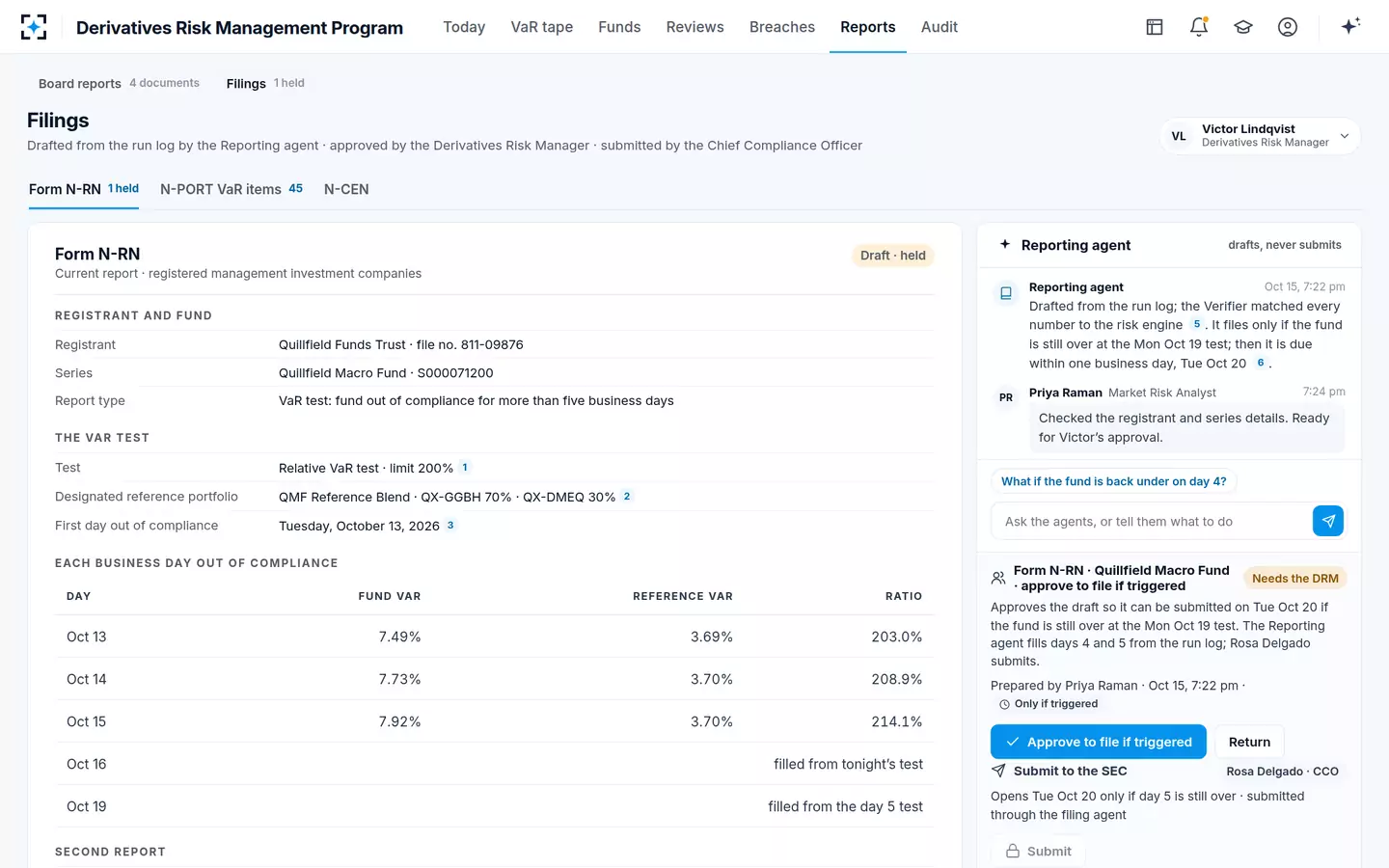
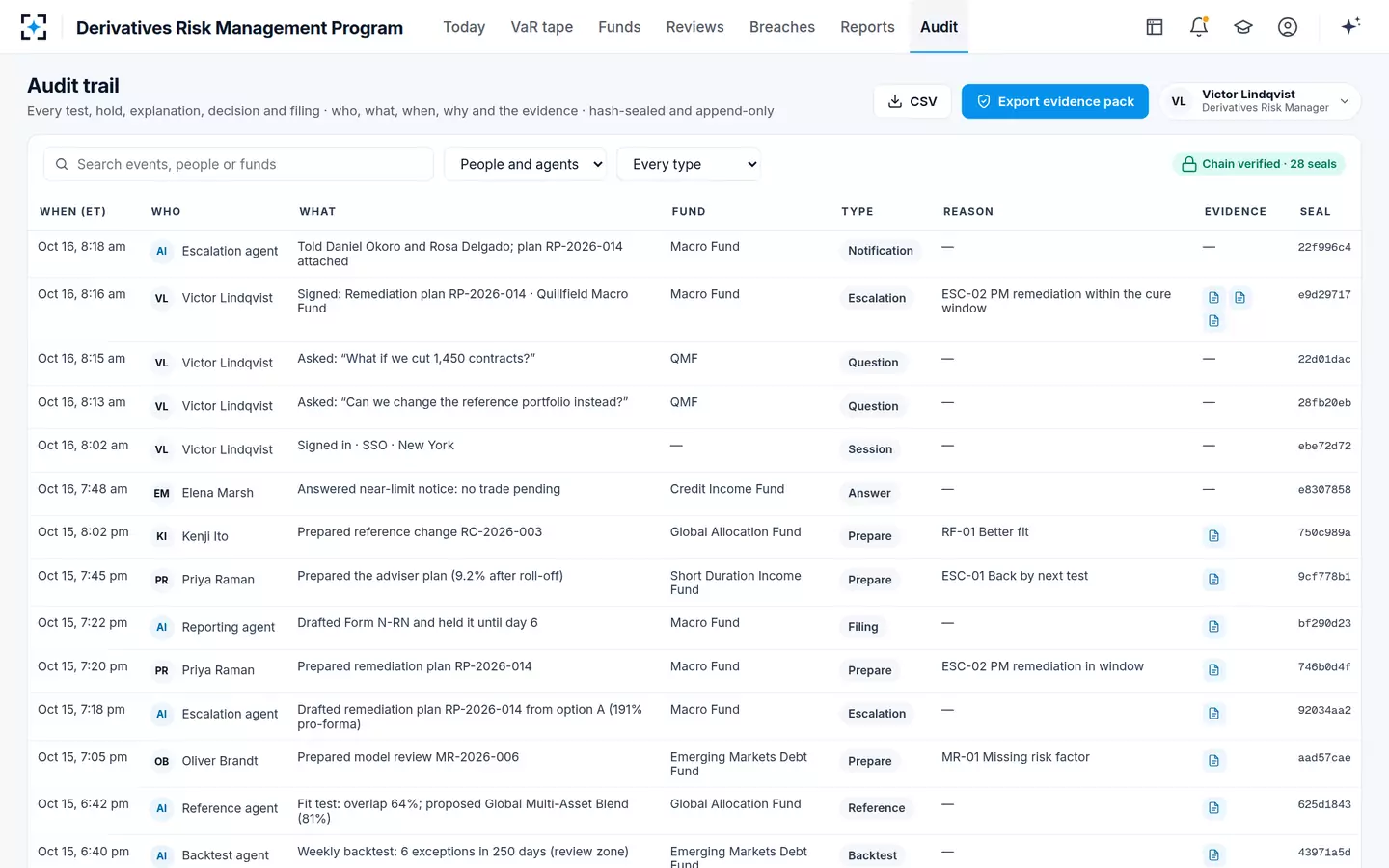
The same evidence that fills the form sits on the audit trail: who drafted it, who checked the registrant and series details, who approved, and when. A board that asks why a filing was or was not made gets the dates and the reasons from one place, and the thirty-day report starts from the same facts. To see the breach that produced this draft, from the first failed test to the signed remediation plan, start from Derivatives Risk Management Program; the rule behind it is set out in the Rule 18f-4 derivatives rule in plain words.
Every step of the breach on one sealed trail
Questions people ask
What happened in the Simplify Rule 18f-4 case?
In a settled order of July 27, 2026, the SEC found that Simplify Asset Management caused one of its ETFs to exceed its 200% relative VaR limit in two episodes in April and May 2024, to tell its board only on August 8, 2024 and to file Form N-RN only on August 9. The order also covered unrelated violations and imposed a $400,000 penalty for all of them; the firm neither admitted nor denied the findings.
Does a fund file Form N-RN when it comes back into compliance?
Yes. A fund that has filed Part E or Part F files Part G once it is back in compliance with its VaR test, giving the dates the limit was exceeded and its current VaR. The same one-business-day deadline applies.
Does a short VaR breach need a Form N-RN?
No. A fund that comes back into compliance within the five business days files nothing with the SEC for the VaR test, though it must still come back promptly, inform portfolio management under its program, and include the exceedance in its regular reports to the board.
Who signs and submits Form N-RN?
The form names a contact person in Item A.7 and is submitted through EDGAR. The rule does not say who inside the firm prepares it; many programs have the derivatives risk manager approve the content and compliance submit it, which keeps the person who measures the breach and the person who files about it separate.
How many Form N-RN reports does the SEC receive?
The SEC's paperwork notice of September 17, 2026 estimates roughly 31 reports a year on average, across liquidity and VaR events together, and about 124 hours and $75,020 of time a year for the whole industry. It does not publish a separate count for VaR breaches, and the reports themselves are not made public.