A limited derivatives user is a fund that relies on Rule 18f-4 but keeps its derivatives exposure at or under 10% of its net assets, after excluding certain currency and interest rate hedges. It does not need a derivatives risk manager, a VaR test or the program's board reports; it needs written policies and procedures "reasonably designed to manage the fund's derivatives risk", and it must be able to show, on any day, that it is still under the line. That proof is the whole job: the exposure figure is a gross notional sum with three permitted adjustments, the hedge exclusions come with a 110% condition that a single bond sale can break overnight, and a fund that stays over 10% for five business days owes its board a written report. Botminds' Derivatives Risk Management Program recalculates every limited user's exposure each night and puts any fund over the line on its own clock.
The SEC expected this to be the larger of the two groups that rely on the rule. Its 2020 economic analysis estimated 2,437 limited derivatives users against 2,766 funds that would need the full program (85 FR 83162). The fund used for the arithmetic below is illustrative; the sample firm shown later is fictional.
One illustrative fund's exposure, position by position: 6.4% counted, 23.8% gross
2-year Treasury futures, long
Gross notional$60.0m
How the rule treats it10-year bond equivalent: duration 1.9 ÷ 8.0 (assumed)
Counted$14.3m
5-year pay-fixed swap on $38.0m par of corporate bonds held
Gross notional$40.0m
How the rule treats itRate hedge of specific holdings; 105% of par, within 110%
Countedexcluded
Euro forward sale against $31.0m of euro bonds held
Gross notional$33.0m
How the rule treats itCurrency hedge of foreign-currency holdings; 106% of value
Countedexcluded
Yen forward purchase, no yen holding
Gross notional$12.0m
How the rule treats itA currency view, not a hedge: full notional
Counted$12.0m
Credit index protection bought
Gross notional$20.0m
How the rule treats itNo adjustment or exclusion applies to credit default swaps
Counted$20.0m
S&P 500 index puts
Gross notional$25.0m
How the rule treats itDelta adjusted: 0.20 × notional
Counted$5.0m
Derivatives exposure
Gross notional$190.0m · 23.8%
Line10% of $800.0m net assets = $80.0m
Counted$51.3m · 6.4%
What is a limited derivatives user under Rule 18f-4?
A limited derivatives user is a fund that meets two conditions in Rule 18f-4(c)(4): it "adopts and implements written policies and procedures reasonably designed to manage the fund's derivatives risk", and its "derivatives exposure does not exceed 10 percent of the fund's net assets", after the permitted hedge exclusions. Meeting both releases it from three things: the written program in paragraph (c)(1), the VaR limit in (c)(2) and the board oversight and reporting in (c)(3).
It does not release it from the rule. The fund still relies on Rule 18f-4 for its derivatives to fall outside Section 18's senior-security limits, it still reports to the SEC, and it still has derivatives risks to manage; for a limited user the rule says it is the investment adviser, not a derivatives risk manager, who decides which risks are material. On Form N-CEN the fund ticks the box that says it relied on the limited derivatives user exception.
The SEC chose 10% after looking at the data. Its staff found, in September 2020 N-PORT filings, that 79% of funds had adjusted notional amounts below 10% of net assets and 83% below 25%, and concluded that a 25% threshold would have taken only about 4% more funds out of the program while giving investors less protection.
Moving the line from 10% to 25% would have moved four funds in a hundred
How is derivatives exposure calculated for the Rule 18f-4 10% test?
Derivatives exposure is "the sum of the gross notional amounts" of the fund's derivatives instruments, plus the value of assets sold short, plus, for a fund that elects to treat reverse repos as derivatives, the proceeds received and not yet repaid. Gross means every position counts in its own right: a long and a short future on the same index add together rather than net.
Three adjustments are allowed, and a fund that skips them overstates its exposure. Interest rate derivatives "may" be converted to 10-year bond equivalents; option notionals "may" be delta adjusted, which the SEC describes as "multiplying the option's unadjusted notional amount by the option's delta"; and positions closed out with the same counterparty, leaving no credit or market exposure, may be dropped. The SEC explained the first adjustment directly: short-term rate derivatives "can produce large unadjusted notional amounts that may not correspond to large exposures to interest rate changes."
The same conventions run through other regulatory data. The Federal Reserve's measure of hedge fund gross leverage, which reached record highs in its May 2026 Financial Stability Report, notes that "Options are delta adjusted, and interest rate derivatives are reported at 10-year bond equivalent values" (Federal Reserve). The SEC's own published fund statistics do not adjust: their notional values "are not delta or duration adjusted", which is why they look far larger than any fund's Rule 18f-4 exposure.
Unadjusted notional is not Rule 18f-4 exposure: what the SEC's fund data show
8.3%
median ratio of derivatives notional to total assets, mutual funds holding derivatives, March 2026
90.7%
the same median for ETFs holding derivatives
$5.7tn
aggregate derivatives notional across registered funds, March 2026
Which hedges can a limited derivatives user exclude?
Only two kinds, and only under conditions. A limited derivatives user may exclude "currency or interest rate derivatives that hedge currency or interest rate risks associated with one or more specific equity or fixed-income investments held by the fund", which in the case of currency hedges "must be foreign-currency-denominated", or that hedge the fund's borrowings. The derivatives must be "entered into and maintained by the fund for hedging purposes", and their notional amounts may not exceed the value of the hedged investments, or their par value for bonds, "by more than 10 percent."
The 110% condition is binary. The SEC said plainly that if a hedge's notional exceeds the hedged value by more than 10%, "it will no longer qualify as a hedge", so the whole notional returns to the count, not just the excess. It set the tolerance at 10% rather than 3% or 5% so that funds would not have to trade constantly to resize hedges as prices moved.
Everything else stays in. The SEC declined to exclude other hedging strategies because they may not "predictably and mechanically" deliver the hedge "without giving rise to basis risks". It declined to exclude derivatives backed by earmarked cash, and it declined to exclude synthetic positions such as futures used to keep cash invested, noting that a swap contract may "terminate upon a valid tender offer for the underlying stock". A fund that equitizes its cash with index futures counts those futures.
A worked exposure calculation, and how one redemption breaks it
The illustrative fund in the first figure looks comfortable at 6.4%. Its swap and its euro forward are excluded as hedges of specific holdings, its two-year futures shrink to about a quarter of their face value as 10-year bond equivalents, and its index puts count at their delta. The credit protection and the yen forward count in full: neither is a currency or rate hedge of something the fund holds.
Now suppose the portfolio manager sells $1.5 million of the euro bonds to buy dollar bonds. The hedged holding falls to $29.5 million while the forward stays at $33.0 million, a ratio of 111.9%. The forward no longer qualifies as a hedge, its full $33.0 million joins the count, and exposure jumps from $51.3 million to $84.3 million: 10.5% of net assets. The fund has crossed the line without a single new derivatives trade.
That is why the calculation belongs to the daily process rather than to a quarterly review. Delta moves the same way: the SEC warned that delta adjusting "creates the risk that the size of a fund's investment exposure can increase quickly as market conditions change, including in times of stress", because an option's delta rises as it moves toward the money.
What happens if a limited derivatives user exceeds 10%?
Nothing, at first, except a five-business-day window to get back under. If the fund is still over 10% after five business days, "the fund's investment adviser must provide a written report to the fund's board of directors" saying which of two paths it will take: reduce exposure below 10% "promptly, but within no more than thirty calendar days of the exceedance", or adopt the full program, the VaR test and the board reporting "as soon as reasonably practicable". The SEC's release calls these a "temporary exceedance" and "derivatives risk management program adoption".
Either way the episode shows up at the SEC. The fund's next Form N-PORT must state the number of business days, beyond the five-day remediation period, that its exposure exceeded 10%. And repeated crossings undermine the exemption itself: the SEC said a fund that exceeds 10% "repeatedly", outside extreme market events, "would not appear to be using derivatives in a limited manner", and that its Rule 38a-1 compliance procedures "should be designed to prevent such repeated exceedances".
Over 10%: five business days to fix it, then a report and thirty days
- Over 10%, business days 1–5≤ 5 bd
- Back under; policies applydone
- Over 10%, business days 1–55 bd
- Board reportadviser
- Reduce below 10% within 30 calendar days of the exceedanceto day 30
- Over 10%, business days 1–55 bd
- Board reportadviser
- Program, VaR test, board reportingfull program
What the SEC sees on Form N-PORT, and what the public does not
A limited derivatives user reports its derivatives exposure on Form N-PORT, with the currency and interest rate hedges it excluded broken out, and the count of business days over 10% beyond the five-day period. The SEC made all of that confidential: "a limited derivatives user's derivatives exposure ... will be confidentially reported to the Commission and not publicly disclosed." Investors see only, through Form N-CEN, that the fund relied on the exception.
Confidential is not unexamined. An examiner reviewing a limited user will ask for the policies, for the exposure calculation on dates the examiner picks, and for the evidence that each excluded hedge met the 110% condition on those dates. A spreadsheet recalculated at month end answers the first question and not the other two.
The policies a limited derivatives user still needs
The rule does not list what a limited user's policies must contain, only that they be reasonably designed to manage its derivatives risk. The SEC added in the release that they "should be reasonably designed generally to address the fund's compliance with the 10% threshold and support the fund's reliance on the exclusion." In practice, that means the calculation, the hedge evidence and the escalation, written down.
Six things a limited derivatives user's procedures should make provable
- Exposure calculated every business day
Gross notional, short sales and any reverse repo proceeds, with the three adjustments applied the same way each day.
- Each excluded hedge tied to a named holding
Which bonds, equities or borrowings it hedges, and its notional as a share of their value or par, recomputed after every sale.
- A warning band below 10%
A level, such as 8%, at which the portfolio manager is told before a trade or a redemption takes the fund over.
- A dated record of every day over 10%
So the five business days, the thirty calendar days and the N-PORT count all come from one source.
- The adviser’s board report, ready to send
Which path it takes, temporary exceedance or program adoption, and why.
- A rule against repeat crossings
What the adviser does if the fund keeps returning to the line, as the SEC expects Rule 38a-1 procedures to address.
Checking 118 limited derivatives users every night with Derivatives Risk Management Program
The fictional sample firm in Derivatives Risk Management Program, Quillfield Capital, runs 45 full-program funds and 118 limited derivatives users. On its sample night of Thursday, October 15, 2026, the Test agent checked all 118 against the 10% line with the allowed hedges excluded, after the full-program funds' VaR tests. One was over: the Short Duration Income Fund, at 10.6% on October 14 and 10.8% on October 15.
Derivatives Risk Management Program checks every limited derivatives user in the same nightly run
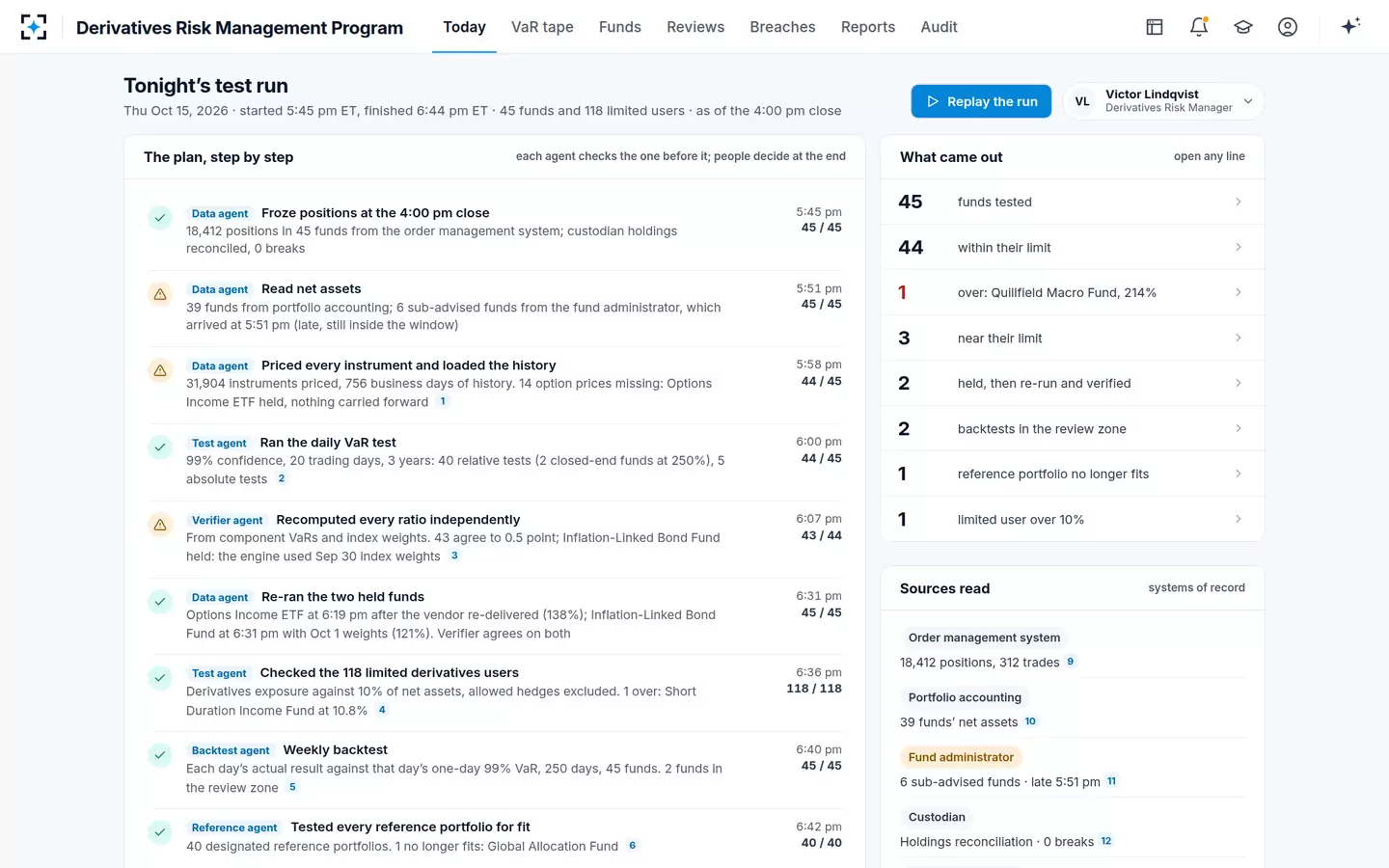
From there the fund sits on its own five-business-day clock beside the full-program funds' VaR breaches. Day 1 was October 14, so day 5 falls on Tuesday, October 20, and thirty calendar days from the exceedance is November 13. The market risk analyst prepared the adviser's plan, which showed the fund back at 9.2% once maturing futures rolled off, for review before it goes to the board. The firm's closed escalations show the two ordinary endings: a corporate bond fund at 10.3% for two days until futures rolled off, and an intermediate bond fund at 10.1% for one day until a hedge was reclassified after review.
A limited user's clock beside a VaR breach
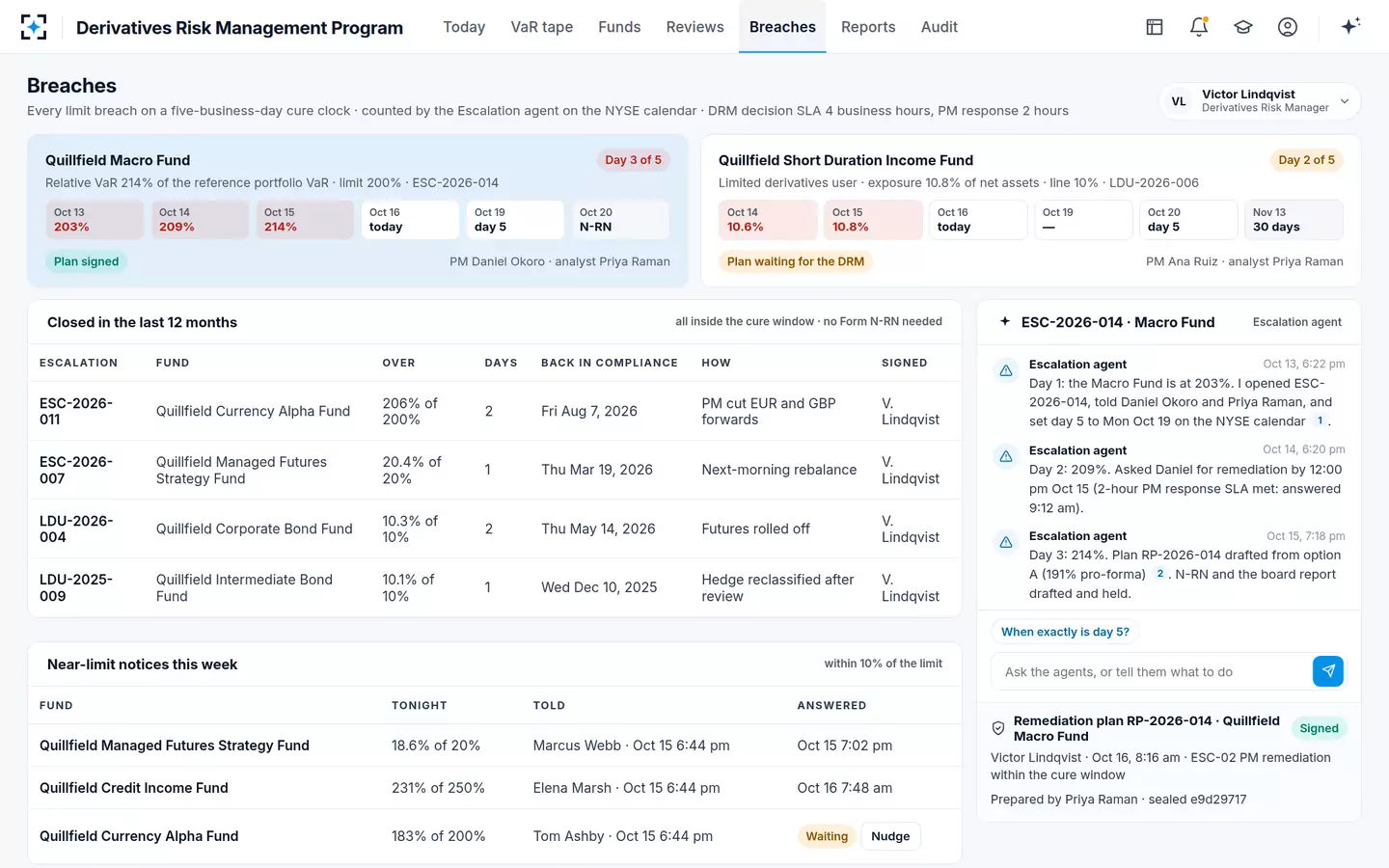
What the solution adds is the evidence. Each night's figure is calculated from the same positions as the VaR tests, each excluded hedge carries its ratio, and a fund over the line gets a dated clock, so the N-PORT count of days beyond five is a by-product rather than a reconstruction. A fund that crosses into the full program needs everything on the Rule 18f-4 derivatives rule: a derivatives risk manager, a reference portfolio and a relative VaR test from the first day. The full program is on the Derivatives Risk Management Program page.
Questions people ask
Does a limited derivatives user need a derivatives risk manager?
No. A fund within the exception does not have to adopt the program in Rule 18f-4(c)(1), so it does not need to designate a derivatives risk manager or have the board approve one. For a limited user, the rule assigns the judgement of which derivatives risks are material to the fund's investment adviser.
Do options count at delta-adjusted notional?
They may. The rule permits a fund to delta adjust option notional amounts, which the SEC describes as multiplying the unadjusted notional by the option's delta. The adjustment is optional, but a fund that applies it should apply it consistently, and should expect its exposure to rise as options move toward the money.
Are futures used to equitize cash excluded from the 10% test?
No. The SEC considered excluding synthetic positions backed by cash and declined, because a derivative can behave differently from the cash position it replicates, for instance when a swap terminates on a tender offer. Index futures held to keep cash invested count toward derivatives exposure.
How often must a limited derivatives user calculate its exposure?
The rule sets no frequency, but its five-business-day remediation window and the N-PORT count of days over 10% assume the fund knows on which day it crossed. A daily calculation is the only way to know that; a monthly one can only say that the fund was over at some point.
Can a fund move between limited user and full program?
Yes. A fund over 10% for five business days can choose to adopt the full program, the VaR test and the board reporting as soon as reasonably practicable. A fund that brings exposure back under 10% within thirty calendar days of the exceedance, after its adviser has reported to the board, stays a limited user.
Is a limited derivatives user's exposure public?
No. The derivatives exposure figure and the count of days over 10% are filed confidentially on Form N-PORT. The only public signal is Form N-CEN, where the fund indicates that it relied on the limited derivatives user exception during the year.