Relative VaR is a fund's value at risk measured against the value at risk of an unleveraged reference portfolio that represents the markets the fund invests in. Under SEC Rule 18f-4, a fund passes its relative VaR test when its VaR is no more than 200% of its designated reference portfolio's VaR, or 250% for a closed-end fund with preferred stock outstanding; Europe's UCITS rules use the same idea and the same doubling. The test is designed to limit leverage, not risk: a volatile fund in volatile markets passes, and a calm fund that doubles its exposure through derivatives fails. That makes the reference portfolio the most consequential choice in the program, because a less volatile denominator tightens the limit and a more volatile one loosens it. Botminds' Derivatives Risk Management Program runs each fund's daily test and, separately, tests every reference portfolio for fit, and its agents refuse to propose a change whose only effect is to pass.
The US rule is 17 CFR 270.18f-4, explained in the SEC's adopting release; the European approach is set out in CESR's 2010 guidelines. The bond fund below is an illustration with invented VaR figures; the screens show a fictional sample firm.
Same fund, three denominators: the reference portfolio decides whether 3.0% VaR passes
1–3 year Treasury index
Fit to the fundDuration close to the fund; misses its corporate credit
Reference VaR1.4%
Ratio214%
ResultFails the 200% test
Short-term corporate and Treasury blend
Fit to the fundSame duration band and the same mix of rates and credit as the fund holds
Reference VaR1.8%
Ratio167%
ResultPasses, and is the honest comparison
Broad aggregate bond index
Fit to the fundSeveral years longer in duration than anything the fund owns
Reference VaR4.5%
Ratio67%
ResultPasses easily, and measures little
What is relative VaR, and what does the 200% limit measure?
The rule defines it in one sentence: the "Relative VaR test means that the VaR of the fund's portfolio does not exceed 200% of the VaR of the designated reference portfolio." The VaR on both sides is the rule's VaR: 99% confidence, 20 trading days, at least three years of data. The fund must check it "at least once each business day".
The limit is about leverage because the reference is unleveraged. The SEC's own example is a fund with $100 that borrows $50 and buys $150 of an S&P 500 portfolio: its VaR is 150% of the index's VaR, because its losses fall on $100 of net assets rather than $150 of assets. A 200% limit therefore allows, roughly, the market risk of an unleveraged portfolio twice the fund's size, whatever the instruments used to get there.
Europe framed the same test in different arithmetic. CESR's guidelines say the VaR of a UCITS must not be "greater than twice the VaR of the reference portfolio", written as (VaR of the UCITS − VaR of the reference) ÷ VaR of the reference ≤ 100%, and are blunt about what that means: the relative approach "does not measure the leverage of the strategies rather it allows UCITS to double the risk of loss" (CESR/10-788). Under both regimes, half the limit is the market and half is the fund's choice.
What is a VaR ratio? Relative VaR worked on one fund
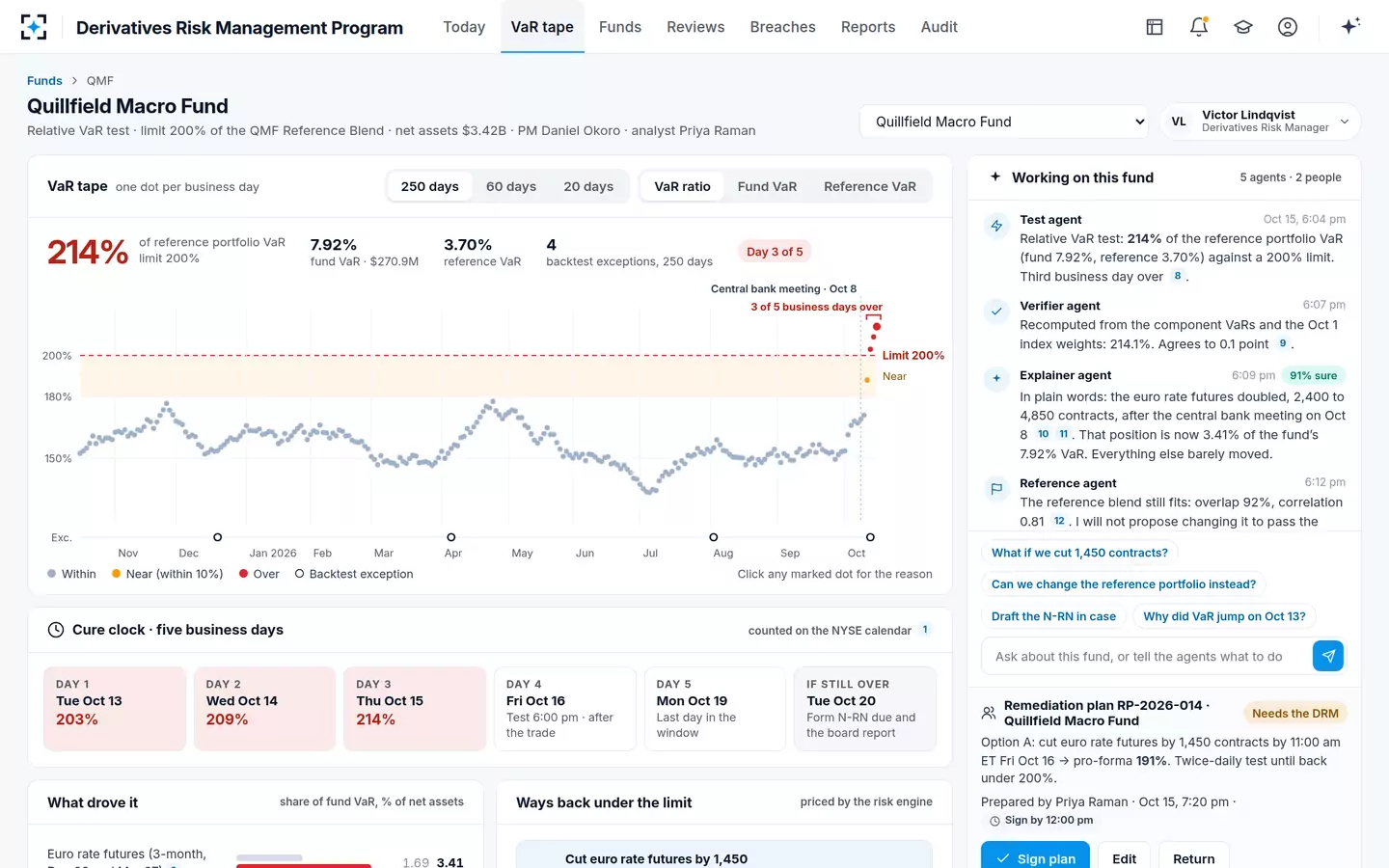
The VaR ratio is the fund's VaR divided by the reference portfolio's VaR, the rule's own definition for the records a fund must keep. On a passing day it is below 200%; on a failing day it is above. Take the fictional sample firm's Quillfield Macro Fund on Thursday, October 15, 2026: fund VaR 7.92% of net assets, reference VaR 3.70%, ratio 214%. Two days earlier it was 7.49% against 3.69%, or 203%.
The reference VaR barely moved while the fund's rose, which tells the derivatives risk manager that the fund changed, not the market. That is the diagnostic value of the ratio: when both move together, volatility rose; when only the numerator moves, positions did. In the sample, the cause was a doubling of euro rate futures after a central bank meeting.
One fund's relative VaR test in Derivatives Risk Management Program: 250 business days against 200%
How do you choose a designated reference portfolio?
A fund has two options. The first is a designated index: "an unleveraged index that is approved by the derivatives risk manager for purposes of the relative VaR test and that reflects the markets or asset classes in which the fund invests". The second is the fund's securities portfolio: its own holdings "excluding any derivatives transactions", again approved by the derivatives risk manager and again required to reflect the markets in which the fund invests, "directly through securities and other investments and indirectly through derivatives transactions."
Three constraints narrow the choice. An index run by an affiliate of the fund, its adviser or its principal underwriter, or one "created at the request of the fund or its investment adviser", is barred "unless the index is widely recognized and used", and the same applies to every component of a blended index; the SEC called these "gaming" concerns. A fund that tracks an unleveraged index, including a leveraged or inverse fund tracking a multiple of one, "must use that index". And only actively managed funds may use their securities portfolio.
What a defensible designated reference portfolio needs, on paper
- Unleveraged
No derivatives or embedded leverage inside the index, or the comparison measures nothing.
- The fund’s markets
Asset classes, regions, duration and credit quality the fund actually holds, including exposure it takes through derivatives.
- Independent, or widely used
Not run by an affiliate or built at the adviser’s request, unless widely recognized and used; the same for each part of a blend.
- Approved by the derivatives risk manager
With the basis in the next annual written report to the board.
- Reviewed at least annually
The program’s annual review must ask whether the reference "remains appropriate".
- Kept as data, not prose
The blend’s weights, identifiers and index provider files, so the reference VaR can be recomputed on any past date.
The rule does not require the fund's VaR model and the reference's to be the same. The SEC chose not to impose "a model consistency requirement", so that a fund could compute the index's VaR "based on the index levels over time without having to obtain more-detailed information about the index constituents", or take the figure from a third-party vendor. The two numbers must still meet the same definition: 99%, 20 days, three years.
When must a fund use the absolute VaR test instead?
Only when its derivatives risk manager "reasonably determines that a designated reference portfolio would not provide an appropriate reference portfolio", taking account of the fund's investments, objectives and strategy. Then the fund's VaR must stay within 20% of its net assets, 25% for the closed-end funds that get the higher relative limit. The determination and its basis go to the board in the annual written report.
The SEC gave the cases it had in mind. A fund that shifts its allocation across markets so often that its appropriate index "would change frequently". A long/short or market-neutral fund whose strategy does not carry "the kind of risk that is associated with the market risk of the index". A multi-strategy fund managed to a target volatility. And a fund whose securities portfolio is mostly cash because it takes its exposure through derivatives, where "the VaR of the cash and cash equivalents would be very low" and would make the comparison meaningless.
It also explained why funds cannot choose the absolute test for convenience. For a short-term bond fund whose reference portfolio had a VaR of 4%, a 20% absolute limit would let it "leverage its portfolio five times" before failing. The relative test keeps a low-risk fund low-risk.
Is a fund's designated index public?
Yes: the name of the designated index, or a statement that the fund uses its securities portfolio, is reported on Form N-PORT and published with the third month of each fiscal quarter's filing, 60 days after the quarter ends. The index identifier is reported too. The fund's median VaR ratio is not: the SEC keeps it, the median daily VaR and the backtesting count confidential.
The SEC meant the name to be seen. It declined to require the index in the fund's performance disclosure, but noted that the index "will remain publicly available on Form N-PORT", so that "research analysts, can still consider and compare a fund's performance with the performance of its designated index and in that way provide a secondary 'check' on funds' designated indexes." Anyone can see whether a fund's reference still looks like the fund.
The same name appears in a fund's current report if it breaches the test. Item E.4 of Form N-RN asks for "the name of the registrant's designated index, or a statement that the registrant's designated reference portfolio is the registrant's securities portfolio", beside the VaR of the fund and of the reference on each day over the limit. Form N-RN instructions, followed through one breach, shows what else the form asks.
How a stale reference portfolio flatters a fund
A reference portfolio goes stale when the fund changes and the index does not. A balanced fund that widens its mandate into emerging market equities and commodities, but keeps a developed-market 60/40 blend as its reference, is now compared with markets it has partly left. Depending on what it added, its ratio can rise or fall for reasons that have nothing to do with leverage.
The fix has to come from fit, not from the ratio. The rule makes the derivatives risk manager approve the reference and review it each year, and requires the annual report to state the basis for "any change in the designated reference portfolio during the period". CESR said the same in 2010: compliance with the selection criteria "should address the risk of reference portfolios being constructed in a way that 'games' the calculation". A change that lowers the ratio needs a reason a board can read that is not the ratio.
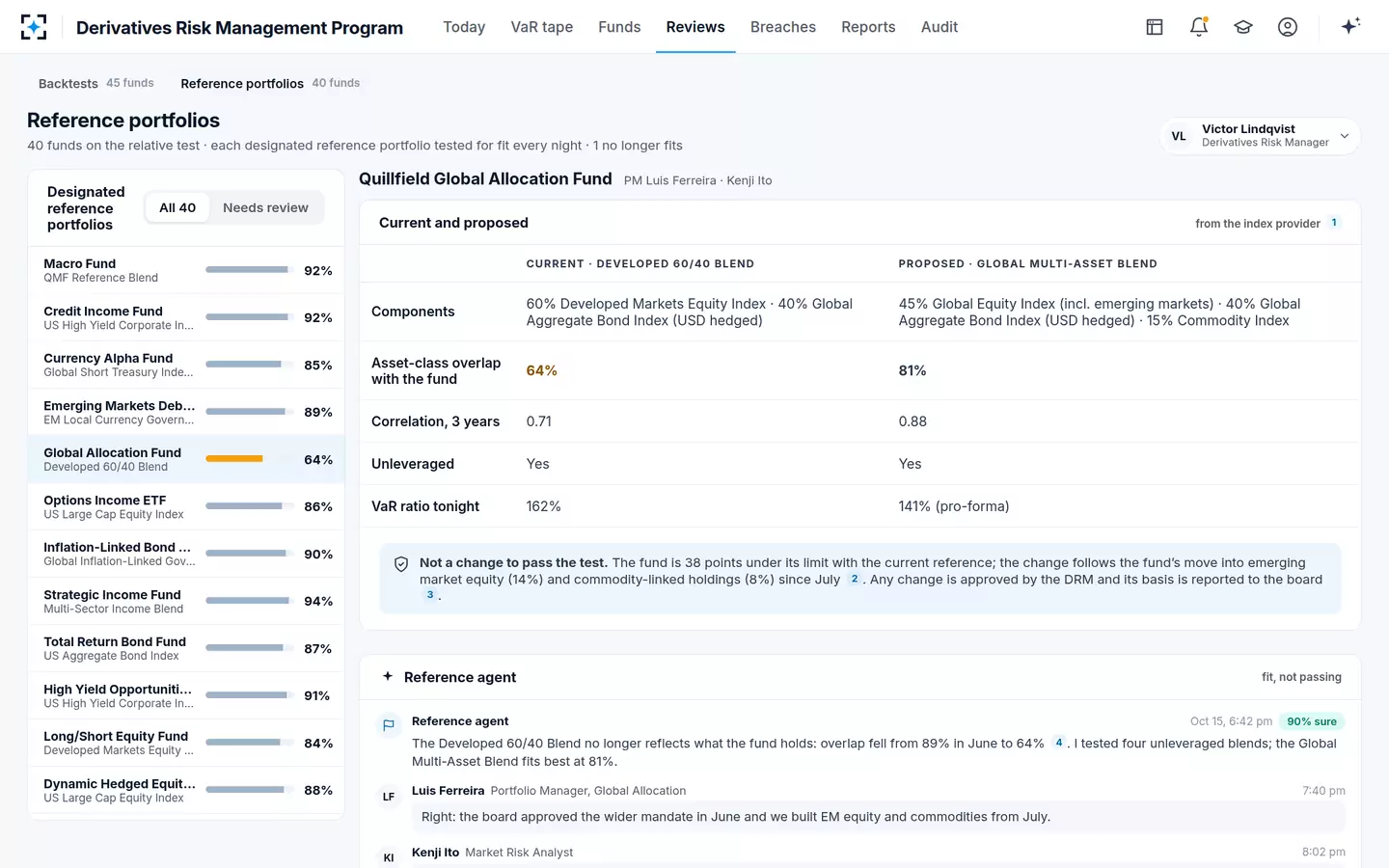
A reference that drifted from its fund: current and proposed blend for one sample fund
Current: developed 60/40 blend: 60% developed markets equity index, 40% global aggregate bond index (USD hedged).
Proposed: global multi-asset blend: 45% global equity index including emerging markets, 40% global aggregate bond index (USD hedged), 15% commodity index.
Current: developed 60/40 blend: 64%, down from 89% in June.
Proposed: global multi-asset blend: 81%.
Current: developed 60/40 blend: 0.71
Proposed: global multi-asset blend: 0.88
Current: developed 60/40 blend: Yes
Proposed: global multi-asset blend: Yes
Current: developed 60/40 blend: 162% tonight.
Proposed: global multi-asset blend: 141% pro forma.
Current: developed 60/40 blend: The fund moved 14% into emerging market equity and 8% into commodity-linked holdings after a wider mandate in June.
Proposed: global multi-asset blend: Fit, not passing: the fund is 38 points under its limit either way.
Derivatives Risk Management Program tests every reference portfolio for fit, and records the reason for a change
The UCITS relative VaR approach compared with Rule 18f-4
The two regimes agree on the core and differ at the edges. Both cap a fund at twice the VaR of an unleveraged reference and offer an absolute alternative of 20% of net assets. CESR asks for a reference whose risk profile is "very close, if not identical" to the fund's and warns that "a long-only benchmark should not be used as a reference portfolio for a long/short strategy". It also says that if a fund's "risk/return profile ... changes frequently or if the definition of a reference portfolio is not possible, then the relative VaR method should not be used", the same reasoning the SEC applied to the absolute test.
Relative VaR under Rule 18f-4 and under the UCITS guidelines
| Point | Rule 18f-4 | UCITS (CESR/10-788) |
|---|---|---|
| Limit | Fund VaR ≤ 200% of the reference VaR; 250% for closed-end funds with preferred stock | UCITS VaR ≤ twice the reference VaR |
| Reference | An unleveraged designated index, or the fund’s securities portfolio (actively managed funds) | An unleveraged reference portfolio; long/short funds may use derivatives for the short side |
| Data history | At least three years | At least one year (250 business days) |
| Calculation | At least once each business day | At least daily |
| Absolute alternative | 20% of net assets, when no reference is appropriate | 20% of NAV |
| Who sees the reference | Public, on Form N-PORT | Disclosed in the prospectus where the relative approach is used |
Reviewing the reference portfolio every year, and every night
The rule asks for the review once a year: the derivatives risk manager's periodic review "must include a review of the VaR calculation model ... and any designated reference portfolio to evaluate whether it remains appropriate." A reference that drifts in June and is reviewed in December spends half a year comparing the fund with the wrong markets, and every daily ratio in that half year sits in the fund's five-year records.
A nightly fit test closes that gap without making changes nightly. In Derivatives Risk Management Program the Reference agent measures each reference against the fund's holdings, flags drift, and prepares a proposal only when fit has fallen; the derivatives risk manager approves any change, and its basis goes into the annual report. The daily test that uses the reference is described in the Rule 18f-4 derivatives rule in plain words, and the other number in every ratio, the fund's VaR, is followed through the model in one VaR ratio, traced. Both are part of Derivatives Risk Management Program.
Questions people ask
What is the relative VaR approach?
It limits a fund's VaR to a multiple of the VaR of an unleveraged reference portfolio that reflects the fund's markets. Under Rule 18f-4 the multiple is 200%, or 250% for a closed-end fund with preferred stock outstanding; under the UCITS guidelines it is twice. It is the default test under Rule 18f-4.
Can a fund change its designated reference portfolio?
Yes. The derivatives risk manager approves the designated reference portfolio and may approve a change, and the next annual written report to the board must include the basis for any change during the period. The new index name also appears on the fund's next public Form N-PORT.
Can a fund use its own benchmark as its designated index?
Often, if the benchmark is unleveraged, reflects the fund's markets and is not an affiliated or custom index that fails the "widely recognized and used" test. The SEC did not presume that a fund's performance benchmark will be its designated index, and an index-tracking fund must use the index it tracks.
What is the UCITS relative VaR limit?
A UCITS using the relative approach must keep its VaR at or below twice the VaR of its reference portfolio, calculated at least daily at 99% over 20 business days with at least one year of history, under CESR's 2010 guidelines. A UCITS on the absolute approach is capped at 20% of net asset value.
Why does a higher reference VaR loosen the test?
Because the reference VaR is the denominator. A reference twice as volatile as the fund's real markets doubles the VaR the fund may run before reaching 200%. That is why the rule requires the reference to be unleveraged and to reflect the fund's markets, and why its name is public.