Rule 18f-4, the SEC's derivatives rule for funds, lets a registered fund or business development company enter into swaps, futures, forwards, options and short sales without breaching the senior-security limits of Section 18 of the Investment Company Act, provided it meets conditions sized to how much it uses them. A fund whose derivatives exposure is at or under 10% of net assets needs only written policies and procedures. Above that line it must run a written derivatives risk management program under a board-approved derivatives risk manager, test its value at risk every business day against a fixed limit, stress test and backtest every week, and report breaches to its board and, after five business days, to the SEC on Form N-RN. The rule is short; the daily work it creates is not. Botminds' Derivatives Risk Management Program runs that work with agents that test, verify, explain and draft, while the derivatives risk manager decides and signs.
The requirements below come from 17 CFR 270.18f-4 and the SEC's adopting release (85 FR 83162, December 21, 2020). Where the page shows how a firm might run it, the firm and its funds are fictional sample data.
Rule 18f-4 as a decision path: four questions sort every fund
1Is it a money market fund?
YesOutside the rule. Rule 2a-7 governs it instead.
NoContinue. Open-end funds, closed-end funds and BDCs are in scope.
2Does it enter into derivatives transactions in reliance on the rule?
YesContinue.
NoNo VaR test or program. Reverse repos, unfunded commitments and when-issued trades have their own conditions in the rule.
3Is derivatives exposure at or under 10% of net assets, after the allowed hedges?
YesLimited derivatives user: written policies and procedures, no VaR test, no derivatives risk manager required.
NoFull program: a derivatives risk manager, six program elements, a daily VaR test and board reporting.
4Does a designated reference portfolio fit the fund?
YesRelative VaR test: fund VaR at most 200% of the reference portfolio’s VaR (250% for a closed-end fund with preferred stock outstanding).
NoAbsolute VaR test: fund VaR at most 20% of net assets (25% for that closed-end fund).
What is Rule 18f-4? The derivatives rule in one paragraph
Rule 18f-4 is an exemption with conditions. Section 18(f)(1) of the Investment Company Act bars an open-end fund from issuing any senior security other than bank borrowing, and many derivatives create the kind of future payment obligation that the SEC treats as one. The rule says that if a fund meets its conditions, it "may enter into derivatives transactions, notwithstanding the requirements" of Section 18, and those transactions do not count toward asset coverage.
It replaced a patchwork of staff guidance and asset-segregation practice with one framework. The SEC adopted it in Release IC-34084 in November 2020; it took effect on February 19, 2021, and funds had to comply from August 19, 2022. The central idea is a limit on leverage risk measured by value at risk, not by notional amounts, so that a bond fund using swaps to manage duration is treated differently from a fund using options to multiply its exposure.
The SEC's economists sized the population at adoption. They estimated that 5,203 funds would rely on the rule, that 2,766 of them, "about 21% of funds", would need the full program, and that 2,437 would qualify as limited derivatives users. Those are 2020 estimates; the SEC has not published a newer count.
Who Rule 18f-4 reaches, by the SEC's own count
5,203
funds expected to rely on the rule
2,766
expected to run the full program and the daily VaR test
2,437
expected to be limited derivatives users, under the 10% line
Aug 192022
compliance date for every condition of the rule
Who must comply with Rule 18f-4, and who is outside it?
Rule 18f-4 applies to registered open-end funds, registered closed-end funds and business development companies, including each series of a trust, that use derivatives in reliance on it. Money market funds are excluded from the rule's definition of "fund"; Rule 2a-7 governs them. A fund that holds no derivatives has nothing to comply with, although the rule's separate conditions for reverse repurchase agreements, unfunded commitment agreements and when-issued or forward-settling trades may still apply to it.
One group sits inside the rule but outside its VaR limit. A leveraged or inverse fund that was already operating and publicly offered on October 28, 2020, with a disclosed multiple above 200% of its index, may skip the limit if it does not change its index or raise its multiple and says in its prospectus that it is not subject to it. No new fund can join that group.
For everyone else the question is the 10% line. The SEC chose 10% after its staff read the September 2020 N-PORT filings: about four in five funds were already under 10% of net assets in adjusted notional, and 83% under 25%, so raising the threshold would barely have changed who qualified. How a fund proves it stays under the 10% line works the calculation hedge by hedge.
Derivatives exposure: how the 10% line is measured
Derivatives exposure is the total of the gross notional amounts of the fund's derivatives, plus the value of assets sold short, plus, for a fund that treats reverse repos as derivatives, the proceeds not yet repaid. It is gross, so a long and a short future on the same index both count. Three adjustments are allowed: interest rate derivatives may be converted to 10-year bond equivalents, options may be delta adjusted, and positions closed out with the same counterparty that leave no credit or market exposure may be dropped.
The adjustments matter. A two-year Treasury future converted to a 10-year bond equivalent counts for a fraction of its face value, and a far out-of-the-money option counts for its delta, not its notional. A limited derivatives user may also exclude currency and interest rate hedges tied to specific holdings or borrowings, provided their notional does not exceed the hedged amount by more than 10%. Everything else is in the count.
The VaR test: 99%, 20 trading days, three years of data
A full-program fund must keep its value at risk under a limit every business day. The rule fixes the model's parameters: it must "use a 99% confidence level and a time horizon of 20 trading days" and "be based on at least three years of historical market data". It must also capture equity, rate, credit spread, currency and commodity risk, the nonlinear behaviour of options and embedded optionality, and sensitivity to volatility. The method is the fund's choice: historical simulation, Monte Carlo and parametric models all qualify if they meet those terms.
VaR at 99% over 20 days is the loss the model expects to be exceeded on one 20-day period in a hundred. The SEC is explicit that it is not a maximum: "1% of the time, the fund would be expected to lose more than $100, and VaR does not estimate the extent of this loss." That is why the rule pairs the limit with stress tests, which look at the tail VaR ignores; scenario analysis vs stress testing explains how those tests are built.
The Rule 18f-4 limits, and the funds each applies to
| Test | Limit | Higher limit | Applies when |
|---|---|---|---|
| Relative VaR test | Fund VaR ≤ 200% of the designated reference portfolio’s VaR | 250% for a closed-end fund with preferred stock outstanding | The default. A fund uses it unless its derivatives risk manager reasonably determines no reference portfolio is appropriate. |
| Absolute VaR test | Fund VaR ≤ 20% of net assets | 25% for the same closed-end funds | The fallback when no designated index or securities portfolio fits the fund. |
| Frequency | At least once each business day | — | Both tests. Out of compliance means come back "promptly", in the best interests of the fund and its shareholders. |
What is the absolute VaR test, and when does a fund use it?
The absolute VaR test caps a fund's VaR at 20% of its net assets. A fund may use it only when its derivatives risk manager has reasonably concluded that no designated reference portfolio would be an appropriate comparison, given the fund's investments, objectives and strategy. The relative test is the rule; the absolute test is the exception.
The SEC chose 20% for a reason it explained in numbers. Its staff computed the S&P 500's VaR on the rule's parameters from 1957 to 2020 and found a mean of about 10.5%, so a fund at 200% of the S&P 500's VaR would sit near 20% of net assets in an average market. The absolute limit was set to treat the two kinds of fund about the same, and to match the 20% limit that UCITS funds in Europe already used.
The SEC also explained why a fund cannot simply prefer the absolute test. Its example is a short-term bond fund whose reference portfolio has a VaR of 4%: on an absolute test it could take on five times the risk of its own markets before reaching 20%. Long/short, market-neutral and multi-strategy funds are the cases the release names as candidates for the absolute test. What relative VaR measures, and how the reference portfolio is chosen, takes the relative test apart.
Six parts of a derivatives risk management program
The program must be written, must be reasonably designed to manage the fund's derivatives risks, and must keep the program's functions reasonably separate from managing the portfolio. The rule lists six elements, and two of them carry fixed frequencies.
The six elements every Rule 18f-4 program must contain
- Risk identification and assessment
Leverage, market, counterparty, liquidity, operational and legal risks, and any other the derivatives risk manager deems material, judged across derivatives and other investments.
- Risk guidelines
Measurable criteria, metrics or thresholds the fund would not normally expect to cross, and what happens if it does.
- Stress testing, at least weekly
Losses under severe but plausible moves, with correlations and the payments the fund would owe its derivatives counterparties.
- Backtesting, at least weekly
Each business day’s gain or loss against that day’s one-day VaR; a loss beyond it is an exception.
- Internal reporting and escalation
When portfolio managers are told, and the derivatives risk manager’s duty to tell them, and the board as appropriate, of material risks.
- Periodic review, at least annually
Effectiveness of the program, including the VaR model, its backtesting and any designated reference portfolio.
Backtesting is the element most often run as a formality. It counts the days a fund lost more than its model said it would, and a model that is right should be beaten on about one business day in a hundred. How to count backtesting exceptions the way the rule defines them explains what the count means and when it calls the model into question.
Weekly is a floor. The rule says stress-test frequency must reflect "the fund's strategy and investments and current market conditions", so a fund running concentrated option positions in a volatile market may need to stress daily. Examiners have looked at whether the paper matches the practice: in November 2024 the SEC's Division of Examinations listed derivatives and liquidity risk programs among the areas where funds' policies were missing, not reasonably designed or not effectively implemented (SEC risk alert).
What does the derivatives risk manager report to the board?
The derivatives risk manager reports to the board in writing, on three occasions. Before the program starts and at least annually, a report representing that the program is reasonably designed, with the basis for that view and, where it applies, the basis for approving or changing the designated reference portfolio, or for deciding none is appropriate. At a frequency the board sets, a report on guideline exceedances, stress test results and backtesting since the last report. And whenever the fund stays out of compliance with its VaR test for more than five business days, the reports described in the next section.
The board's own duty is narrower but sharp. A majority of directors who are not interested persons must approve the designation of the derivatives risk manager, who must be an officer of the adviser, may not be a portfolio manager of the fund, and must bring relevant experience in managing derivatives risk. The derivatives risk manager's seat looks at what that officer actually decides.
Five business days, then the board and Form N-RN
A fund that fails its VaR test must come back into compliance promptly. If it has not done so within five business days, three things follow. The derivatives risk manager sends the board a written report explaining how, and within how many business days, the fund will come back. The derivatives risk manager analyses what kept the fund out and updates the program. And within thirty calendar days of the exceedance, a second written report tells the board how the fund came back, or updates the first if it has not.
In parallel the fund files Form N-RN, Part E for the relative test or Part F for the absolute test, "within one business day" of the event, and Part G once it is back in compliance (Form N-RN). The SEC now estimates about 31 Form N-RN reports a year across all the events the form covers, liquidity events included, and keeps them non-public (91 FR 58935, September 17, 2026).
A breach that lasts: the rule's clocks from the first failed test
- Over, days 1–55 bd
- Plan to boardreport
- Back in compliance by planby plan
- No filing yet
- Form N-RN1 bd
- Part G when back in compliancewhen back
- Escalated as appropriate
- First reportreport
- Second written report within 30 calendar days of the exceedance30 cd
The clocks are where programs fail. In an order dated July 27, 2026, the SEC found that an ETF advised by Simplify Asset Management ran above its 200% limit for two episodes in April and May 2024, that the board was not told until August 8, 2024, and that the fund did not file Form N-RN until August 9 (Release IC-36269; settled, findings neither admitted nor denied). Form N-RN instructions, read through that breach, follows it day by day.
What the SEC sees, and what anyone can see
Rule 18f-4 added items to three SEC forms. Form N-PORT now carries each full-program fund's median daily VaR, its median VaR ratio and the number of backtesting exceptions, all reported confidentially, and the name of its designated reference portfolio, which is public. Form N-CEN records reliance on the rule. Form N-RN carries the breaches.
Recordkeeping is long. The fund keeps its policies and every stress test, backtest, escalation, review and board report, and each day's determination of fund VaR, reference VaR and the VaR ratio, for at least five years, the first two in an easily accessible place. In practice that is about 1,260 daily VaR determinations per fund over five years, each of which an examiner can ask to see.
The examiners are looking. The SEC's examination priorities for fiscal 2027, published October 23, 2026, name funds with leverage vulnerabilities, including BDCs and leveraged and inverse ETFs, among the areas of focus (SEC Division of Examinations).
What Rule 18f-4 asks of software, and where Derivatives Risk Management Program fits
Most of the rule's arithmetic already runs on a risk engine; the SEC noted at adoption that many advisers already used platforms with VaR capability, and that a fund may take its VaR from a third-party vendor. What the engine does not do is the program around the number: confirming the inputs were complete, recomputing the ratio before anyone relies on it, explaining a breach or a backtest exception, counting business days on the right calendar, telling the portfolio manager, and drafting the board report and Form N-RN from the same figures.
That is the work Derivatives Risk Management Program takes on. Its Test agent runs each fund's relative or absolute test on the firm's own engine, a separate Verifier agent recomputes every ratio, and an Escalation agent counts the five-day clock. The rule's limits are locked in its settings; the firm's choices, such as the near-limit warning and the test time, are versioned and approved by the derivatives risk manager.
In Derivatives Risk Management Program, the rule's limits are locked beside the firm's own settings
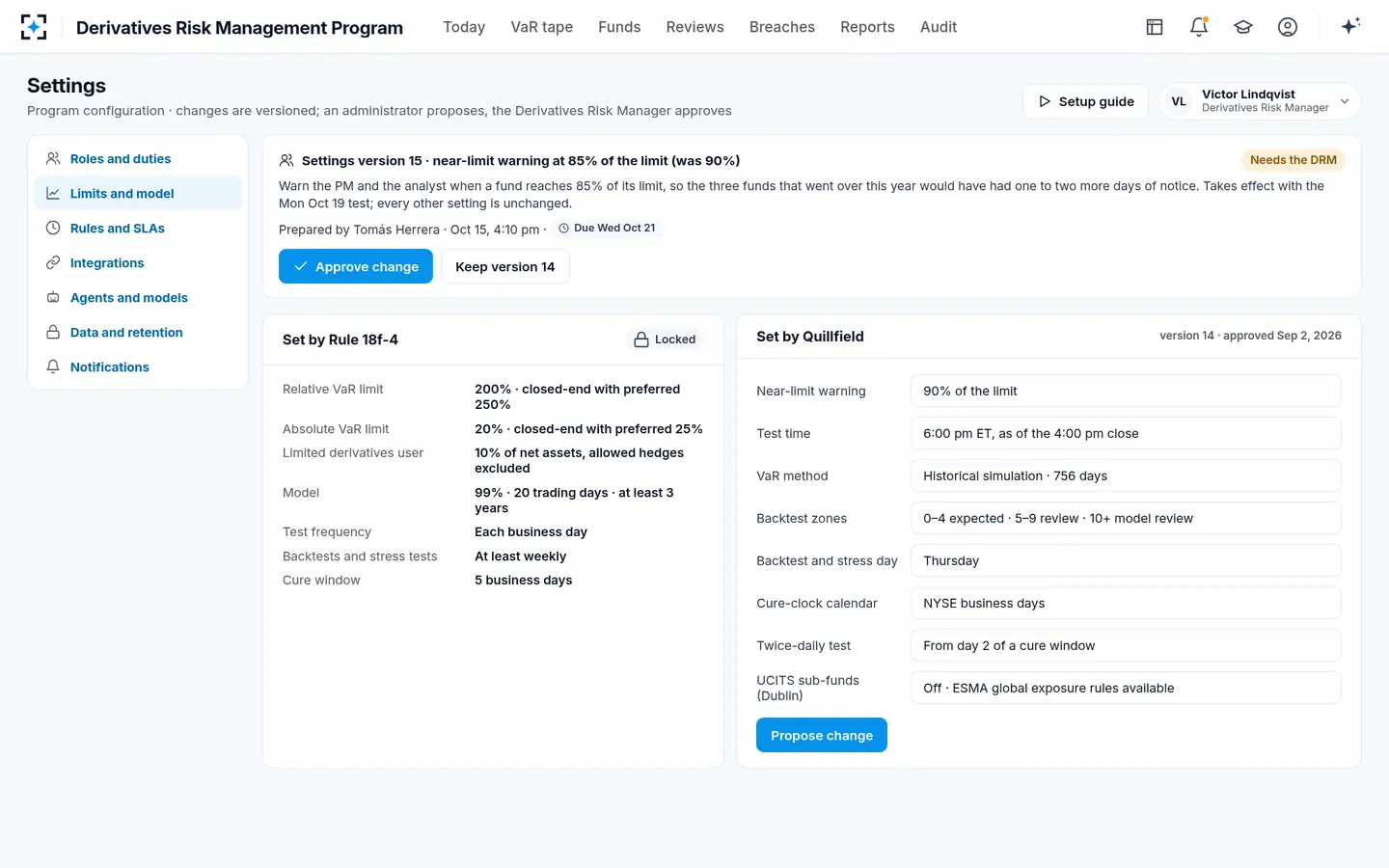
On the sample firm's busiest night, the Test agent ran 45 full-program funds and checked 118 limited derivatives users between 5:45 and 6:44 pm Eastern; one fund was on its third business day over its limit and one limited user had crossed 10%. Both appear on the derivatives risk manager's morning screen with the decision each needs and its deadline.
The morning after the test: one fund over, three near, five decisions
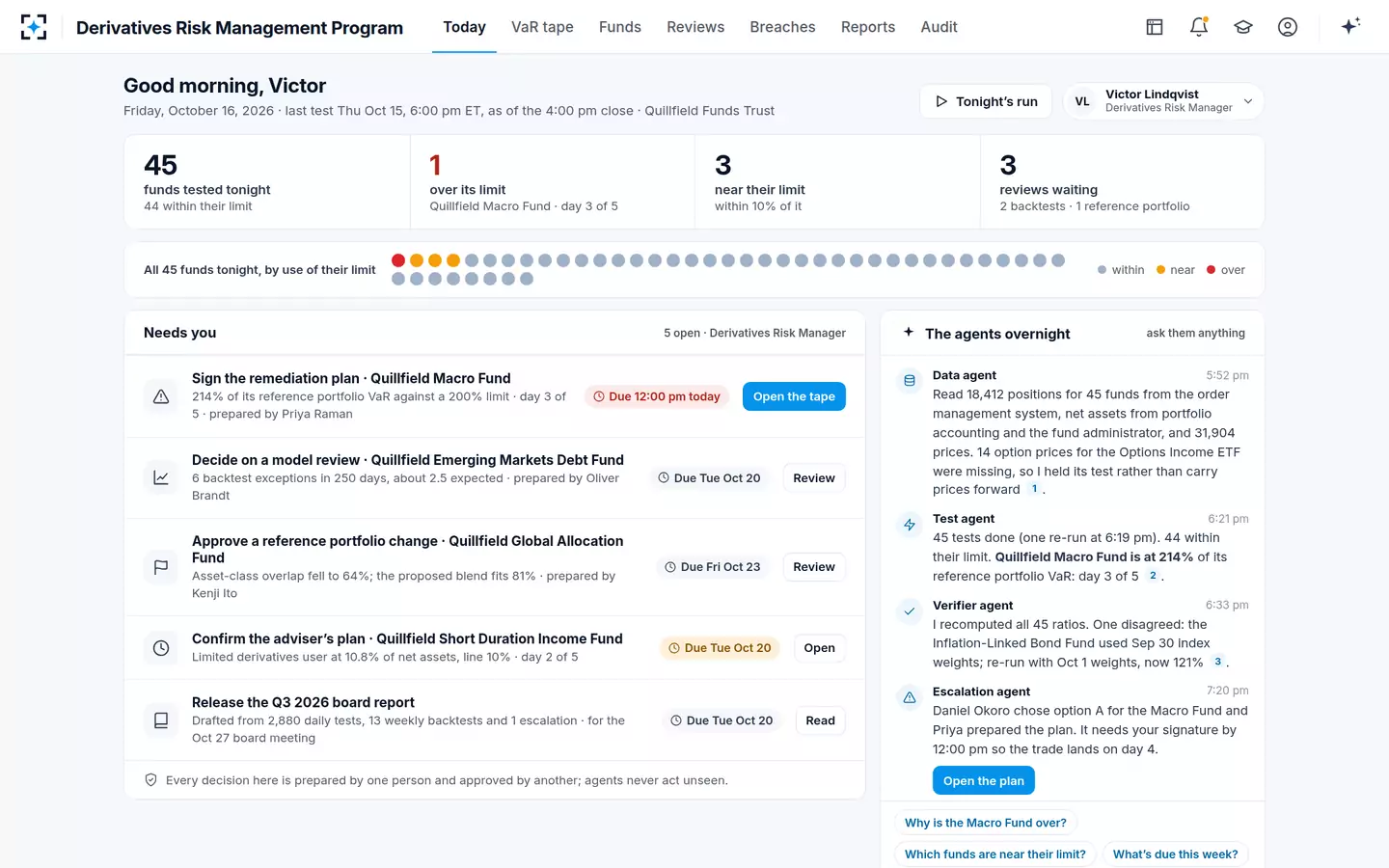
The solution does not replace the derivatives risk manager's judgement, the fund's VaR model or the board's oversight, and it never files with the SEC: filings are approved by the derivatives risk manager and submitted by the chief compliance officer. To see the whole program on one fund's breach, start from Derivatives Risk Management Program.
Questions people ask
What is the Rule 18f-4 compliance date?
August 19, 2022. The rule was adopted in Release IC-34084 in November 2020, published at 85 FR 83162 on December 21, 2020, and took effect on February 19, 2021, with an 18-month transition before funds had to comply with its conditions.
Does Rule 18f-4 apply to money market funds?
No. The rule's definition of "fund" excludes a registered open-end company regulated as a money market fund under Rule 2a-7. A money market fund may still buy securities on a when-issued or forward-settling basis under the rule's paragraph (f), if it intends to settle physically within 35 days.
What is a VaR ratio under Rule 18f-4?
The rule defines it as the VaR of the fund's portfolio divided by the VaR of its designated reference portfolio. A ratio of 1.9, or 190%, passes the relative test; 2.1 fails it. The fund must keep each business day's ratio for five years, and reports its median ratio to the SEC confidentially on Form N-PORT.
Can a fund switch from the relative to the absolute VaR test?
Only if its derivatives risk manager reasonably determines that no designated reference portfolio is appropriate for the fund, and the basis for that determination goes in the annual written report to the board. The SEC rejected letting funds choose freely, because a low-volatility fund on the absolute test could take on several times the risk of its markets.
Is a limited derivatives user exempt from Rule 18f-4?
Not entirely. It skips the program, the VaR test and the derivatives risk manager, but it must adopt written policies and procedures reasonably designed to manage its derivatives risk, keep its exposure at or under 10% of net assets, and report its exposure to the SEC confidentially on Form N-PORT.
How many funds file Form N-RN for a VaR breach?
The SEC does not publish a separate count. Its September 2026 estimate is roughly 31 Form N-RN reports a year on average across every event the form covers, including liquidity events under Rule 22e-4, at about 4 hours and $2,420 of lawyer and programmer time each.