Scenario analysis vs stress testing is less a choice than a division of labour. Scenario analysis defines a coherent market event, a set of moves in rates, currencies, credit spreads, equities and commodities that belong together and play out over a stated horizon. Stress testing takes that event and prices it on each portfolio, full revaluation where the positions demand it, and compares the loss with the portfolio's own limit. The first is a judgement about the world; the second is arithmetic about the book. Done apart, each fails in a predictable way: a scenario nobody prices never reaches a decision, and a stress test run on an unexamined scenario produces precise numbers about an event nobody believes. Botminds' Stress Testing and Scenario Analysis exists to keep them together: agents draft and challenge the scenario, run it across every portfolio each week and explain the losses, while the analyst prepares and the chief risk officer approves.
The examples on this page come from the solution's fictional sample firm, Quillfield Capital, which runs 300 portfolios against 40 official scenarios every week.
From an event to a decision: where scenario analysis ends and the stress test begins
A person decides
The questionThe CIO asks what a Bank of Japan exit from bond buying would do to the portfolios. Nothing is priced yet.
Agent
Scenario analysisTwelve factor shocks over ten days, each tied to a source sentence or a historical window: JGB 10-year +80bp, USD/JPY −14%, TOPIX −16% and nine more.
Never: makes the scenario official
Agent
ChallengeEach shock is set against history and against the others. Two come back: one contradicts the story, one is larger than any move on record.
Never: changes a shock itself
Agent
Stress testThe event is priced on all 300 portfolios. Global Balanced loses 312bp of NAV against a 300bp limit; three positions explain 285bp of it.
Never: changes positions or prices
A person decides
DecisionThe CRO approves the scenario into the official set with a reason code, and the portfolio manager has two business days to answer the breach.
What is the difference between stress testing and scenario analysis?
Scenario analysis decides what happens; stress testing measures what it costs. A scenario is a narrative turned into numbers: a trigger, a set of factor moves consistent with it, a horizon and an assumption about how the moves combine. A stress test is the calculation that applies those numbers to positions and returns a loss, usually in basis points of net asset value, set against a limit that someone has approved.
The distinction matters because the two fail differently and are owned by different people. Scenario design is analyst and committee work; it is argued, sourced and approved. The stress test is risk-engine work; it is run, reconciled and repeated. A firm that blurs them tends to argue about losses when the real disagreement is about the scenario, or to approve scenarios without seeing which portfolios they hurt.
Four tools that get called stress testing, and the question each answers
What it changes: Many factors at once, chosen to be consistent with one story, over a stated horizon.
What it tells you: Whether the event is coherent and plausible, before anyone prices it.
What it changes: Applies a scenario, historical or hypothetical, to every position, revaluing options and other non-linear instruments in full.
What it tells you: The loss for each portfolio, the positions that drive it and how close it comes to the limit.
What it changes: One factor at a time, by a fixed amount, with everything else held still.
What it tells you: Which single factor the book is most exposed to. Nothing about how factors move together.
What it changes: Starts from an outcome, such as a breached limit or a negative NAV, and searches for the moves that produce it.
What it tells you: How far markets would have to move to break the portfolio, and whether that path is plausible.
What is scenario analysis in risk management? Writing the event down
In risk management, scenario analysis is the discipline of turning a worry into a specified event. A good scenario has four parts: a trigger someone can name, a set of factor moves that follow from it, a horizon over which they happen, and a statement of what is held fixed. Without the fourth, two analysts can price the same headline and get answers that differ only because one let the dollar move and the other did not.
Central banks show what a written scenario looks like. The Bank of England's private markets exercise, published on 19 June 2026, describes "a severe but plausible global aggregate supply and geopolitical shock, which leads to a deep global recession," then states the consequences sector by sector: in the first year the FTSE All-Share falls by around 30% and the S&P 500 by around 35%, while sterling and US dollar high-yield spreads widen by 390 and 490 basis points (Bank of England, PM SWES scenario). It is explicit that the scenario "is a hypothetical scenario and not a forecast." That sentence is the right posture for every house scenario too: the point is to be specific about an event, not to predict it.
A written scenario names its moves sector by sector, not just an index
| Sector | Severity | UK corporate revenues, year 0 to 2 | UK equity prices, year 0 to 2 |
|---|---|---|---|
| Technology | Severe | −20% | −50% |
| Industrials | Severe | −20% | −50% |
| Consumer discretionary | Severe | −20% | −40% |
| Health care | Moderate | −10% | −35% |
| Energy | None | +15% | +20% |
| Utilities | None | +5% | +5% |
A fund firm's scenario is narrower but should be no less specific. Quillfield's Japan scenario names twelve factor shocks over a ten-day horizon, and every one carries the sentence or the market window it rests on: the JGB 10-year move cites the Bank of Japan's July 2024 purchase-reduction statement, the yen move cites the summer 2024 carry-trade unwind. That is what lets a committee member challenge one shock without arguing about the whole scenario.
What is stress testing in risk management? Pricing the event on every portfolio
Stress testing applies a scenario to positions and reports the loss. For US funds that use derivatives beyond the limited-user threshold, it is a rule: Rule 18f-4 requires a derivatives risk management program to stress test the portfolio against "extreme but plausible" market changes, taking account of correlations and the payments the fund would owe its derivatives counterparties, at a frequency that reflects the fund's strategy and market conditions and never less than weekly (17 CFR 270.18f-4(c)(1)(iii)).
Three choices decide whether a stress test is worth reading. Coverage: the rule's test is of the whole portfolio, not the derivatives sleeve, so positions, private marks and cash all belong in it. Method: shifting sensitivities is quick but understates options and anything else whose value is not linear in the factor, which is why serious tests revalue in full. And the benchmark: a loss means little until it is set against a limit approved in advance. In the sample run, Global Balanced's 312bp loss is a finding only because the fund's limit is 300bp, set before anyone saw the number.
Stress Testing and Scenario Analysis: the event on the left, its price on the right
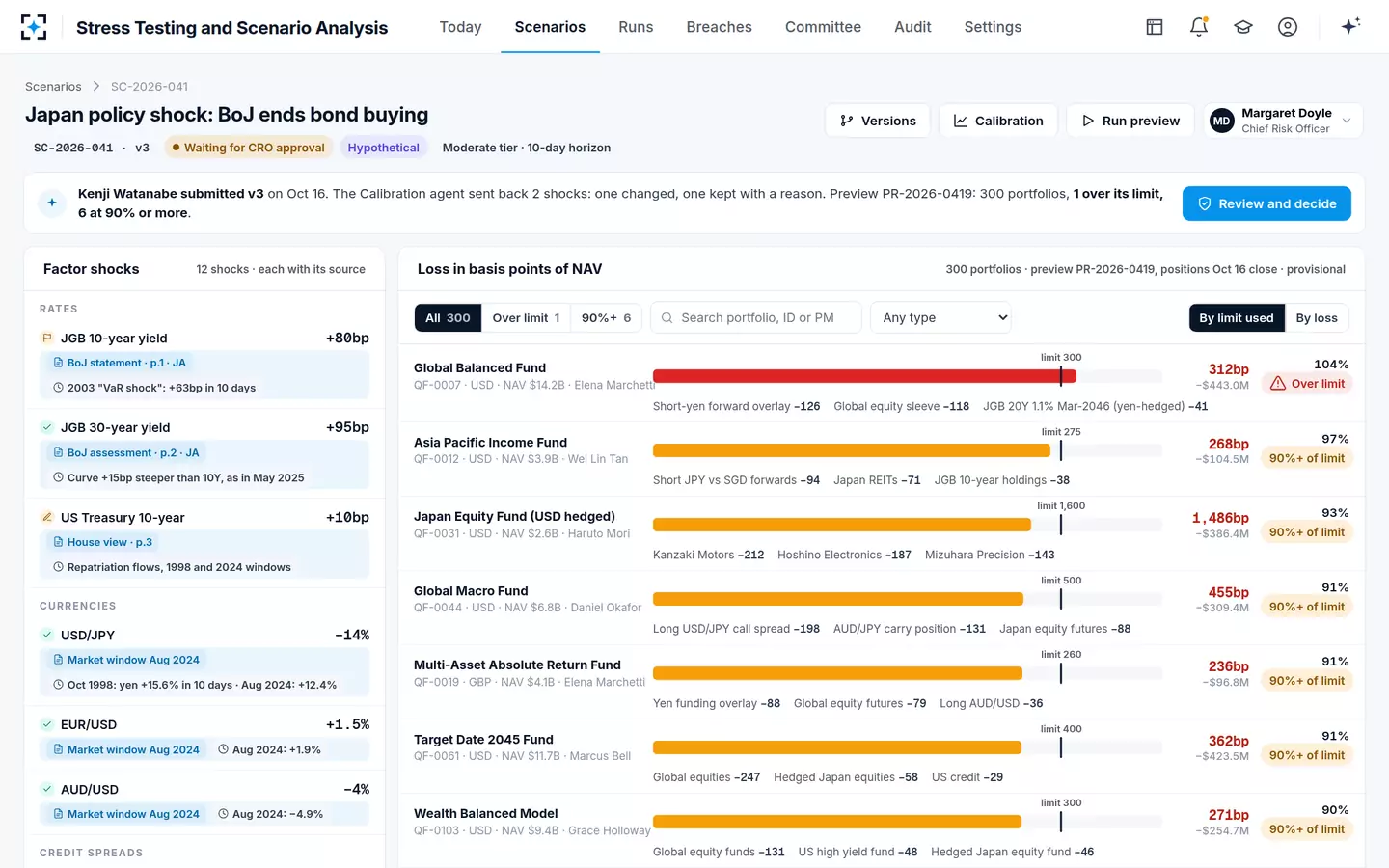
Reading across the screen is the point: a committee member can see which shock drives which loss before approving the event.
Scenario analysis vs sensitivity analysis: one factor at a time
Sensitivity analysis moves one factor by a fixed amount and holds everything else still. It is the cleanest way to see what a book is exposed to, and the least informative about a real crisis, because real crises move factors together. Regulators use it as a common yardstick precisely because it is standard: every filer answers the same question.
Form PF's market factor question for large hedge fund advisers is the best-known example. The amended form's instruction is blunt: "Assume that changes in a market factor occur instantaneously and that all other factors are held constant." Advisers report the effect of each prescribed move separately for the long and short sides of the portfolio (Form PF, SEC 2048 (4-25)). Those amendments apply from 1 July 2027, after the SEC and CFTC extended the compliance date again in a release published on 3 September 2026 (91 FR 56593).
Form PF's market factor grid is sensitivity analysis: one factor, one size, everything else still
| Market factor | Change the amended form prescribes | Reported as |
|---|---|---|
| Equity prices | Up 10% and down 10% | Effect on long and on short components, % of NAV |
| Risk-free rates, by segment | 0–3, 3–10 and over 10 years, each up and down 50bp | Segments must sum to the parallel move |
| Credit spreads | Up and down 100bp | Long and short components |
| Currency rates | All currencies up and down 10% against the base currency | Long and short components |
| Commodity prices | Up and down 10% | Long and short components |
| Option implied volatilities | Up and down 10 percentage points | Long and short components |
| Default rates | ABS, and corporate bonds and CDS, each up and down 10 percentage points | Long and short components |
The SEC explained why it changed the sizes. The old pair of thresholds produced data that "was not useful because the thresholds are either too frequent (for the lower threshold) or too extreme," so the amended form asks for a single move per factor, which the adopting release calls "a more plausible but still infrequent scenario" (Form PF adopting release, March 2024). The lesson carries beyond Form PF: a sensitivity is only useful at a size that is rare enough to matter and common enough to be believed.
What a sensitivity grid cannot tell you is what happens when the factors move together. Quillfield's Global Balanced Fund is hurt by a falling dollar against the yen, by falling equities and by rising JGB yields. Each alone is a modest loss; the scenario's value is in saying they arrive in the same ten days.
Stress testing vs reverse stress testing: starting from the loss
A reverse stress test runs the question backwards: instead of asking what a given event costs, it asks which events would cost enough to break the fund, then whether any of them is plausible. CESR's guidelines for UCITS using value at risk asked for both directions in one sentence: the program should measure the depreciation from "unexpected changes in the relevant market parameters and correlation factors" and, "conversely," the changes "which could result in major depreciation of the UCITS value" (CESR/10-788, Box 19).
For a fund, the most useful reverse tests look for the shortest path to a breached limit or to a forced sale, and the liquidity version, which starts from the day a fund can no longer meet redemptions, is its own discipline; reverse stress testing a fund works through it. In market-risk scenario design, reverse thinking is mostly a check on blind spots: if the loss that would break a portfolio needs only a modest move in a factor nobody has written a scenario for, the scenario set is incomplete.
Why do regulators ask for both stress tests and scenario analyses?
Because each answers a different supervisory worry. The EU's AIFMD rules require managers to "conduct, periodic appropriate stress tests and scenario analyses to address risks arising from potential changes in market conditions that might adversely impact the AIF" (Delegated Regulation 231/2013, Art. 45(3)(c)). The pairing is deliberate: the stress test checks the portfolio against limits, the scenario analysis checks whether the firm has thought about the right events.
The SEC drew the same line when it adopted Rule 18f-4 and turned down requests for monthly instead of weekly testing:
While a fund must run stress tests on a weekly basis, the scope of stress testing may vary. Funds may, for example, conduct more-detailed scenario analyses on a less-frequent basis … while conducting more-focused weekly stress tests under rule 18f-4.
SEC, Rule 18f-4 adopting release (December 2020)
That is a workable operating model: a stable official set priced every week, and a slower cycle of new or revised scenarios argued, approved and added. The weekly test without the slower cycle goes stale; the slower cycle without the weekly test never reaches a portfolio manager.
How often the rules ask for a stress test
Weekly
US funds with a Rule 18f-4 derivatives risk management program, at least
17 CFR 270.18f-4(c)(1)(iii)
Monthly
UCITS using value at risk, at least, and whenever the portfolio or markets change materially
CESR/10-788, Box 21
Periodic
AIFMs: stress tests and scenario analyses, at a frequency the manager justifies
AIFMD Level 2, Art. 45(3)(c)
Money market funds are the one fund type with prescribed scenario content, and the board, not the rule, sets the interval in the US; money market fund stress testing under Rule 2a-7 and the ESMA guidelines sets the two regimes side by side.
Hypothetical scenario vs historical stress test: the past as evidence, not as limit
A historical stress test replays a real window, such as the March 2020 dash for cash, on today's positions. A hypothetical scenario describes an event that has not happened, such as the Bank of Japan ending bond purchases altogether. The choice is not either-or: a hypothetical scenario borrows its sizes from history wherever it can, and a historical replay needs judgement about which window, which horizon and how to map yesterday's instruments onto today's.
In the sample firm's taxonomy, every scenario is one of three kinds: historical, replaying a window; hypothetical, an event that has not happened; or regulatory, prescribed by a rule or a supervisor. The Japan scenario is hypothetical, but its shocks still cite windows, which is what lets the challenge step ask how rare each move would be. Historical stress testing takes the replay question further, including the 2022 gilt window that more than doubled the previous record.
Where Stress Testing and Scenario Analysis fits
The solution's job is to keep the event and its price in one place and to make the hand-offs between them visible. Its Scenario agent drafts shocks from central bank statements and market events, each cited to a sentence or a window; its Calibration agent tests each shock against daily history from 1990 and sends back the ones it cannot support; the Run agent drives the firm's own risk engine across every portfolio; and the Explainer agent names the positions behind each loss. People make every decision that matters: the analyst prepares and can never approve, the CRO approves or returns each scenario with a reason code, and portfolio managers answer breaches on their own funds.
One portfolio, one scenario: the stress test read position by position
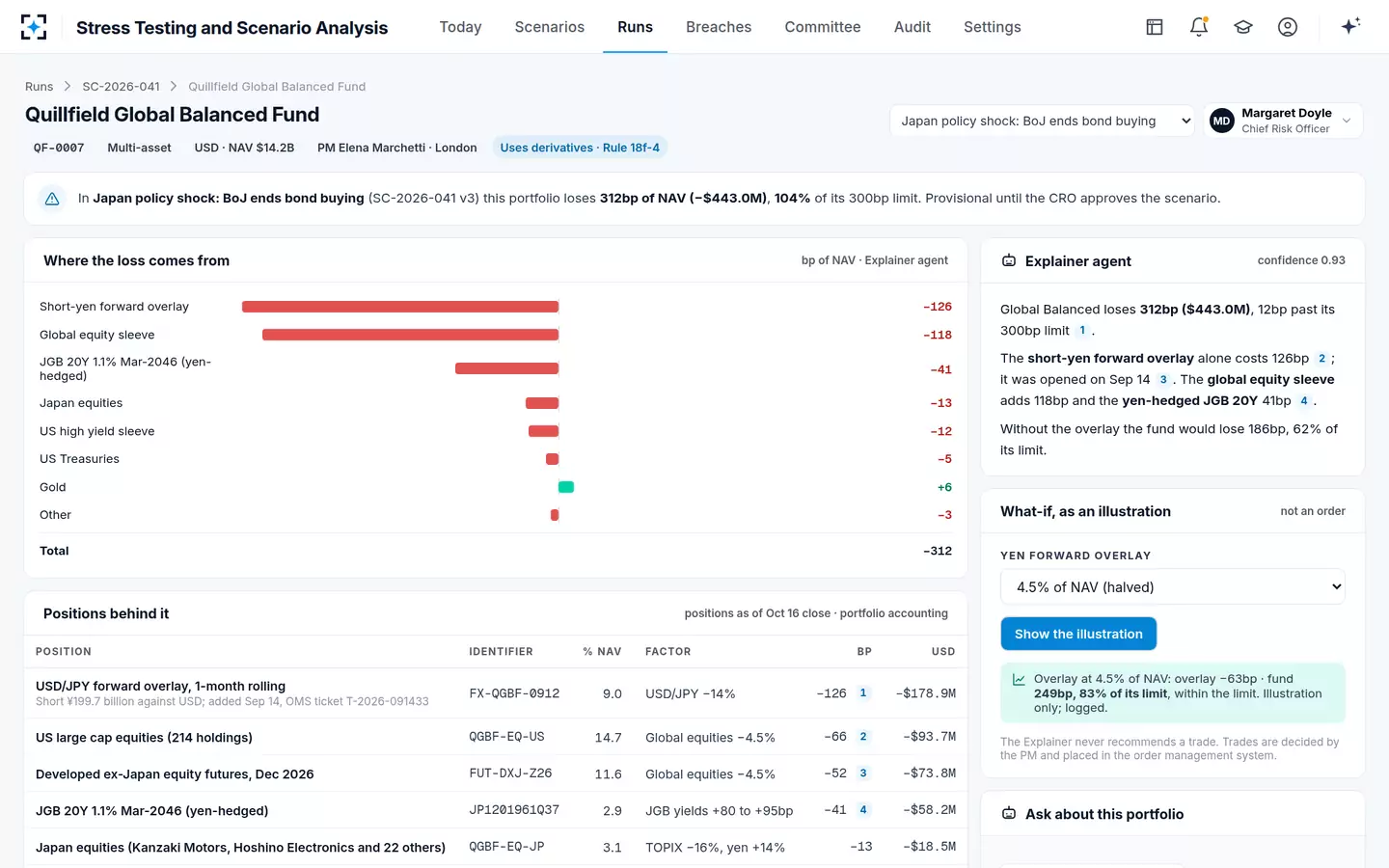
What it does not do is decide which events matter. That remains a judgement for the firm's risk function and its committee, and the solution is built to make that judgement faster to exercise and easier to audit, not to replace it. Where it is not the right tool: a fund that needs only the prescribed Form PF sensitivities, priced once a quarter from a stable book, can do that in its risk engine directly.
Questions people ask
Is scenario analysis the same as stress testing?
No. Scenario analysis specifies an event, the factor moves and horizon that describe it; stress testing applies that event to positions and measures the loss against a limit. Rules often name both: the EU's AIFMD Level 2 regulation requires "stress tests and scenario analyses" for every AIF in Article 45(3)(c).
What is the difference between scenario analysis and sensitivity analysis?
Sensitivity analysis moves one factor at a time and holds the rest constant; scenario analysis moves many factors together because they belong to one event. Form PF's market factor question is sensitivity analysis: in the amended form, applying from 1 July 2027, equities move 10% and credit spreads 100bp, each on its own.
Can a historical event be a scenario?
Yes, and many official scenario sets are mostly historical replays, such as 2008 or March 2020 applied to today's positions. The hard parts are choosing the window and horizon and mapping instruments that did not exist then onto factors that did. A hypothetical scenario usually borrows its sizes from historical windows too.
How often should scenario analysis be done?
The rules set the stress-test minimum, not the scenario review cycle: weekly under Rule 18f-4 and at least monthly for VaR UCITS under CESR's guidelines. The SEC's adopting release expressly allows more detailed scenario analyses on a slower cycle, such as monthly, alongside the weekly tests. The sample firm also re-approves each official scenario every 12 months, a setting rather than a rule.
Who should own scenario analysis?
Usually the market risk team drafts, the chief risk officer or a risk committee approves, and the stress test is run by risk operations on the firm's engine. Separating the drafter from the approver matters most: in Stress Testing and Scenario Analysis the analyst who drafts a scenario can never approve it.