Market risk stress testing measures what a set of shocks to rates, credit spreads, currencies, equities, commodities and volatility would cost each portfolio, and compares the loss with a limit. The methodology is mostly settled: propagate the scenario's shocks to every risk factor, revalue every position, aggregate by portfolio, name the drivers. What is not settled is the size of each shock. That is a judgement, and two capable analysts reading the same central bank statement will reach different numbers. A firm that never measures the difference cannot tell its committee whether a scenario reflects the firm's view or one analyst's afternoon. Botminds' Stress Testing and Scenario Analysis puts a second sizer on every shock, its Calibration agent, records every disagreement and the reason it was resolved one way, and leaves the decision to the chief risk officer.
The examples come from the solution's fictional sample firm, Quillfield Capital. The method for measuring disagreement is ours, set out so any firm can run it; the historical scales it uses are our arithmetic on Federal Reserve data.
Two sizers, one scenario: where the analyst's draft and the challenge disagreed
What is market risk stress testing?
Market risk stress testing applies large, adverse moves in market prices to a portfolio and measures the loss. It sits beside value at risk rather than replacing it. The SEC made the distinction when it adopted Rule 18f-4: "Stress testing allows funds to tailor the hypothetical scenario to the needs of a particular fund. VaR, in contrast, is based on historical data," and stress testing "may identify risks that may not result in a VaR breach, yet may not be appropriate in light of the fund's investment strategy" (Rule 18f-4 adopting release, December 2020).
For an asset manager the test covers every portfolio the firm runs, each against its own limit, and its results have to survive a committee's questions. That raises the stakes on the one input no model supplies: how big each shock should be.
Market risk stress testing methodology: from twelve shocks to every risk factor
The usual methodology has five stages. Define the scenario's headline shocks. Propagate them to every risk factor the book uses, typically through correlations estimated in past stress windows. Map each instrument to its factors. Revalue each position in full, which matters for options and anything else non-linear. Aggregate to the portfolio and attribute the loss to positions and factors. In the sample, twelve headline shocks are propagated by the risk engine to 1,840 risk factors using correlations from stress windows between 1990 and 2026, and each portfolio's loss is attributed to the three positions that drive it.
The SEC chose not to standardise any of this for US funds. Its adopting release says a "principles-based approach to stress testing allows funds to tailor their simulations to a fund's particular relevant risk factors," and that "the specific factors to consider in a particular stress test may vary from fund to fund and will require judgment by fund risk professionals in designing stress tests" (Rule 18f-4 adopting release). Judgement is written into the rule. The question is how a firm shows that the judgement is sound.
How consistent are stress scenarios between analysts?
No regulator or independent study publishes a measure for fund firms; you have to measure it yourself. Central banks show the shape of the problem. The Bank of England's 2024 system-wide scenario was designed from "a mixture of firms' internal stress testing, historical shocks, Bank modelling of the impact of different shocks on firms, and Bank staff judgement" (Bank of England, SWES final report, November 2024). Four sources, one of them judgement, and a central bank's staff to reconcile them. An asset manager's scenario usually has one analyst.
The test is simple to run. Give two analysts, or an analyst and an independent challenger, the same source and the same horizon, have each size every factor shock without seeing the other's, and compare. Repeat it on the next three new scenarios. If the two agree on most factors and disagree on a few, the disagreements are where the committee's attention belongs. If they disagree on most factors, the firm's scenarios depend on who drafts them.
Measuring disagreement factor by factor
Raw differences mislead, because 20bp on a 10-year yield and 20bp on a high-yield spread are not the same disagreement. Scale each difference by how large a rare move in that factor is over the scenario's horizon. A practical yardstick is the move reached in one window in a hundred of history; for the US 10-year Treasury over ten trading days since 1990 that is a 44bp rise, and for the dollar against the yen a 5.1% fall (Fed H.15, Fed H.10, our arithmetic).
Scoring two analysts' shocks: divide the gap by a rare move in that factor
| Factor, 10-day horizon | Analyst A | Analyst B | Gap | A 1-in-100 move since 1990 | Gap as a share of it |
|---|---|---|---|---|---|
| US 10-year Treasury yield | +40bp | +60bp | 20bp | 44bp rise | 0.45 |
| US dollar against the yen | −10% | −14% | 4 points | 5.1% fall | 0.78 |
| Same factor, opposite signs | −15bp | +10bp | 25bp | 44bp rise | Flag regardless of size |
The sign check matters most. In the sample scenario, the draft had US Treasury yields falling 15bp while Japanese investors sold foreign bonds, which would push them up. The disagreement was not about size but about the story, and the analyst accepted a 10bp rise. A scored comparison catches that kind of error mechanically; a committee reading a finished scenario rarely does.
Who decides the final shock size?
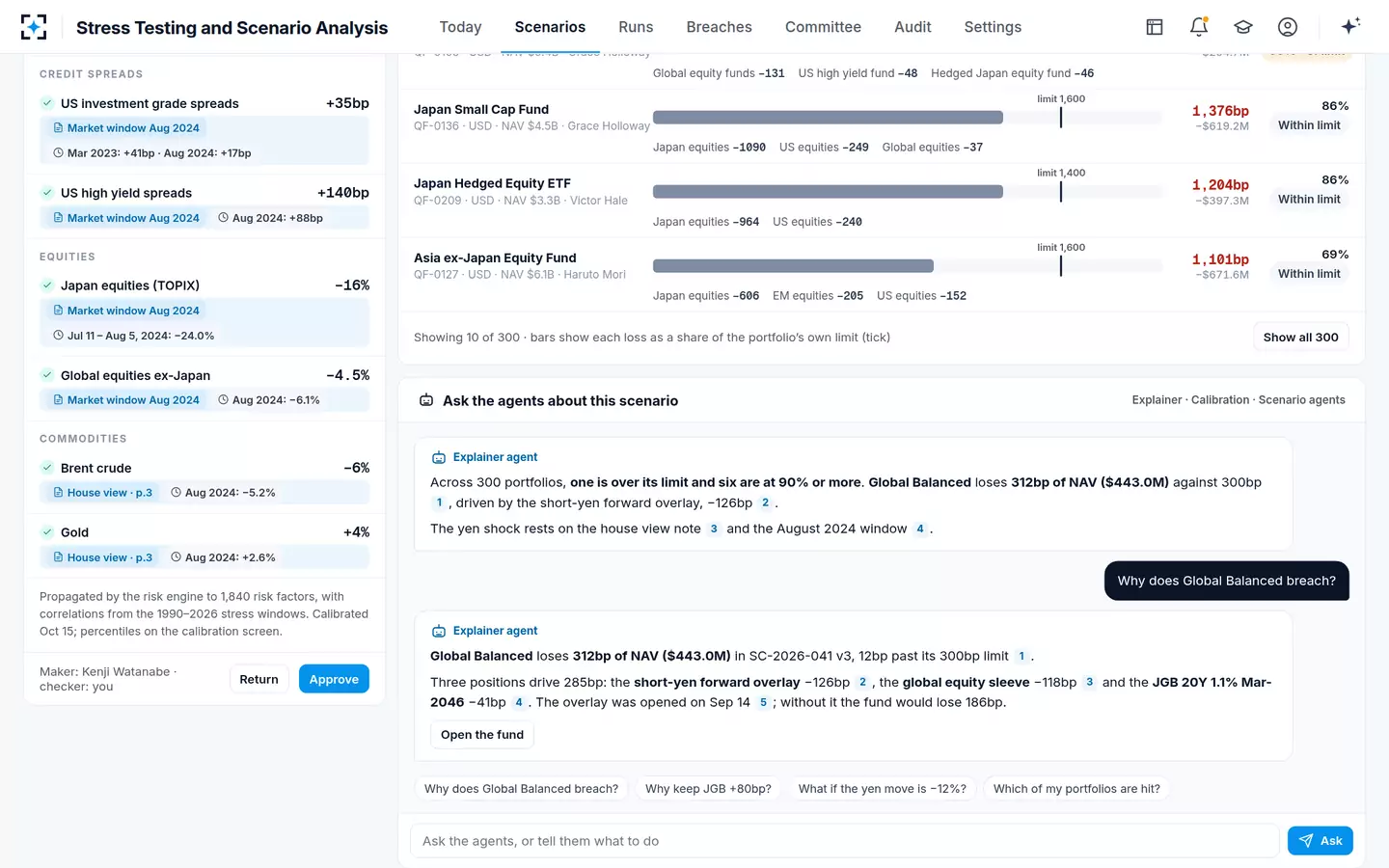
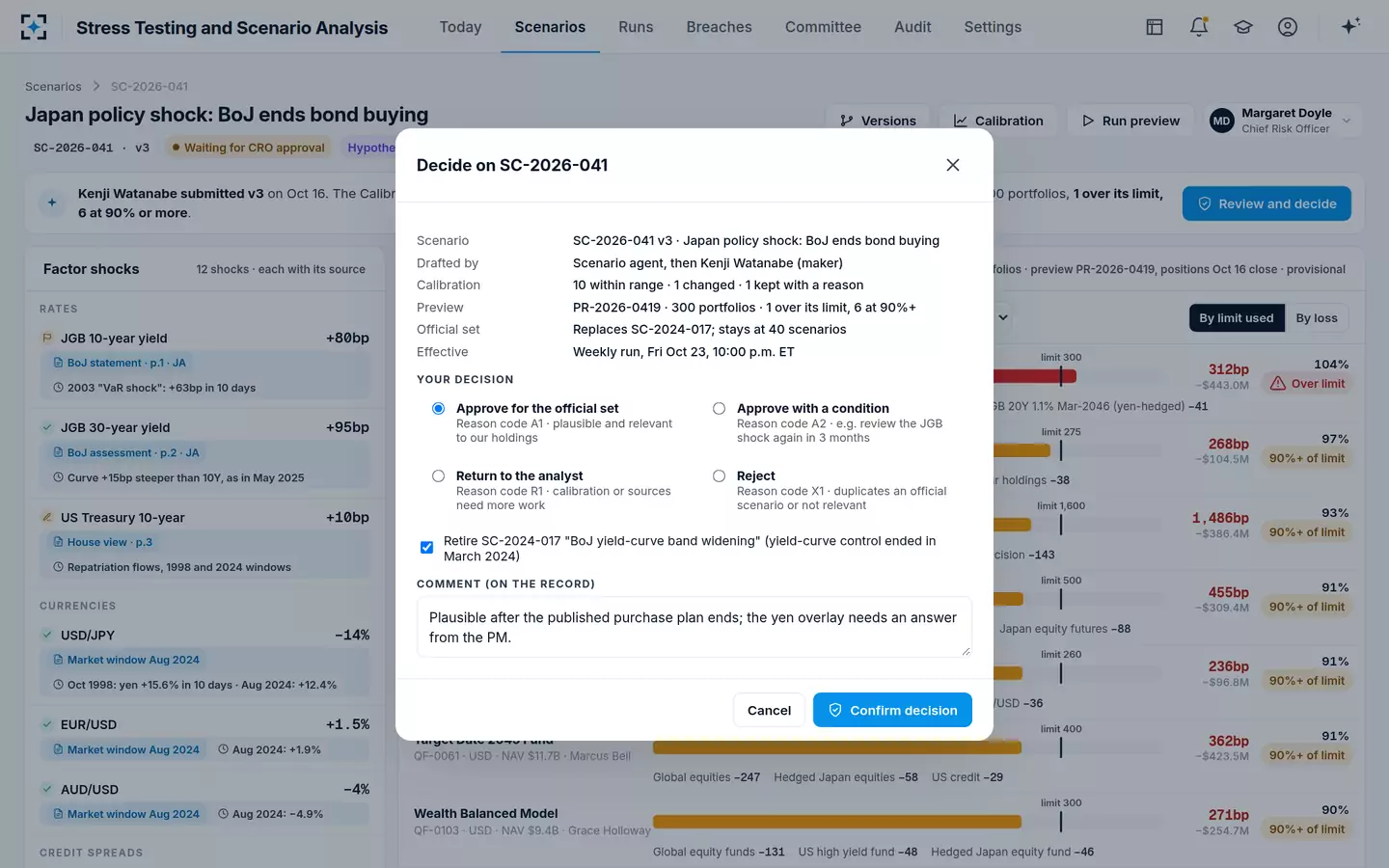
The analyst proposes, the challenger objects or does not, and the CRO decides, with the disagreement and its resolution in front of them. In the sample, the JGB 10-year shock of +80bp lay beyond the challenger's historical range and it suggested +60bp. The analyst kept +80bp with a reason: the scenario removes the central bank's promise to buy more bonds when yields jump, a promise still in place in the closest historical window. The CRO saw both before approving.
Two facts made the disagreement easy to settle. The reason was specific to the scenario's story, not a general appeal to caution. And the consequence was small: at the suggested +60bp, the most affected fund, Global Balanced, would still lose 302bp against a 300bp limit, because its breach came from a yen overlay rather than the JGB shock. A disagreement that changes no decision deserves a line in the paper, not a week of email.
Asking why a disputed shock was kept, and what difference it makes
How do you document a shock override?
With a reason code, a sentence of reasoning, the evidence and the name, kept with the scenario version. In Stress Testing and Scenario Analysis every human override of an agent carries a code from O1 to O5 and a comment, and a shock kept against a challenge carries the analyst's written reason, which the CRO reads on the decision sheet.
What a shock override should leave on the record
- The two numbers
The proposed shock and the challenged one, at the same horizon and in the same units.
- The scale of the disagreement
The gap as a share of a rare move in that factor, and whether the signs differ.
- The reason, specific to the scenario
Why this event would move this factor further than history did. "Prudence" is not a reason.
- What it changes
The loss under each number for the portfolios most affected, so the committee sees whether the dispute matters.
- Who decided and when
The analyst who kept it, the CRO who approved it, and the reason code.
- When it will be looked at again
Every official scenario is re-approved on a cycle; a disputed shock is the first thing to recheck.
Market risk stress test for a fixed income fund
For a bond fund, size the curve and the spreads separately and expect the disagreement to concentrate there. Short, intermediate and long rates move differently in most stress windows, and credit spreads by rating and sector carry most of a corporate bond fund's loss. Two analysts are likely to agree on the direction of a curve move and disagree on its shape, so score each segment separately.
Calibrate the long end with particular care. The Bank of England's Financial Policy Committee concluded after September 2022 that liability-driven investment funds "should maintain financial and operational resilience to withstand severe but plausible market moves, including those experienced during the recent period of volatility" (Bank of England, Financial Stability Report, December 2022). Any fund with leverage against long-dated bonds is in the same position: the most recent extreme window belongs inside its plausible range. Historical stress testing sets out how far that window exceeded the record.
Market risk stress testing for asset managers: what a price shock leaves out
A market risk stress test prices the shock; it does not price what other firms do next. The Bank of England's system-wide exercise was built to see exactly that, and its findings are a checklist of what a single firm's test misses.
What a system-wide stress showed that firm-level tests did not
~50
firms took part: banks, insurers, pension schemes, hedge funds, asset managers and clearing houses
~40
market variables given day-by-day price paths, over 10 business days
−0.6%
average hedge fund loss as a share of NAV, with a very wide range across funds
The average hedge fund loss hides the point. The Bank reports "a very wide range of outcomes for individual funds, reflecting the range of strategies they adopt and how they were positioned going into the stress," and concludes that firms in the exercise often could not foresee how their counterparties, investors and markets would behave, which could leave them underprepared for a real stress (Bank of England, SWES final report). For an asset manager, the market stress test is the first number, not the last; the funding, redemption and margin consequences belong in the liquidity stress test that follows, and liquidity stress testing scenarios built from your own holders takes that up. Bank capital stress tests are a different discipline again; bank stress testing software covers the bank side.
Two sizers or one: what changes when every shock has a challenger
One analyst sizes the shocks: Nowhere. The committee sees a finished number.
Analyst and independent challenger: In the disputed shocks, each with both numbers and the reason one was kept.
One analyst sizes the shocks: Caught if a reader happens to notice.
Analyst and independent challenger: Flagged mechanically: a shock that contradicts the story is sent back.
One analyst sizes the shocks: Days of email: about eight working days per new scenario, on the solution's estimate of a typical firm.
Analyst and independent challenger: One exchange on the record, with history attached.
One analyst sizes the shocks: The analyst's view.
Analyst and independent challenger: The analyst's view, the challenge and the resolution.
Stress Testing and Scenario Analysis: a challenger on every shock
The solution makes the disagreement visible and cheap. Its Calibration agent sizes every shock against daily factor history from 1990 at the scenario's horizon and checks the set for consistency; the analyst answers each objection on the record; the CRO approves with the challenge in view. Every official scenario then runs on every portfolio each week on the firm's own risk engine, and every loss is explained by position.
Stress Testing and Scenario Analysis: the CRO decides with the dispute in view
Questions people ask
What is the difference between market risk stress testing and VaR?
VaR estimates a loss at a confidence level from historical data; a stress test prices a chosen extreme scenario. The SEC's Rule 18f-4 adopting release calls them complementary: stress testing can find risks that do not cause a VaR breach but are not appropriate for the fund's strategy.
What scenarios should market risk stress testing include?
Historical replays of the windows that hurt the firm's portfolios, hypothetical scenarios for events that have not happened, and any scenarios a regulator prescribes. Every factor the portfolios are directly exposed to should move in at least one of them; the amended Form PF requires advisers to report the effect of every listed factor they are directly exposed to.
How do you know if a stress scenario is too severe?
Compare each shock with how often history produced a move that large over the same horizon, and check the shocks fit together. Too severe is not the same as beyond the record: in September 2022, 30-year gilt yields rose more than twice as far over four days as in any period since 2000.
Who should challenge the shock sizes?
Someone who did not draft them, with their own data: a second analyst, a validation team or an independent agent. In the sample, the challenger sent back two of twelve shocks and the CRO approved with both objections and answers in view.
How often should market risk scenarios be recalibrated?
On a fixed cycle and whenever markets move enough to change the answer. The sample firm re-approves every official scenario every 12 months; Rule 18f-4 requires weekly stress tests and an annual review of the program's effectiveness.