Portfolio stress testing software is worth buying if it lets a risk committee reproduce any figure it is shown and challenge any shock behind it. Most firms already own the hard mathematics: a risk engine that revalues positions under a scenario. What they lack is everything around it: scenarios kept in versions with a source for every shock, a challenge to each shock before it is priced, runs that carry identifiers and cannot be edited, losses explained by position, approvals with reasons, and committee papers built from the same runs. Those are what a committee trusts, and they are what a buyer should test. Botminds' Stress Testing and Scenario Analysis is that layer: agents draft, challenge, run on the firm's own engine and explain, people approve, and every figure keeps its trail.
The examples come from the solution's fictional sample firm, Quillfield Capital, which runs 300 portfolios against 40 official scenarios every week. The checklist and the adoption path are ours, built on the rules and cases linked below.
How a committee comes to trust new stress testing software: three committee cycles
- Connect engine, positions, limits4 wks
- Weekly runs in parallel; differences explained9 wks
- New scenarios drafted, challenged, approved there13 wks
- Official runs and committee papers from signed runs13 wks
What makes a risk committee trust stress test results?
Three things: it can reproduce any number, it can see what was argued, and it can tell who decided. Reproduction means a figure opens its run, scenario version and position date. Argument means the challenge to each shock and the answer are visible, not settled in someone's inbox. Decision means every scenario and every breach carries a named approver and a reason. Without these, a committee is trusting people, which is reasonable until the people change or the numbers do.
The SEC's Allianz order is the cautionary case. The firm described the affiliate producing its risk reports "as a service provider supporting an independent risk management function," and yet, the order found, nobody else at the firm meaningfully reviewed those investor communications while the portfolio management team altered the stress results investors received (SEC order 34-94927, 2022). Independence on paper did not protect the numbers. A system in which results cannot be edited after the run, and the people being measured cannot touch them, would have.
Does stress testing software replace the risk engine?
It should not need to. The revaluation of thousands of instruments under a scenario is a solved, expensive problem, and most fund firms have paid for a solution and calibrated it. What is rarely solved is the work before and after: the scenario's design, its challenge and approval, the data checks, the explanation and the paper. A buyer should ask early whether a product requires replacing the engine, and what is lost if it does.
The risk engine and the layer around it: two different purchases
Risk engine: Revalues positions under shocks; propagates shocks to risk factors; computes losses.
Stress testing governance layer: Drafts and challenges scenarios, runs them on the engine, explains losses, routes breaches, drafts papers, keeps the trail.
Risk engine: Coverage of instruments, pricing accuracy, speed.
Stress testing governance layer: Whether a committee figure can be reproduced, challenged and attributed to a decision.
Risk engine: Quants and risk operations.
Stress testing governance layer: Analysts, the CRO, portfolio managers, committee members, internal audit.
Risk engine: A wrong number for an option.
Stress testing governance layer: A right number nobody can prove, or an unchallenged shock that sets the limit.
Risk engine: Your existing engine, driven in batches by the Run agent.
Stress testing governance layer: Stress Testing and Scenario Analysis.
In the sample firm, the Run agent pulls positions from portfolio accounting and the order management system, prices from two market data vendors, maps instruments to risk factors and sends the batches to the firm's own engine; it reconciles totals to NAV and holds a portfolio rather than guessing a price. The engine stays where it is.
How do you evaluate portfolio stress testing software?
On your own scenarios, against a written list, with the committee's questions in mind. Take three scenarios your firm approved recently and rebuild them in the product from their original sources. Then ask the questions below, and ask to see the answers on screen rather than in a slide.
Twelve questions for any portfolio stress testing software
- Can any committee figure be opened to its run, scenario version and position date?
From the figure itself, not from a separate report.
- Are scenario versions immutable once approved?
A change creates a new version; official results come only from approved versions.
- Does every shock carry a source a person can open?
A passage and page, or a named historical window.
- Is every shock challenged before pricing, and is the challenge kept?
Rarity at the scenario's horizon, direction against the story, joint plausibility.
- Does it use your risk engine, or replace it?
And what the cost of re-calibrating a new engine would be.
- What happens when a price or position is missing?
Hold the portfolio or use a flagged proxy. Never a silent guess.
- Are segregation of duties enforced by permission?
The drafter cannot approve; a portfolio manager cannot decide their own breach.
- Do breaches open with drivers, a clock and a reason code?
And escalate to the committee at a set point without anyone remembering to.
- Are regulatory extracts drawn from the same signed runs?
Rule 18f-4 board reporting, Form PF's market factor effects, UCITS stress results.
- Can internal audit export a quarter as one sealed file?
Versions, runs, decisions and sources, with hashes that would break on an edit.
- If it uses AI, what may the agents never do?
Make a scenario official, change positions, recommend a trade, send the papers.
- How is a new version of the software or an agent tested?
On past results, compared, before it goes live.
Which rules shape what the software must produce?
The rules do not certify software, but they define the outputs it must support, and a buyer can test each one.
What fund rules ask the stress testing process to produce
| Rule | What it asks | What the software must support |
|---|---|---|
| SEC Rule 18f-4 | Weekly stress tests of the whole portfolio; reports to the board; results kept five years; annual review of the program's effectiveness | Weekly runs on every fund in scope, a board report from the same runs, retention and a record of changes for the annual review |
| Form PF, amended (from 1 July 2027) | Large hedge fund advisers report the effect of prescribed moves in every market factor the fund is directly exposed to | A prescribed single-factor grid alongside the firm's own scenarios, run on the same positions |
| CESR/10-788 (VaR UCITS) | Monthly stress tests at least; documented program with reasons it suits each fund; old and new designs run in parallel when changed | Per-fund programs, documented reasons, versioned designs and side-by-side runs |
| AIFMD Level 2, Art. 45 | Periodic stress tests and scenario analyses; risk measurement adequately documented and based on sound and reliable data | Scenario analyses beside stress tests, data controls and documentation |
Two details are worth testing with a vendor. CESR's guidelines ask that the stress program for each UCITS say why it is right for that fund: "It should be explained why the program is suitable for the UCITS," and "Reasons should be given if it is intended to deviate from the program" (CESR/10-788, Box 21). And the amended Form PF removes an escape hatch: advisers must answer for every listed factor, though the SEC noted an adviser "will only be required to stress test risk factors to which their portfolios are directly exposed and are instructed to report zero for any inapplicable market factors" (Form PF adopting release, March 2024). Software that cannot show which factors each fund is exposed to will make that answer harder than it needs to be.
Can stress testing software read central bank statements?
Some can, and it is useful, but reading is the easy part to demonstrate and the hard part to trust. In the solution, the Scenario agent reads statements in their original language, aligns an English text sentence by sentence and proposes each factor shock with the passage and page it rests on; a separate Calibration agent then tests every shock against daily history from 1990 and sends back what it cannot support. Ask any vendor to show the citation behind each proposed shock and what happens to a shock without one.
Stress Testing and Scenario Analysis: ask why, and the answer cites the run
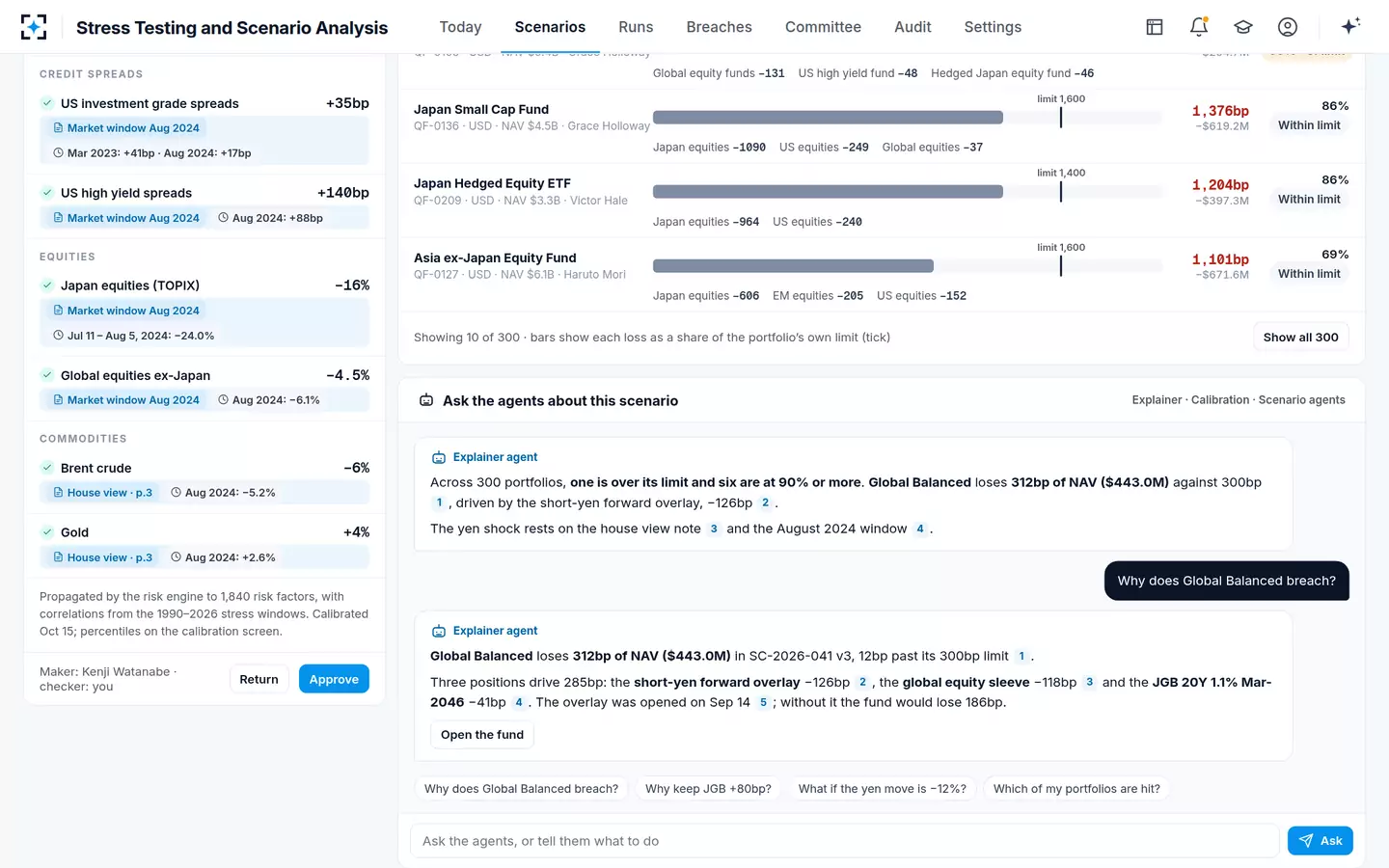
Trust is not a human in the loop
Putting a person at the end of an automated process does not by itself make the result trustworthy. The Financial Stability Board's final report on sound practices for adopting AI, published on 15 October 2026, counts the belief that a person in the process guarantees effective oversight among the misconceptions that weaken it. It warns that over-reliance and automation bias erode oversight, and that leaning on AI for long enough can wear down staff expertise and their ability to challenge. Its answer is information built for challenge:
Financial institutions tailor the information they provide to different stakeholders to support effective challenge and accountability, oversight and use of AI, while maintaining proportionality and avoiding undue complexity.
Financial Stability Board, Sound Practices for Responsible Adoption of AI: Final report, 15 October 2026
The design answer is to give the person something to judge. A CRO who sees only a final loss is approving the software's output; one who sees the two shocks the challenger disputed, the analyst's reasons and the effect of each alternative is exercising judgement. In the sample, the decision sheet shows the drafter, the calibration result, ten within range, one changed, one kept with a reason, the preview's results and the scenario being retired, and the CRO must pick a reason code. That is also how a firm keeps its people's expertise: they argue the shocks that matter instead of retyping the ones that do not.
What the first committee cycle should prove
The parallel cycle is where trust is earned or lost, so decide in advance what it must show. First, that the new runs reproduce the old ones where nothing should differ: same scenario, same positions date, same engine, same answer, portfolio by portfolio. Second, that every difference that does appear is explained by something nameable: a position the old process missed, a factor mapped differently, a stale mark now flagged, a scenario version that changed. Third, that the time from event to approved scenario falls without the challenge getting thinner.
Write the tolerance down before the first run. A committee that sees a 12bp difference on one fund should be able to read why: in the sample firm's weekly run, six portfolios were held because of stale private marks, two unmapped instruments and a position mismatch between portfolio accounting and the order management system, and each came with a proposed fix that a person applied. A difference explained that precisely builds more trust than a perfect match nobody can account for.
The cost of a figure nobody can reproduce
The cost arrives later, when an examiner, an auditor or the board asks how a number was produced. Rule 18f-4 requires funds with a derivatives risk management program to keep their stress test results and the reports given to the board for at least five years, the first two in an easily accessible place (17 CFR 270.18f-4(c)(6)). Keeping a spreadsheet for five years is easy. Reproducing from it the figure the board saw, with the scenario version, positions and prices behind it, is often impossible.
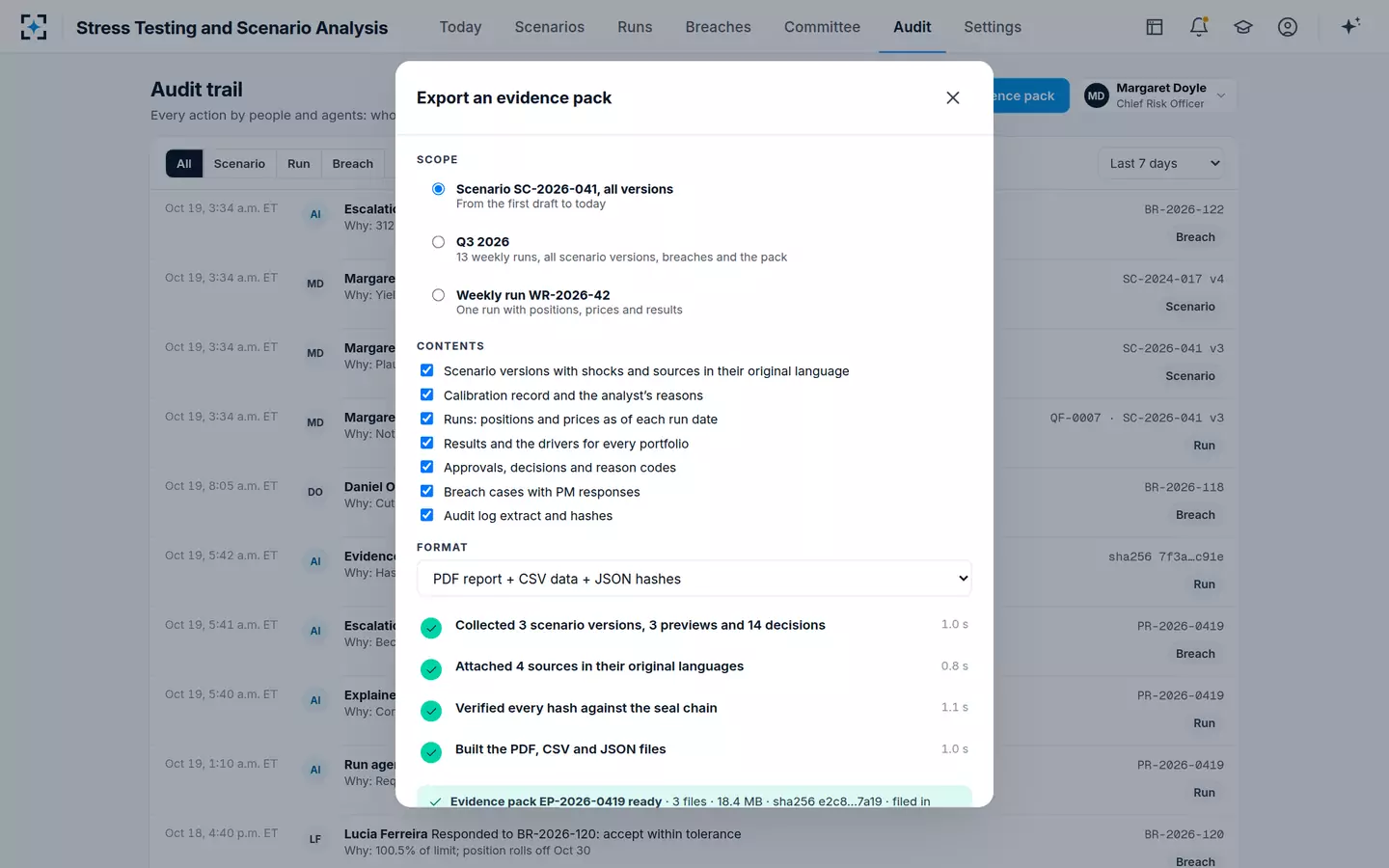
That is the practical meaning of trust in a buying decision: the cost of answering the question "where did this number come from?" three years after the meeting. In the solution, the answer is one export: every scenario version with its sources, the calibration record and the analyst's reasons, the runs with positions and prices as of each date, the results and drivers, the approvals and breach decisions, each sealed with a hash.
Best portfolio stress testing software: what the comparison should weigh
No regulator or independent study ranks these products, and vendors don't publish prices, so build the comparison from your own evidence. Weigh, in this order: whether committee figures are reproducible; whether shocks are challenged and the challenge kept; whether it works with your engine; how it handles bad data; and the total cost per approved scenario, including the people's days it saves or adds. A product that scores well on factor coverage and poorly on the first two will produce faster numbers the committee trusts no more than before.
One export for auditors and examiners: every version, run and decision
Who Stress Testing and Scenario Analysis is for, and who it is not for
It fits a firm that already runs a risk engine, has more portfolios and scenarios than people to argue them, and answers to a board, a committee and examiners for its stress numbers. It brings seven agents, scenario drafting, calibration, runs, explanation, escalation, committee papers and evidence, around the engine, with people approving every scenario and deciding every breach, and the evidence sealed and kept. In the sample that means 300 portfolios against 40 scenarios each week, with every result explained.
It is not a risk engine, so a firm without one needs one first. It is not a bank capital stress testing system; banks should look at bank stress testing software. And it is built for market scenarios; the redemption and liquidity side of a fund's stress program belongs with fund liquidity stress testing, ideally fed by the same approved scenarios. System-wide effects, such as the margin calls and repo behaviour the Bank of England's 2024 exercise explored, are a reason to run both: the Bank's report "highlights the importance of financial institutions considering system-wide dynamics in their internal risk management and stress tests" (Bank of England, SWES final report).
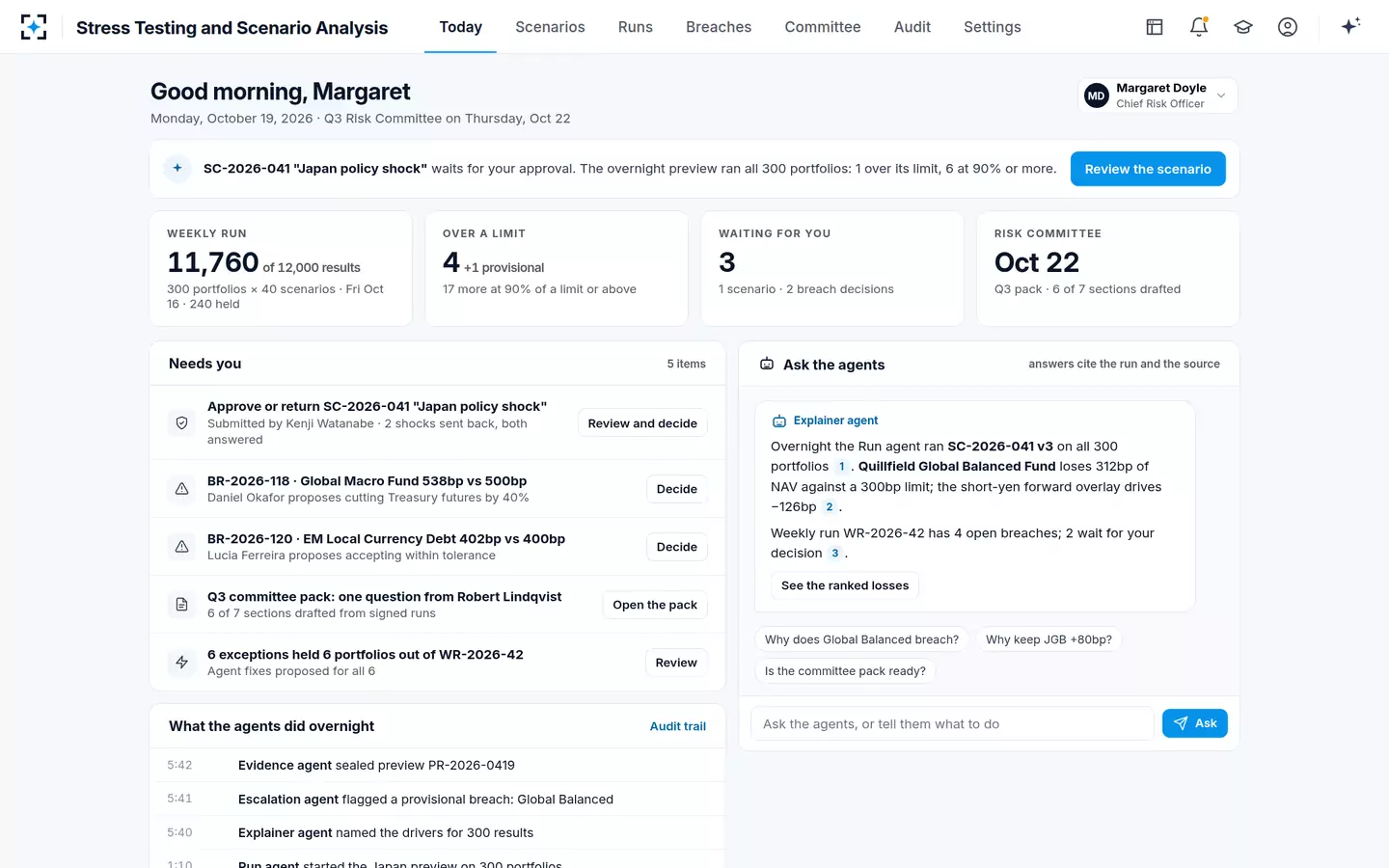
What a CRO sees on Monday morning in Stress Testing and Scenario Analysis
For the cost side of the decision, the scenario analysis Excel template comparison prices one approved scenario step by step.
Questions people ask
What is portfolio stress testing software?
Software that applies stress scenarios to portfolios and reports the losses. The term covers both risk engines, which do the revaluation, and governance layers, which manage scenarios, runs, explanations, approvals and reports around an engine. Stress Testing and Scenario Analysis is the second kind and drives the engine a firm already uses.
Is a portfolio stress testing calculator enough?
For one portfolio of linear holdings and a few what-ifs, often yes. Once options, many portfolios, a committee or a regulator are involved, the calculation is the small part; versions, challenge, data controls and a trail behind every figure are what the committee and examiners need.
How long does portfolio stress testing software take to go live?
It depends on the engine connection, the data and the scenario set, so ask for a plan built on your own scenarios. A cautious path is one committee cycle running beside the current process, then new scenarios in the software, then the official set and papers, with the committee deciding at each step.
Can stress testing software use AI safely?
Yes, if the agents' limits are enforced and their work is checked. In Stress Testing and Scenario Analysis no agent may make a scenario official, change positions or prices, recommend a trade, close a breach or send the committee papers, and each agent version is evaluated on past results before it goes live.
What does a risk committee need from stress testing software?
Figures it can reproduce, shocks it can challenge and decisions it can attribute. In practice: every number linked to its run, scenario version and date; the disputed shocks with both sides; and a named approver with a reason for every scenario and breach.