AI-assisted scenario analysis is worth buying for one job above all: challenging the shocks a scenario is made of before anyone prices them. An agent can test every factor shock against decades of daily history at the scenario's horizon, check that the shocks fit together and fit the story, and send back the ones it cannot support with a suggested alternative, all in minutes rather than the weeks of email it replaces. Drafting shocks from central bank statements is useful too, but drafting is where generative AI is most likely to produce a confident number with no basis, so the drafter needs a challenger. Botminds' Stress Testing and Scenario Analysis has both, as separate agents: the Scenario agent drafts with a citation for every shock, the Calibration agent challenges, and only the chief risk officer can make a scenario official.
The walk-through follows one scenario at the solution's fictional sample firm, Quillfield Capital: "Japan policy shock: BoJ ends bond buying," twelve factor shocks over ten days, drafted on 14 October and challenged on the evening of 15 October.
Inside the Calibration agent: one shock from draft to decision
Agent
Drafted with a sourceThe Scenario agent proposes JGB 10-year +80bp, citing the Bank of Japan's statement, page 1, in Japanese with an aligned English text.
Never: sets a shock without a cited passage or window
Agent
Tested for rarityThe Calibration agent scales the shock to the 10-day horizon and places it in daily history since 1990, naming its nearest analog windows.
Never: changes the shock itself
Agent
Tested for consistencyIt checks direction against the story and the joint plausibility of all twelve shocks together; one other shock, US Treasuries −15bp, fails the story.
Never: approves anything
Agent
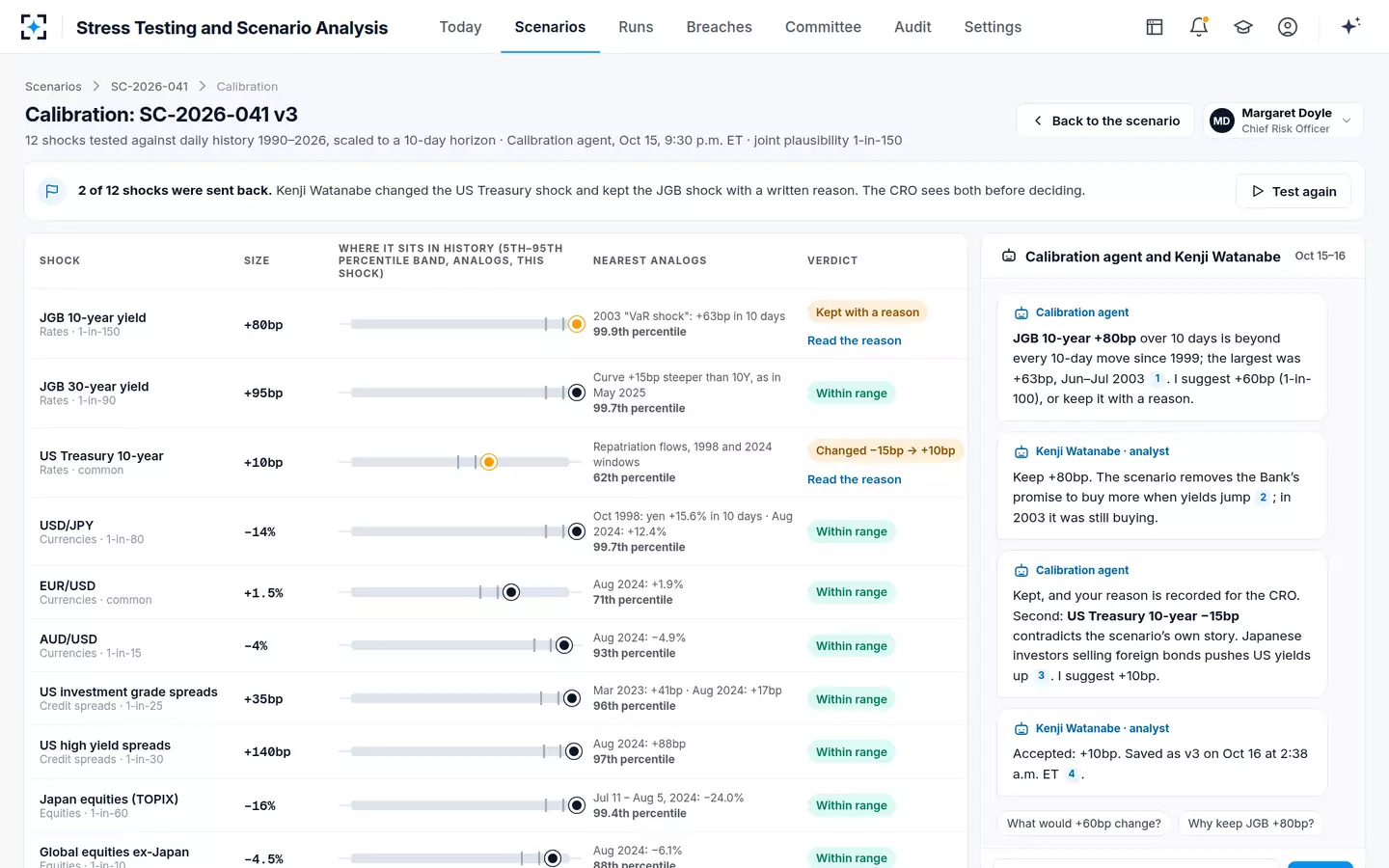
Sent back with a suggestionThe JGB shock lies beyond the agent's historical range: it suggests +60bp, or keeping +80bp with a written reason.
A person decides
The analyst answersKeeps +80bp: the scenario removes the Bank's promise to buy more when yields jump. Changes the Treasury shock to +10bp.
A person decides
The CRO decidesReads both objections and both answers on the decision sheet, approves with a reason code.
What is AI-assisted scenario analysis?
It is the use of AI agents in the design half of stress testing: reading the sources a scenario rests on, proposing factor shocks, measuring how plausible each shock and the combination are, and explaining the losses once the scenario is priced. It is not the risk engine, which still does the revaluation, and it is not the approver. The useful question for a buyer is which of those tasks an agent does, what it is forbidden to do and how its work is checked.
Regulators frame the boundary the same way. ESMA's 2024 statement on AI in investment services is blunt: a decision stays the management body's responsibility whether a person or an AI tool took it (ESMA, Public Statement on AI and investment services, May 2024). The SEC's examiners, describing registrants' growing use of what they call "super intelligence (SI)", say existing duties apply to it unchanged, because those duties are "technology-neutral" (SEC Division of Examinations, FY2027 priorities). A scenario approved on an agent's say-so is still the firm's scenario.
Can AI draft a stress scenario from a central bank statement?
Yes, and it is a real time saving, especially for texts in another language: the sample firm's analyst in Singapore drafts from Bank of Japan statements in Japanese, which by hand meant browser translation and a morning per text. The Scenario agent reads the original, aligns an English text sentence by sentence, and proposes each shock with the passage and page it rests on, or the historical window it echoes, and it asks a person when its confidence on a shock falls below 0.80.
Stress Testing and Scenario Analysis: the source in its own language, each passage tied to a shock
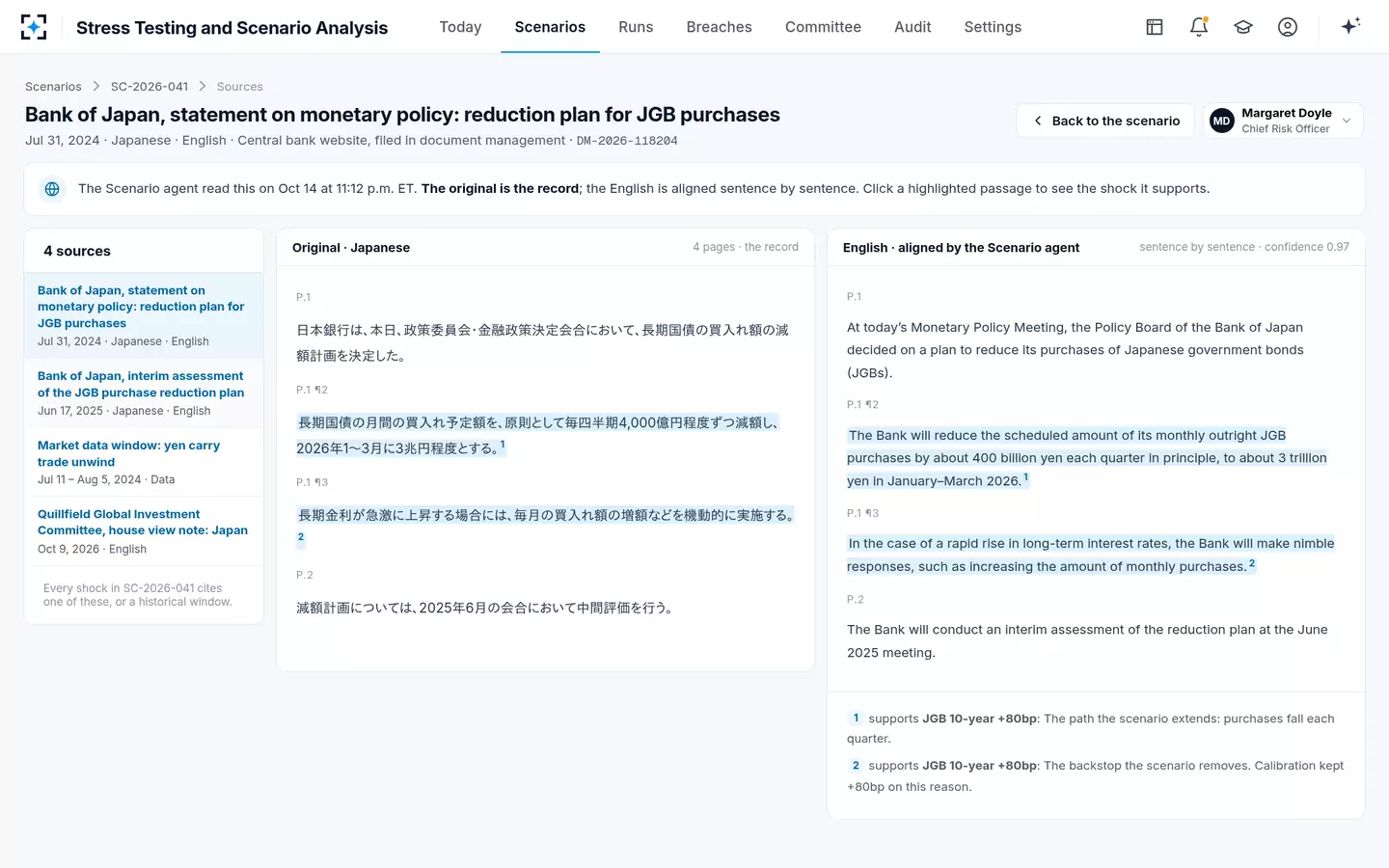
Drafting is also where the risk is. The Financial Stability Board's final report on sound practices for adopting AI, published on 15 October 2026, describes the failure precisely:
For example, models trained on historical data may underperform in new market conditions. Some type of AI such as GenAI may hallucinate by generating seemingly plausible but incorrect outputs.
Financial Stability Board, Sound Practices for Responsible Adoption of AI: Final report, 15 October 2026
In scenario design, a "seemingly plausible but incorrect output" is a shock size with no source behind it, and it looks exactly like a good one. That is why a citation for every shock is a hard rule rather than a feature: a shock without a passage or a window behind it cannot be drafted at all, and one with a citation can be checked by a person in seconds.
How do you stop AI inventing a shock size?
By separating the agent that proposes from the agent that challenges, and giving the challenger a test that does not depend on the drafter's reasoning. The challenge has three parts. Rarity: where does this move sit in daily history at the scenario's horizon, and which past windows came closest? Direction: does the move follow from the story, or contradict it? Joint plausibility: are the twelve moves, taken together, a combination history has produced or something close to it?
Research on stress scenario selection supports the third test. An Office of Financial Research working paper by Glasserman, Kang and Kang proposed methods to "estimate the most likely outcome for other variables given a stress in one variable, and thus to gauge the plausibility of particular combinations of stresses" (OFR working paper 0007, 2013; later published in Quantitative Finance, 2015). An earlier OFR working paper by Flood and Korenko argued that selecting scenarios by enforcing "internal consistency among the shock dimensions" reduces "the danger of 'blind spots' in stress testing" (OFR working paper 0005, 2013). An agent that runs such checks on every draft makes the committee's question, "is this combination plausible?", answerable with evidence.
One scenario through the challenge
12
factor shocks tested against daily history from 1990, scaled to ten days
2
sent back: one contradicted the story, one lay beyond the historical range
1 / 1
changed by the analyst / kept with a written reason the CRO reads
302bp
Global Balanced's loss at the suggested smaller JGB shock: still over its 300bp limit
What is a plausible stress scenario?
One that is unlikely but not impossible, and whose parts belong together. CESR's guidelines for UCITS using value at risk put the first half in a phrase: scenarios "should be plausible, i.e. unlikely to occur but not impossible" (CESR/10-788, explanatory text 62). Rule 18f-4 asks for "extreme but plausible" market changes. Neither defines a number, and that is deliberate: plausibility is a judgement the firm owns.
An agent can make the judgement better informed without making it for you. It can say that a move has been reached in only a handful of ten-day windows since 1990, or never, and which windows came closest. It cannot say that the next crisis will be no larger. In September 2022, 30-year gilt yields rose more than twice as far over four days as in any period since 2000, according to the Bank of England (Bank of England, letter of 5 October 2022). An agent that blocked every shock beyond the record would have blocked that one, which is why the sample firm's rule asks for a written reason beyond 1-in-100 and reserves the block for shocks rarer than 1-in-500, and why that block is a setting the firm should set with care. Historical stress testing works through the 2022 numbers.
Stress Testing and Scenario Analysis: the agent's objection and the analyst's answer
AI for scenario analysis: the agent that drafts vs the agent that challenges
Both are useful, and a buyer should know which one a product actually contains. A drafter reads news or central bank text and proposes a scenario; a challenger tests what was proposed; and only some designs keep the challenge and the answer where the approver can read them.
Two jobs for AI in scenario analysis, and what each needs to be safe
An agent that drafts: Reads statements, reports and market events; proposes factor shocks.
An agent that challenges: Tests each proposed shock against history and the story; tests the set for joint plausibility.
An agent that drafts: A confident shock with no basis: a seemingly plausible but incorrect output.
An agent that challenges: Treats the historical record as a ceiling, or passes an implausible combination because each shock alone looks fine.
An agent that drafts: A cited passage or window for every shock; a person asked when confidence is low.
An agent that challenges: Its own data and test, independent of the drafter; it may suggest but never change a shock.
An agent that drafts: A draft with its sources.
An agent that challenges: Each objection, the analyst's answer and the reason for any shock kept against the challenge.
An agent that drafts: The analyst, who submits.
An agent that challenges: The CRO, who approves, returns or rejects with a reason code.
Who approves an AI-drafted scenario?
The same person who approves any scenario, and never the person, or agent, who drafted it. In the sample firm the analyst is the maker and the CRO the checker; the decision sheet shows who drafted, what the challenge found, what the overnight preview cost each portfolio and which scenario the new one replaces in the official set. The CRO picks a reason code, approve, approve with a condition, return or reject, and writes a comment. No agent has a button for that.
Accountability is the reason, and the FSB's 2026 report warns against the opposite assumption, counting among the misconceptions that undermine oversight the belief that AI output is nearly always right. An approver who sees the objection and the answer is exercising oversight; one who sees only the final numbers is trusting the drafter twice.
How do you know the challenger is right?
Test it the way you would test a new analyst: on scenarios whose outcome you already know. Run the challenger on the last year's approved scenarios and compare what it flags with what your committee changed, kept or argued about. A challenger that flags nothing is not checking; one that flags everything will be ignored within a month. The useful middle sends back a few shocks per scenario, each for a reason a person can evaluate in a minute.
Then keep testing it. The FSB's 2026 sound practices treat performance management as a duty for any AI use case, noting that performance "may also degrade due to version changes in key AI models or systems." In the solution, each agent has a versioned instruction set and an approved model and is evaluated on a set of past results before a new version goes live; the firm's own historical scenarios are the natural test set. Ask any vendor what its test set is, who reviews the results and what happens when a new version flags more or fewer shocks than the old one.
Where an AI challenger saves time, and where it adds little
It saves the most where scenarios are argued, not prescribed. On the solution's own estimate of a typical firm, arguing each shock size by email and checking it against history takes about eight of the roughly 22 working days a new hypothetical scenario needs by hand, the largest single block. A challenge that arrives with the draft, with the history and the analog windows attached, turns that argument into one exchange on the record. The design target for the whole path, from a central bank statement to a CRO-approved scenario, is one business day; that is a target, not a measured result.
It adds little where the sizes are set by someone else. Form PF's market factor question prescribes its moves, equities up and down 10% in the amended form, and ESMA publishes the parameters EU money market funds apply; there is nothing for a challenger to argue about in either. A firm whose stress program is only prescribed sensitivities and a static set of historical replays needs reliable runs and a clean record more than it needs a calibration agent. The case for the challenger grows with the number of new hypothetical scenarios a year and the number of people who argue their sizes.
Questions to ask before buying AI for scenario analysis
Eight questions for a vendor of AI-assisted scenario analysis
- Does every proposed shock cite a source a person can open?
A passage and page, or a named historical window. No citation, no shock.
- Is the challenge done by a separate agent with its own data?
A drafter that checks its own work is not a challenge.
- What history does the challenge use, and at what horizon?
Daily factor history over decades, scaled to the scenario's horizon, not a single crisis.
- Does it test the combination, not just each shock?
Direction against the story and joint plausibility across all shocks.
- Can it change a shock, or only suggest?
Only suggest. The analyst answers; the answer is kept.
- What happens to a shock beyond the historical record?
A reason and an approver, set by the firm. A hard ceiling would have refused September 2022.
- Can any agent make a scenario official, send the committee papers or recommend a trade?
The answer should be no, enforced by permissions.
- How is a new version of an agent tested before it goes live?
On past scenarios, with results compared, and its instructions versioned.
It also helps to see where the agents stop. In Stress Testing and Scenario Analysis no agent may make a scenario official, change positions or prices, recommend a trade, close a breach, send the committee papers or contact a client; each agent has a versioned instruction set and is evaluated on past results before a new version goes live, and no firm data is used to train models. The pricing remains on the firm's own risk engine. For how the challenge plays out between two people rather than a person and an agent, market risk stress testing with two analysts measures the disagreement directly.
Questions people ask
Can AI do scenario analysis on its own?
It can draft a scenario and test it, but it should not approve one. ESMA's 2024 statement says firms' decisions remain the responsibility of management bodies whether people or AI tools take them, and in Stress Testing and Scenario Analysis only the CRO can make a scenario official.
How does an AI agent check whether a shock is plausible?
By placing it in daily history at the scenario's horizon, naming the closest past windows, and testing whether it fits the other shocks and the scenario's story. The sample agent sent back two of twelve shocks: one contradicted the story and one lay beyond its historical range.
Should AI cap stress scenarios at historical extremes?
No. History measures rarity; it does not bound the future. In September 2022, 30-year gilt yields rose more than twice as far over four days as in any period since 2000. A firm can require a written reason and a named approver for a shock beyond the record instead of blocking it.
What do regulators say about AI in risk management?
That the obligations do not change. The SEC's FY2027 examination priorities say examiners will look at whether firms using "super intelligence (SI)" continue to meet existing, technology-neutral obligations, and the FSB's October 2026 final report on sound practices stresses human oversight and performance management.
Does the AI see our positions?
The agents that run and explain the stress test do; they pull positions from portfolio accounting and the order management system to drive the firm's risk engine. They never change positions or prices, and in the solution no firm data is used to train models.