Money market fund stress testing is the most prescribed stress test in fund regulation. In the United States, Rule 2a-7 requires written procedures for periodic stress tests of a fund's ability to keep the liquidity it has set for itself and to minimise principal volatility, under named hypothetical events: higher short-term rates, credit deterioration and wider spreads, each combined with rising redemptions, at intervals the board decides. In the EU, Article 28 of the MMF Regulation names six factors, requires tests at least twice a year and has ESMA publish common reference parameters that it updates every year. Both send the results to the board. Botminds' Stress Testing and Scenario Analysis handles the part both regimes share with every other fund: scenarios written as cited factor shocks, approved by a named person and run across every fund on a fixed cycle, with each result traceable when the board or the regulator asks.
The product examples come from the solution's fictional sample firm, Quillfield Capital.
What Rule 2a-7 tells a money market fund to stress test
| Hypothetical event | Combined with | What the test asks |
|---|---|---|
| (A) Increases in the general level of short-term interest rates | Various levels of an increase in shareholder redemptions | Can the fund keep the liquidity its procedures name, and limit principal volatility, as rates rise and holders leave? |
| (B) Credit deterioration: a downgrade or default of particular portfolio positions, each representing various portions of the portfolio | Various levels of an increase in shareholder redemptions | The same, with varying assumptions about the loss on each security |
| (C) A widening of spreads against the indexes portfolio securities are tied to, by sector | Various levels of an increase in shareholder redemptions | The same, sector by sector: industry, region or security type |
| (D) Any additional combinations of events the adviser deems relevant | At the adviser's discretion | Whatever the fund's own holders and holdings make likely |
What scenarios must a money market fund stress test?
Under Rule 2a-7, every one of the rule's events is paired with redemptions, which is the design choice that matters. The rule does not ask how a rate shock alone moves the portfolio's value; it asks whether the fund can still meet its holders when the shock and the withdrawals arrive together. The rule lists rate increases, credit events and spread widening, and adds "any additional combinations of events that the adviser deems relevant" (17 CFR 270.2a-7(g)(8)(i)(D)).
The rule does not prescribe sizes. A fund decides how far rates rise, which positions default and how much of the shareholder base leaves, and those choices are the stress program. A test that pairs a modest rate rise with modest redemptions will pass every quarter and tell the board nothing; the useful versions find the combination at which the fund's liquidity falls below the level its procedures name, which is a reverse stress test in all but name.
The EU regime is broader and more specific. Article 28 of the MMF Regulation requires scenarios that consider at least six factors: changes in the liquidity of the assets, changes in their credit risk, movements in interest rates and exchange rates, levels of redemption, widening or narrowing of spreads, and "hypothetical macro systemic shocks affecting the economy as a whole" (Regulation (EU) 2017/1131, Art. 28(1)). The tests "shall be based on objective criteria and consider the effects of severe plausible scenarios," and the manager of a constant or low-volatility NAV fund must also estimate the gap between the constant NAV and the market NAV under each scenario.
What are the ESMA MMF stress test scenarios?
ESMA's guidelines turn Article 28's factors into common reference parameters every EU money market fund applies, and the regulation requires ESMA to update them at least every year. The version in force is dated 26 March 2026 (ESMA50-481369926-30848). Funds report the results of these common scenarios to their regulators in a standard template; the guidelines tell managers how to calibrate each one.
The redemption scenarios show how specific the parameters are. ESMA asks for three: a reverse liquidity stress test, measuring the largest weekly outflow the fund could meet while staying within all its portfolio rules; a weekly liquidity stress test, in which "the fund receives net weekly redemption requests from 40% of the professional investors and 30% of the retail investors"; and a concentration test, in which the fund faces redemption requests from its two main investors. The macro scenario combines a market shock with a redemption shock that follows it, and counts the extra losses from the assets sold to meet it.
Money market fund stress testing by the numbers
284
US money market funds subject to Rule 2a-7, by the SEC's estimate in October 2026
SEC notice, 91 FR, Oct 2026
40% / 30%
of professional and retail investors redeeming in a week, in ESMA's weekly liquidity stress test
ESMA guidelines, March 2026
2
stress tests a year at least, for EU money market funds; US boards set their own interval
MMF Regulation, Art. 28(3)
The annual cycle is itself changing. On 5 May 2026 ESMA proposed to replace the yearly re-issue of the guidelines' calibration section with "an annual update of a dedicated page on the ESMA website where the parameters would be made available," so that new parameters apply as soon as they are approved rather than after translation; it took comments until 6 August 2026 (ESMA consultation paper, May 2026). It is a proposal. A manager's procedures should say which year's parameters each test used, whatever the publication route.
How often do money market funds stress test?
In the US, as often as the board decides is "appropriate and reasonable in light of current market conditions"; the rule sets no minimum (17 CFR 270.2a-7(g)(8)(i)). In the EU, the board of the fund or its manager sets the frequency after considering market conditions and planned portfolio changes, and "such frequency shall be at least bi-annual" (MMF Regulation, Art. 28(3)).
The board's discretion is a design decision, and it is worth writing down why. A fund whose shareholders are a few large institutions can see a quarter's worth of outflows in a day, and a test interval that suits a broadly held retail fund will not suit it. The interval should also tighten when markets move: the 2a-7 wording ties it to "current market conditions," which implies a procedure for testing out of cycle when conditions change.
Money market fund stress testing in the US and the EU, side by side
SEC Rule 2a-7: The board, at intervals it finds appropriate and reasonable in light of current market conditions.
EU MMF Regulation and ESMA: The board of the fund or manager, at least twice a year.
SEC Rule 2a-7: Rate rises, credit events and spread widening, each combined with rising redemptions, plus combinations the adviser deems relevant.
EU MMF Regulation and ESMA: Six factors: asset liquidity, credit, rates and exchange rates, redemptions, spreads and macro-systemic shocks.
SEC Rule 2a-7: Not prescribed. The fund chooses them.
EU MMF Regulation and ESMA: Common reference parameters set by ESMA and updated at least yearly, plus the manager's own scenarios.
SEC Rule 2a-7: Ability to keep the liquidity named in the fund's procedures and to minimise principal volatility; for stable-price funds, the stable price.
EU MMF Regulation and ESMA: Effect on NAV and on liquidity or the ability to meet redemptions; for CNAV and LVNAV funds, the gap between constant and market NAV.
SEC Rule 2a-7: The board, at its next regularly scheduled meeting or sooner.
EU MMF Regulation and ESMA: The board; where a test reveals a vulnerability, an extensive report and action plan go to the national regulator, which sends it to ESMA.
SEC Rule 2a-7: Procedures and the board's considerations and actions: six years, the first two easily accessible.
EU MMF Regulation and ESMA: The extensive report and action plan: at least five years.
Did the 2023 money market fund reforms change stress testing?
Yes: they replaced a fixed test with one the fund defines. Before the 2023 reforms, Rule 2a-7 asked whether a fund could keep at least 10% of its assets in weekly liquid assets under the hypothetical events, a threshold chosen because falling below it used to trigger a default liquidity fee. The reforms removed that link, raised the minimums to 25% daily and 50% weekly liquid assets, and changed the test.
As a result, each fund will be required to determine the minimum level of liquidity it seeks to maintain during stress periods, identify that liquidity level in its written stress testing procedures, periodically test its ability to maintain such liquidity, and provide the fund's board with a report on the results of the testing.
SEC, money market fund reforms adopting release (July 2023)
The amendments took effect on 2 October 2023, with six months to comply with the liquidity changes, which the SEC said gave "sufficient time for funds to update their stress testing procedures" (88 FR 51404). The practical consequence is that every money market fund's procedures now contain a number the fund chose, and the board should ask how it was chosen. A floor set just below what the fund holds in calm markets makes the test easy to pass and hard to learn from.
What is the board's role in money market fund stress testing?
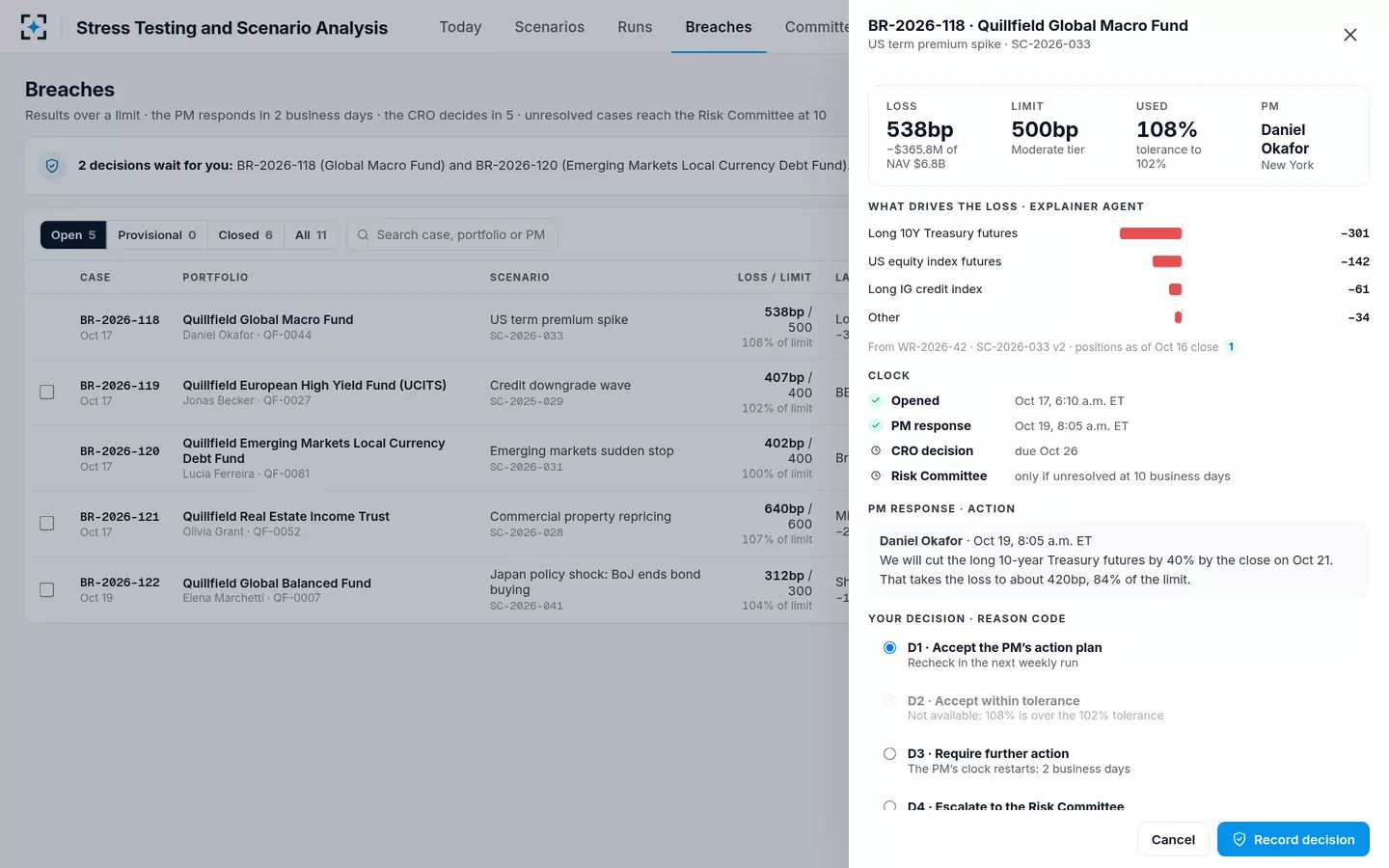
The board sets the interval, receives the results and is told what the adviser assumed. Rule 2a-7 requires the report to reach the board at its next regularly scheduled meeting, or sooner if the results warrant, and to include the test dates, an assessment of the fund's ability to keep its liquidity and limit principal volatility, an assessment of the fund's ability to withstand events "reasonably likely to occur within the following year," and a summary of the significant assumptions (17 CFR 270.2a-7(g)(8)(ii)). In the EU, where a test reveals a vulnerability, the board examines the manager's extensive report and action plan, amends the plan if necessary and approves the final version.
Questions a money market fund board can ask of every stress test report
- Which events, at what sizes, and why those sizes?
Rule 2a-7 names the events but not the sizes; the board should know who chose them and on what evidence.
- What liquidity floor is the test protecting, and how was it set?
Since the 2023 reforms the fund names its own floor in its procedures.
- What combination of shock and redemptions breaks the floor?
The breaking point says more than a pass at a moderate scenario.
- How concentrated are the holders?
ESMA's concentration test, the two largest investors leaving, is a useful question for US funds too.
- What changed since the last report?
New scenarios, new sizes, new parameters, and whether the old and new versions were run side by side.
- What would trigger a test out of cycle?
The interval is tied to current market conditions; the procedure should say what conditions.
Why March 2020 is the scenario every money market fund board remembers
Because it combined every factor the rules name in the same fortnight. The Financial Stability Board's review of the March 2020 turmoil described how "the commercial paper (CP) and certificate of deposit (CD) segments of money markets started to exhibit signs of severe stress, with outflows from non-government MMFs in the US and EU leading to selling pressures on the assets held by these funds," while government money market funds took in cash (FSB, Holistic Review of the March Market Turmoil, November 2020). Spreads widened, the paper the funds held became hard to sell, and redemptions came at the same time: event (C) and redemptions, exactly as the rule pairs them.
A replay of that window, with the fund's own holder mix, is the most persuasive single test a money market fund can show its board, and historical stress testing covers how to build one. Credit work sits upstream of all of it: the minimal-credit-risk judgments a fund makes under Rule 2a-7 are the subject of Rule 2a-7 minimal credit risk.
What records of money market fund stress tests must be kept?
In the US, the written procedures, including the stress testing procedures and any changes, for six years after they are replaced, and a written record of the board's considerations and actions, included in the minutes, for six years, the first two in an easily accessible place in both cases (17 CFR 270.2a-7(h)(1)–(2)). In the EU, the extensive report and action plan for at least five years. The SEC's October 2026 estimate puts all of Rule 2a-7's recordkeeping at about 700 hours a year for each fund, across 284 funds (SEC notice, October 2026).
The records that matter most in an examination are the ones that let a test be reproduced: the scenario as it was defined on the test date, the positions and prices used, the liquidity floor in force and who approved each. A report that says "the fund passed" without them is a conclusion without evidence.
Where Stress Testing and Scenario Analysis fits for a money market fund
Stress Testing and Scenario Analysis is built around market scenarios: rate, spread, currency and equity shocks, each cited to its source, challenged against history, approved by the CRO and run on every fund on a fixed cycle. For a money market fund that covers the market side of the rule's events, rate and spread shocks, along with the versioning and approval of each scenario, and the trail behind every figure the board reads. A firm that runs money market funds alongside other funds can hold them all to one approved scenario set.
Stress Testing and Scenario Analysis: a scenario approved into the official set
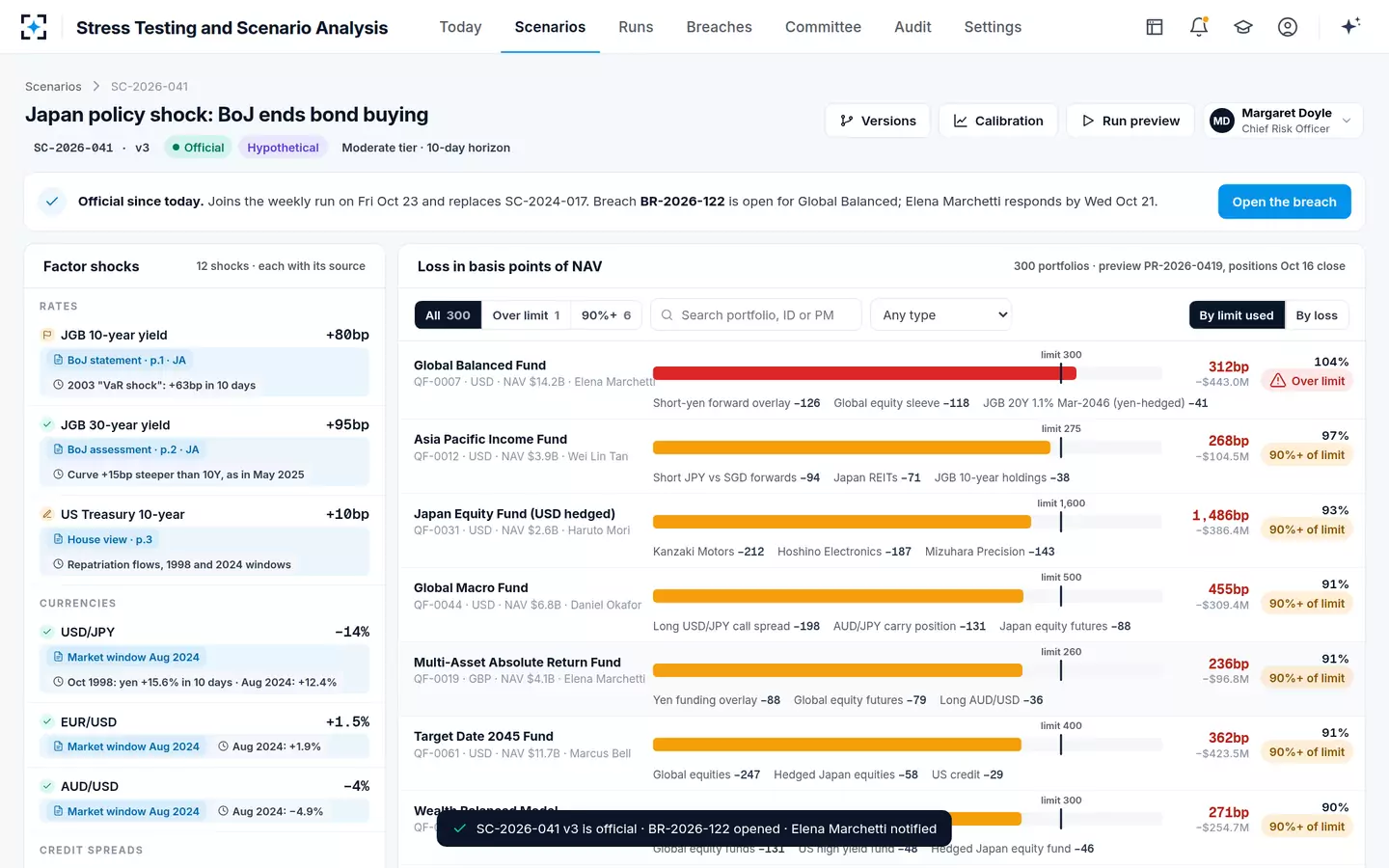
The redemption side is a different discipline. Who holds the fund, how fast they leave and what can be sold to meet them is the core of the money market test, and it belongs with the fund's liquidity stress testing; SEC and ESMA liquidity stress testing requirements compares those regimes. The combined test the rules require, a market event with the redemptions that follow it, is strongest when both halves come from the same approved scenario.
Breach cases with a clock: the same discipline a board report needs
Questions people ask
Are money market funds required to stress test?
Yes, in both the US and the EU. Rule 2a-7 requires written procedures for periodic stress testing at intervals the board sets, and Article 28 of the EU MMF Regulation requires stress testing at least twice a year using ESMA's common reference parameters alongside the manager's own scenarios.
What are the ESMA MMF stress test scenarios?
They cover asset liquidity, credit, interest and exchange rates, redemptions, spreads and macro-systemic shocks, with parameters ESMA updates at least yearly. The redemption tests include a weekly liquidity test with 40% of professional and 30% of retail investors redeeming, a reverse liquidity test and a concentration test on the two largest investors.
Did the 2023 reforms remove the 10% weekly liquid asset test?
Yes. The SEC replaced it with a test against a minimum liquidity level each fund sets in its own written stress testing procedures, and raised the regulatory minimums to 25% daily and 50% weekly liquid assets. The amendments took effect on 2 October 2023, with six months to comply with the liquidity changes.
Who receives money market fund stress test results?
The board, in both regimes. In the US the report goes to the next regularly scheduled board meeting, or sooner if the results warrant. In the EU, where a test reveals a vulnerability, the extensive report and action plan also go to the national regulator, which forwards it to ESMA.
Do money market fund stress tests need to be reverse stress tests?
ESMA's guidelines require one form of it: the reverse liquidity stress test measures the largest weekly outflow the fund could meet within its portfolio rules. Rule 2a-7 does not use the term, but finding the combination of shock and redemptions that breaks the fund's liquidity floor is the most informative way to run its events.