Rule 2a-7 is the SEC rule under the Investment Company Act of 1940 that governs money market funds: what they may hold, how long it may mature, how concentrated and how liquid the portfolio may be, and how credit risk is judged. On credit, the rule says a fund may buy only "eligible securities", and since October 14, 2016 a security is eligible because the fund's board, or the adviser it delegates to, has determined it "presents minimal credit risks to the fund", based on an analysis of the issuer's capacity to pay that considers four factors, not because of an agency rating. The determination has to be kept under ongoing review and written down. For a credit team that rates the names in a money market fund, those are four duties per security. Botminds' Internal Credit Rating writes a section on the four factors into every credit memo and checks every money market credit file against the rule, gaps first.
Sample figures on this page come from the solution's fictional data: Quillfield Capital's money market credit files and the credit memo on Orrin Freight Lines. The rule is quoted from the current eCFR text and the SEC's 2015 adopting release.
The four factors of Rule 2a-7, and what evidence answers each
(A) Financial condition
“Financial condition”
What answers it
Latest annual and interim statements, spread and tied out; revenue, margin and leverage trends.
In the sample memo
Revenue growth slowed to 1.1% over the last twelve months; margin 12.4%, down from 13.6% in fiscal 2023.
(B) Sources of liquidity
“Sources of liquidity”
What answers it
Cash, undrawn committed lines, the maturity schedule, and what could stop a line being drawn.
In the sample memo
$188 million of cash and a $612 million undrawn revolver; no maturity before 2029.
(C) Ability to react to events
“Ability to react to future market-wide and issuer- or guarantor-specific events, including ability to repay debt in a highly adverse situation”
What answers it
A written stress case: what happens to cash and covenants if revenue or funding falls sharply.
In the sample memo
The sample gap: one file had no stress case, and the solution listed it first.
(D) Industry and position
“Strength of the issuer or guarantor's industry within the economy and relative to economic trends, and issuer or guarantor's competitive position within its industry”
What answers it
Sector outlook and the issuer's place among peers on scale, margins and concentration.
In the sample memo
Fourth-largest US truckload carrier; customer concentration the highest of nine peers.
What is Rule 2a-7?
It is the rulebook a fund must follow to call itself a money market fund and, for government and retail funds, to keep a stable share price. Its risk-limiting conditions cover maturity, quality, diversification and liquidity, and its procedures cover credit review and stress testing. Credit is one strand among several, but it is the strand where the fund's own judgment, rather than arithmetic, decides compliance.
Rule 2a-7's main limits, and where credit judgment enters
| Condition | What the rule requires | Credit judgment? |
|---|---|---|
| Maturity | No instrument with a remaining maturity over 397 calendar days; weighted average maturity no more than 60 days and weighted average life no more than 120. | No |
| Portfolio quality | US dollar securities that are eligible securities when acquired. | Yes: the minimal credit risk determination |
| Diversification | Generally no more than 5% of total assets in one issuer, with limited exceptions; 10% for a demand feature or guarantee provider. | Partly: who the issuer or guarantor is |
| Liquidity | At least 25% of total assets in daily liquid assets (taxable funds) and 50% in weekly liquid assets; no more than 5% illiquid. | No |
| Ongoing review | Written procedures requiring the adviser to review whether each security still presents minimal credit risks. | Yes |
| Stress testing | Periodic tests including an event indicating credit deterioration, such as a downgrade or default. | Yes: which positions and how bad |
What is an eligible security under Rule 2a-7?
An eligible security is one of three things: a share of another registered money market fund, a government security, or a security "with a remaining maturity of 397 calendar days or less that the fund's board of directors determines presents minimal credit risks to the fund" (2a-7(a)(11)). For a prime fund's commercial paper, bank deposits and corporate notes, only the third route applies, and it is entirely the fund's own determination.
The rule adds what the determination must contain. It "must include an analysis of the capacity of the security's issuer or guarantor ... to meet its financial obligations, and such analysis must include, to the extent appropriate, consideration of the following factors": the four in the figure above. "To the extent appropriate" is not an escape clause. The SEC's examiners have treated a missing factor as a deficiency, as the 2019 findings below show.
What is a minimal credit risk determination?
It is the fund's documented conclusion that a particular security is unlikely enough to default that the fund may hold it, made on the analysis above. The board makes it or delegates it: the board "may delegate to the fund's investment adviser or officers the responsibility to make any determination required" except a short list, and must "establish and periodically review written guidelines (including guidelines for determining whether securities present minimal credit risks)" (2a-7(j)). In practice the adviser's credit team makes the determination under board-approved procedures, and the board oversees it.
The phrase is old; the content changed in 2016. Before then the determination sat on top of a ratings test: a security had to carry a rating in one of the two highest short-term categories from a "requisite NRSRO", or be a comparable unrated security, and no more than 3% of a fund could be in "second tier" securities (SEC Release IC-31828, 80 FR 58124). Now the four factors carry the whole weight.
What changed in Rule 2a-7 in 2016?
The references to agency ratings came out. Section 939A of the Dodd-Frank Act told every federal agency to "review any regulation issued by such agency that requires the use of an assessment of the credit-worthiness of a security or money market instrument", and to replace such references with a standard of creditworthiness of its own. For money market funds, the SEC removed the requirement to designate rating agencies, ended the first-tier and second-tier distinction, and codified the four factors. The amendments took effect on October 26, 2015, with compliance from October 14, 2016.
Five and a half years from proposal to compliance: removing ratings from Rule 2a-7
- First proposal to re-proposalMar 2011 – Jul 2014
- Re-proposal to adoptionto Sep 2015
- Effective 26 Oct 2015, then compliance periodto 14 Oct 2016
The SEC also dropped a tougher test it had proposed. In 2014 it suggested requiring a finding that the issuer had an "exceptionally strong capacity" to meet its short-term obligations; commenters warned of interpretive confusion, and the final rule instead kept the "well-developed existing requirement that a security present minimal credit risks" and codified the factors (80 FR 58124).
Do money market funds need credit ratings?
They no longer need them, and many still use them. The SEC said so plainly: "NRSRO ratings provide one indicator of credit risk of a fund's portfolio securities and ... we anticipate that they will continue to be considered by many money market fund managers in performing credit quality assessments." The 2015 amendments required funds to report on Form N-MFP any agency rating the board or its delegate considered in making the minimal credit risk determination, with the agency's name (80 FR 58124).
What a fund may not do is let the rating be the determination. A file that says "rated A-1, therefore eligible" has skipped the analysis the rule requires. The internal rating is where the four factors are weighed and the agency's view is one input; when the two differ by two or more notches, the reason belongs in the file, as the guide to splits from the agencies explains.
How often must the credit risk be reviewed?
Continuously, without a fixed calendar. The fund's written procedures must make the adviser keep reviewing whether each security other than a government security still presents minimal credit risks, based on, among other things, the issuer's financial data (2a-7(g)(3)). The SEC deliberately set no frequency, and no list of trigger events either, after a commenter warned that triggers might cause managers to limit reviews to those events.
We expect that for purposes of the rule, ongoing monitoring would mean that monitoring efforts should occur on a regular and frequent basis.
SEC, Release IC-31828 (2015)
The release added that many funds monitor daily, "and do so even on an hourly basis if there are rapidly changing events", and that monitoring will "as a practical matter, require the adviser to monitor for downgrades by relevant credit rating agencies because such a downgrade would likely affect the security's market value". A full annual review on a fixed cycle is therefore a floor many firms set themselves, not the rule's requirement; the sample firm's 12-month cycle, with any credible event opening a review on money market names, is its own policy. EU money market funds, by contrast, must review every assessment at least annually (Regulation (EU) 2017/1131, Article 19(4)). How to set the clock for an event review has its own guide.
What happens when a money market security is downgraded?
Nothing automatic, since 2016: a downgrade is a reason to re-examine, not an instruction to sell. The disposal duty is triggered by three adverse events: a default (other than an immaterial one unrelated to the issuer's financial condition), the security ceasing to be an eligible security, for example because it "no longer presents minimal credit risks", or an insolvency event at the issuer or a guarantor. Then the fund "shall dispose of such security as soon as practicable consistent with achieving an orderly disposition", unless the board finds that disposal would not be in the fund's best interests (2a-7(f)(1)).
That finding is one the board cannot delegate: 2a-7(j) excludes the adverse-event determinations from what the adviser may decide alone. Certain material events also require notice to the SEC on Form N-CR (2a-7(f)(2)). And the stress tests the adviser runs for the board must include "an event indicating or evidencing credit deterioration, such as a downgrade or default of particular portfolio security positions" (2a-7(g)(8)). A downgrade therefore has three places to show up: the ongoing review, the stress test and, if the review concludes the risk is no longer minimal, the disposal decision.
How long must 2a-7 records be kept?
At least three years from the latest review. The rule requires "a written record ... of the determination that a portfolio security is an eligible security, including the determination that it presents minimal credit risks at the time the fund acquires the security", kept "for a period of not less than three years from the date that the credit risks of a portfolio security were most recently reviewed" and "in an easily accessible place" (2a-7(h)(3)). The clock runs from the latest review, so the record of the original determination stays in the file for as long as the security is held and reviewed, and three years after.
What SEC examiners found in money market credit files
After the 2016 changes took effect, the SEC's examiners looked at more than 70 money market funds and found the gaps a reader of this page would expect. Some funds did not "include in their credit files one or more of the factors required"; some did not "adequately document the periodic updating of their credit files to support the eligible security determination"; and some had no policies addressing "periodic board oversight of the MMFs' written guidelines and procedures under which the adviser, when delegated by the MMFs' board, analyzes credit risks and makes minimal credit risk determinations" (SEC Risk Alert, November 7, 2019). The staff also said most funds examined appeared to be in substantial compliance.
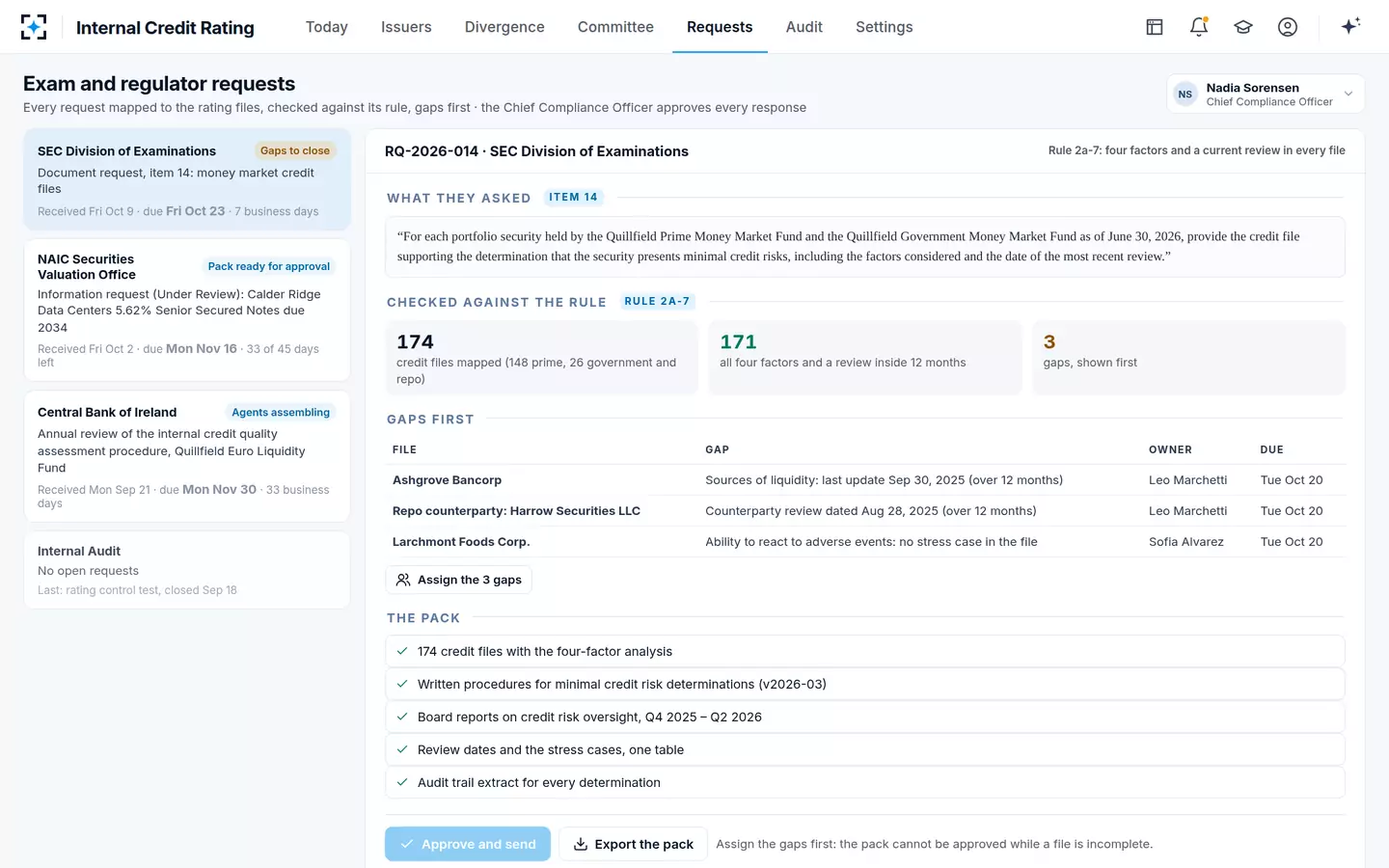
Each finding is a file problem rather than a credit problem: the analysis may have happened, but the file could not show it. That is why the sample firm answers the SEC's document request from the files, checked factor by factor. Of 174 money market credit files, 148 prime and 26 government and repo, 171 carry all four factors and a review inside the firm's 12-month standard; the three gaps are listed first with their owners: a liquidity update more than a year old, a repo counterparty review more than a year old, and a missing stress case.
An SEC document request answered from the files, checked against Rule 2a-7
What Internal Credit Rating does for a money market credit file
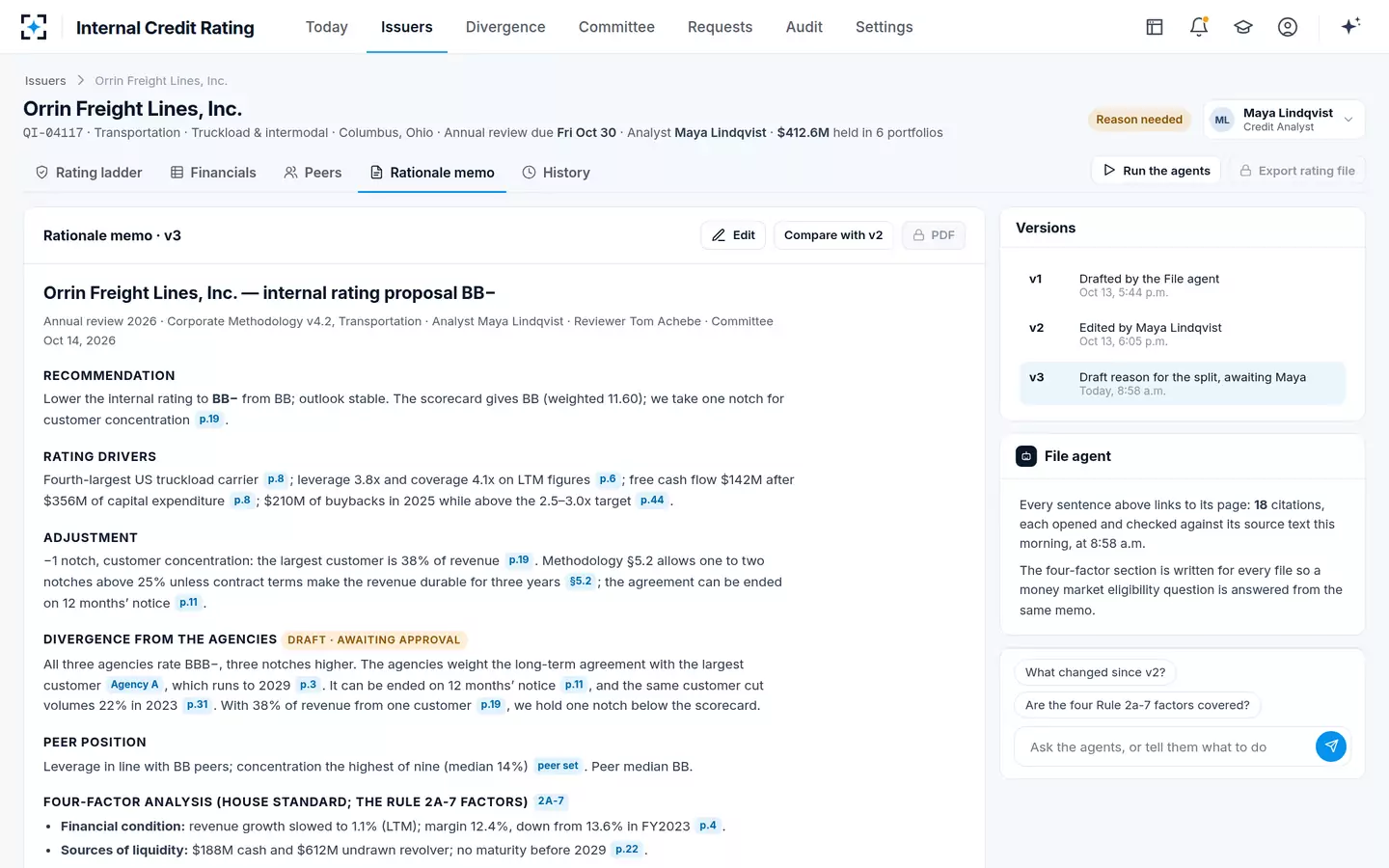
The solution helps with the file, not the fund's obligations themselves. Every credit memo carries a section on the four factors, each sentence cited to its source page, so a money market eligibility question is answered from the same memo as the internal rating. The Intake agent opens a review on any credible event for money market names. The File agent maps an SEC request to the files and checks each against the rule, gaps first, and the chief compliance officer approves the response.
One memo answers the internal rating and the money market question
It does not decide eligibility, set the fund's procedures, run the fund's liquidity or diversification tests, or take the board's adverse-event decisions. Those stay with the adviser's people and the board. What it removes is the gap the 2019 examiners found between an analysis that happened and a file that proves it. What the agents prepare and what people decide is laid out in its own guide.
Questions people ask
Who makes the minimal credit risk determination?
The fund's board of directors, which may delegate it to the investment adviser or the fund's officers under written guidelines it establishes and periodically reviews. The board keeps oversight and cannot delegate the decision not to dispose of a security after an adverse event.
Are government securities subject to the minimal credit risk test?
No. A government security is an eligible security by definition, and the ongoing review requirement excludes government securities. Repurchase agreements are a different matter: a government money market fund's file still has to show that its repos with non-government counterparties are fully collateralized, which the SEC's 2019 examiners found some funds could not support.
Does an EU money market fund face the same test?
A similar one, more prescriptive. The EU Money Market Funds Regulation requires a documented internal credit quality assessment procedure, validated by back testing, reviewed at least annually, approved by senior management, and kept away from the portfolio managers, with documentation kept for three complete annual accounting periods.
What is Form N-CR?
It is the form a money market fund files with the SEC when certain material events occur, such as certain defaults or insolvency events affecting portfolio securities. Rule 2a-7(f)(2) requires the notice, and the fund must also post the same information on its website for at least a year.
Can a fund keep a security after it stops presenting minimal credit risks?
Only if the board finds that disposal would not be in the fund's best interests, which may take account of market conditions affecting an orderly sale. Otherwise the fund must dispose of it as soon as practicable, consistent with an orderly disposition.