A credit rating outlook is a rating agency's opinion on the likely direction of a rating over the coming months, often labelled positive, negative or stable; a rating watch, also called a review, is a stronger and shorter signal that the agency is actively considering a change, often after a specific event such as an acquisition or a profit warning. The difference matters less to a fund than it seems, because neither is a rule the fund must follow. What binds a fund is its own clock: a US money market fund's duty to keep minimal credit risk under ongoing review, an EU money market fund's duty to reassess on a material change, and the deadline the firm sets for its own event reviews. Botminds' Internal Credit Rating treats an agency action as one event among several, opens a review with a due date and the event cited, and escalates when the review runs late.
The examples come from the solution's sample data on fictional firms, on Wednesday, October 14, 2026: a French profit warning, an agency downgrade and an agency's negative outlook, all landing in one analyst's morning.
After a credit event, whose clock runs, and how long it gives
- Event to filing4 days
- Event to notice10 days
- Opened at once; review, challenge, signdue day 10
- Dueday 10
- To head of research+5
- To the CRO+15
What is the difference between a rating outlook and a watch?
An outlook is about direction over a longer horizon; a watch is about a possible change soon, usually tied to an event the agency is assessing. The EU's rating agency regulation is the rare legal text that defines the first: a "'rating outlook' means an opinion regarding the likely direction of a credit rating over the short term, the medium term or both" (Regulation (EC) 1060/2009, Article 3(1)(w)). It then treats outlooks almost like ratings, applying the same conflict-of-interest, disclosure and confidentiality rules to both.
No regulation defines a watch, and US rules treat it as something less than a rating action. For its disclosure rule, the SEC defines a rating action as an expected or preliminary rating, an initial rating, an upgrade or downgrade, or an affirmation or withdrawal after a review (17 CFR 240.17g-7(a)); the rating histories agencies must publish record upgrades, downgrades, defaults and withdrawals, not outlooks or watches (17g-7(b)). The one place the SEC's rules use the word sets a deadline: if an agency finds a conflict of interest influenced a rating and has not revised or affirmed it "within fifteen calendar days", it must publish "a rating action placing the credit rating on watch or review" (17g-8(c)(2)(ii)).
Outlook, watch and downgrade: what each one is, and what it asks of a fund
What the agency is saying: No change expected over the outlook horizon.
What it asks of the fund's own file: Nothing beyond the normal cycle. Note it in the annual review.
What the agency is saying: A direction over the short or medium term; defined in EU law as an opinion on the rating's likely direction.
What it asks of the fund's own file: A reason to check that your own view already reflects what the agency is worried about. Not, by itself, a review trigger.
What the agency is saying: A change is being actively considered, usually after a specific event.
What it asks of the fund's own file: Look at the event, not the watch. If the event is credible and material, open a review now.
What the agency is saying: The rating has changed.
What it asks of the fund's own file: Since 2016, no automatic sale for a US money market fund; reassess. For an EU money market fund, a downgrade below the two highest short-term ratings is a material change that requires a new assessment.
What is a rating watch, and what does it tell an investor?
A watch is the agency telling the market it is reviewing a rating now. Research suggests it does more than speed up news. Using Moody's data from 1982 to 2004, Bannier and Hirsch found that "for borrowers of high creditworthiness, rating agencies employ watchlists primarily in order to improve the delivery of information", while for low-quality borrowers "the review procedure seems to have developed into an implicit contract ... inducing the companies 'on watch' to abstain from risk-augmenting actions" (Journal of Banking & Finance, 2010).
For an internal rating, the second finding is the more useful. A weak issuer on watch may behave differently while the review runs, cutting buybacks or delaying a deal, so the facts the internal rating rests on can move during the watch itself. The review the firm opens should look at what the issuer does next, not only at what triggered the watch.
How long does a rating watch last?
As long as the agency's review takes; no rule fixes it, and a review tied to a pending transaction can stay open until the transaction closes or fails. That is a reason not to tie the fund's own clock to the watch: if the fund waits for the agency to resolve it, the fund's review takes as long as the agency's, which may be months.
When must an internal rating be reviewed after an event?
When the event could change the rating, on a deadline the firm sets and can show it met. For US money market funds, the SEC chose not to set either a frequency or a list of triggers in 2015, after a commenter warned that triggers might cause managers "to limit their reviews to those triggering events, rather than truly evaluating risk on an ongoing basis"; it expects monitoring "on a regular and frequent basis", noting many funds monitor daily, "even on an hourly basis if there are rapidly changing events" (SEC Release IC-31828, 80 FR 58124). Banks rating under Basel must start a new rating when material information about the borrower comes to light (CRE36.41).
A deadline turns that expectation into something an examiner can check. In the sample, the firm's setting is ten business days from the event date, and money market names get a review on any credible event. The Intake agent opens the review with the due date and cites the event; late reviews escalate to the head of credit research after five days and to the CRO after fifteen. The setting is the firm's choice, changed only by the administrator with the CRO's approval.
What is a material change in credit quality?
For EU money market funds the term is defined, and the definition is a useful checklist for anyone. A manager must make a new credit quality assessment whenever a material change could affect the existing one (Regulation (EU) 2017/1131, Article 19(4)(d)), and the delegated regulation lists what counts: a material change in bond and CDS pricing, default statistics, the issuer's financial situation, its sources of liquidity, its ability to react to events, its industry and position, securities-related research, and "analysis of the credit ratings or rating outlook given to the issuer or instrument by a credit rating agency or agencies selected by the manager" (Delegated Regulation (EU) 2018/990, Article 8(1)(a)).
Two details are worth copying. A downgrade "below the two highest short-term credit ratings" by an agency is itself a material change (Article 8(1)(b)), after which the manager must "carry out their own assessment" (Article 8(4)). And managers must set an internal procedure for choosing which agencies they follow and "the frequency with which the MMF shall monitor the ratings of those agencies" (Article 8(3)). An outlook appears in the list as one input to analyse, not as an instruction.
Events that should open a review, and where each signal usually arrives first
| Event | Where it usually appears | Why it matters to the rating |
|---|---|---|
| Profit warning or guidance cut | Company release; Form 8-K for US registrants | Changes the financial condition and cash flow the scorecard reads. |
| Triggering event on a debt obligation | Form 8-K Item 2.04 for US registrants | Acceleration or a payment increase can change liquidity overnight. |
| Agency downgrade, watch or outlook change | Agency announcement; the firm's licensed ratings feed | Moves the split from the agency median; a watch says the agency sees an event. |
| Large acquisition or leveraged recapitalisation | Company release, offering documents | Changes leverage and financial policy, often before any filing shows it. |
| Rating change on a municipal issuer | Event notice under the issuer's continuing disclosure undertaking | Rating changes are one of the listed events, due within ten business days. |
| Spread or CDS widening well beyond peers | Market data | For EU money market funds, a material change in pricing is a listed material change. |
What happens to a money market security on a downgrade?
In the US, nothing automatic since 2016; in the EU, a mandatory reassessment for downgrades below the top two short-term grades. A US fund must dispose of a security only on a default, an insolvency event or when it ceases to be an eligible security, for instance because it "no longer presents minimal credit risks", unless the board finds disposal not in the fund's best interests (17 CFR 270.2a-7(f)(1)). The SEC added that monitoring will "as a practical matter, require the adviser to monitor for downgrades by relevant credit rating agencies because such a downgrade would likely affect the security's market value" (80 FR 58124, note 114). Rule 2a-7 in plain words covers the disposal rule in full.
The sample shows the ordinary case. Overnight, Agency B downgraded Westmarch Carriers to B; the firm's internal rating is B+, one notch apart, so no reason is needed and the Intake agent logs it. The same morning, a French profit warning from Sauveterre Transports, a margin target cut to 8.5%, opens an event review due Tuesday, October 27, ten business days after the October 13 warning. And Agency C's negative outlook on Orrin Freight Lines sits on the rating ladder beside the internal rating, which is already three notches below the agencies.
One morning's events, each turned into a next step
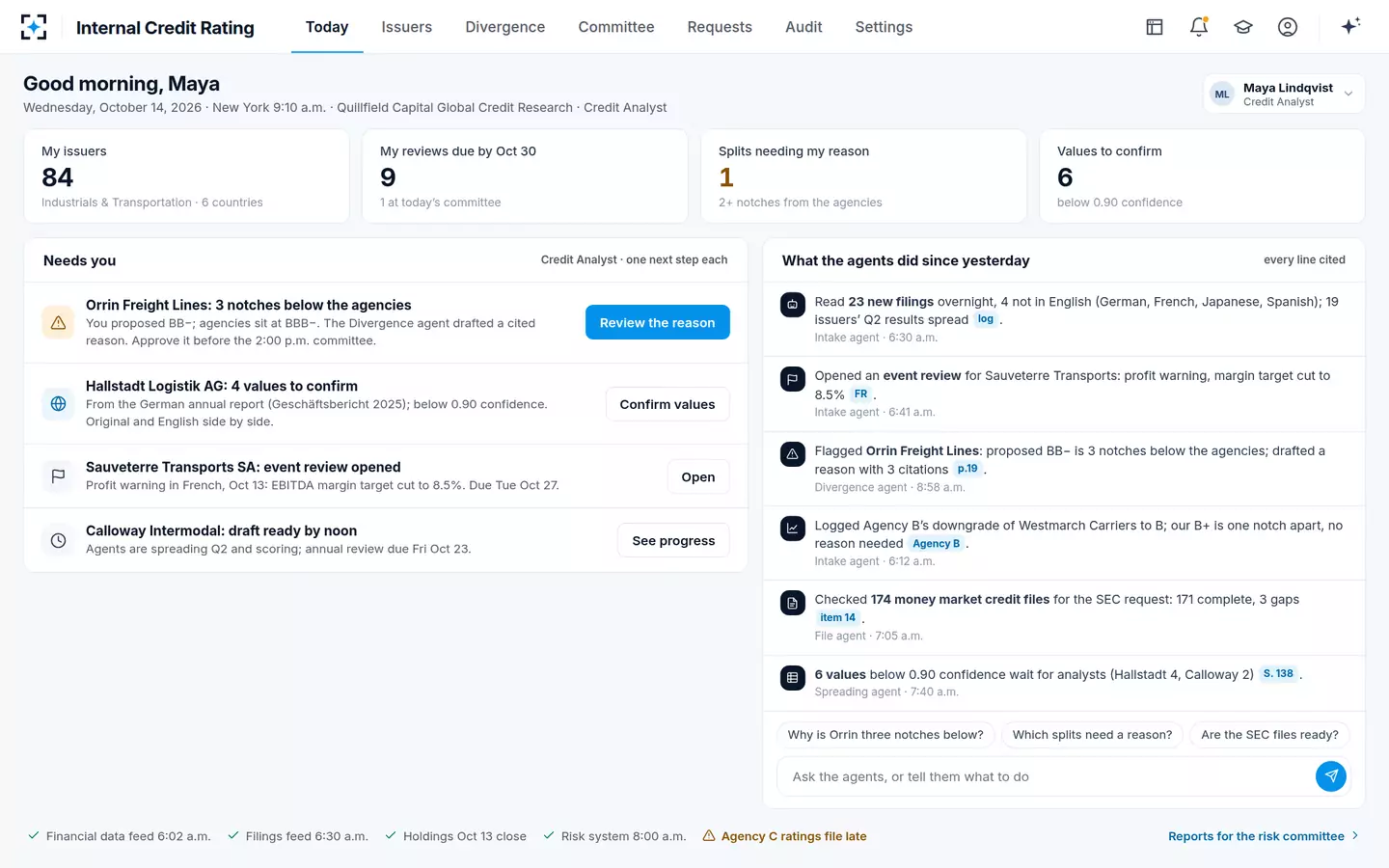
How fast must a fund react to a default?
As soon as practicable, consistent with an orderly sale, unless the board decides otherwise. For a US money market fund, a default on a portfolio security, other than an immaterial one unrelated to the issuer's financial condition, triggers the disposal duty, and the board's decision not to dispose cannot be delegated to the adviser (2a-7(f)(1) and (j)). Certain events also require notice to the SEC on Form N-CR. Every other fund sets its own speed in its credit policy; the useful question for a committee is whether the review, the decision and the reasons were in the file before the trade.
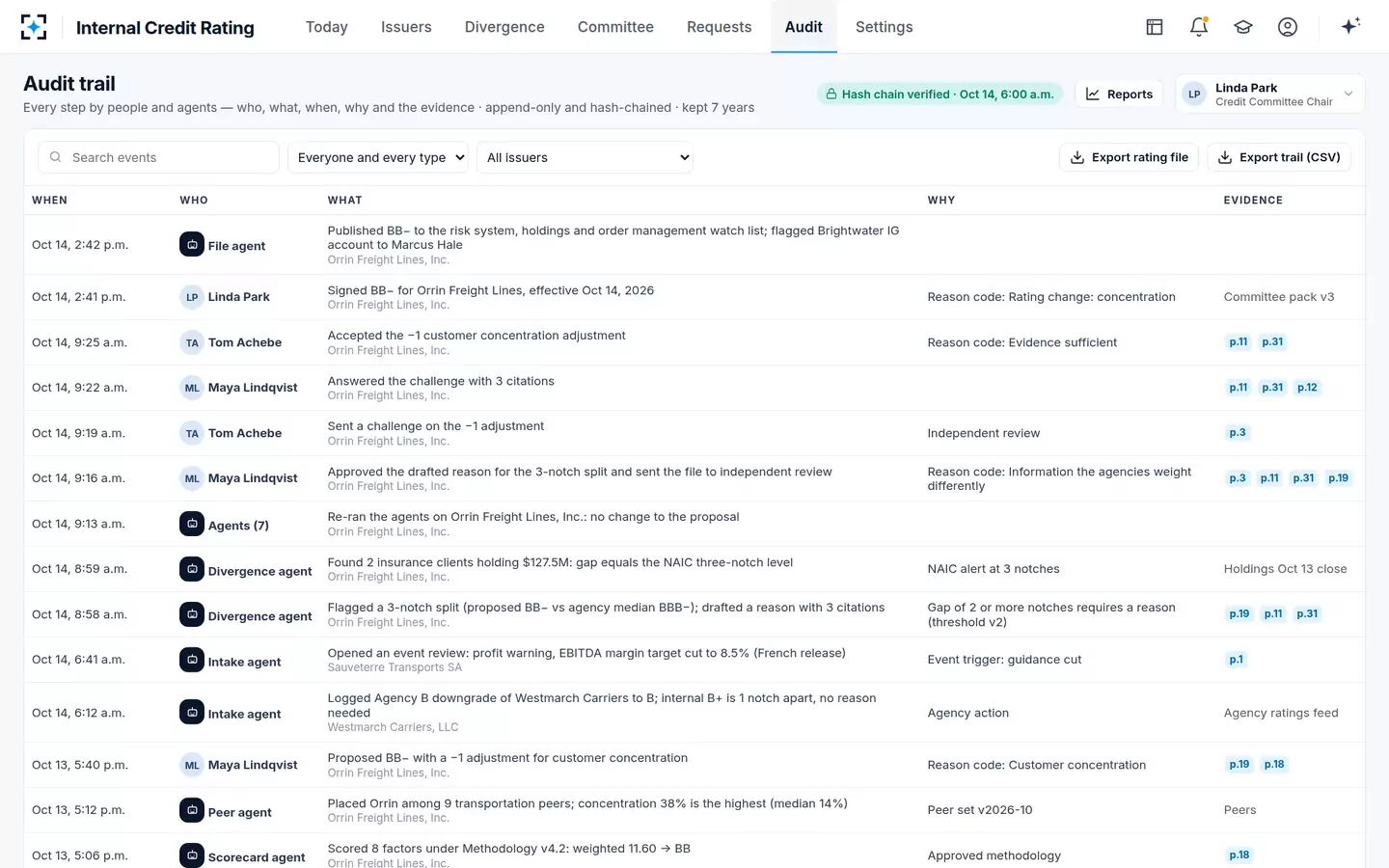
The audit trail is what shows that. In the sample, the trail records the agency action, the event review and every person's decision with the time, the reason code and the pages behind it, so the order of events can be read back months later.
The order of events, as an examiner would read it
How Internal Credit Rating keeps the event clock
The solution watches filings, agency actions, news and covenant events, opens annual and event reviews with a due date and the event cited, and escalates late ones. It shows each agency's rating and outlook on the same ladder as the internal rating, so an analyst sees at a glance whether a negative outlook is already priced into the house view. It never changes a rating or closes a review on its own; a watch placement, like any other event, ends up in front of a person.
It does not decide what your event-review deadline should be, or which agencies a fund follows; those are policy, set by the administrator and approved by the CRO. And it cannot make an agency resolve its watch sooner. What to write when the agencies' action leaves you two notches away is the next question, and it has its own guide.
Questions people ask
What is CreditWatch?
It is one agency's name for its watch list: a notice that a rating is under review for a possible change, usually with a direction. Other agencies use "review for upgrade" or "rating watch". Whatever the name, for a fund it is a signal to look at the underlying event, not a rule to act on, and the firm's own credit watch list is where that look is recorded.
Is a negative outlook a downgrade?
No. The rating is unchanged; the agency is saying the direction of risk is downward over the short or medium term. Some outlooks are followed by downgrades and some are not. An internal rating that already sits below the agency may simply have moved first.
What triggers an event review?
Anything that could change the rating: a profit warning, a large acquisition, a covenant breach, an acceleration, a restatement, a default elsewhere in the capital structure, an agency action or a sharp move in spreads. EU money market fund rules list such material changes; US rules leave the list to the firm.
Should an agency outlook change our internal rating?
Only through your own analysis. EU rules list an agency's rating or outlook as one input to analyse, and EU fund managers may not rely on ratings solely or mechanistically. If the outlook reflects a fact your file does not, add the fact; if it reflects a view you do not share, say why.
How often should a fund check the agencies' ratings?
Often enough that no agency action reaches the committee before it reaches the file. EU money market fund managers must set, in an internal procedure, which agencies they follow and how often they monitor them; with a licensed ratings feed the check can be continuous, and a late feed should itself be flagged.