A credit rating methodology is the written rulebook a credit team rates issuers by: the factors that matter in each sector, how each is measured, the thresholds that place it in a rating band, the weights that combine them, the adjustments an analyst may make and how far, the meaning of each grade on the rating scale, and who may change any of it. At an asset manager it is the firm's own intellectual property and its own regulatory obligation, and it usually lives in a PDF while the arithmetic lives in a spreadsheet that may or may not match. Botminds' Internal Credit Rating keeps your methodology and runs it as settings: each clause becomes a value the agents apply, stamped with a version, and changed only when a proposal has been re-run on the book, validated and approved by the CRO.
The examples are the solution's sample data on fictional firms: Quillfield Capital's Corporate Methodology v4.2 for transportation issuers, and a proposed v4.3. The regulatory texts are quoted from the source and linked.
One methodology, clause by clause, as the settings Internal Credit Rating applies
Factors and weights, transportation sector table
SettingEight factors; leverage 25%, business profile and coverage 15% each, liquidity 5%
Versionv4.2
Who approves a changeCRO, after model risk validation
Grade thresholds for each factor
SettingRatio ranges per rating band, by sector
Versionv4.2
Who approves a changeCRO, after model risk validation
Adjustment limits
Setting±2 notches per adjustment, ±3 in total
Versionv4.2
Who approves a changeCRO
No double counting
SettingA risk scored in a factor cannot also be notched
Versionv4.2
Who approves a changeCRO
Split from the agencies needs a reason
SettingAt 2 notches from the agency median
Versionthreshold v2
Who approves a changeAdministrator changes, CRO approves
Review cycle and events
SettingEvery 12 months; event reviews due in 10 business days
Versionpolicy
Who approves a changeAdministrator changes, CRO approves
Independent review
Setting3 business days; late at 5 days to head of research, 15 days to CRO
Versionpolicy
Who approves a changeAdministrator changes, CRO approves
What is a credit rating methodology?
It is the set of rules that makes two analysts reach the same rating on the same evidence. The SEC's rule for registered rating agencies is a useful map of what one contains, even for a firm it does not bind. Agencies must have policies ensuring their "procedures and methodologies, including qualitative and quantitative data and models" are approved by the board (17 CFR 240.17g-8(a)(1)), and must "clearly define each symbol, number, or score in the rating scale ... to denote a credit rating category and notches within a category" (17g-8(b)(2)).
A buy-side methodology has the same parts on a smaller scale: a rating scale with definitions, sector tables of factors and thresholds, weights, adjustment rules and limits, review triggers, and a governance clause naming who proposes, validates and approves changes. What it adds is the link to the firm's own decisions: which grade makes a security eligible for a money market fund, which split from the agencies needs a reason, which names an insurance client must be told about.
Can we use our own rating methodology?
Yes, and for several mandates you must. An EU money market fund's manager must establish its own internal credit quality assessment procedure; it "may have regard to" an agency rating "while not solely or mechanistically relying on such rating" (Regulation (EU) 2017/1131, Article 20(1)), and its methodology must "incorporate factors that managers of MMFs deem relevant" (Delegated Regulation (EU) 2018/990, Article 3(1)(f)). A US money market fund's board must establish written guidelines for determining minimal credit risk if it delegates the determination (Rule 2a-7(j)(1)). In both cases the methodology is the fund's own.
The practical risk in buying rating software is the opposite one: a vendor's scorecard quietly becomes the methodology because it is easier than encoding yours. In Internal Credit Rating the Scorecard agent applies only approved versions of your methodology and your sector tables, cannot change a weight and cannot notch. If the software cannot run your rules, the rules have not changed; the software is wrong.
How are rating methodologies documented?
In writing, with the reasons, and with a history of every change. The Basel standard for banks' internal ratings is the most detailed statement: banks "must document in writing their rating systems' design and operational details", including "definition of what constitutes a rating exception, parties that have authority to approve exceptions, frequency of rating reviews", and "must document the rationale for its choice of internal rating criteria" (Basel Framework, CRE36.34). The EU money market fund rules ask for the design and operational details of the procedure and "all major changes to the internal credit quality assessment procedure, including identification of the triggers of such changes" (Article 21(1)(a) and (c)).
Documentation fails in a predictable place: the gap between the PDF and the spreadsheet. A weight changed in the workbook but not in the document, or a threshold table copied from last year's sector, leaves the firm with two methodologies and no way to say which one rated a given name. Running the methodology as settings closes that gap: the document and what the agents apply are the same version, and each rating carries it.
Who approves a methodology change?
Someone other than the person who proposed it, after an independent review. The SEC's internal control rule lists controls to ensure that a new or updated methodology "is subject to an appropriate review process (for example, by persons who are independent from the persons that developed the methodology or methodology update) and to management approval prior to the new or updated methodology being employed" (Rule 17g-8(d)(1)(i)). For EU money market funds the procedure is approved by senior management, the governing body and any supervisory function (Article 23(1)).
Approval has to cover the whole methodology, including the tools that apply it. The SEC's examiners reported in their 2025 report that one medium-sized agency's "board of directors did not approve the entirety of a methodology because it did not approve a quantitative tool used in applying the methodology"; the agency disagreed and the staff was still reviewing (SEC Office of Credit Ratings, 2025 Staff Report). For a buy-side firm the equivalent tool is the spreadsheet or the software that applies the weights. If it is not part of what the CRO approved, the approval covers a document, not the ratings.
A methodology change in Internal Credit Rating, from proposal to re-rated issuers
A person decides
Head of credit researchProposes Methodology v4.3: customer concentration becomes a scored factor in the transportation table instead of an adjustment.
Agent
Scorecard agentRe-scores the book under the proposal: 9 of 61 transportation issuers move one notch, 7 down and 2 up; 52 stay.
Never: applies an unapproved version to a live rating
A person decides
Model riskValidates the proposal: back test, sensitivity, consistency with the rating scale. Three of five tests passed at the time of the sample.
A person decides
Chief risk officerApproves or rejects. Never the person who proposed it.
A person decides
Analysts and the committeeRe-rate the affected issuers under the new version; past ratings keep the version they were signed under.
How do rating agencies change their methodologies?
In public, consistently and with the expected effect stated. A registered US agency must apply material changes "consistently to all current and future credit ratings to which the changed procedures or methodologies apply" (17g-8(a)(3)(i)) and promptly publish them with "the reason for the changes, and the likelihood the changes will result in changes to any current credit ratings" (17g-8(a)(4)(i)). Agencies must also consider controls that put a new methodology out for public consultation before use (17g-8(d)(1)(ii)).
A methodology change can also break the meaning of the scale. One small agency's revised methodology "allowed the NRSRO, when rating an obligation, to ignore the obligor's ability to make timely payments even though its rating definitions ... called for it to assess the obligor's ability and willingness to fulfill payment obligations in a timely manner"; the staff classed it as a material regulatory deficiency, and the agency disputed the finding (2025 Staff Report). A buy-side firm need not consult the public, but the other lessons transfer: replay the change on the book, state who moves and why, and check that a BB still means what your scale says it means.
What is a notching adjustment, and what are adjustment limits?
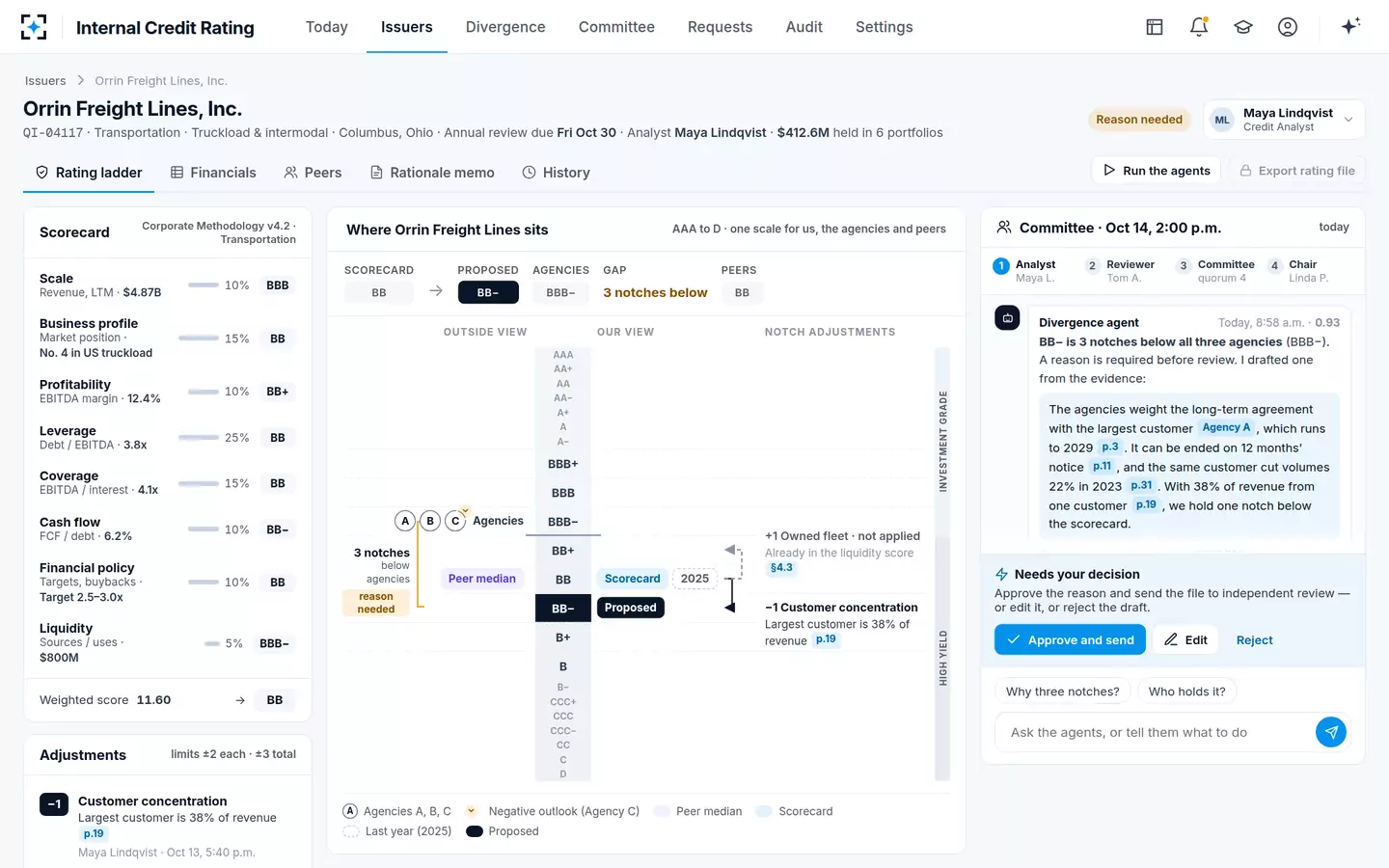
A notching adjustment moves a rating up or down one or more steps from the scorecard's implied rating, for something the scorecard does not capture; adjustment limits cap how far an analyst may move it. Limits matter because a scorecard whose output is routinely moved three notches is no longer the methodology. In the sample, the limits are two notches per adjustment and three in total, and a risk already scored in a factor cannot also be notched.
The EU rules treat a departure from the methodology's output as the exception. Managers of money market funds "may override the output of an internal credit quality assessment methodology only in exceptional circumstances, including stressed market conditions, and where there is an objective reason for doing so", and must name the person responsible (Delegated Regulation (EU) 2018/990, Article 7). A notch inside the methodology's own adjustment rules is the methodology working; an override outside them needs its own record.
Notches drawn as arrows, each with its reason and source page
How to version a credit rating methodology
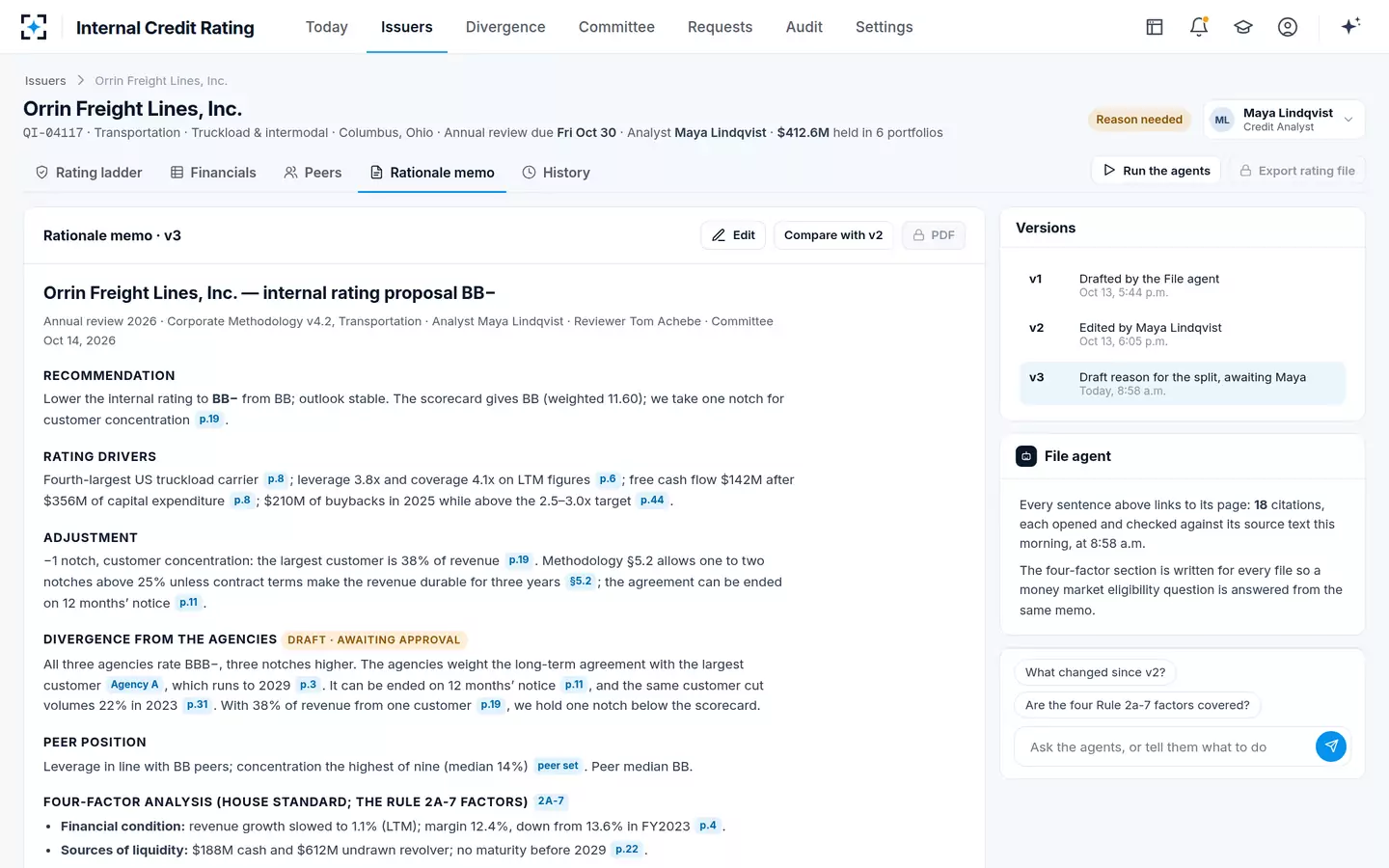
Give every approved methodology a version number and an effective date, stamp the version on every rating signed under it, never edit an approved version in place, and keep old versions applicable to the ratings they produced. Rating agencies must disclose "the version of a credit rating procedure or methodology ... used with respect to a particular credit rating" (17g-8(a)(5)); a buy-side firm needs the same link internally, because the first question about an old rating is which rules it was judged by.
Versioning rules that keep a methodology defensible
| Rule | Why it matters |
|---|---|
| Every rating carries the version it was signed under | A rating from 2024 is judged by the 2024 rules, and a back-test can replay it under them. |
| Approved versions cannot be edited | A fix is a new version with a reason, so no rating changes meaning silently. |
| A proposal is re-run on the book before approval | The committee sees who moves and by how much before the change takes effect. |
| The approver is never the proposer | Mirrors the independent review the SEC lists for rating agencies' methodology changes. |
| A change triggers re-review of affected ratings | Required for EU money market funds; good practice for every book. |
| Settings outside the scorecard are versioned too | Split thresholds, review cycles and escalation rules change outcomes as surely as weights do. |
The rationale memo names the methodology version it applies
Going live with your own methodology: what to bring
Bring the methodology as it is, not as you wish it were; the first job is to make the software reproduce last cycle's ratings, and only then to improve the rules. Set-up in Internal Credit Rating is five steps: connect the systems, import the issuers, map your rating scale to the agencies', choose the approved methodology versions and assign analysts and reviewers. The CRO approves the set-up before the first live review.
What a credit team brings to run its methodology in Internal Credit Rating
- The methodology document, every approved version
With effective dates, so past ratings can be replayed under the version that produced them.
- Sector tables
Factors, measures, thresholds per band and weights for each sector you rate.
- Your rating scale and its mapping
Grade definitions and how each maps to the agencies' scales, so splits can be counted in notches.
- Adjustment rules and limits
What may be notched, by how much in each adjustment and in total, and what cannot be counted twice.
- A sample of last cycle's rating files
Spreads, scorecards, memos and committee decisions: the answers the first replay is checked against.
- Policy settings
Review cycle, event triggers, split threshold, independent review deadlines and escalation.
- Who does what
Analysts, independent reviewers, committee members, the CRO and the administrator, by coverage.
What Internal Credit Rating does with your methodology, and what it leaves to you
The solution fits a team whose methodology is sound but whose application of it is hard to prove: weights kept in more than one place, notches without a limit check, approvals in email, and no quick way to replay a change on the book. It does not write your methodology, and it does not validate it on your behalf; validation stays with your model risk team. It will show you, on the first replay, where the methodology as written and the ratings as signed have drifted apart, which is often the most useful finding of a go-live.
The next step after go-live is usually a back-test of the scorecard on issuers you already rated, and the most argued output of any methodology, a split from the agencies, has its own guide.
Questions people ask
What is the difference between a rating methodology and a rating model?
The methodology is the rulebook: factors, thresholds, weights, adjustments and governance. A model is a quantitative tool inside it, such as a scorecard or a default probability estimate. The SEC's rule for rating agencies treats both as part of the methodology to be approved, including "qualitative and quantitative data and models".
How often should a credit rating methodology be reviewed?
At least yearly. EU money market funds must review their credit assessment methodologies at least annually and send the review to their regulator, and EU rating agencies review methodologies on an ongoing basis and at least annually. A material change in markets or a failed back-test should trigger a review sooner.
What if our methodology does not cover a new sector or instrument?
Do not stretch a neighbouring sector table without saying so. The SEC asks rating agencies to consider whether they have the competency, information and resources before rating a type of obligor they have not rated before; a buy-side firm should write and approve a sector table, or record a documented exception, before the first rating.
Can an analyst depart from the methodology?
Within the methodology's own adjustment rules, yes, with a reason and evidence. Outside them it is an override, which EU money market fund rules allow only in exceptional circumstances with an objective reason and a named responsible person.
Does running the methodology in software make it a model that needs validation?
The methodology needs validation whatever it runs in; EU money market funds must validate theirs with back testing. Software makes validation easier because every rating can be replayed under the version that produced it.