A shadow rating is a credit rating assigned on the rating agencies' scale by someone other than the agencies: an investor, a lender or a bank's internal model. It is used for issuers the agencies do not rate, such as private placements, and, more often at asset managers, to set the firm's own view beside the agencies' so the two can be compared notch for notch. The comparison is where the work is. When an internal rating sits two or more notches from the agency median, either the firm knows something the agencies weight differently, or the file contains a mistake, and the only way to tell is a written reason. Botminds' Internal Credit Rating maps every internal rating to the agencies' scale, flags any split of two notches or more, and stops the file until the analyst approves a reason that cites its sources.
The book on this page is the solution's fictional sample: Quillfield Capital, 912 issuers, three agencies shown as Agency A, B and C. The research is from the Federal Reserve Bank of New York, the American Economic Review and the regulators' own texts.
Splits of two notches or more from the agency median, across a 912-issuer book
What is a shadow rating?
The term covers three related things. In private markets it is an indicative rating on an unrated issuer, put on the agencies' scale so it can be compared and priced. At an asset manager it usually means the internal rating itself, kept on the same scale as the agencies'. In bank supervision it names a modelling approach: the ECB understands a shadow rating model "to be an internal rating approach that selects and weighs the risk drivers to be used for risk differentiation purposes by identifying the main factors that explain external ratings provided by an external credit assessment institution or similar organisation, rather than internal directly observed defaults" (ECB guide to internal models, July 2025, paragraph 222).
All three share a requirement: a mapping between the firm's scale and the agencies'. The Basel standard sets the bar for banks that map their grades to an external scale: "Mappings must be based on a comparison of internal rating criteria to the criteria used by the external institution and on a comparison of the internal and external ratings of any common borrowers" (Basel Framework, CRE36.78(2)). A buy-side firm that counts splits in notches needs the same thing, written down, or its split count measures the mapping rather than the credit view.
What is a split rating, and how often do the agencies split?
A split rating is a security or issuer that two agencies rate differently. Splits are routine, which is the first thing a committee should remember when its own rating differs from theirs. In a classic Federal Reserve Bank of New York study of sovereigns, the agencies agreed less often than one might expect.
Two agencies, 49 countries, and 21 disagreements
28
of 49 sovereigns received the same rating from Moody's and S&P in September 1995
21
were split: 12 rated higher by S&P, 9 higher by Moody's
7
countries where the two agencies differed by two notches
Corporate and financial issuers split too, and not at random. Studying bond ratings, Donald Morgan found that "Moody's and S&P split more often over these financial intermediaries", banks and insurers, "and the splits are more lopsided", because their assets, "loans and trading assets in particular", have risks "hard to observe or easy to change" (Morgan, American Economic Review, 2002). A split is more likely where the issuer is harder to see into, which is also where an internal view adds most.
Why do rating agencies disagree?
Because their methodologies, information and timing differ, and sometimes because the issuer chose which agency to hire. Each cause has a different meaning for an internal rating that sits away from them.
Methodology. Agencies weight the same facts differently, and US law keeps the regulator out of that choice. The NAIC's draft due diligence framework for the rating providers it relies on says plainly that it "acknowledges that methodological differences among CRPs exist" and does not require a uniform methodology (NAIC, draft of 25 September 2026). Information. Some ratings rest on non-public information; the SEC's staff notes that disclosures for private ratings "are made to a limited group of investors" (SEC Office of Credit Ratings, 2025 Staff Report). Timing. An agency rating reviewed eleven months ago and an internal rating reviewed last week are views of different companies. In the sample, one approved reason reads simply: agency rating stale, over 12 months.
Selection. Issuers that seek an additional rating may do so because they expect a better one. A Federal Reserve Bank of New York staff report found that most "third" agencies "assign significantly higher ratings on average than Moody's and Standard & Poor's", and that sample selection bias "can account for at most half of the observed average difference" (Cantor and Packer, FRBNY Staff Report No. 12, April 1996). The SEC's staff reports the NAIC's concern about "growing discrepancies between credit ratings of different NRSROs on the same security" and the risk of rating shopping (2025 Staff Report).
What is the agency median rating?
It is the middle of the agencies' ratings on the same scale: with three agencies, the one in the middle; with two, a house rule decides. The median is a sensible comparison point because one outlying agency cannot move it, which matters given the finding that additional agencies tend to rate higher. In the sample, the split threshold is two notches from the median of the three agencies.
Regulators that use ratings pick a rule and write it down. For insurers' filing exempt securities the NAIC uses the lowest of two eligible ratings and, where there are three or more, "the credit rating falling second lowest ... even if that rating is equal to that of the first lowest" (NAIC Purposes and Procedures Manual, December 2025, Part Three). That rule is conservative by design and differs from a median. A firm that manages insurance money should know both numbers for each bond: the median it argues with and the rating the NAIC would translate; how filing exempt designations work is explained separately.
Should an internal rating follow the agencies?
No, and in the EU it may not simply copy them. Banks, investment firms, insurers and fund managers "shall make their own credit risk assessment and shall not solely or mechanistically rely on credit ratings for assessing the creditworthiness of an entity or financial instrument" (Regulation (EC) 1060/2009, Article 5a(1)). EU money market fund managers may have regard to an agency rating in their own assessment but must not rely on it "solely or mechanistically" (Regulation (EU) 2017/1131, Article 20(1)). Even the Basel standard, which lets banks lean on external ratings, adds a condition: "An external rating can be the primary factor determining an internal rating assignment; however, the bank must ensure that it considers other relevant information" (CRE36.26).
The opposite error is to treat every split as a sign of insight. The Treasury's Office of Financial Research, reviewing how regulators replaced rating references after Dodd-Frank, summed up the alternatives, own definitions of creditworthiness, regulatory models and third parties, in four words: "Each approach has challenges" (OFR Brief 16-04, April 2016). An internal rating is one of those approaches, and it is only as good as the reasons in its file.
What does mechanistic reliance on ratings mean?
It means letting a rating, or a change in one, make a decision without an assessment in between: a rule that a name is eligible because it is rated A-1, or must be sold because it was downgraded. The EU rules for money market funds show the alternative. A downgrade below the two highest short-term ratings is a "material change" that forces a new assessment; the manager must "take into account a downgrading ... and thereupon carry out their own assessment according to their internal credit quality assessment methodology" (Delegated Regulation (EU) 2018/990, Article 8(4)). The agency action starts the work; it does not end it.
Shall make their own credit risk assessment and shall not solely or mechanistically rely on credit ratings.
Regulation (EC) 1060/2009, Article 5a(1)
How to document a rating disagreement before the committee meets
Write the reason before the meeting, cite the evidence, and say what would close the gap. A reason written after a vote reads as a justification; one written before reads as analysis. Rating agencies themselves are held to this when they depart from each other: an EU agency "shall record all instances where in its credit rating process it departs from existing credit ratings prepared by another credit rating agency with respect to underlying assets or securitisation instruments", "providing a justification for the differing assessment" (Article 8(4)).
What a reason for a two-notch split should contain
- The gap, in notches and direction
Internal rating, each agency's rating, the median and the distance from it, on one mapped scale.
- Where the difference comes from
The scorecard, an adjustment, or the timing of the agencies' last review. Name the factor.
- The evidence, cited to the page
The filing, note or contract that supports your weighting. A reason that cites nothing is an opinion.
- What the agencies appear to weight
From their published rationale, stated fairly, so the committee argues with their best case.
- What would close the gap
The event or number that would move you toward them, or them toward you. It makes the next review faster.
- Who approved it, and when
The analyst who proposed, the reviewer who challenged and the date, before the committee met.
- Who holds the bonds
For splits on bonds insurance clients hold, whether a client notice is needed and who approves it.
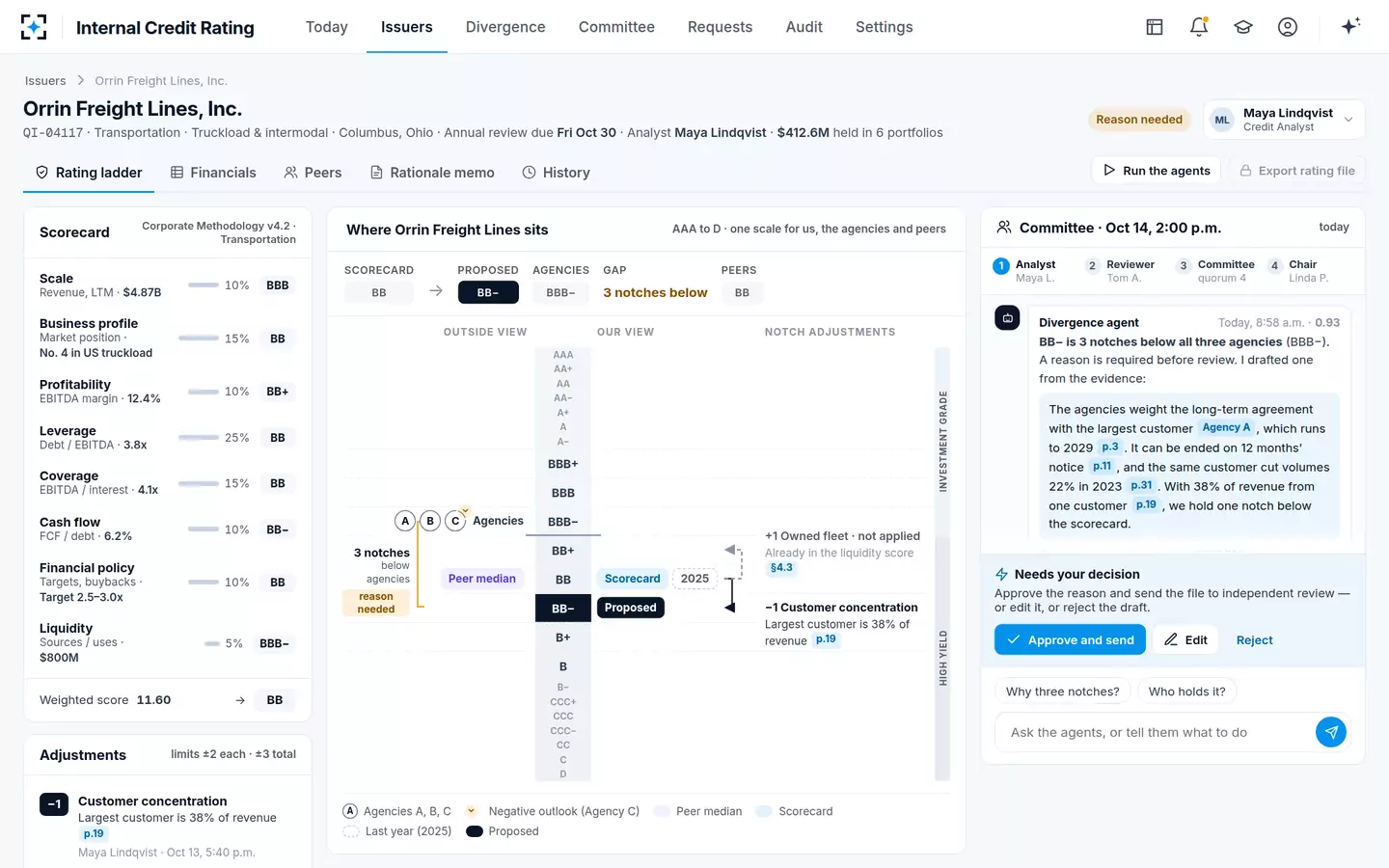
In the sample, Orrin Freight Lines is three notches below all three agencies. The drafted reason reads: the agencies weight the long-term agreement with the largest customer, which runs to 2029; it can be ended on 12 months' notice; that customer cut volumes 22% in 2023; with 38% of revenue from one customer, the firm holds one notch below its scorecard. Each clause carries its page. The analyst edits one sentence and approves it; the reviewer challenges the durability of the 38%; the committee votes with the reason in front of it.
A three-notch split stopped until the reason is approved
What is notching in credit ratings?
Notching means moving a rating by steps on the scale, and it has two uses that a split discussion should keep apart. Issue notching places a particular bond above or below the issuer's rating for its seniority and recovery prospects; the NAIC, for instance, adjusts designations "so that an NAIC Designation and Designation Category for a given security reflects the position of that specific security in the issuer's capital structure" (NAIC Purposes and Procedures Manual, Part One, paragraph 100). Analyst notching moves the issuer's rating away from the scorecard's implied rating for something the scorecard misses.
Confusing the two produces false splits: comparing your issuer rating with an agency's rating of a subordinated bond can show two notches that are pure seniority. In the sample, ratings are compared like for like, issuer with issuer, and every analyst notch is drawn on the ladder with its reason. How adjustment limits keep notching inside the methodology is covered in the methodology guide.
Splits across a book: the CRO's view
One split is an analyst's argument; forty-seven are a portfolio fact. The chief risk officer needs to see every split, its direction, whether its reason is approved, and who holds the bonds, because a three-notch split on a bond an insurance client holds can become that client's problem. In the sample, six splits sit at three notches on bonds insurance clients hold, and for each the solution drafts a client notice that waits for the CRO.
Every split from the agency median, with its reason and its holders
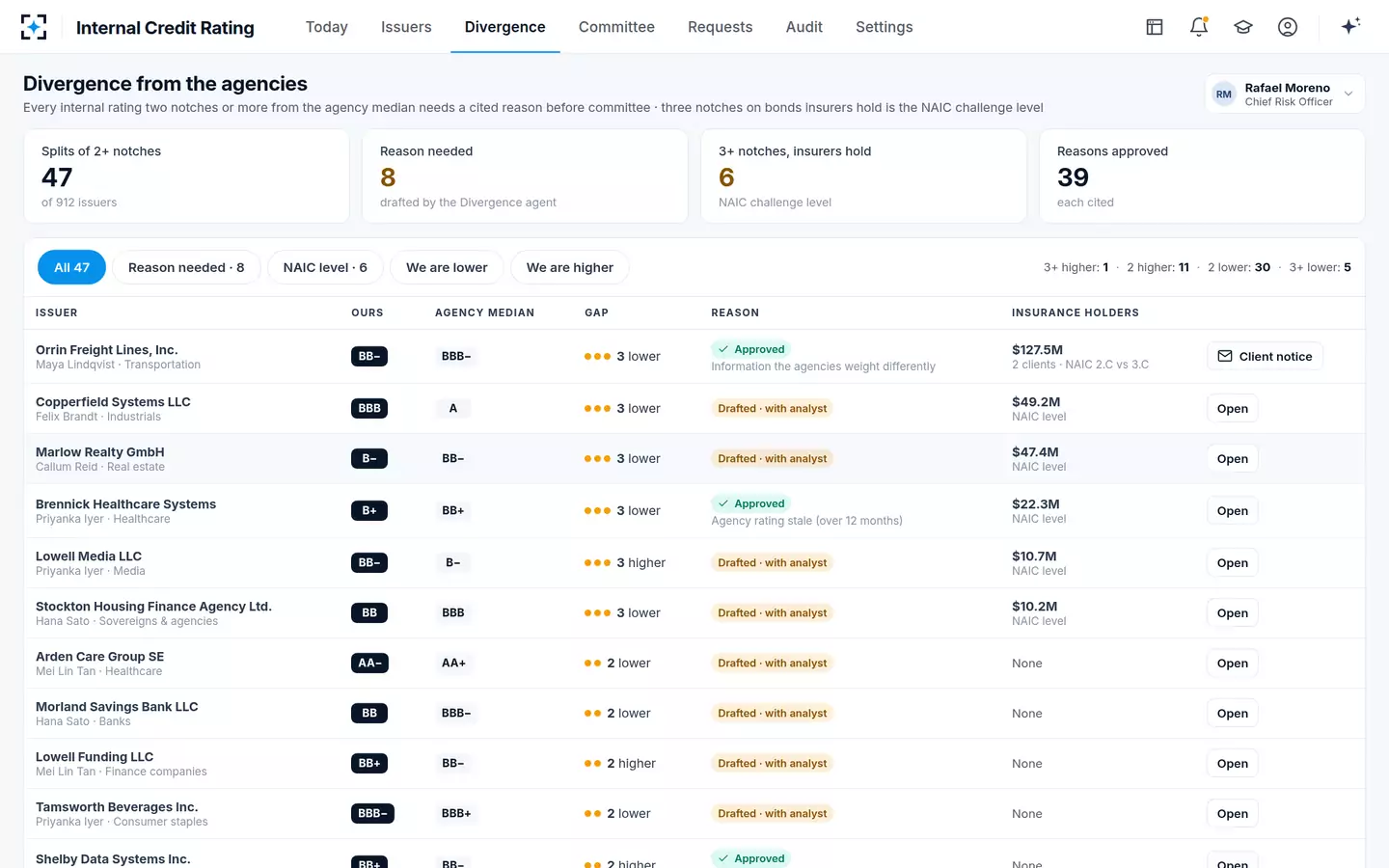
The direction matters as much as the size. Internal ratings below the agencies are conservative for the fund but can trigger limits, client notices and forced reviews; internal ratings above the agencies are the ones an examiner will test hardest, because they let a portfolio hold more than the agencies' view would allow. A firm should expect to defend its few higher ratings more carefully than its many lower ones.
Questions people ask
Is a shadow rating an official credit rating?
No. It is the firm's own opinion on the agencies' scale. It cannot stand in for an agency rating where a rule requires one, such as the NAIC's filing exempt process, which translates ratings from approved credit rating providers only.
How often do internal ratings and agency ratings differ?
No regulator or independent study publishes a figure for asset managers, so measure your own book: count issuers two or more notches from the agency median and track the share each quarter. In the fictional sample book it is 47 of 912, about 5%.
Should we report splits to clients?
That depends on the mandate. Clients whose regulatory treatment depends on ratings, such as insurers, care most about large splits on bonds they hold. In the sample, a split of three notches on an insurer-held bond produces a drafted client notice that only the CRO can approve.
What is the difference between a split rating and a rating outlook?
A split is a difference between two raters at the same moment; an outlook is one rater's view of where its own rating may move. An internal rating can split from the agencies while matching the direction of an agency's negative outlook, which is often a sign that the internal view has simply moved first.
Can a shadow rating model replace analysts?
It can produce a starting point. The ECB expects shadow rating models to set explicit thresholds for how well they explain the target ratings, and a model built to explain agency ratings will reproduce their disagreements and their delays. The judgment about where the firm differs still needs an analyst and a written reason.