NAIC filing exempt (FE) is the route by which a large share of the bonds US insurers hold get their NAIC designation: if a bond carries a rating from a credit rating provider the NAIC accepts, the designation is a direct translation of that rating and the insurer does not file the bond with the NAIC's Securities Valuation Office (SVO) for review. The designation drives the insurer's risk-based capital charge, so the translation matters. State insurance regulators have concluded that the NAIC relies on those ratings without checking them, its own phrase is "blind reliance", and they are changing that in two steps: a process, in force since January 1, 2026, to challenge an individual filing exempt designation, and a draft framework, dated September 2026 and open for comment until 26 October, to test the rating providers themselves. For an asset manager running insurance money, both make the manager's own credit view part of the insurer's defence. Botminds' Internal Credit Rating keeps that view on file, flags the bonds where it sits three notches from the agencies, and assembles the response when the NAIC asks.
The NAIC texts are quoted from its Purposes and Procedures Manual (December 2025), its March 2026 issue brief and the September 2026 draft framework. The examples are the solution's sample data on fictional firms.
The scale of reliance on rating providers in NAIC designations
152,000+
securities relied on credit rating provider ratings for their NAIC designation in 2024
250,000+
securities from over 40,000 issuers in the NAIC's Valuation of Securities database
8
credit rating providers whose ratings the NAIC translates into designations
3
notches: the gap at which the SVO may propose removing a rating from filing exemption
What is NAIC filing exempt?
Filing exempt is an exemption from filing a security with the SVO because it already has an eligible rating. The Manual's rule is short: bonds and preferred stock within the relevant statutory accounting principles "that have been assigned an Eligible NAIC CRP Rating, are exempt from filing with the SVO (FE securities)", with stated exceptions (NAIC Purposes and Procedures Manual, Part One, paragraph 79). The exceptions matter: CLOs, residential and commercial mortgage-backed securities that are subject to financial modelling are outside it, and the Manual notes that from January 1, 2026 the NAIC's Structured Securities Group models CLOs.
The NAIC's March 2026 issue brief describes filing exemption as "the process by which an NAIC Designation is assigned based on a direct translation from a CRP rating without the insurer submitting the security for full review by the SVO" (NAIC, Leveraging Credit Ratings for Regulatory Use, March 2026). Where a bond has several ratings, the Manual takes the lowest of two, or the second lowest of three or more, "even if that rating is equal to that of the first lowest" (Part Three, paragraph 7).
What is an NAIC designation, and how are designations assigned?
An NAIC designation is the NAIC's measure of a security's investment risk for insurance regulation, on a scale from NAIC 1 (highest quality) to NAIC 6, refined into 20 designation categories from 1.A to 6. The categories link to capital: the NAIC's Capital Adequacy Task Force "assigns RBC factors to each NAIC Designation Category" (Part One, paragraph 99). A designation is assigned in one of two ways: by the SVO's own analysis of a filed security, or, for FE and private letter rated securities, by translating an eligible rating through a translation matrix.
Two routes to an NAIC designation
| Filed with the SVO | Filing exempt (FE) | |
|---|---|---|
| Who assesses the credit | SVO analysts, from the insurer's filing. | A credit rating provider; the NAIC translates its rating. |
| What the insurer submits | An initial filing with the documents the SVO needs. | Nothing, unless the rating is challenged. |
| How a designation is chosen with several ratings | Not applicable: the SVO decides. | The lowest of two eligible ratings; the second lowest of three or more. |
| What can override it | The SVO's own review on renewal. | Since January 2026, a challenge that can remove the rating from filing exemption. |
What does “blind reliance” on ratings mean at the NAIC?
It means the NAIC translates ratings without any process to check whether the translation fits the risk. The draft framework puts it in so many words: "The NAIC has 'blind reliance' on these CRP-provided mappings in that the NAIC does not have a due diligence process to assess the reasonableness or equivalency of the CRP-provided mapping to NAIC Designations. In 2024, more than 152,000 securities relied on CRP ratings" (NAIC CRP Due Diligence Framework, draft of 25 September 2026). The issue brief adds why: there are "no criteria for being a CRP other than being an NRSRO meaning regulators are relying on them with no oversight" (March 2026).
The phrase is not new to the NAIC's own rules. The Manual's policy on filing exemption already says the benefit of using ratings "must be balanced against the risk of blind reliance on credit ratings" (Part One, paragraph 77), and the SEC's staff, who cannot regulate the substance of ratings, have noted the NAIC's aim "to reduce or eliminate such 'blind reliance'" (SEC Office of Credit Ratings, 2025 Staff Report). The brief's stated goal is a move "away from blind reliance on credit ratings towards informed reliance".
Can the NAIC challenge a filing exempt rating?
Yes, since January 1, 2026, though rarely and with safeguards. The Manual sets out a process by which "a state insurance regulator or IAO staff can contest an NAIC Designation Category assigned through the filing exemption process which it thinks is not a reasonable assessment of investment risk"; the guidance is "effective as of January 1, 2026, but this date may be amended if additional time is needed to implement the necessary NAIC technological enhancements" (Part Two, paragraph 133). The NAIC says it expects "very limited use of this authority", reserved "for use in only the most egregious circumstances" (issue brief).
How a filing exempt designation is challenged, step by step
A person decides
A state regulator or SVO staffIdentifies an FE security whose designation appears not to be a reasonable assessment of investment risk.
A person decides
SVO Credit CommitteeDecides whether it agrees. If not, the process ends; if so, the security is placed Under Review with the symbol UR.
A person decides
Every insurer holding the securityReceives an information request: an initial-filing equivalent "accompanied by each insurer's internal analysis", within 45 days, extendable to 90 in total.
A person decides
SVO analysts, then the Credit CommitteeA full analysis in dialogue with the insurers, who may bring the issuer or rating agency. The committee sets its own designation; only if the rating is three or more notches from it (for example 1.G against 2.C) may the SVO propose removal.
A person decides
A subgroup of regulatorsHears the SVO, the insurers and the rating agency, then decides. If removal is authorised, the security takes another eligible rating or the SVO's designation.
Two details shape what an asset manager must be ready for. The information request asks for the insurer's own internal analysis, not only documents, and if nothing equivalent to an initial filing arrives within 90 days the SVO may remove the rating from filing exemption without convening the subgroup (paragraph 136). And the three-notch test applies to the SVO's final proposal, not to opening a review: a security can be placed Under Review on a regulator's or staff member's concern, once the SVO Credit Committee agrees, before any notch count.
What is the NAIC's credit rating provider due diligence framework?
It is a draft programme, not yet adopted, to test whether each rating provider's ratings and mappings are reasonable for regulatory use, by asset class rather than security by security. It has four parts, scoping, risk assessment, detailed testing and governance, and is led by the Credit Rating Provider (E) Working Group. The latest cumulative draft is dated 25 September 2026; comments were due by 26 October 2026, and the working group meets at the NAIC's Fall National Meeting on 15 November 2026 (NAIC Credit Rating Provider (E) Working Group).
Three NAIC clocks a manager of insurance money should know, in days
- Comment periodto 26 Oct
- To the Fall National Meeting15 Nov
- Initial period45 days
- Possible extensionto 90 in total
- After an annual update or rating change90 days
The draft's mechanics show where the pressure will land. Securities whose rating improved by more than three notches against a prior SVO designation or another provider's rating would be sent to detailed testing (the draft's wording on that test is still being revised), and in those tests the NAIC would apply its "three sub-notch materiality tolerance threshold" to its own independent rating analysis. Remedies range from a watchlist to requiring more than one rating, adjusting the translation matrix, "Removal of Filing Exempt Status for an Asset Class" and "CRP De-admittance" (draft framework, sections 1.2.2.3, 3.2.1 and 4.2.2). Historically accepted providers would be provisionally accepted for 36 months while they are assessed. All of this is a draft and may change.
What is a private letter rating, and what changed for it?
A private letter rating is a rating a provider gives privately, typically on a private placement, which the insurer files so the NAIC can translate it. Since August 2025 the Manual requires a rationale report with analytical substance: it "shall be no less comprehensive than the work product that a CRP would produce for a similar publicly rated security", and it must reach the SVO within 90 days of an annual update or rating change, or the security loses filing exemption (NAIC Purposes and Procedures Manual, December 2025).
That standard is useful to an asset manager in a second way. An internal rationale that would pass the NAIC's test for a private letter rating, cited, complete and comparable to a public rating report, is also what an insurer needs to send when its holding is placed Under Review. In the sample, the solution checks the rationale in the file against that standard before the insurer's response is assembled.
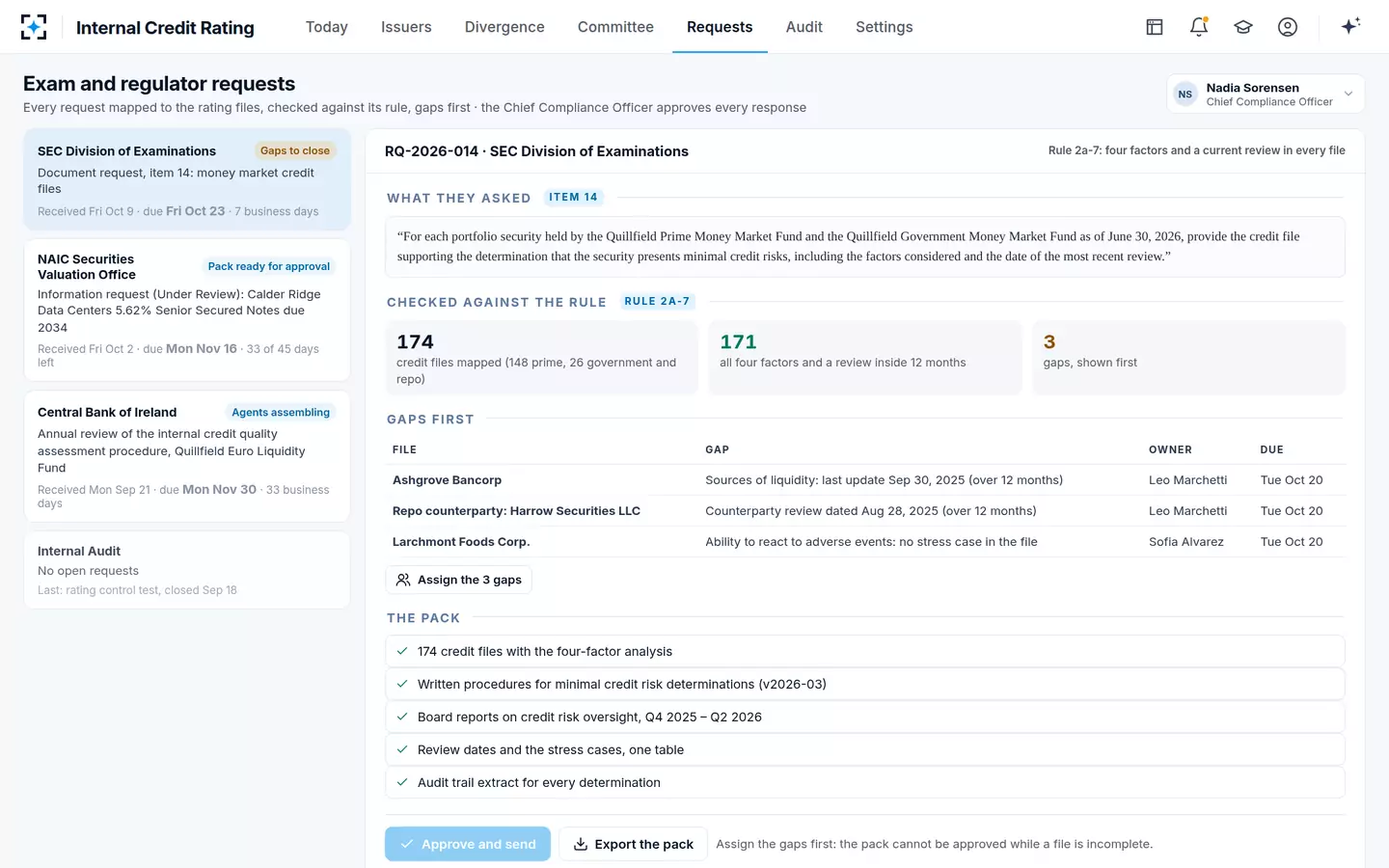
An NAIC information request mapped to the rating file, with its clock
How do insurers use credit ratings, and where does the asset manager come in?
Insurers use ratings to set designations, and designations to set capital, limits and investment policy; many outsource the credit work on their portfolios to asset managers. The challenge process and the draft framework both reach the manager through the insurer: the information request wants the insurer's internal analysis, and a translation matrix adjustment or the loss of FE status for an asset class would change capital on bonds the manager chose.
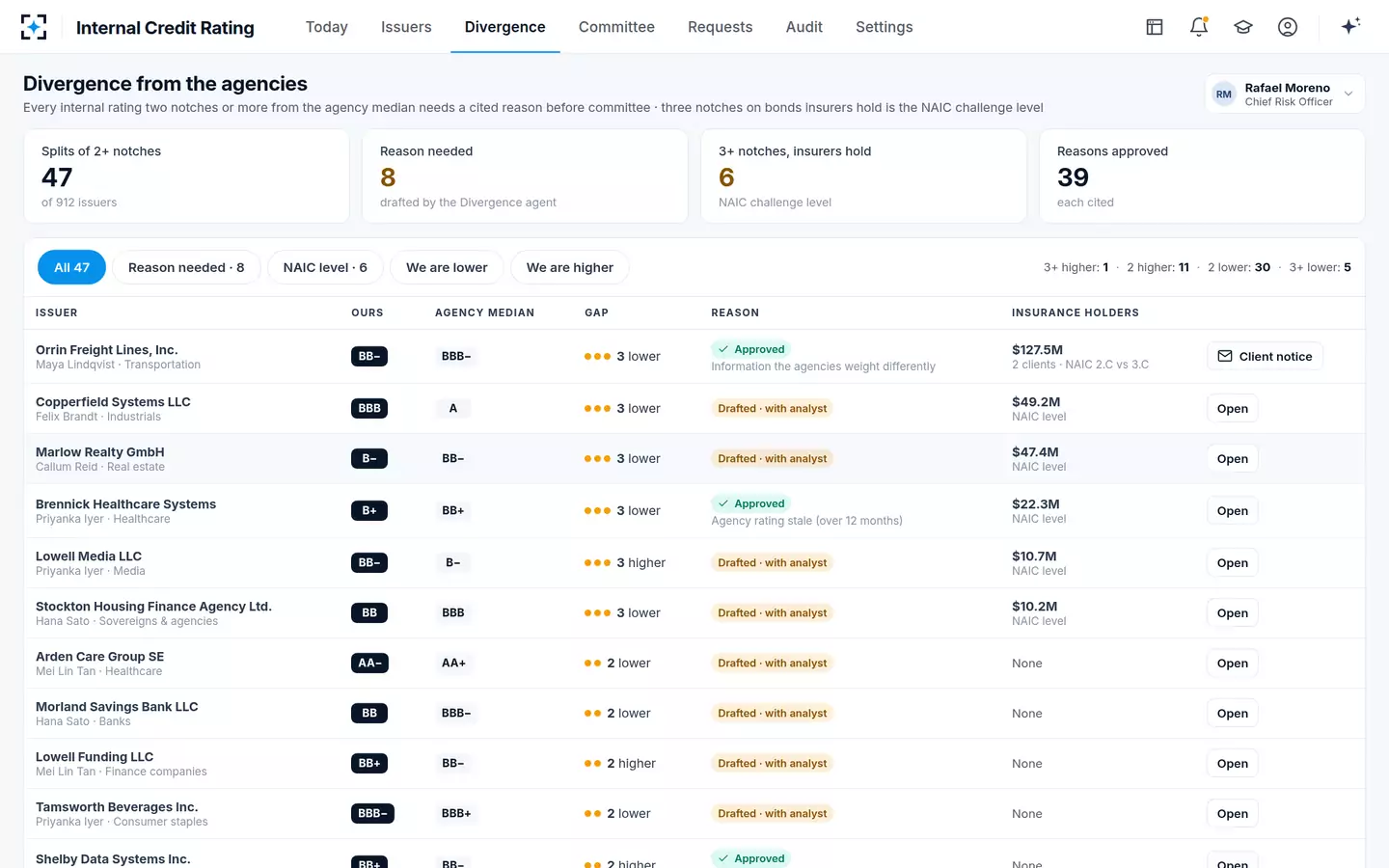
What helps is an internal rating already on file for every bond an insurance client holds, compared with the agencies notch for notch, with a reason for every large split. In the sample, the solution flags any internal rating three notches or more from the agency median on a bond insurance clients hold, a threshold the sample firm calls the NAIC challenge level, and drafts a client notice for the CRO. Six bonds sit there. That is the firm's own early-warning setting; the NAIC's three notches apply to its own assessment, not to the firm's.
Splits on bonds insurance clients hold, at the sample firm's NAIC challenge level
What Internal Credit Rating does for insurance mandates, and what it cannot
The solution does not file with the SVO, assign designations, or speak to regulators; insurers do, and the chief compliance officer approves anything the firm sends. It keeps the evidence an insurer will be asked for: a cited rationale for every holding, the agencies' ratings and the gap, the challenge record and the committee's decision, and a request view that maps an NAIC information request to the files with its 45-day clock. When the framework is finalised, the same file answers its questions about whether a rating was reasonable. Writing the reason for a split before the committee meets is the habit that makes all of this cheap.
Questions people ask
Which securities are not filing exempt?
Securities without an eligible rating from an accepted credit rating provider, security types the NAIC has excluded, and structured securities subject to financial modelling, such as residential and commercial mortgage-backed securities and, from January 1, 2026, CLOs. US government securities follow a separate procedure in the Manual.
What does the SVO do?
The Securities Valuation Office, part of the NAIC's Investment Analysis Office, assesses the credit quality of securities insurers file, produces NAIC designations, publishes them in its Automated Valuation Service, and administers the filing exempt process, including the new challenge process.
What is the difference between an NRSRO and a CRP?
An NRSRO is a rating agency registered with the SEC; a credit rating provider (CRP) is an NRSRO whose ratings the NAIC accepts for designations. Until the draft framework is adopted, the NAIC's issue brief says there are no criteria for being a CRP other than being an NRSRO. The draft refers to eight CRPs; the SEC lists eleven NRSROs.
How long does an insurer have to answer an NAIC information request?
Forty-five days, which the SVO may extend up to 90 days in total from the request. If nothing equivalent to an initial filing has arrived after 90 days, the SVO may remove the rating from filing exemption without a subgroup hearing.
What happens after a rating is removed from filing exemption?
The rating is blocked from the FE process. If another eligible rating exists it may still be used; if not, the SVO's own designation applies. The SVO publishes an anonymised summary within 45 days, and an insurer can ask for the rating to be reinstated in a later year.