A rating committee is the group that turns an analyst's proposed credit rating into the firm's rating: members read the file, question the analyst, vote, and the chair signs the result. At a rating agency it is a familiar part of the process; at an asset manager it approves the internal credit rating a buy-side credit team keeps on every issuer it holds, and that rating decides whether a money market fund may buy a name, how an insurer's bonds are flagged and which splits from the agencies need a reason. The hard part is not the meeting. It is making each signature mean something: the analyst vouches for the evidence, the reviewer for the challenge, the chair for the decision. Botminds' Internal Credit Rating is built around that chain, with agents that spread, score and draft and three different people who propose, challenge and sign.
The examples come from sample data on fictional people and companies: Quillfield Capital's credit committee meeting on Wednesday, October 14, 2026, to sign 18 files, among them a three-notch downgrade of Orrin Freight Lines. The rules and exam findings are quoted from the regulators' own texts and linked where they appear.
What SEC examiners found inside registered rating agencies in 2025
9 of 10
registered rating agencies with at least one essential finding in the 2025 exams
3
findings classed as material regulatory deficiencies, at two agencies
1
analyst who voted in a rating committee while owning the obligor's securities
What is a rating committee?
A rating committee is a review step: the lead analyst's work is examined by people who did not produce it before the rating becomes official. The SEC's internal control rule for registered rating agencies describes exactly that, listing among the controls an agency must consider that "the work and conclusions of the lead credit analyst ... is reviewed by other analysts, supervisors, or senior managers before a rating action is formally taken (for example, having the work reviewed through a rating committee process)" (17 CFR 240.17g-8(d)(1)(x)).
No rule makes an asset manager hold a committee. The obligations fall on the decision instead. A US money market fund's board must determine that each security "presents minimal credit risks", and it may delegate that determination to the adviser only under written guidelines it reviews (17 CFR 270.2a-7(a)(11) and (j)). An EU money market fund's internal credit quality assessment procedure "shall be approved by the senior management, the governing body, and, where it exists, the supervisory function" of the manager (Regulation (EU) 2017/1131, Article 23(1)). A committee is how most credit teams put several accountable people between an analyst's opinion and a portfolio's eligibility list.
Banks under the internal ratings-based approach work to a stricter version of the same idea. The Basel standard requires that "All material aspects of the rating and estimation processes must be approved by the bank's board of directors or a designated committee thereof and senior management" (Basel Framework, CRE36.54). What a chief credit officer does when a bank's grade is wrong covers the lending side; this page is about the buy side's rating of issuers and bonds.
Who sits on a credit rating committee, and who must stay out?
A typical internal rating committee has a chair, a handful of voting members drawn from senior credit staff, a quorum rule, and people who attend without voting: the analyst who presents and the independent reviewer who challenged the file. The membership is a firm's own choice, written in the committee's charter. Who must stay out is less a matter of choice.
For an EU money market fund, the people running the portfolio may not do the credit work: assessments and their periodic reviews "shall not be performed by the persons performing or responsible for the portfolio management" of the fund (Article 23(4)). For rating agencies the exclusions are personal. A registered US agency may not issue or maintain a rating where "a credit analyst that participated in determining the credit rating, or a person responsible for approving the credit rating, directly owns securities of" the rated person (17 CFR 240.17g-5(c)(2)). The EU rule adds a broader test: no one may take part who "has had a recent employment, business or other relationship with the rated entity that may cause or may be generally perceived as causing a conflict of interest" (Regulation (EC) 1060/2009, Annex I, Section C, point 2(c)).
Neither rule binds an adviser's internal committee, but both describe the conflicts an examiner will ask about. In the sample committee, one voting member is recused from Quinnell Digital Infrastructure because her team arranged its private placement: a business relationship, not a holding, and the reason is written into the agenda so the vote count explains itself.
Four signatures on one internal rating, and what each one attests
An internal rating that a portfolio manager can rely on carries four signatures, each for a different question. If two of them are the same person, one of the questions has not been asked.
Who signs an internal credit rating, and what each signature vouches for
Today
Proposes the rating. Today the spread is re-keyed, the source page behind a number is lost when the analyst moves on, and a notch off the scorecard is explained in a sentence.
With agents
Opens a file already spread, scored and placed among peers, with every value cited to its page and a drafted reason for any split from the agencies; edits and approves it.
Still theirs: vouching that the evidence is complete and the methodology was followed, step by step.
Today
Challenges files from other teams. Today the challenge lives in an email chain.
With agents
Gets drafted questions with the rule or page behind each, sends the ones that matter and accepts or rejects with a reason code that stays in the file.
Still theirs: vouching that the adjustments survived a challenge from someone who did not make them.
Today
Runs the meeting and signs. Today the minutes are typed afterwards.
With agents
Sees agenda, quorum, votes and recusals on one screen; signs affirmations together and changes one by one, with a reason code and an attestation.
Still theirs: vouching that the committee decided, on this file and this challenge.
Today
Owns the methodology and what leaves the firm. Today a client can learn of a three-notch split before the CRO does.
With agents
Sees every split across the book and who holds the bonds, approves methodology changes after validation and every client notice.
Still theirs: vouching that the rules the file was judged by were approved, and so was anything sent out.
The analyst's signature is the one most easily emptied. A proposal can be signed by someone who never opened the source pages, if the spread arrived pre-built and nobody checked it. That is why, in the solution, every spread value, factor score and adjustment opens on its page, and a value read with less than 0.90 confidence waits for the analyst to confirm or override it. The signature then covers something a reviewer can test.
What happens when a signature means nothing
The SEC's examiners review a sample of every registered rating agency's files each year, and their 2025 findings read like a list of empty signatures. They concern rating agencies, not asset managers. But the failures are general to any rating file, and a buy-side credit team can test its own process against them.
Four SEC exam findings, and the signature each one would have caught
| What the examiners found | The signature that failed | The control on an internal rating file |
|---|---|---|
| An analyst took part in a rating "by voting in the rating committee while at the same time owning securities of the obligor." Compliance had seen it happen before and "did not prevent the credit analyst from participating again." | The committee member's, and the chair's for accepting the vote | A conflicts check before each meeting; recusals recorded on the agenda with the reason; a vote cannot count from a recused member. |
| A "qualitative adjustment without first producing and considering a model-implied rating", and "the participants in the rating determination [did not] identify or question the absence of required analysis." | The reviewer's and the committee's | The file cannot reach committee without the scorecard result; every notch shows the scorecard rating it moves from. |
| Analytical files that "did not contain all applicable emails, which could negatively affect the ability to conduct an after-the-fact review." | The analyst's | The challenge, the answers and the reasons live in the file, not in a mailbox. |
| Documentation that "included the outcome of a qualitative assessment ... but did not include a documented rationale supporting that outcome." | The analyst's and the chair's | A reason code and a cited rationale on every decision; a reason that cites nothing is refused. |
The second row is the instructive one. The agency's own methodology called for a model-implied rating before any judgment was layered on, and several people signed off without noticing it was missing. A committee that reads only the conclusion will miss that every time. The fix is structural: the conclusion should be unreadable without the step it rests on. What SEC examiners found at the ten agencies registered in 2025 sets out the full list.
In neither instance did the participants in the rating determination identify or question the absence of required analysis.
SEC Office of Credit Ratings, 2025 Staff Report
Can an analyst who owns a bond vote on its rating?
At a registered rating agency, no: a rating is prohibited where an analyst who took part, or the person approving it, directly owns the rated person's securities (Rule 17g-5(c)(2)). At an asset manager the question looks different, because the firm owns the bonds by design; that is why it rates them. The conflict worth managing is personal: an analyst's own account, a family holding, or a business relationship such as having arranged the deal.
The 2025 finding shows why a policy is not enough. The agency had a rule, and its compliance department had already caught the same analyst once. The analyst voted again. What stops that is a check that runs before the vote, against the agenda, not an annual attestation. In the solution, recusals sit on the agenda with their reason, and members recuse themselves from issuers their team arranged.
Independent challenge: what the reviewer signs for
Independent challenge means a credit professional who did not build the rating, from a team that does not own the position, tests the adjustments before the committee sees them, and the questions and answers stay in the file. The value is in what is written down. A challenge that happens in a corridor leaves the committee voting on a file that looks unchallenged.
In the sample, the Challenge agent reads Orrin Freight Lines' file the way a sceptical reviewer would and drafts two questions: whether the 38% customer concentration is durable when the agreement runs to 2029, and whether concentration is already counted in the business profile score, which the methodology forbids. The reviewer, Tom Achebe in Credit Risk Review in London, sends the first. The analyst answers from the file: the customer can end the agreement on 12 months' notice and cut volumes 22% in 2023. He accepts the adjustment with the reason code "Evidence sufficient".
The independent review, kept in the file before the committee meets
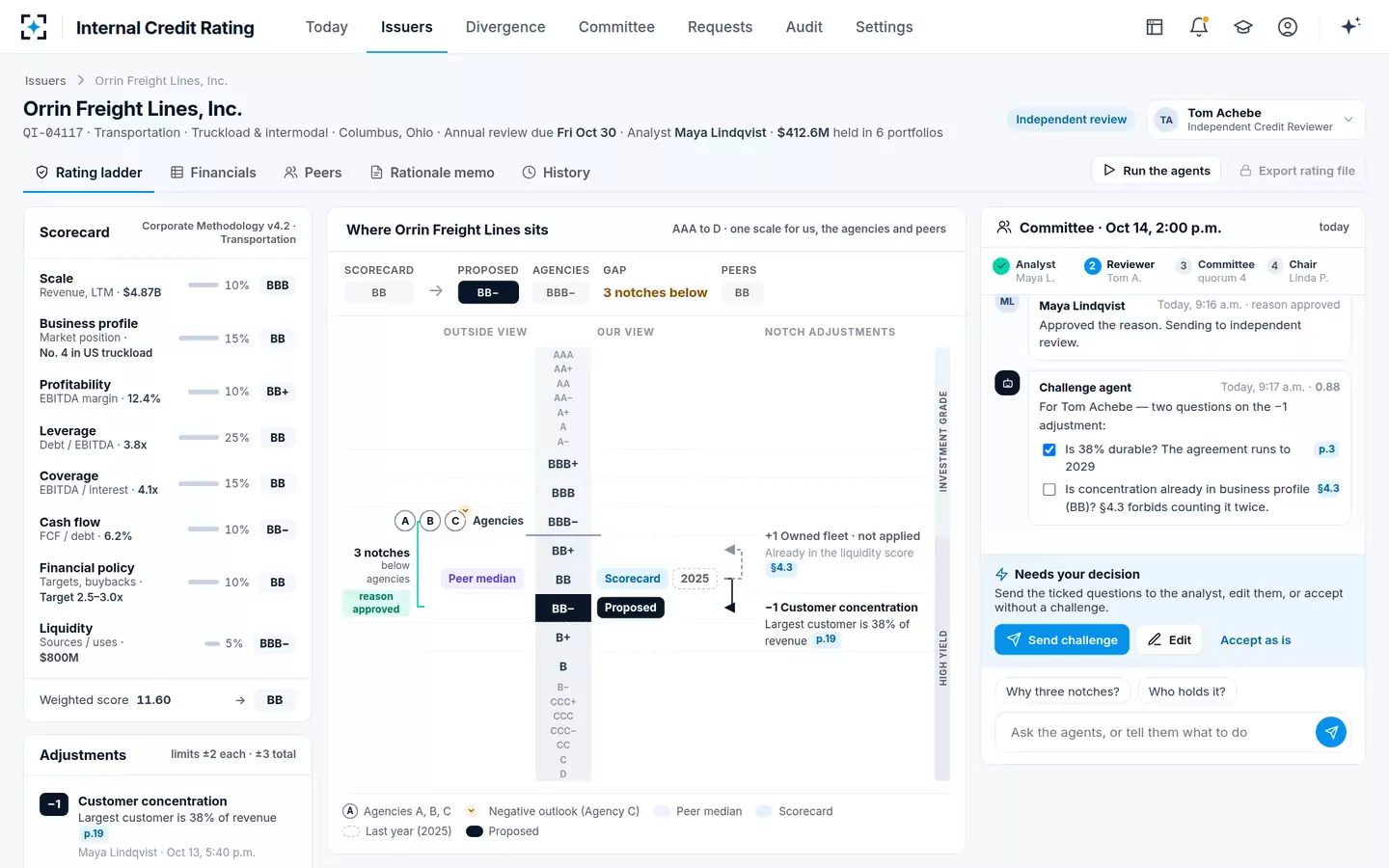
The reviewer's signature means the adjustments were tested by someone with no stake in them. It does not mean the reviewer agrees with the rating; that is the committee's call. Keeping those two apart is why the reviewer presents but does not vote in the sample committee.
How does a rating committee vote?
Most committees decide by majority of the voting members present, once a quorum is met, with the chair signing the outcome. The useful distinctions are between a vote against, an abstention and a recusal: a member who votes against has a view; one who abstains is present but not deciding; one who is recused should not be counted at all, and the minutes should say why.
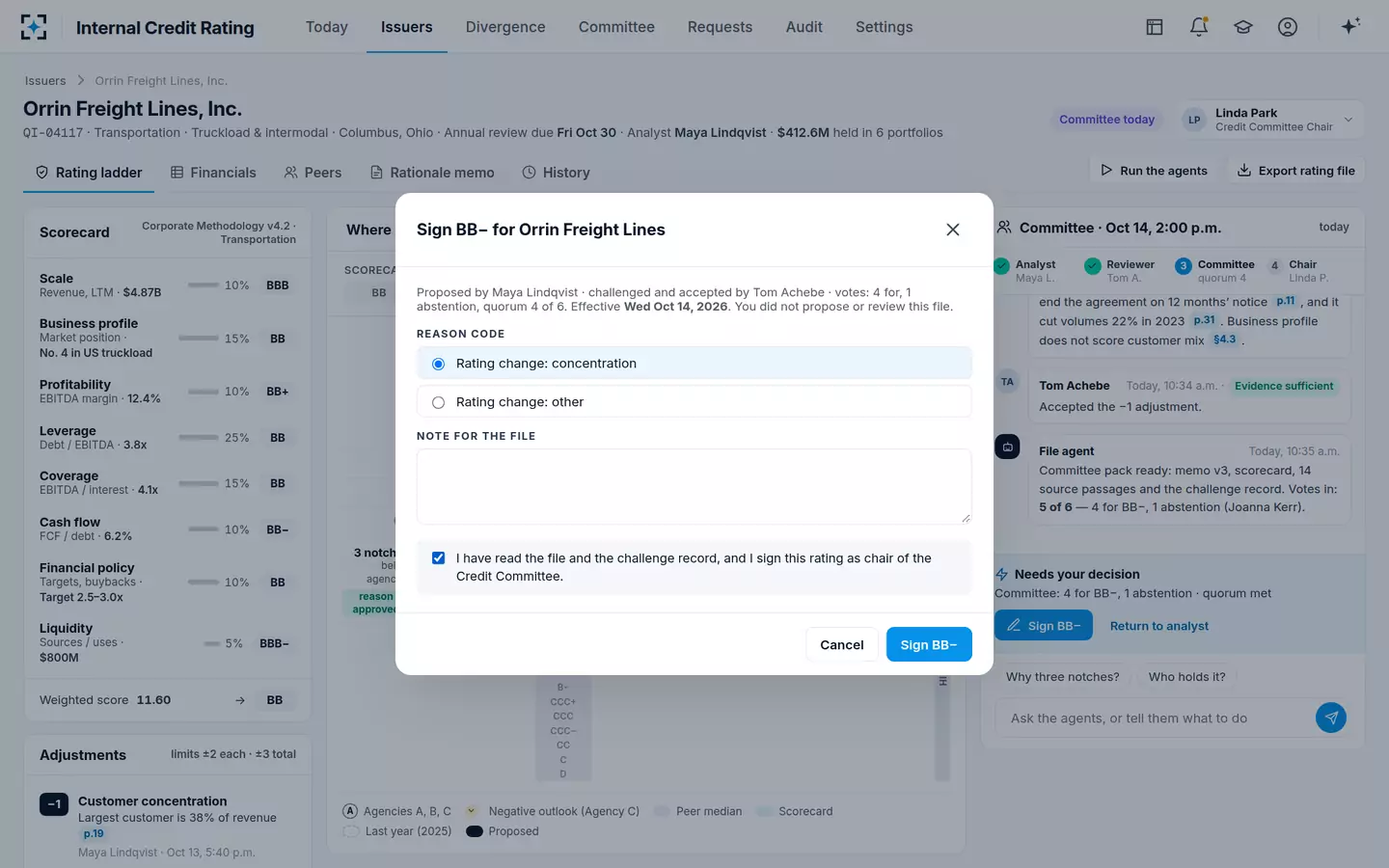
The sample committee meets at 2:00 p.m. across New York and London with 18 files: 4 rating changes, 2 new issuers and 12 affirmations, quorum 4 of 6 voting members. Votes are cast on the file before the meeting and in the room. On Orrin, 5 of 6 voted: 4 for BB−, 1 abstention. Affirmations are signed together; changes one by one.
One screen for the credit committee: agenda, quorum, votes and recusals
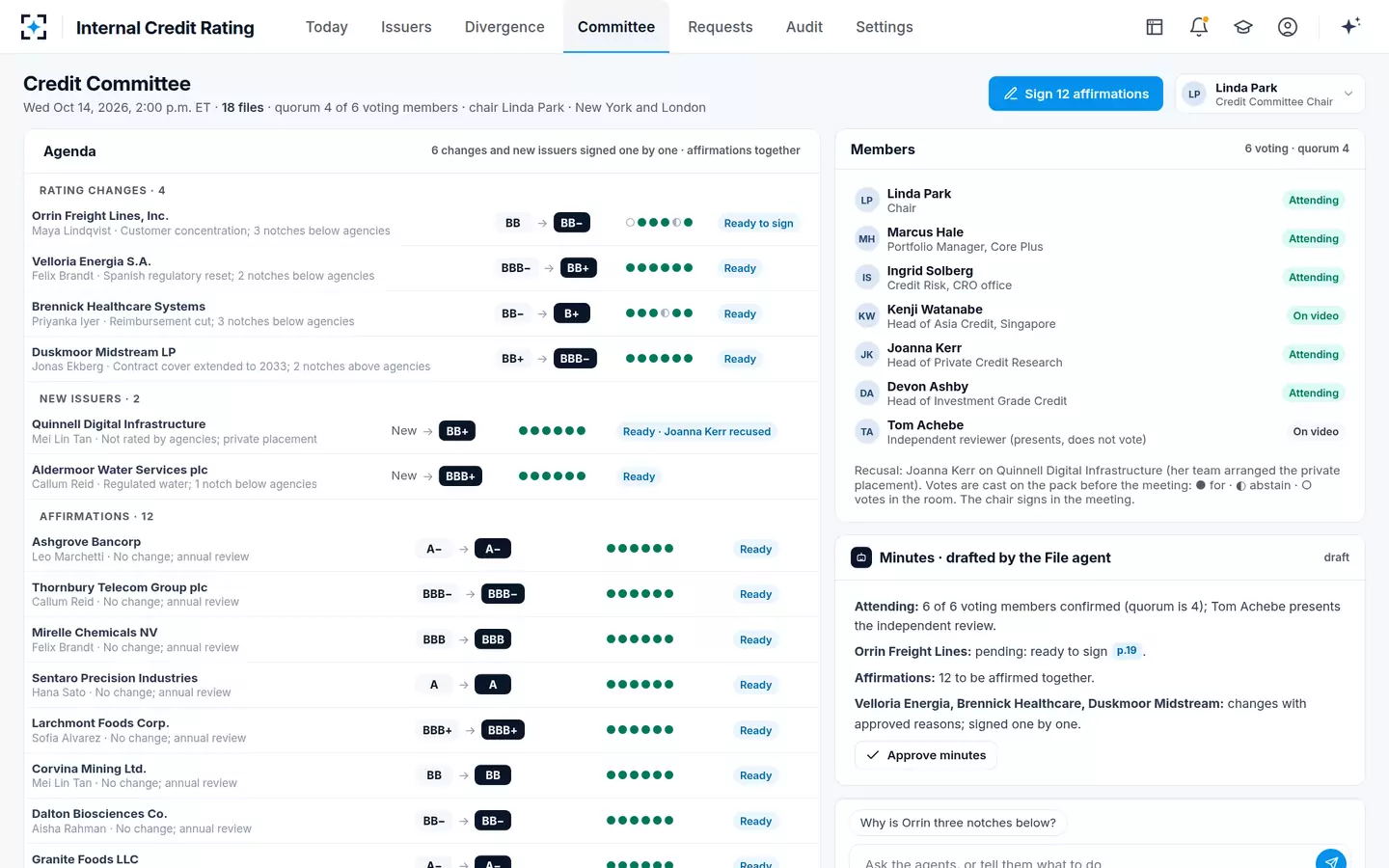
Splitting affirmations from changes is a practical answer to a real problem: a committee with 18 files cannot give each the same time. Affirmations with no change and no open challenge can be signed as a group; a change, a new issuer or a split from the agencies gets its own discussion and its own signature.
The chair's signature, the minutes and an after-the-fact review
The test of a rating committee comes months later, when someone who was not in the room asks why. The SEC's rule asks rating agencies to consider controls ensuring an analyst documents the steps taken "with sufficient detail to permit an after-the-fact review or internal audit of the rating file" (Rule 17g-8(d)(1)(xi)). For funds the duty is explicit. A US money market fund keeps the written record of each minimal credit risk determination for "not less than three years" from the latest review (Rule 2a-7(h)(3)). An EU money market fund documents "the rationale for and the analysis supporting the credit quality assessment" and "the person or persons responsible", and keeps it for "at least three complete annual accounting periods" (Article 21).
That is what the chair's signature should rest on. In the sample, Linda Park did not propose or review the Orrin file, so she may sign it. She picks the reason code "Rating change: concentration" and attests that she has read the file and the challenge record. Her signature closes a file that already holds the cited memo, the scorecard, the challenge and the votes.
The chair signs with a reason code and an attestation
Where Internal Credit Rating fits in a committee's work
Internal Credit Rating does not decide who sits on your committee, what quorum it needs or which conflicts disqualify a member; those belong in your charter. What it does is make the charter enforceable in the file. The analyst, reviewer and chair are three different people on every file, and the same person in two roles is refused. Recusals carry a reason. Every approval, acceptance, signature and override carries a reason code, and the chair signs with an attestation.
The agents do the reading and drafting around the decisions: spreading filings with every value cited, scoring under the approved methodology, placing the issuer among peers, drafting the reason for a split and the reviewer's questions, writing the memo and the minutes. They never change a rating, send a challenge or sign. The line between what the agents prepare and what people decide is drawn step by step in a separate guide, and the committee's most common argument, a two-notch split from the agencies, has one of its own.
Questions people ask
What is a credit committee charter?
It is the document that sets out what the committee decides, who votes, the quorum, how conflicts and recusals are handled, and what the minutes must record. No US rule prescribes one for an asset manager's internal ratings, but a money market fund's board must adopt written guidelines for minimal credit risk determinations if it delegates them, and an examiner will read the charter alongside them.
Is a rating committee the same as a credit committee?
Often the same body under a different name. At a lender, a credit committee usually approves new exposure; at an asset manager, a rating committee approves the internal rating that decides eligibility and limits. Where one committee does both, the minutes should say which decision was taken on each file.
How often should a rating committee meet?
Often enough to keep every rating current. An EU money market fund must review all its credit quality assessments at least annually and reassess on a material change, so a committee that meets monthly with a route for urgent event reviews is common. A US money market fund's review must be ongoing; the SEC chose not to set a frequency.
Who can overrule a rating committee?
That depends on the charter, but the override should be rarer and better documented than the decision. The EU's money market fund rules allow overriding a methodology's output only in exceptional circumstances with an objective reason, and require naming the person responsible for that decision (Delegated Regulation (EU) 2018/990, Article 7).
How long must rating committee records be kept?
For a US money market fund, the written record of a minimal credit risk determination is kept at least three years from the latest review. For an EU money market fund, the documentation is kept for at least three complete annual accounting periods. Many firms keep rating files longer; the sample keeps its audit trail seven years.
Can a rating committee simply adopt an agency rating?
It can consider one, but not rest on it alone. Since October 2016 a US money market fund's eligibility turns on its own minimal credit risk determination, and EU fund managers "shall not solely or mechanistically rely on credit ratings". A committee that copies the agency rating has signed for an analysis it did not do.