A credit watch list is the short list of held issuers a credit team has decided to examine harder than the rest: each name on it owes a fresh credit view from its analyst, a hold-or-reduce decision from the portfolio manager, and a running total of exposure for the head of credit risk until someone closes it. On a buy-side desk it is the firm's own list, not a rating agency's public watch placement, and its weakness is timing: with thousands of issuers and each analyst covering dozens, a name joins the list when someone happens to read the right filing. Botminds' Credit Surveillance is a credit early warning system built for that gap. Its agents read every held issuer's filings, rating actions, prices, news and court dockets every day, in the language each is published, and the people keep the decisions about what goes on the watch list and what comes off.
The examples come from the solution's sample data: Quillfield Capital, a fictional London manager holding 2,486 issuers across 318 funds and mandates. Every person, fund and issuer named on this page is invented; the rules and statistics are real and linked where they appear.
What one night of watching covers, in the sample
2,486
held issuers read overnight, every one of them, every day
15,214
filings, rating actions, news items, court notices and lender reports read
14
open watch cases, with $166.2M on watch across 35 funds
64
issuers covered by one European high yield analyst
What is a credit watch list on a buy-side credit desk?
A credit watch list is a register of held names under heightened review, and each entry is useful only if it carries three things: an owner, a clock and a position. The owner is the covering analyst, who owes a view. The clock says when that view, and then the trade decision, are due. The position is the exposure in every fund that holds the name, because the same bond can be a 0.3% holding in a high yield fund with no rating floor and a forced sale in a mandate that must exit below a set rating.
It is not the same thing as a rating agency's watch placement. An agency watch is a public statement that the agency's own rating may change; the firm's watch list is a private working tool, and an agency action is only one of the reasons a name lands on it. In the sample, a negative outlook on a Swedish packaging issuer trips one wire on the analyst's screen, and nothing more, until a second warning arrives.
For a money market fund the list has legal edges. Under SEC Rule 2a-7, when a portfolio security defaults, stops being an eligible security or its issuer becomes insolvent, the fund must sell it as soon as it practicably can in an orderly way, unless the board finds that selling would not be in the fund's best interests (17 CFR 270.2a-7(f)(1); the rule's credit test is explained in Rule 2a-7 and minimal credit risk). A watch list that learns of an insolvency late shortens the time the fund has to act in an orderly way.
Who decides when an issuer goes on the watch list?
The covering analyst decides, and everyone else's role follows from that. In a sound operating model, agents and rules may open a watch case, size it and draft a note, but only the analyst can set the credit view, only the portfolio manager can decide the trade, and only the head of credit risk can close a case or change what opens one. The point of separating the roles is that each signature means something: the analyst cannot quietly trade, and the portfolio manager cannot quietly change the view to justify a trade.
Five people behind one credit watch list: what changes, and what stays theirs
Today
Covers 64 names from terminal alerts, agency emails and memory between quarters; hears about a French court notice when a colleague who reads French gets to it.
With agents
Starts the day with what changed on her names overnight, each warning cited, the original-language source beside the English, and a drafted note to accept, change or reject.
Still theirs: The credit view and the internal rating, signed with a reason code.
Today
Learns of a problem name by email, then works out the position and each fund's guidelines before he can act.
With agents
Receives the signed view with the position already sized in every fund and the guideline consequence of each.
Still theirs: The trade decision, one per case, and never the credit view.
Today
Receives orders with the reason somewhere in a chat thread.
With agents
Checks each staged order against the portfolio manager's signed decision before releasing it.
Still theirs: The release: a different person from the one who decided.
Today
Pieces together watch exposure across funds and the money market holdings that need a fresh minimal credit risk review.
With agents
Sees dollars on watch and share of NAV by fund, and approves every rule change and every closing.
Still theirs: Taking names off the list, and changing what puts them on it.
Today
Finds out a guarantor is in court abroad when the press reports it, days into the claim window.
With agents
Gets the legal question with the court text, the indenture clause and the claim deadline the same morning.
Still theirs: Every legal reading, including whether anything is a default.
What changes is the work before the decision. The analyst no longer finds the warning; she weighs it. In the sample she covers 64 issuers, and her morning screen opens on the three wires that tripped overnight on one of them, with a view due by 8:12 a.m. The workout specialist, who used to learn of a foreign court case from the press, receives the court text and the claim deadline before London opens.
Credit watch list in banking vs asset management: one word, two jobs
A bank's watch list and an asset manager's share a name and little else. The bank lends, holds the loan to maturity and can renegotiate; its watch list feeds the risk rating, the loan review and the allowance. An asset manager holds traded securities in several funds at once, cannot renegotiate a bond alone, and has one main lever: hold, reduce or exit, before the price has finished moving.
The same words describe different work at a bank and at a bond fund
Bank credit watch list: Borrowers whose risk rating is under review, usually from covenant tests, financial statements and the relationship manager.
Buy-side credit watch list: Held issuers with a fresh warning sign: a filing, a court case, a spread move, a rating action, a restructuring step.
Bank credit watch list: Renegotiate, add collateral, waive or reprice, because the bank is the lender.
Buy-side credit watch list: Hold, reduce or exit across every fund that holds the name, usually in a market that is already moving.
Bank credit watch list: The relationship manager, who receives the borrower's statements directly.
Buy-side credit watch list: Whoever reads the public record first: other holders, dealers and the market.
Bank credit watch list: Quarterly certificates, annual reviews, a monthly committee.
Buy-side credit watch list: Filings and court notices arrive any night; an 8-K has four business days, a court notice none.
Bank credit watch list: A borrower whose certificate is late is read as fine.
Buy-side credit watch list: A guarantor's court case abroad, or a name nobody covers, is read by no one.
That difference in levers is why the bank's watch list can afford a monthly committee and the bond fund's cannot. A lender who reads a weak certificate late still holds the same contractual rights. A bondholder who reads a court notice late sells into a price that has already absorbed it. Banks building the same capability start from different data and a different decision, set out in what to require from an early warning system for banks.
Why a watch list is only as current as the last thing someone read
Most watch lists are built from the inputs the team already watches: quarterly results, rating agency notices and the market screen. Each is late or partial in its own way, and the warnings that matter most often arrive somewhere else. A US registrant has four business days to report a reportable event on Form 8-K, and when the event falls on a weekend or holiday "the four business day period shall begin to run on, and include, the first business day thereafter" (SEC Form 8-K, General Instruction B.1). A court notice about a foreign subsidiary has no such clock and no English version.
The volume is the other problem. In the twelve months to 30 September 2026, US bankruptcy courts received 9,986 chapter 11 cases, 9,453 of them business cases, and 259 chapter 15 cases, which ask a US court to recognise a proceeding opened abroad (US Courts, Table F-2). Each case is filed by one legal entity, and a credit book's exposure usually runs through a parent, an issuer and a list of guarantors. Matching a filing to the bonds it touches is a reading task before it is a credit task, and it is the one a bankruptcy court docket search leaves undone.
One night on the sample watch list: from the first warning to orders released
Agent
2:51 a.m. · Filings agentReads an 8-K under Item 5.02: the group finance chief has resigned. Management wire on Sorel Distribution.
Never: open a case on one amber wire
Agent
5:44 a.m. · Docket agentReads a Lyon court notice in French: safeguard for a subsidiary that guarantees both notes held. Court wire.
Agent
6:05 a.m. · Market agentThe 2029 notes widen 45 bp while their sector moves 3 bp. Spread wire.
Agent
6:12 a.m. · Correlator agentAfter the Challenger agent's checks, opens the watch case, sizes it in four funds and tells the analyst, the portfolio manager and credit risk.
Never: set a view or trade
A person decides
6:41 a.m. · Credit analystSets the internal rating from B+ to B, outlook negative, recommendation Reduce, with a reason code.
A person decides
7:30 and 7:36 a.m. · Portfolio manager, then head of credit tradingThe manager decides one trade for four funds; a different person releases the orders.
What are watch list criteria? Eight tripwires and one rule for opening a case
Watch list criteria are the house rules that turn a warning sign into a reason to look. Good criteria are written down, tuned by asset class, compared against the sector rather than in isolation, and changed only with approval. In the sample they take the form of eight tripwires, each a column on a matrix where every held issuer is a row.
The eight high yield tripwires in the Credit Surveillance sample, and when each trips
| Tripwire | Trips when | Severity |
|---|---|---|
| Spread widening | +35 bp in 2 days and 25 bp more than the sector, or +75 bp in 10 days | Amber |
| Rating or outlook | Any downgrade, negative outlook or watch | Amber |
| Covenant headroom | Under 15% on a maintenance or springing test, or any waiver | Amber |
| Court filing | Proceeding at the issuer; at a guarantor or subsidiary over 10% of EBITDA | Red at the issuer, amber below it |
| Auditor change | Auditor resigns, is dismissed or disagrees | Amber |
| Management departure | Chief executive, finance chief, general counsel or treasurer leaves | Amber |
| Late filing | NT 10-K or NT 10-Q; a missed indenture reporting deadline | Amber |
| Restructuring signs | Advisers hired, exchange offer, consent solicitation, written procedure, missed coupon | Red |
The case rule matters more than any single threshold. One amber wire is a note for the covering analyst to acknowledge or dismiss; in the sample, five names carried a single wire that morning and none of them opened a case. Two wires within ten days on the same issuer are rarely a coincidence. A finance chief leaving is a governance event; a finance chief leaving the week a guarantor enters court protection is a credit event. Correlating weak signals is the part of the job a person reading feeds one at a time does worst, and the going concern warning usually arrives after them.
How often should a credit watch list be reviewed?
The reading should be daily and the review should be event-driven, with a weekly committee to look across the list. Daily, because filings and court notices arrive every night. Event-driven, because a case needs a decision within hours, not at the next meeting. Weekly, because the committee's job is different: to see concentrations, stale cases and names that have sat on the list too long without a decision.
In the sample the clocks are settings. The analyst's view is due within two hours of a case opening, with the head of credit research told if it is missed; the portfolio manager's decision is due within four hours of the view, with the chief investment officer for fixed income told if that is missed. The agents draft the weekly committee papers from the open cases, and the head of credit research approves and sends them.
The reviews that change nothing need a trail as well. Under the CFA Institute's Standard V(C), the duty to keep records of research and reasons covers a review that changes nothing just as it covers a trade (CFA Institute, Standard V(C), Record Retention). A watch list where a dismissed wire leaves no reason cannot show, a year later, that the name was looked at.
The analyst's morning on the credit watch list: what changed on her names overnight
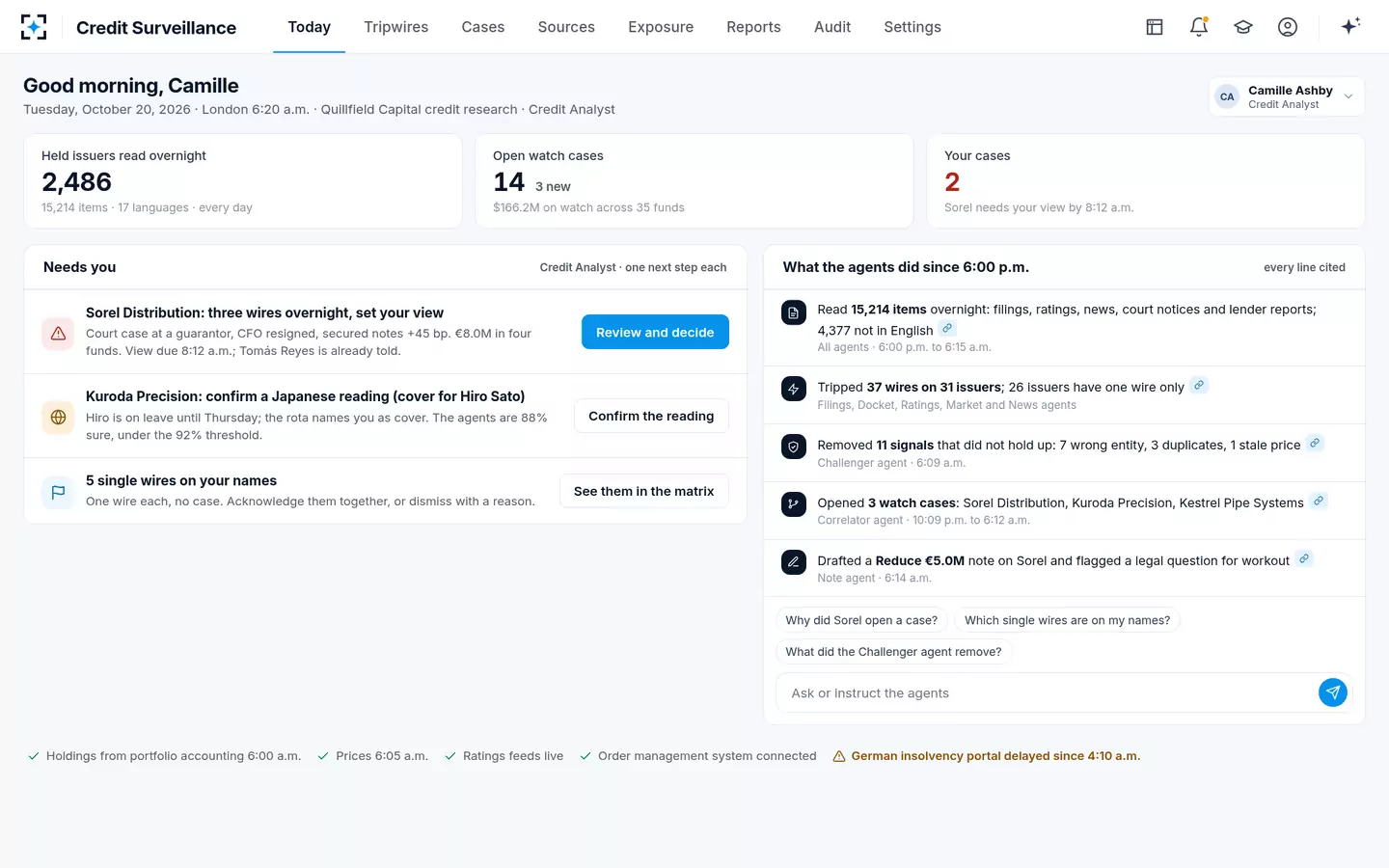
How do you take an issuer off the watch list?
An issuer comes off the watch list when the reason it went on has been resolved or the position has gone, and the person who proposes the closing should not be the person who approves it. Resolved means something specific: the court case is closed or the guarantor released, the refinancing has priced, the spread has come back inside the sector, the auditor's report is clean. A list that only grows is a list nobody reads.
In the sample, an analyst proposes a closing with a reason, and the head of credit risk checks it before the case closes. Nobody approves their own closing. The same maker-and-checker rule applies to the rules themselves: an administrator proposes a change to a tripwire, the head of credit risk approves it after it has been replayed on the last 90 days, and every version stays on the audit trail.
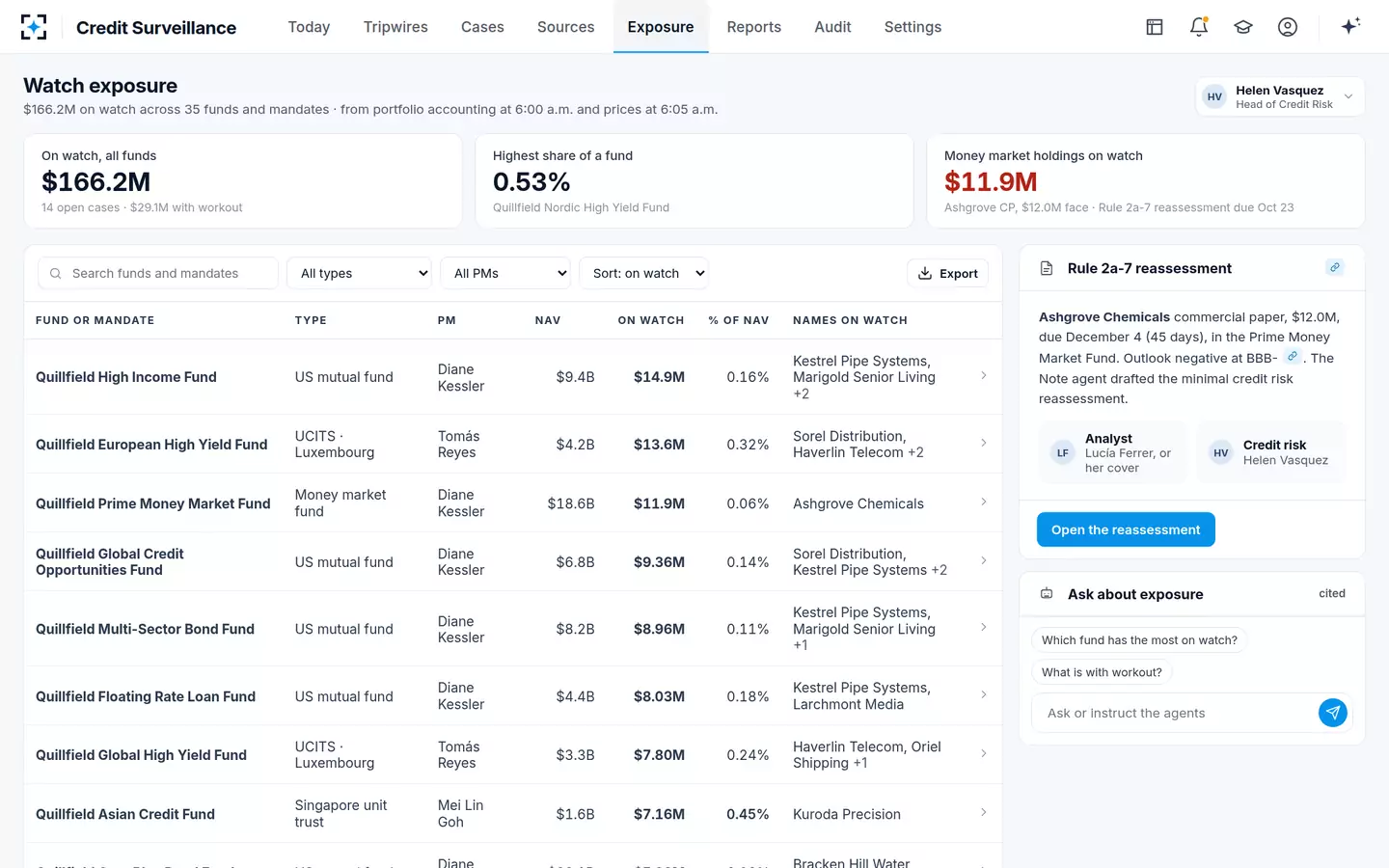
Watch exposure by fund, and the money market reassessment due
What changes in the team's week when agents do the watching
The team's size does not change; where its hours go does. Most of the time an analyst spends on one watch case today goes to finding, reading and matching, not to judging. Moving that work to agents leaves the analyst with the note and the view, which were always the part only she could do.
Where an analyst's hours go on one high yield watch case
By hand · about 13 hours (estimate)
- Spotting the signals · 23%
- Reading a foreign filing · 15%
- Matching entity to guarantors · 12%
- Sizing in every fund · 12%
- Writing the note · 23%
- Rebuilding the trail · 15%
With Credit Surveillance · about 2.4 hours (estimate)
- Spotting · 21%
- Reading · 12%
- Matching · 8%
- Sizing · 8%
- Reviewing and signing the note · 43%
- Trail · 8%
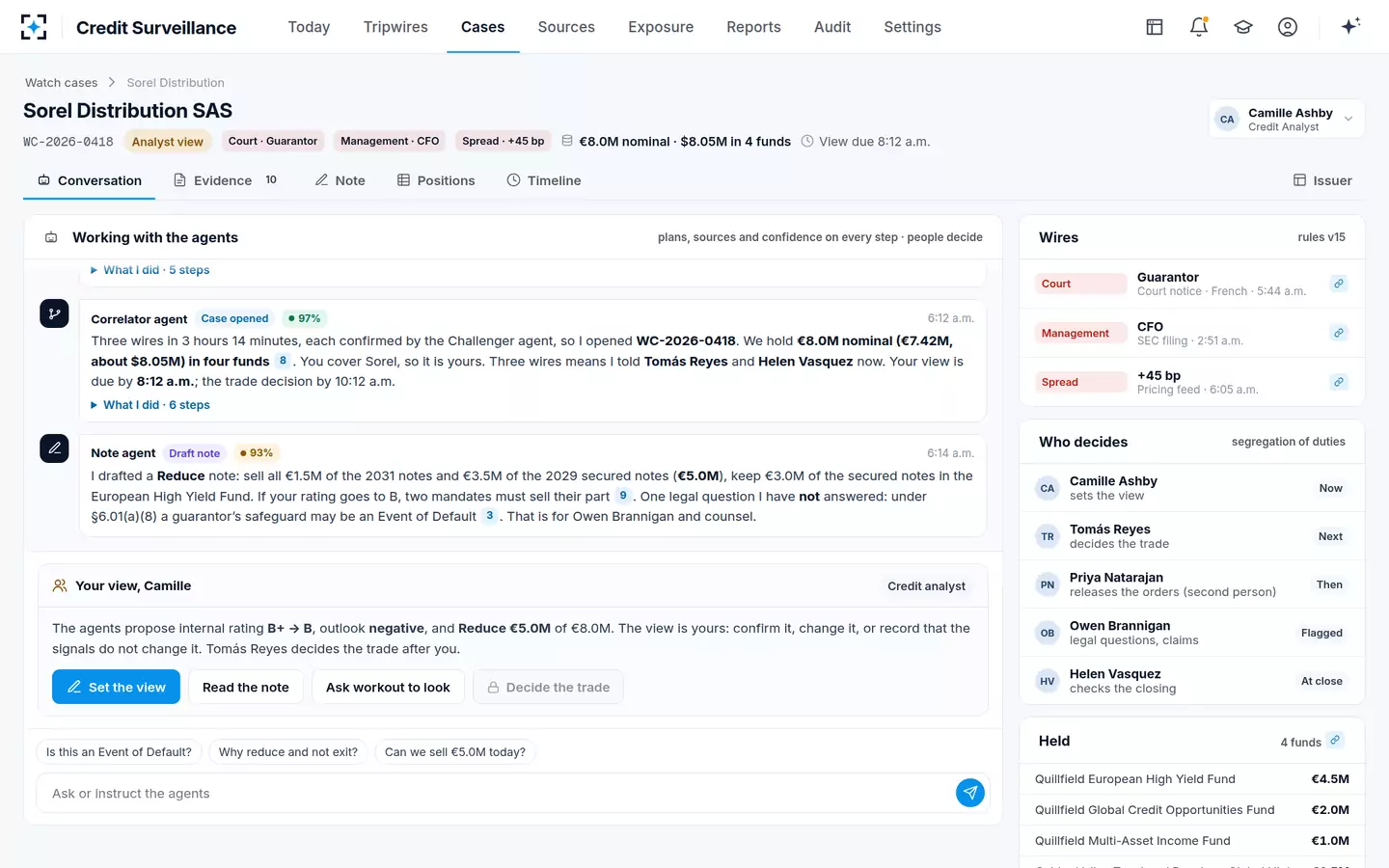
FINRA's 2026 oversight report, written for broker-dealers but useful to any firm putting agents to work, notes that the capabilities of AI agents "may call for supervisory processes that are specific to the type and scope of the AI agent being implemented" (FINRA, 2026 Annual Regulatory Oversight Report). On a watch list that means writing down what each agent may do and what it may never do. In the sample, no agent can set a view, change an internal rating, decide a trade, send an order, declare a default or close a case, and a reading below 92% confidence goes to a person before anyone relies on it.
One watch case: the agents' work, the wires and who decides next
Where Credit Surveillance fits on a watch list, and where it does not
It fits a buy-side credit team that holds more issuers than its analysts can read every day, across currencies and jurisdictions, with funds that hold the same names under different guidelines. That is where the reading, matching and sizing work is largest, and where a court notice in French or a Japanese disclosure is most likely to be read late. The solution works from the firm's own holdings, coverage list, indentures and fund guidelines, so the cases it opens are the firm's cases, not a generic alert feed.
It does not replace the analyst's judgment, the committee or counsel. It does not decide whether a court case is an event of default; it shows the clause and the deadline and hands the question to workout. Lender reports and other private-side material stay behind the firm's information barrier. And a firm whose holdings cannot be read by fund each morning, or whose coverage list is out of date, should fix that first, because a watch case without an owner and a position is just another alert. Which tasks a credit early warning system should take on sets out the split in more detail, and the Credit Surveillance page shows the whole night of the sample case.
Questions people ask
How many issuers can a credit analyst cover?
No regulator or independent study sets a number, and it depends heavily on asset class: investment grade names change less often than distressed ones. In the fictional sample, a European high yield analyst covers 64 issuers. The practical limit is reading time between quarters, which is why coverage that relies on alerts and memory thins out as the list grows.
Is a credit watch list the same as a rating agency watch?
No. A rating agency watch is the agency's public signal that its own rating may change. A firm's credit watch list is its private list of names under review for its own reasons, and an agency action is only one possible trigger; in the sample it trips a single amber wire.
Does an issuer on the watch list have to be sold?
Not by itself. The watch list obliges a fresh view and a decision, which can be hold, reduce or exit, and different funds may reach different answers under their own guidelines. In the sample case all four funds reduce, and the European high yield fund keeps €3.0M of the secured notes. Money market funds are the exception with a rule attached: Rule 2a-7 requires disposal as soon as practicable after a default or insolvency, absent a board finding.
Do money market funds need a credit watch list?
They need ongoing credit review, and a watch list is how most advisers organise it. Rule 2a-7 requires written procedures for ongoing review of whether each security still presents minimal credit risks, and sets disposal duties after adverse events. In the sample, $12.0M face of commercial paper in the prime money market fund is on watch with a reassessment due on 23 October.
How long should watch list records be kept?
Investment advisers keep the books and records Rule 204-2 requires for at least five years, the first two in an appropriate office (17 CFR 275.204-2(e)(1)); whether a given watch list note is one of them depends on how it is used. The fictional sample firm keeps every read, wire, view and decision for seven years, with a legal hold able to extend it.
Who should be able to see the watch list?
The people who act on it: covering analysts, portfolio managers, credit risk, trading and compliance. Private-side information from lender groups or creditor committees needs an information barrier, because Advisers Act section 204A requires policies to prevent the misuse of material nonpublic information. In the sample, private-side lender reports stay behind that barrier.