A distressed exchange is a transaction in which a borrower in financial difficulty offers its creditors new debt, equity or cash worth less than what they were originally promised, such as a lower principal, a lower or payment-in-kind coupon, or a later maturity, in place of their existing claims, usually to avoid a missed payment or a bankruptcy filing. Creditors accept because the alternative looks worse. Default statistics that include distressed exchanges count them as defaults, and in the Federal Reserve's reports those broader measures have stayed high while the traditional default rate on leveraged loans has stayed low: a growing part of credit distress now arrives as a negotiated deal rather than a court filing. Because a deal has deadlines and favours the creditors who are in the room early, it is a surveillance problem as much as a credit one. Botminds' Credit Surveillance, a credit early warning system for buy-side credit teams, watches every held issuer for the first signs, advisers hired, exchange offers, consent solicitations, missed coupons, and turns them into a case on the analyst's screen the same day.
Examples from the solution's sample data concern fictional firms. Statistics and rules come from the Federal Reserve, US law and peer-reviewed or working-paper research, linked where they appear.
Two ways the Fed's report measures leveraged loan defaults, and why they now disagree
Realized default rate: Amount in default over the past 12 months
Default rate including distressed exchanges: Issuers in default or distressed exchange over the past 12 months
Realized default rate: Total outstanding volume of loans not in default at the start of the 12 months
Default rate including distressed exchanges: Total number of issuers not in default at the start of the 12 months
Realized default rate: By dollars: large borrowers dominate
Default rate including distressed exchanges: By issuers: each borrower counts once
Realized default rate: December 1998
Default rate including distressed exchanges: December 2016
Realized default rate: Below its historical median
Default rate including distressed exchanges: Still high relative to its history
What is a distressed exchange?
It is a restructuring done by agreement rather than by a court. The borrower, usually advised by investment bankers and lawyers, offers holders of its bonds or loans something new in place of what they hold: new notes with a lower face value, a longer maturity or a coupon partly paid in more debt; secured notes in exchange for unsecured ones; equity; or cash at a discount. Holders who accept give up part of their claim in return for a better position, more security or an earlier payment. Holders who refuse keep the old instrument, sometimes with fewer protections than before.
What makes an exchange "distressed" is the reason for it and the value given up. A company refinancing early on better terms is managing its liabilities. A company that would otherwise miss a payment, offering holders less than they were promised, is restructuring, and default statistics treat it that way.
How are distressed exchanges counted in default rates?
They are counted as defaults in the broader measure and left out of the traditional one, and the two measures are calculated on different bases. In the Fed's reports, the realized default rate on leveraged loans is "calculated as the amount in default over the past 12 months divided by the total outstanding volume of loans that are not in default at the beginning of the 12-month period," while the rate including distressed exchanges is "calculated as the number of issuers in default or distressed exchange over the past 12 months divided by the total number of issuers that are not in default at the beginning of the 12-month period" (Federal Reserve, Financial Stability Report, November 2025, figure 2.9 notes).
That difference in weighting matters as much as the inclusion. The first measure is weighted by dollars, so a few large healthy borrowers can keep it low; the second counts each issuer once, so many small borrowers in distress push it up. A credit team reading a single "default rate" should first ask which of the two it is, and whether exchanges are in it. What the public numbers say about high yield default rates in 2026 sets both beside the courts' own counts.
Is a distressed exchange a default?
For statistics, yes, when the measure includes them. For the documents, usually not: a holder who accepts an exchange offer has agreed to the new terms, and no payment has been missed. That gap is the heart of the matter for a bondholder. The economic loss is real, the debt is worth less than promised, but the contractual events that would let holders act, a payment default, a bankruptcy filing, may never occur.
The same gap explains why exchanges are attractive to borrowers. Chapter 11 requires a plan that classes of creditors vote on: a class accepts when holders of "at least two-thirds in amount and more than one-half in number" of the allowed claims voting in it accept (11 U.S.C. 1126(c)). An exchange avoids the court, its cost and its publicity, but it cannot bind holders who refuse on their right to be paid; it can only make refusing less attractive. When enough holders agree in advance, the two routes meet in a prepackaged plan, for which the Bankruptcy Code counts acceptances given before the case under conditions in section 1126(b).
Why are distressed exchanges rising?
The Fed's reports show the gap between the two measures persisting across 2025 and 2026, and the reasons lie in the documents and in who holds the debt. In November 2025 the Fed wrote that defaults including distressed exchanges were still elevated even as the traditional measure stayed low.
"The volume-weighted default rate on leveraged loans stayed well below its historical median … However, defaults including distressed exchanges … continued to be elevated relative to history."
Federal Reserve, Financial Stability Report, November 2025
Six months later the Fed's assessment had not changed: the volume-weighted rate was still below its historical median, and the measure including distressed exchanges was still high (Financial Stability Report, May 2026). Loan and bond documents explain part of it. Studying 1,240 credit agreements, Ivashina and Vallée found that the carve-outs and deductibles that weaken negative covenants are as common as the covenants themselves (NBER Working Paper 27316, 2020), and flexible documents leave room to restructure without a court. Who holds the debt explains another part: when the debt sits with many funds rather than a few banks, an out-of-court deal needs only enough of them to agree.
Research on an earlier wave of distress shows how much rides on the bondholders. In a study of 102 public junk bond issuers that ran into financial distress, Asquith, Gertner and Scharfstein found that "out-of-court debt relief mainly comes from junk bond - holders; banks almost never forgive principal, though they do defer payments and waive debt covenants." And: "If a company simply restructures its bank debt, but either does not restructure its public debt or does not sell major assets or merge, the company goes bankrupt" (NBER Working Paper 3942, 1991; Quarterly Journal of Economics, 1994). The data are old; the mechanism is not.
Distressed exchange vs liability management exercise
A distressed exchange is one kind of transaction; a liability management exercise is a broader family that includes it. Liability management covers any reshaping of a company's debt by agreement: exchanges, tender offers, amendments, and the more aggressive transactions in which some creditors gain priority over others, such as an uptier exchange or a drop-down of assets to a new subsidiary. Those transactions and the documents that permit them are the subject of what a liability management exercise is.
Three ways distress is resolved, and what each means for a bondholder who does not join
| Distressed exchange | Priority-shifting liability management | Chapter 11 | |
|---|---|---|---|
| Where it happens | Out of court, by offer | Out of court, by amendment and exchange among a group of lenders | In a bankruptcy court |
| Who must agree | Each holder who exchanges | The majority the documents require for the amendment | Classes voting by the Code's two-thirds and one-half test |
| A holder who refuses | Keeps the old instrument, possibly with covenants removed by the majority | Can end up behind the creditors who took part | Is bound if the class accepts and the plan is confirmed |
| How it shows up first | Advisers hired, a consent solicitation, an exchange offer | A new financing, an amendment, a group of lenders organising | A petition on the docket; an 8-K Item 1.03 for a registrant |
| Counted as a default | In measures that include distressed exchanges | Often, when it is distressed | Yes |
What is a coercive exchange offer?
A coercive exchange offer is one designed so that refusing is worse than accepting, even if the offer is poor. The usual tool is the exit consent: holders who tender into the exchange also vote, as they leave, to strip the old bonds of their covenants, so the holders who stay behind keep a bond with fewer protections and a thinner market. Each holder may prefer that nobody accept, yet accept anyway for fear of being left in the stub.
The law draws the limit at payment. Under the Trust Indenture Act, a majority cannot impair a holder's right to receive principal and interest when due without that holder's consent, but it can remove most other covenants by the indenture's ordinary voting rules; how a consent solicitation works, and what bondholders can lose by vote, follows the mechanics. Time is the other lever. A tender or exchange offer must stay open at least twenty business days under SEC Rule 14e-1, but offers commonly pay a premium only to holders who tender before an earlier deadline, so the effective window to decide is shorter.
How do distressed exchanges affect recovery?
They usually give holders less than the original promise and more than a messy bankruptcy might, but no regulator publishes recovery rates for distressed exchanges, and the result depends on what the new securities are worth. A secured note in exchange for an unsecured one can improve a holder's position even at a lower face value; a longer maturity with a payment-in-kind coupon can leave the holder exposed to the same risk for longer. The comparison that matters is the value of the package offered against the holder's realistic recovery if the company files.
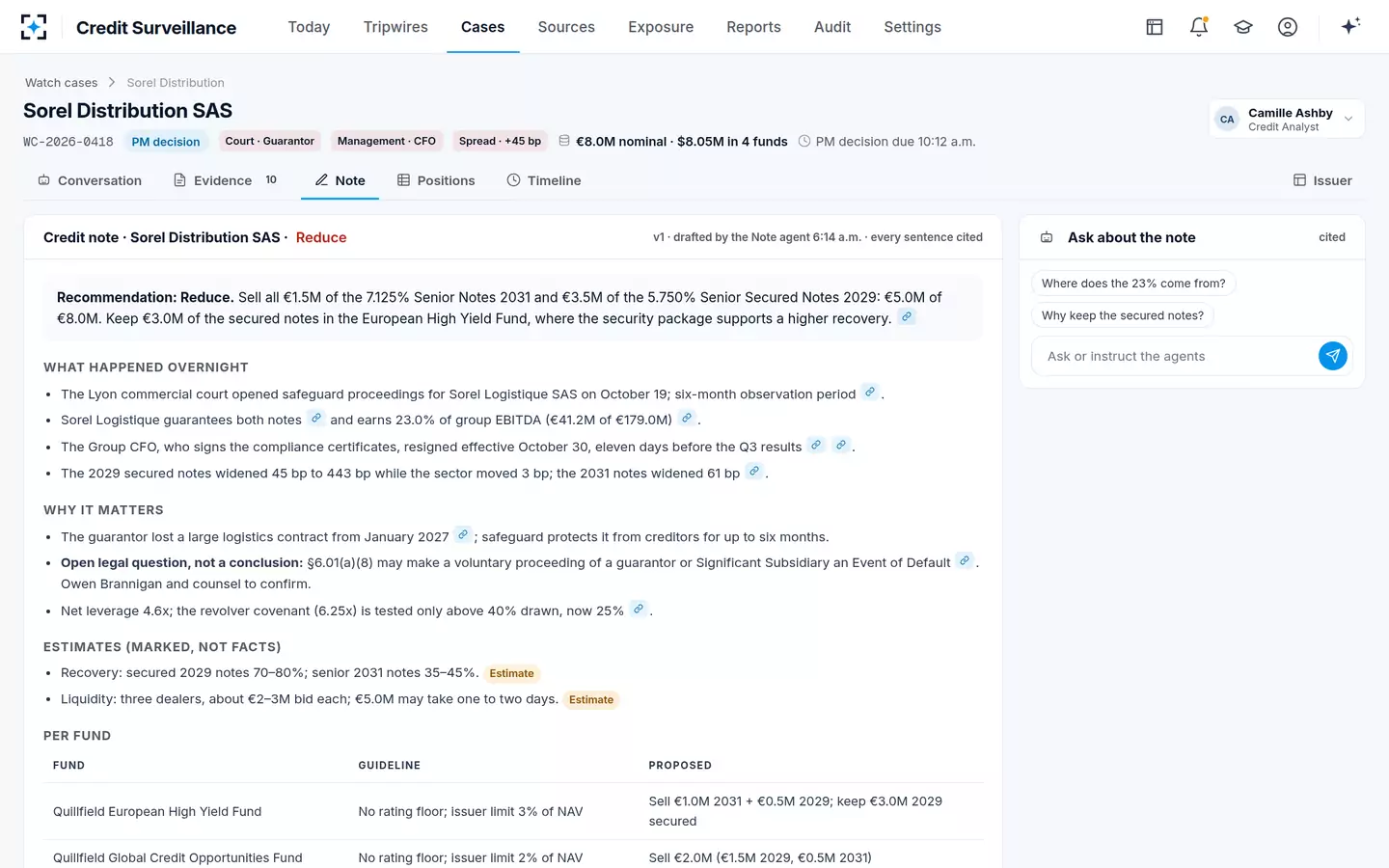
Recovery is also where reading early pays twice. A holder who knows the documents, the guarantors and the collateral when the first adviser is hired can model the alternatives before the offer arrives, and has the time to decide whether to join a creditor group, which brings its own rules on confidential information. In the sample note, recovery estimates are set apart and marked as estimates: 70 to 80% for the secured 2029 notes and 35 to 45% for the senior 2031 notes of the fictional issuer.
A Credit Surveillance hold-or-reduce note, with recovery estimates marked as estimates
Why reading first pays: the first signs of an exchange
An exchange is announced on a date, but it is prepared for weeks, and much of the preparation is public. The company hires restructuring advisers, often reported in the press. It may launch a consent solicitation before the exchange itself. In Nordic bond markets, a written procedure, a vote of bondholders held in writing, can be the first formal step. A coupon may be skipped into its grace period. Each of these is a restructuring sign, and in the sample firm's settings each trips the restructuring wire, which is red: one is enough to open a watch case.
An illustrative exchange offer, from the first public sign to settlement
- Advisers hired; coupon in graceAdvisers · grace
- Consent solicitation or written procedureConsents
- Exchange offer launchedLaunch
- Early tender deadline, with a premiumEarly deadline
- Expiration, at least 20 business days after launchExpiration
- SettlementSettle
The holder who sees the first two steps is in a different position from one who learns of the offer from the launch announcement. Time to read the documents, to compare the offer with a bankruptcy recovery, to decide whether to sell before the terms are known or to join the negotiation: all of it comes from the weeks before the launch. That is why the sample's restructuring wire watches advisers hired, exchange offers, consent solicitations, written procedures and missed coupons, read in each source's language, and why the News agent never trips it on one unconfirmed report.
What should a bondholder do when an exchange offer arrives?
Decide quickly, but in the right order: understand the offer, value the alternatives, check each fund's position and guidelines, and keep decisions with the people who own them. A checklist keeps the first days from being spent on the wrong questions.
The first questions when an exchange offer lands on a held issuer
- What are the deadlines?
Early tender, expiration, withdrawal rights. The early deadline is usually the one that decides the economics.
- What is offered against what is held?
Face value, coupon, cash or payment in kind, maturity, ranking, collateral, guarantors. Compare with the realistic recovery in a filing.
- What happens to bonds left behind?
Read the exit consents: which covenants would be removed, and whether the old bonds would still be tradable.
- Can every fund hold the new securities?
Equity, payment-in-kind notes or lower-rated debt may breach a fund's guidelines even when the exchange is the better economic choice.
- Should the firm join a creditor group?
A group can negotiate better terms, but its information may restrict trading; advisers must keep policies against misuse of material nonpublic information.
- Who decides, and where is it written down?
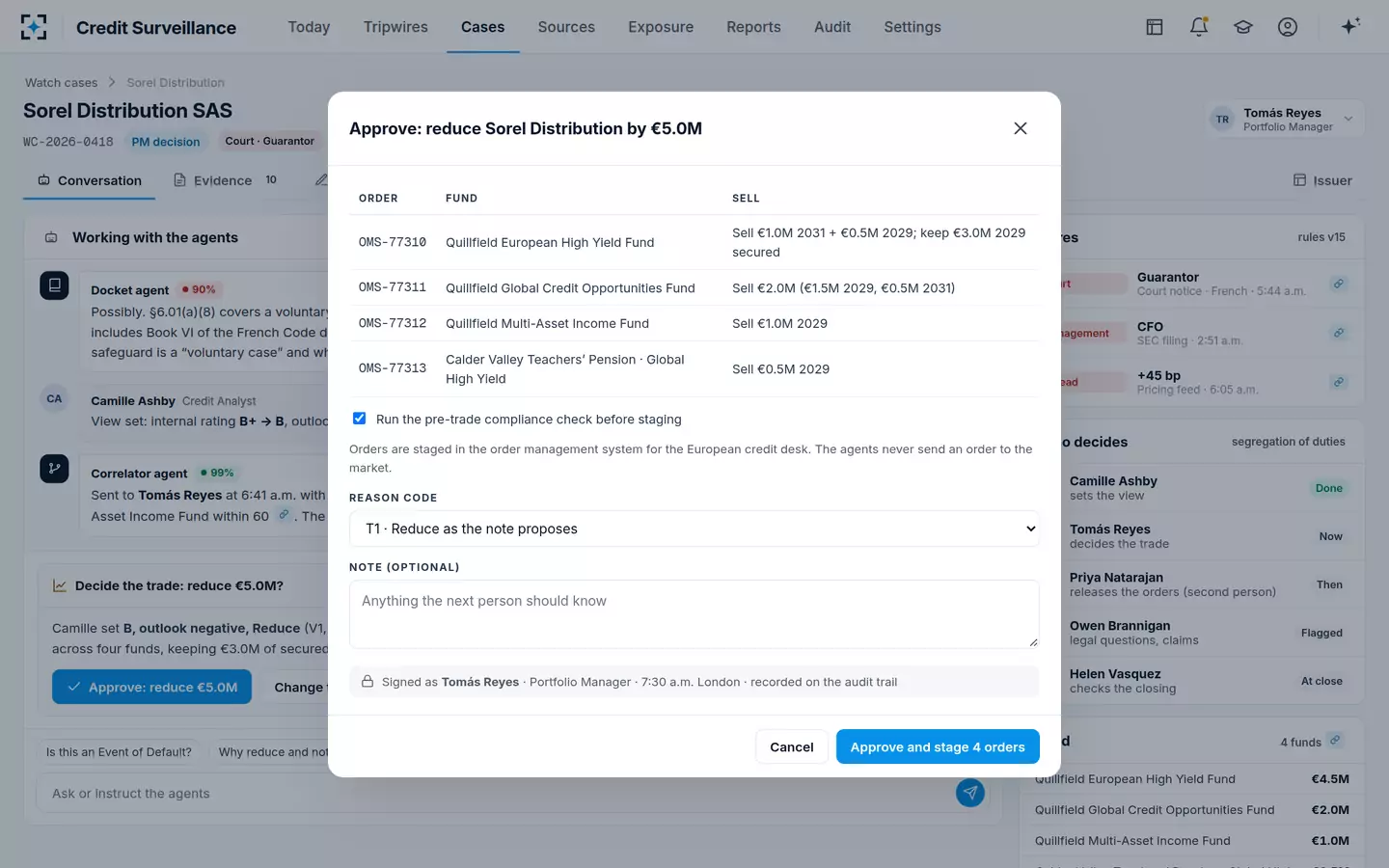
The analyst sets the view, the portfolio manager decides for each fund, and the reasons are kept with the case.
One trade decision for every fund that holds the name
Where Credit Surveillance fits, and where it stops
It fits the weeks before an exchange: reading every held issuer's filings, news and court records in their own languages, tripping the restructuring wire on the first sign, and putting the case in front of the covering analyst with the position in every fund, the guarantors and a cited note. When the offer itself arrives, the agents draft; the analyst, the portfolio manager and, for legal questions, the workout specialist and counsel decide.
It does not negotiate, tender, vote or value the new securities, and it never decides whether a transaction is a default under the documents. For the priority-shifting transactions an exchange can be part of, see the liability management guides linked above; for how a restructuring step joins other warnings in a case, see the going concern warning and the signals that come before it. The sample night is on the Credit Surveillance page.
Questions people ask
What is a distressed debt exchange in simple terms?
A company that cannot comfortably pay its debts offers its lenders new debt or other securities worth less than the original promise, and they accept to avoid something worse. Default statistics that include such exchanges count them as defaults, even though no payment was missed.
What should a fund write down when it accepts or rejects an exchange?
The view behind the decision, the alternatives compared, each fund's guideline consequence and who decided. The CFA Institute's Standard V(C) asks members to keep records that support the reasons for their actions, including reviews that leave a position unchanged. In the sample, the analyst's view and the portfolio manager's decision are each signed with a reason code on the audit trail.
Why do companies choose a distressed exchange over chapter 11?
An exchange is faster, cheaper and more private, and it keeps the company out of court. Its weakness is that it cannot force holders who refuse to accept new payment terms, whereas a chapter 11 plan binds a class once holders of two-thirds in amount and more than half in number of the voting claims accept.
How long does an exchange offer stay open?
At least twenty business days from launch under SEC Rule 14e-1 for a tender or exchange offer, and often longer. Many offers pay a premium only to holders who tender by an earlier deadline, so the time to decide is shorter than the offer's life.
Are distressed exchanges more common in loans or bonds?
The Fed's published series that includes them covers leveraged loans, where the broader measure has stayed high through 2025 and 2026. Bonds are restructured the same way, often through exchange offers with exit consents, but no official US series separates the two.