A going concern warning is a statement, by a company's management in its financial statements or by its auditor in the audit report, that there is substantial doubt about the company's ability to continue as a going concern: in US accounting, that it is probable the company will be unable to meet its obligations as they fall due within one year. It is one of the strongest public warnings a bondholder can receive, and one of the latest. The conditions behind it, a covenant waiver, a default on a loan, a lost customer, a need to restructure debt, usually show up first in other places, and a credit team that ties two of those together has its decision made before the auditor writes the paragraph. Botminds' Credit Surveillance, a credit early warning system for buy-side credit teams, is built to catch those earlier signals on every held issuer and combine them into one watch case.
Examples from the solution's sample data concern fictional firms and people. The accounting and auditing standards quoted are real and linked.
A typical order of warnings before a going concern paragraph
- Covenant waiver or amendmentCovenant waiver
- Finance chief leaves (8-K 5.02)Finance chief leaves
- Spread widens against the sectorSpread widens
- Late annual report (NT 10-K)NT 10-K
- Audit report with going concern paragraphGoing concern
What is a going concern warning?
It is a disclosure that substantial doubt exists about the company's ability to keep operating and paying its debts. US accounting standards give the term a precise meaning: "Substantial doubt about an entity's ability to continue as a going concern exists when relevant conditions and events, considered in the aggregate, indicate that it is probable that the entity will be unable to meet its obligations as they become due within one year after the date that the financial statements are issued" (FASB, Accounting Standards Update 2014-15).
The warning can come from two places. Management must evaluate the question "in connection with preparing financial statements for each annual and interim reporting period," and if its plans do not remove the doubt, the footnotes must say so expressly. The auditor makes its own evaluation, and if substantial doubt remains, the audit report carries an explanatory paragraph. Either is what the market calls a going concern warning; the auditor's paragraph is the one that reaches the headlines.
The going concern clocks in US reporting
1year
management looks ahead, from the date the statements are issued
1year
at most, the auditor's "reasonable period of time" beyond the balance sheet date
1day
business day after a missed 10-K or 10-Q to file a late-filing notice
15days
calendar days of grace for a late 10-K after that notice; 5 for a 10-Q
How do auditors decide on going concern?
Auditors decide it as part of the audit rather than as a separate test. Under the PCAOB's standard for audits of public companies, the auditor "has a responsibility to evaluate whether there is substantial doubt about the entity's ability to continue as a going concern for a reasonable period of time, not to exceed one year beyond the date of the financial statements being audited" (PCAOB AS 2415.02). The evidence comes from procedures the audit runs anyway; the standard lists examples such as analytical procedures, a review of subsequent events, and one a credit analyst will recognise: "Review of compliance with the terms of debt and loan agreements."
When conditions point to substantial doubt, the auditor looks at management's plans, such as asset sales, new borrowing or cost cuts, and how likely they are to work. If doubt remains, the report must say so in an explanatory paragraph using the words "substantial doubt about its (the entity's) ability to continue as a going concern," or similar wording that includes the terms substantial doubt and going concern (AS 2415.12). That phrase is the one to search a filing for.
Does a going concern warning mean bankruptcy?
No. It means the doubt is substantial, not that failure is certain, and many companies with the paragraph refinance, sell assets or recover. The reverse matters more to a credit team: the absence of the paragraph is not a clean bill of health. The PCAOB says so directly.
"The auditor is not responsible for predicting future conditions or events … Accordingly, the absence of reference to substantial doubt in an auditor's report should not be viewed as providing assurance as to an entity's ability to continue as a going concern."
PCAOB, AS 2415.04
Research on audit reports before bankruptcies bears that out, and shows that the warning's frequency moves with auditors' caution. Studying 226 financially stressed companies that entered bankruptcy from 2000 to 2003, Geiger, Raghunandan and Rama found auditors were more likely to have issued a going concern opinion after December 2001 than before (Auditing: A Journal of Practice & Theory, 2005). A later study of bankruptcies from 2004 to 2010 starts from a complaint made during the financial crisis: "Auditing regulators and the business press had complained that auditors did not provide adequate warning in their reports prior to many companies filing for bankruptcy" (Accounting Horizons, 2014). A warning whose frequency depends on the climate in the audit profession is a poor timer for a trading decision.
Why a going concern warning usually arrives third, or later
Because it is a conclusion drawn from conditions that are visible before it. The standards list the conditions an auditor or management weighs, and almost every one of them has an earlier public trace: a loan default in an 8-K, a debt restructuring in an exchange offer, a lost customer in the news, a legal proceeding in a court docket. The going concern paragraph is the formal statement, published with the annual report, that those conditions add up.
Timing makes it later still. An auditor's report is issued with the annual financial statements, which for a company in difficulty are often late, and the lateness itself is a warning that arrives first. Management's own evaluation runs every quarter under the 2014 standard, so the doubt can appear in a quarterly report's footnotes before any audit paragraph, but it still follows the conditions rather than leading them.
The conditions behind a going concern doubt, and where each usually shows first
| Condition the standards list | Where it often appears first | Tripwire in the sample |
|---|---|---|
| Recurring operating losses, working capital deficiencies, negative operating cash flow, adverse key ratios | Quarterly reports; falling covenant headroom | Covenant: headroom under 15% or any waiver |
| Default on loans or similar agreements | Lender notices; Form 8-K Item 2.04 once a triggering event occurs | Restructuring or covenant |
| A need to restructure debt to avoid default | Advisers hired, exchange offers, consent solicitations, written procedures | Restructuring (red) |
| Denial of usual trade credit from suppliers | Trade and local press, often in the issuer's language | News: never alone on one unconfirmed report |
| A need to seek new financing or dispose of substantial assets | Form 8-K Items 1.01 and 2.03; announcements of sales | Analyst note; restructuring if distressed |
| Legal proceedings that might jeopardise operations; loss of a key licence, customer or supplier | Court dockets and registries; issuer announcements | Court; news |
The list ends with a sentence a surveillance rule should take literally: the standard says the significance of such conditions "will depend on the circumstances, and some may have significance only when viewed in conjunction with others" (AS 2415.06). That is a description of correlation. One condition is a single wire; two in the same weeks are a case. Which 8-K filing triggers signal credit trouble covers the US filings that carry most of them.
What are the early warning signs of default?
The early warning signs of default are the conditions above, seen from outside the company: covenant headroom falling or waived, a missed or delayed payment, advisers hired and talk of an exchange, an auditor or finance chief leaving, a late filing, a court case at a subsidiary, a spread widening while the sector does not. None is decisive alone. Two arriving close together are worth more than any one of them strong, because they are rarely coincidences.
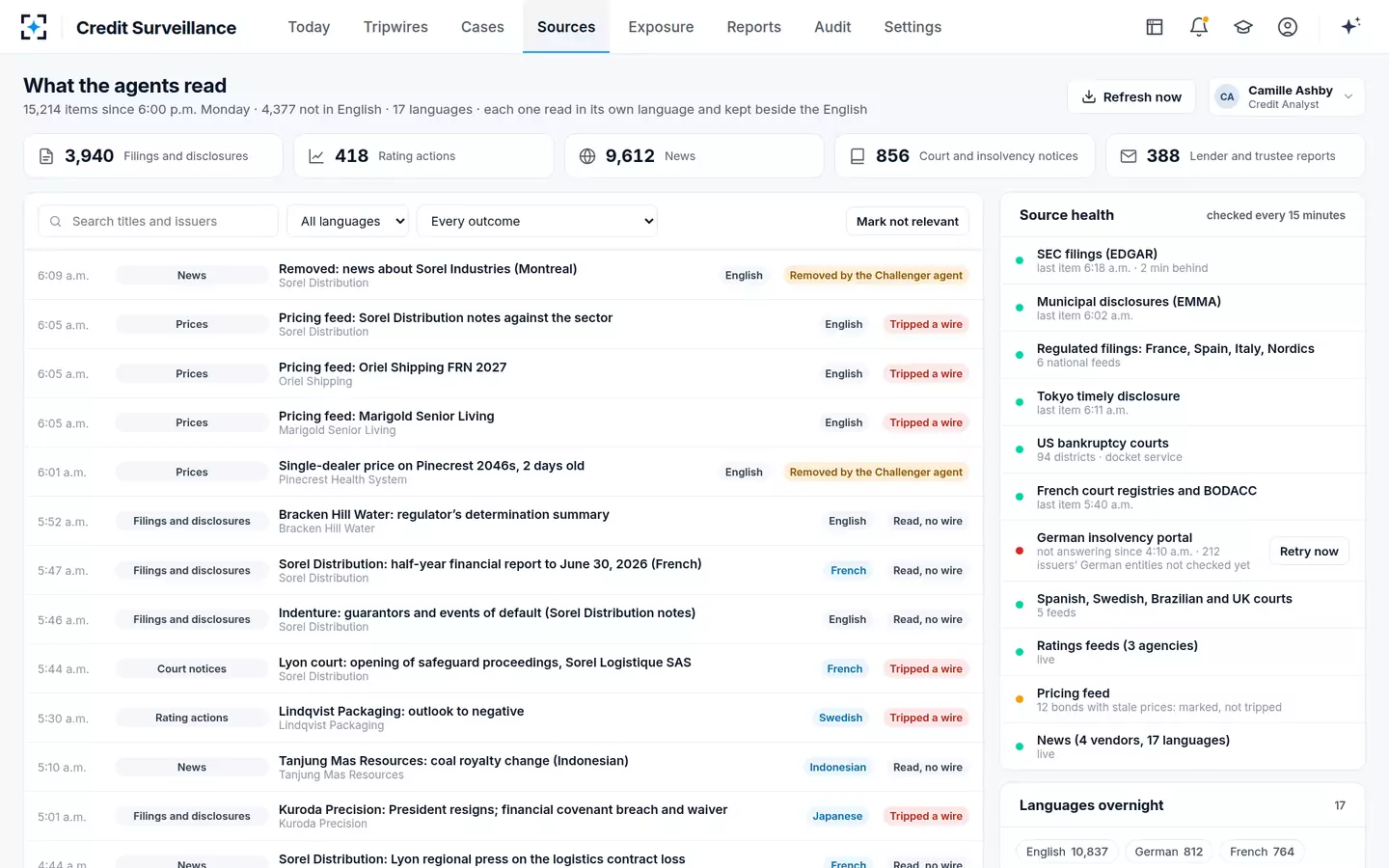
In the sample night, a Japanese issuer shows the pattern. Its filing, read in Japanese at 5:01 a.m., reported that its president had resigned and that it had breached a financial covenant and obtained a waiver. That is two of the conditions in one document. On the tripwire matrix the issuer sits among the open watch cases with both wires lit, and because the agents were only 88% sure of the Japanese reading, the covering analyst's cover was asked to confirm it before anyone relied on it. No auditor had said anything, and none would until the next annual report.
A covenant waiver and a president's resignation, read in Japanese, trip two wires at once
What is an NT 10-Q, and what does a late 10-Q filing tell you?
An NT 10-Q is the notice a company files on Form 12b-25 when it cannot file its quarterly report on time; the NT 10-K is the same for the annual report. Rule 12b-25 requires the notice "no later than one business day after the due date for such report," with the reasons "in reasonable detail" (17 CFR 240.12b-25(a)). If the company says the delay could not be avoided without unreasonable effort or expense, the report is treated as timely if it follows within five calendar days for a 10-Q and fifteen for a 10-K.
For a credit analyst the notice is often the warning that arrives second, and it is worth reading closely, because it says why. A delay caused by a system migration is not a delay caused by an unfinished impairment test or a disagreement with the auditor. The rule itself flags the most telling case: if the delay is because another person, such as the auditor, cannot furnish a required opinion, the notice must attach that person's statement of the reasons (paragraph (c)).
Reading a late-filing notice on a held issuer
- Which report, and how late?
An NT 10-K before the year-end audit is finished is a different signal from a one-off NT 10-Q.
- What reason does it give?
Impairment testing, going concern evaluation, a restatement or an internal investigation are credit reasons; a system change usually is not.
- Is the auditor's statement attached?
Rule 12b-25(c) requires it when the delay is the auditor's inability to give its opinion. Read it first.
- Does it arrive with other warnings?
Check the last ten days: an Item 4.01 auditor change, an Item 5.02 departure, a covenant waiver, an exchange offer.
- What do the indentures say about reporting?
Bond and loan documents set their own reporting deadlines and cure periods, which may be shorter than the SEC's grace.
- Did the report follow inside the grace period?
If not, the company loses the timely-filing treatment, and the absence is now a second warning.
What does a going concern warning mean for bonds?
For bonds it is a confirmation, not a discovery, in most cases, and its practical effects come through documents and counterparties. Read the reporting covenants: some debt documents require audited statements without a going concern qualification, and a qualified opinion can then become a default of its own. Read the funds' guidelines: a downgrade that often follows can force sales in mandates with rating floors. And read management's plans, which the standards require it to disclose; they say what the company thinks will keep it going, and whether those plans depend on the bondholders.
No regulator publishes an average bond-price reaction to going concern warnings, and for this page the reason matters more than the number: by the time the paragraph is printed, the earlier warnings have usually been priced. The useful measure is your own: on the names in your book that received the paragraph, how many days before it did the second warning arrive, and what did the bonds do in between?
Linking the first two signals before the auditor speaks
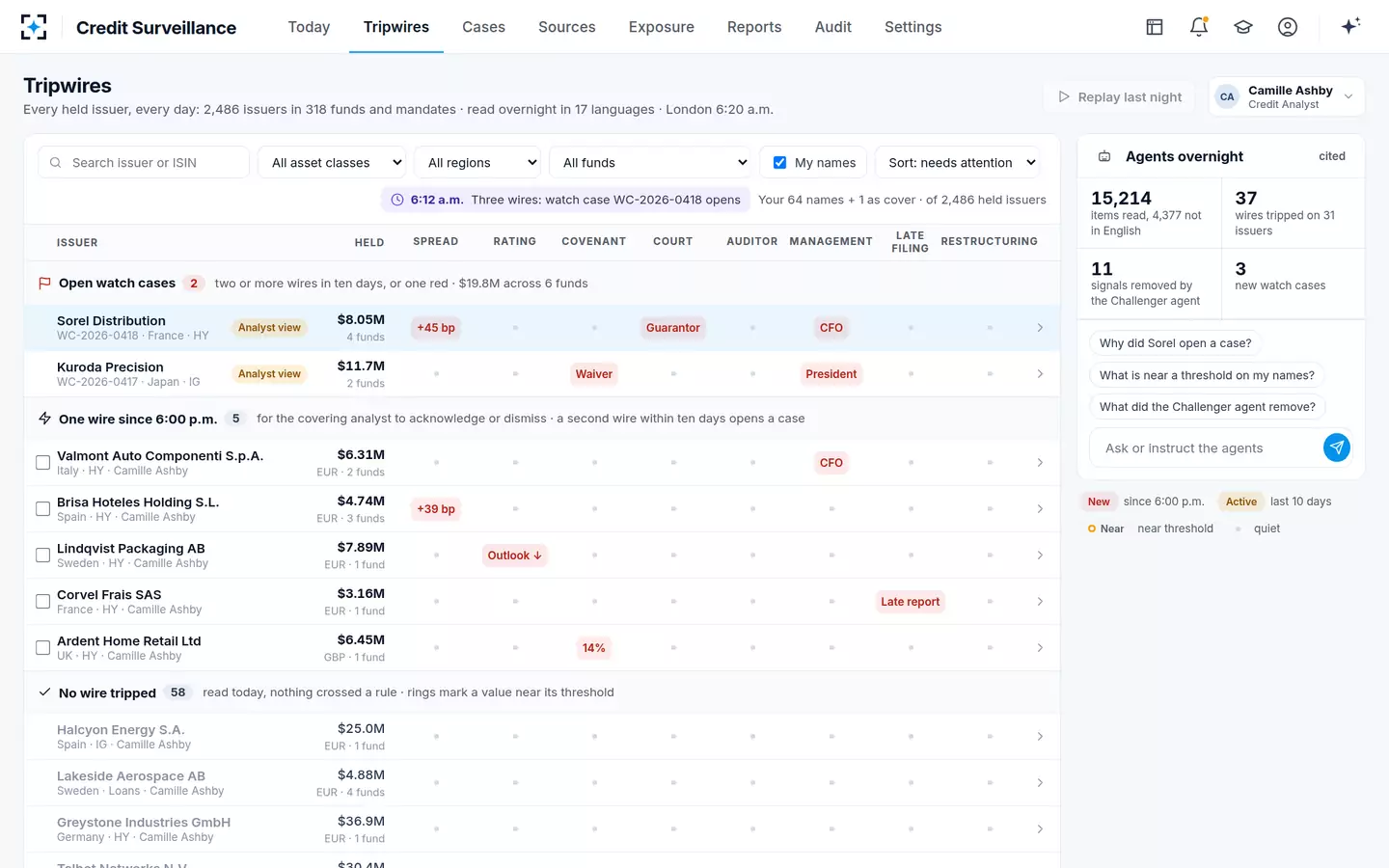
The way to act before a going concern warning is to treat the first two of its underlying conditions as a case. That is what the sample firm's rule does: a watch case opens on two wires within ten days, or one red wire, and the case goes to the covering analyst with the position sized in every fund and a note drafted with every sentence cited. The analyst sets the view; the portfolio manager decides the trade.
Two watch cases on the Credit Surveillance tripwire matrix, each built from two or more early warning signs
Speed matters less here than completeness. A going concern trajectory usually takes months, and the risk is not that a warning is read an hour late but that it is never read at all, because it was a Japanese filing, a court notice about a subsidiary, or a late report that nobody noticed was missing. Who watches every issuer between quarters sets out who owns each case, and what a distressed exchange is covers the restructuring step that often comes next.
Where Credit Surveillance fits, and where the auditor still matters
It fits a credit team that wants the conditions behind a going concern doubt watched on every held issuer, in every language, and combined under a rule it controls. The Filings agent trips the auditor, management, late filing and covenant wires; the Docket agent the court wire; the News agent the restructuring wire, and never on one unconfirmed report alone. The Correlator agent ties them into a case.
It does not audit anything or predict the auditor's opinion, and it does not replace reading management's plans, which is analysis only the analyst should sign. When the paragraph does arrive, it is one more cited wire on a case that, on the evidence above, should already be open. The sample night is on the Credit Surveillance page.
Questions people ask
Can a company recover after a going concern warning?
Yes. The warning expresses substantial doubt, not a forecast of failure, and management's plans, such as refinancing or asset sales, can remove the doubt in a later period. The standards also say that doubt arising in the current period does not imply it existed in the prior one (AS 2415.15).
How far ahead does a going concern assessment look?
Management looks one year from the date the financial statements are issued, under ASU 2014-15. The auditor's evaluation under AS 2415 covers a reasonable period not exceeding one year beyond the date of the financial statements being audited, a slightly shorter window when the statements are issued months after year-end.
Is a going concern warning the same as material uncertainty under IFRS?
They address the same question. FASB's update notes that IFRS covers the preparation of financial statements as a going concern and requires disclosures when there is a material uncertainty about the entity's ability to continue; the periods differ: under IFRS the assessment covers at least one year from the balance sheet date with no upper limit, under US GAAP one year after the statements are issued.
Does a going concern warning trigger a default on bonds?
Only if the documents say so. Some debt agreements require audited statements free of a going concern qualification, so the paragraph becomes a reporting default; many bond indentures do not. Read the reporting covenant and the events of default for each held bond.
Where is the going concern paragraph in a 10-K?
In the auditor's report, immediately after the opinion paragraph, with its own title, using the words substantial doubt and going concern (AS 2415.12). Management's disclosure sits in the notes to the financial statements, usually near the basis of presentation.