A bankruptcy court docket search in the United States starts with PACER, the federal courts' electronic records service: its Case Locator searches a nationwide index of federal cases by party name, and each court's own system holds the docket, the list of everything filed in a case. That finds a case if you know whom to look for. For a bond investor the difficulty is that the debtor is often a subsidiary nobody thought to search, a guarantor named in a schedule at the back of an indenture, and sometimes a company in another country whose case is in a register in another language. Botminds' Credit Surveillance, a credit early warning system for buy-side credit teams, reads court dockets, registries and insolvency portals every day and matches each debtor by its registry number to the held issuer's legal-entity tree and guarantor schedule, so a filing reaches the analyst as a warning on the bonds it touches.
The examples come from the solution's sample data on fictional firms: a London manager, Quillfield Capital, and its French issuer Sorel Distribution. Court statistics and rules are real and linked.
From a court filing to the bonds it touches: the guarantor map in Credit Surveillance
Agent
Read the filingDocket agent reads the court notice, docket or register entry in its own language and keeps the original beside the English.
Never: treat a press report as the court's record
Agent
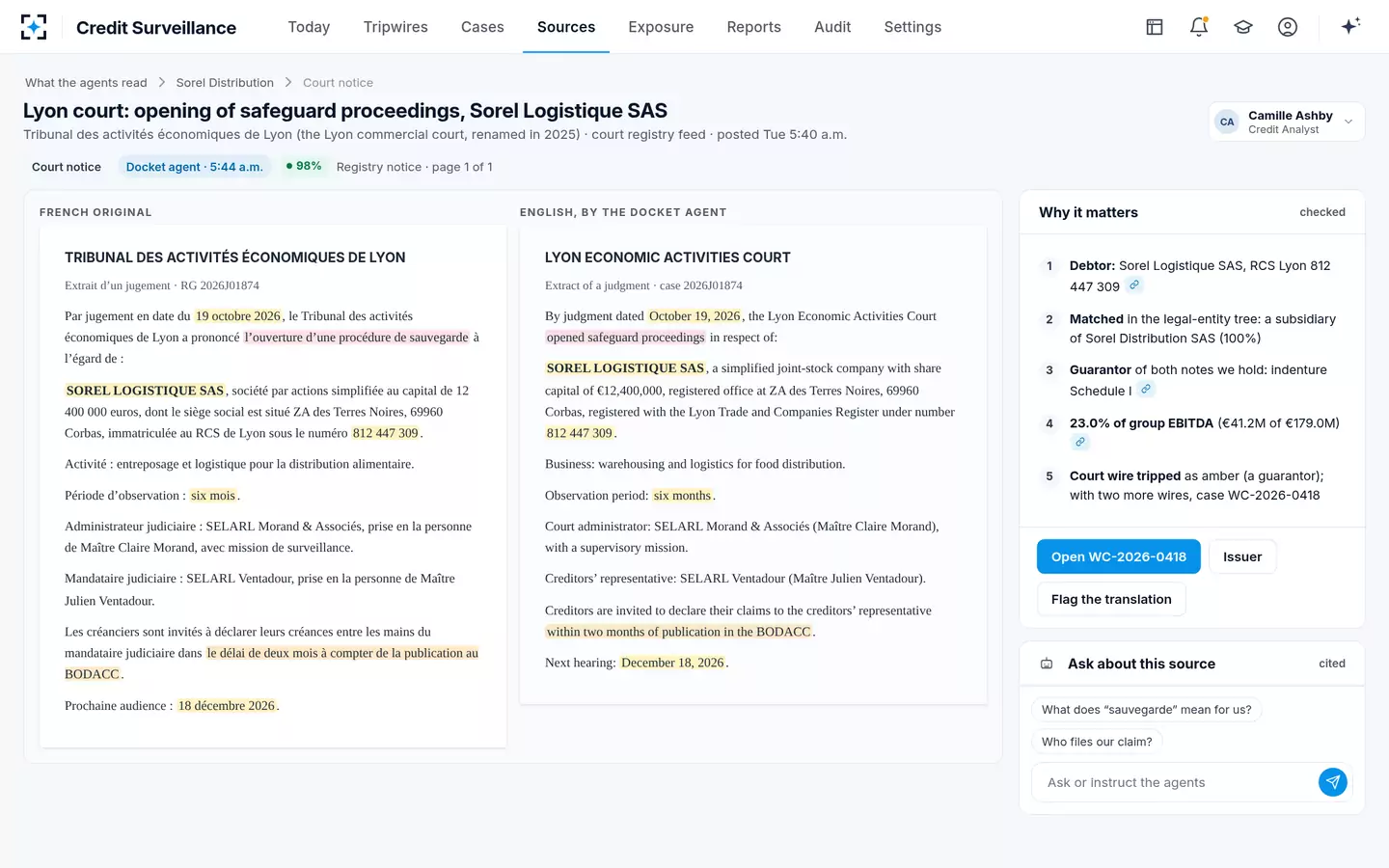
Identify the debtorTakes the debtor's registration number, not just its name: in the sample, RCS Lyon 812 447 309.
Never: match on a name alone; a namesake is removed with a reason
Agent
Place it in the entity treeFinds the debtor in the held issuer's legal-entity tree: here a 100% subsidiary of Sorel Distribution SAS.
Agent
Check the guarantor scheduleReads the indenture's schedule of guarantors: the subsidiary guarantees both notes held, and earns 23.0% of group EBITDA.
Never: decide whether the proceeding is an event of default
Agent
Size and routeSizes the position in every fund, sets the claim deadline, trips the court wire and opens a case with the covering analyst.
A person decides
Analyst and workout specialistThe analyst sets the credit view; the workout specialist and counsel take the legal reading and the claim.
How to search bankruptcy court dockets
Search a federal bankruptcy court's docket through PACER: use the PACER Case Locator when you do not know the court, and the court's own system when you do. The Case Locator searches "a nationwide index of federal court cases," which the courts say is "updated daily" (PACER, Find a case). Each court maintains its own records, so once the case is found, the docket, the claims register and the filed documents are read in that court's system.
Searching costs money, but not much, and the costs fall in odd places. PACER charges $0.10 a page, with a cap of $3 per document, but searches are charged by the pages of results they generate "even if the search displays 'no matches found'," with no maximum (PACER, How fees work). A user who spends $30 or less in a quarter pays nothing. The courts' own advice is to search by case number rather than by a common party name, because a broad name search can generate many pages.
For a credit team the practical problem is not cost but scope. A search is for a name you already have. A book of 2,500 issuers has many thousands of legal entities behind it, most of them never searched, and a search tells you nothing about entities you did not think to search.
How to find out if a company filed for bankruptcy
For a US public company, the first public notice is often its own filing: Form 8-K Item 1.03 requires a report when a receiver or a bankruptcy proceeding covers "a registrant or its parent" (SEC Form 8-K, Item 1.03). For everything else, a subsidiary, a private issuer, a company abroad, the court record comes first, and the place to look depends on where the case was opened.
Where an insolvency case is published, and the claim clock that follows
| Where the case is | Where to look | What the notice gives you | Claim deadline |
|---|---|---|---|
| A US bankruptcy court | PACER Case Locator; the court's docket | Debtor, chapter, case number, filings as they are made | Set by the court in each chapter 11 case |
| Any EU member state | The national insolvency register, searchable through the European e-Justice Portal | Court, case number, type of proceeding, a company debtor's name and registration number, and the time limit for claims | National law; for a foreign creditor at least 30 days after publication in the register |
| France (safeguard and other proceedings) | The court registry and the BODACC | The opening judgment, the observation period, the administrators | Two months from BODACC publication, plus two months for creditors outside metropolitan France |
| Abroad, with recognition sought in the US | A chapter 15 case on PACER | That a foreign representative has asked a US court to recognise the foreign proceeding | Follows the foreign proceeding |
One feature of US practice catches investors out. When a group files, each entity files its own case, and the court may order joint administration: under the bankruptcy rules it may jointly administer two or more cases brought by or against "a debtor and an affiliate" (Federal Rule of Bankruptcy Procedure 1015(b)(1)(D)). The subsidiary's case is real and separate, but most of the action happens on the lead case's docket, which a search by the subsidiary's name may not show.
What is a guarantor subsidiary?
A guarantor subsidiary is a company in the issuer's group that has promised to pay the bonds if the issuer does not, usually listed by name in a schedule to the indenture or in a supplemental indenture when it joins. High yield bonds are often guaranteed by most of the issuer's material operating subsidiaries, so that bondholders have a direct claim on the companies that hold the assets and earn the cash, rather than only on a holding company.
That direct claim is why a guarantor's insolvency matters so much. The guarantee becomes a claim in the guarantor's proceeding, alongside that company's own creditors, and the deadline to file it is set by that proceeding's law, not by the indenture. Many indentures also count the insolvency of a guarantor or a significant subsidiary as an event of default under the bonds themselves. The list of guarantors changes over a bond's life as subsidiaries are added, released or designated, so the schedule a surveillance system matches against must be the current one.
What happens to bonds when a subsidiary files for bankruptcy?
It depends on two documents: whether the subsidiary guarantees the bonds, and what the indenture's events of default say about subsidiaries. If the subsidiary is a guarantor, bondholders have a claim in its case. If it is not, they sit behind that subsidiary's own creditors for whatever value is left to pass up to the parent. And if the indenture names "any Guarantor or any Significant Subsidiary" in its bankruptcy event of default, as the sample's does, the proceeding may itself be a default on the bonds, with acceleration in the hands of the trustee or a set share of holders.
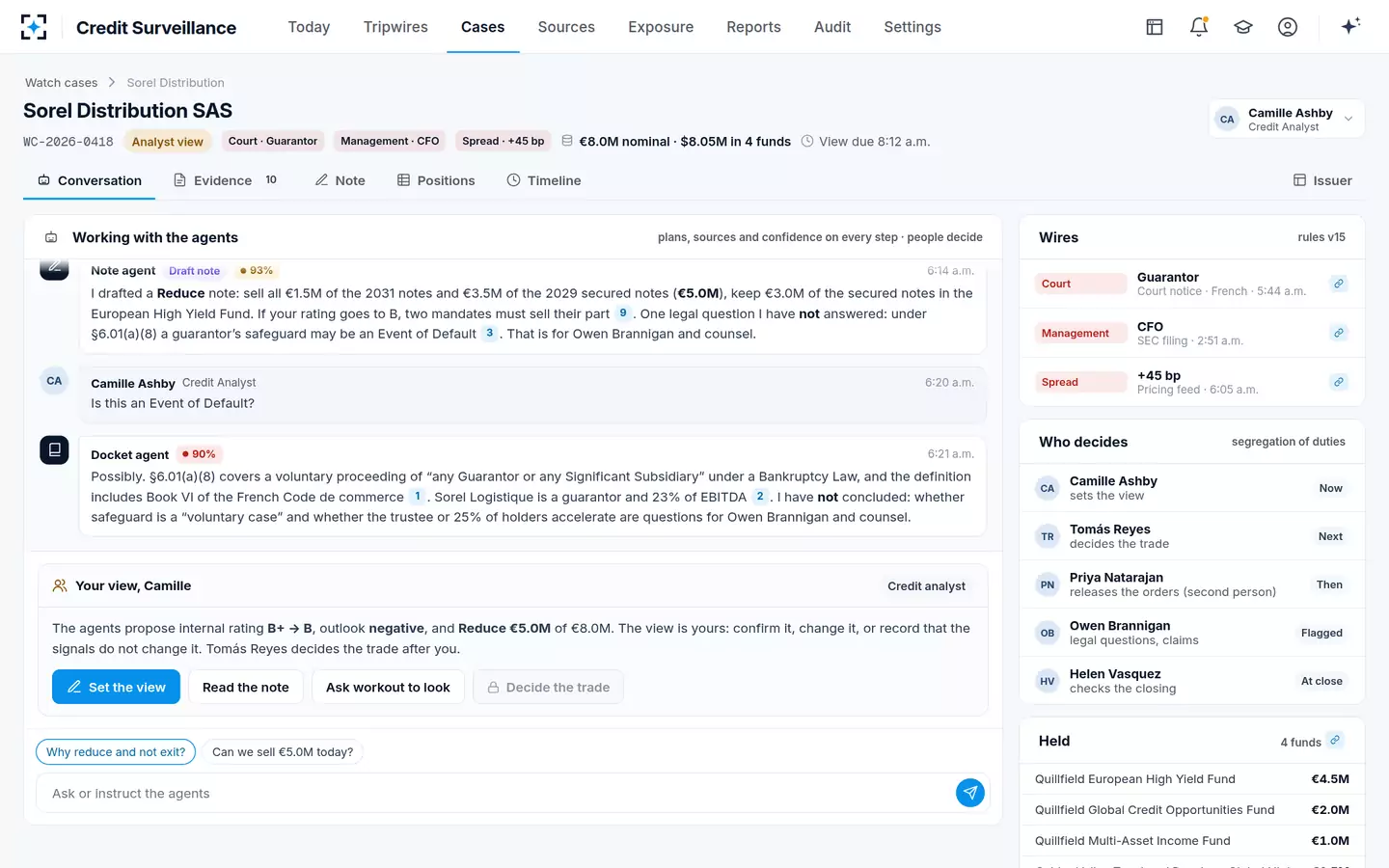
Whether that clause is triggered is a legal question, and it should be treated as one. In the sample, the analyst asked the agents directly whether the French safeguard was an event of default. The Docket agent answered with the clause, the definition and the guarantor's share of EBITDA, and stopped: whether safeguard is a "voluntary case" under that definition, and whether holders accelerate, went to the workout specialist and counsel.
Asking the agents whether a guarantor's safeguard is an event of default
How to track foreign insolvency proceedings
Track them where the law requires them to be published, by registration number, in the original language. Inside the EU, every member state must keep insolvency registers that publish, as soon as possible after a proceeding opens, the court, the case number, the type of proceeding and, for a company, "the debtor's name, registration number, registered office" (Regulation (EU) 2015/848, article 24). Since 26 June 2019 those registers are to be interconnected through the European e-Justice Portal, with a search service in all the EU's official languages (article 25).
The deadlines that follow are local. A foreign creditor's time to lodge a claim cannot be less than 30 days after the opening is published in the register of the state where it was opened (article 55(6)), and many states give more. In France, the time to declare claims is two months from publication of the opening judgment in the BODACC, the official bulletin of civil and commercial notices, and "le délai de déclaration est augmenté de deux mois pour les créanciers qui ne demeurent pas sur ce territoire," that is, two months more for creditors outside metropolitan France (Code de commerce, article R622-24). In the sample, with the bonds' trustee in New York, that window is about four months, and it starts from the BODACC notice, not from the day anyone reads it.
The Lyon court notice in French beside the English, matched to the guarantor
The US side has a door for foreign cases too. A foreign representative can ask a US bankruptcy court to recognise a proceeding opened abroad under chapter 15; in the twelve months to 30 September 2026 there were 259 such cases (US Courts, Table F-2). A chapter 15 filing often comes after the foreign opening, so it is a confirmation rather than an early warning.
How many chapter 11 cases are filed a year?
In the twelve months to 30 September 2026, 9,986 chapter 11 cases were filed in US bankruptcy courts, 9,453 of them classed as business cases, the most for that twelve-month period in at least eight years. Business filings under all chapters reached 27,054. The count is of cases, not companies: a corporate group that files files one case per entity, so a single restructuring can add dozens.
Chapter 11 cases filed in US bankruptcy courts, twelve months to 30 September
The US bankruptcy courts in the year to 30 September 2026
9,986
chapter 11 cases, of which 9,453 business
27,054
business cases under all chapters, up from 24,039 a year earlier
259
chapter 15 cases recognising a proceeding opened abroad
$30
or less a quarter, and PACER fees are waived
How to monitor bankruptcy filings across a credit book
Monitoring is searching every day, for every entity that matters, in every court system where they sit, and acting on what turns up. That is a different job from a search, and it needs three things a search does not: a complete list of the entities behind each held bond, a daily read of every relevant docket and register, and a match that ties each debtor to the right bond and fund.
A docket search and a docket watch built for a credit book
Searching dockets by name: The names someone thought to search, usually issuers and parents.
Credit Surveillance's Docket agent: Every entity in each held issuer's legal-entity tree and guarantor schedule.
Searching dockets by name: Usually US federal courts through PACER.
Credit Surveillance's Docket agent: US bankruptcy courts plus registries and insolvency portals in France, Germany, Spain, Sweden, Brazil and the UK, in the sample.
Searching dockets by name: By name, which catches namesakes and misses renamed or foreign entities.
Credit Surveillance's Docket agent: By registry number, re-run by a second agent; anything under 92% confidence goes to a person.
Searching dockets by name: A case number and a docket to read.
Credit Surveillance's Docket agent: A wire on the right issuer, the claim deadline, the position in every fund and an owner.
Searching dockets by name: Nothing: a failed search looks like no case.
Credit Surveillance's Docket agent: Shown as a source outage, with the entities left unchecked.
The last row is the one most often missed. In the sample night, the German insolvency portal stopped answering at 4:10 a.m.; the solution showed that 212 issuers' German entities had not been checked and retried every 15 minutes, rather than presenting a quiet night. Bankruptcy monitoring that cannot tell "no filing" from "could not look" will eventually report the wrong one.
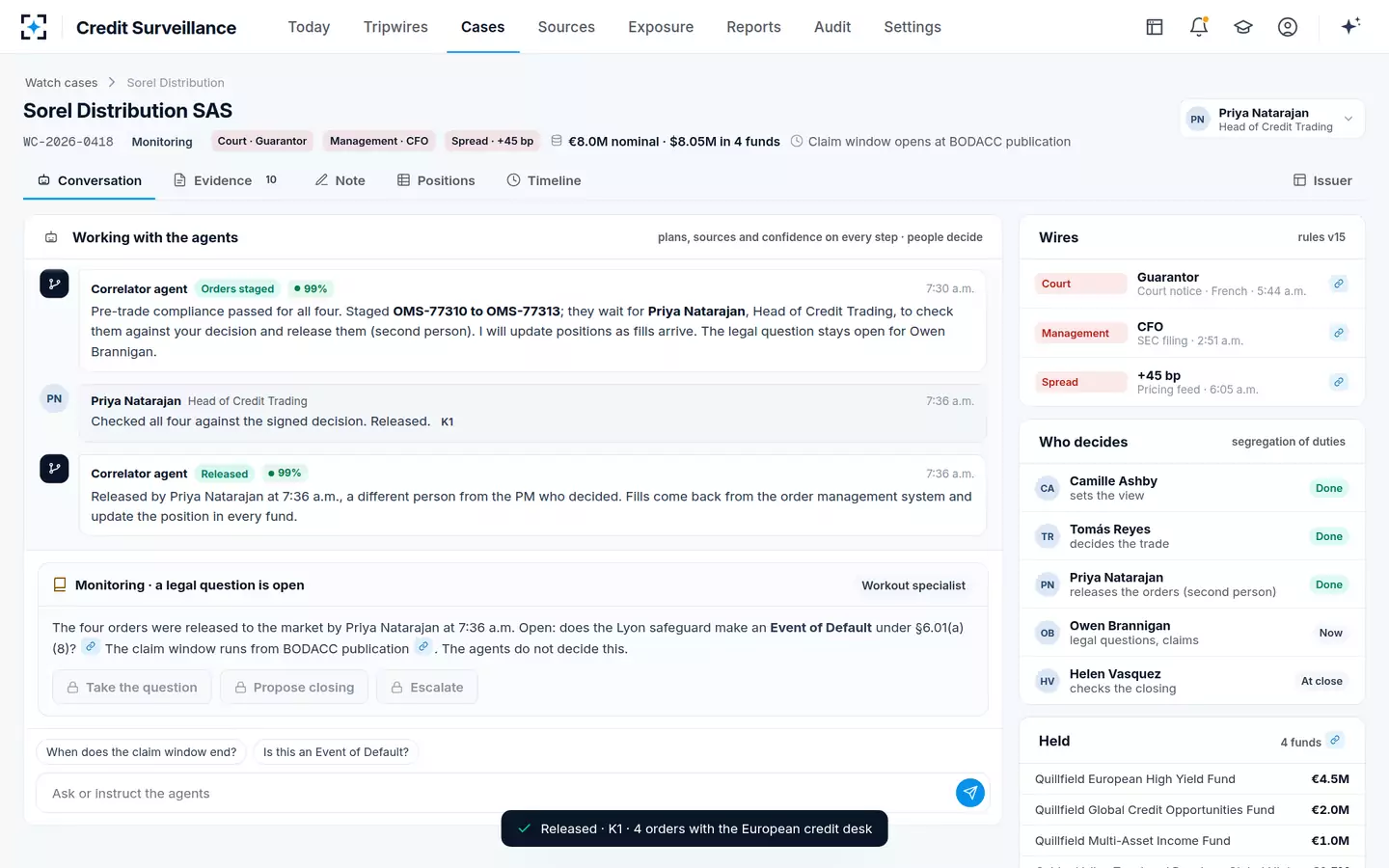
After the trade: the claim window tracked, and the legal question still open
Where Credit Surveillance fits for docket monitoring, and where it does not
It fits a credit book with many issuers whose guarantors sit in several countries, where a case can open in a register no one on the team reads. The Docket agent's job is the matching most docket services leave to the analyst: registry number to entity tree to guarantor schedule to held bonds to funds, with the claim deadline attached. A seeded test with a planted foreign insolvency is the fastest way to see whether any tool, this one included, does that on your own book.
It does not file claims, appear in court or decide whether a proceeding is a default; those stay with workout, counsel and the indenture trustee. It does not replace a law firm's docket service for a live restructuring the fund is party to. And it only matches what it knows about: a guarantor that joined by a supplemental indenture last month must be in the schedule it reads. For how a court warning combines with others into a watch case, see who watches every issuer on the credit watch list, and the full sample night is on the Credit Surveillance page.
Questions people ask
Is PACER free?
Not entirely. PACER charges $0.10 a page, capped at $3 per document, but fees are waived for anyone who spends $30 or less in a quarter. Search results are charged by page with no cap, so broad name searches cost more than searches by case number.
Can you search every bankruptcy court at once?
For US federal courts, yes: the PACER Case Locator searches a nationwide index of federal cases, updated daily. There is no single search across all foreign courts, but the EU's national insolvency registers are meant to be searchable together through the European e-Justice Portal.
What is chapter 15 bankruptcy?
It is the part of the US Bankruptcy Code that lets a foreign representative ask a US court to recognise an insolvency proceeding opened abroad. There were 259 chapter 15 cases in the twelve months to 30 September 2026, against 85 in the same period to 2022.
Who files a claim for bondholders?
Usually the indenture trustee, on behalf of all holders, with counsel; individual funds may also file. The deadline is set by the law of the proceeding: in a French safeguard, two months from BODACC publication, plus two months for creditors outside metropolitan France.
What is a claims bar date?
It is the deadline by which creditors must file proofs of claim in a bankruptcy case. In a US chapter 11 case the court sets it for each case; in EU proceedings the national law sets it, with at least 30 days after publication in the insolvency register for a foreign creditor.