A credit early warning system is the set of sources, rules and people that turns a held issuer's first signs of trouble into a decision while there is still time to make one. On a bond portfolio it reads filings, court dockets, rating actions, prices and news for every issuer held, matches each item to the right legal entity and the bonds that entity issues or guarantees, ties weak signals together, and puts one case in front of the analyst who covers the name. Botminds' Credit Surveillance is a credit early warning system for buy-side credit teams in which eight agents do the reading, matching, checking, correlating and drafting, and the analyst, portfolio manager and head of credit risk keep every decision. For a buyer, the useful question is not whether a system raises alerts, since every terminal does, but which of those tasks it takes off the team and which it leaves behind.
The examples on this page are from the solution's sample data on a fictional London manager, Quillfield Capital, with 2,486 held issuers across 318 funds and mandates. People, funds and issuers named here are invented; the research and rules are real and linked.
What a credit early warning system reads in one night: mostly news, a little of everything else
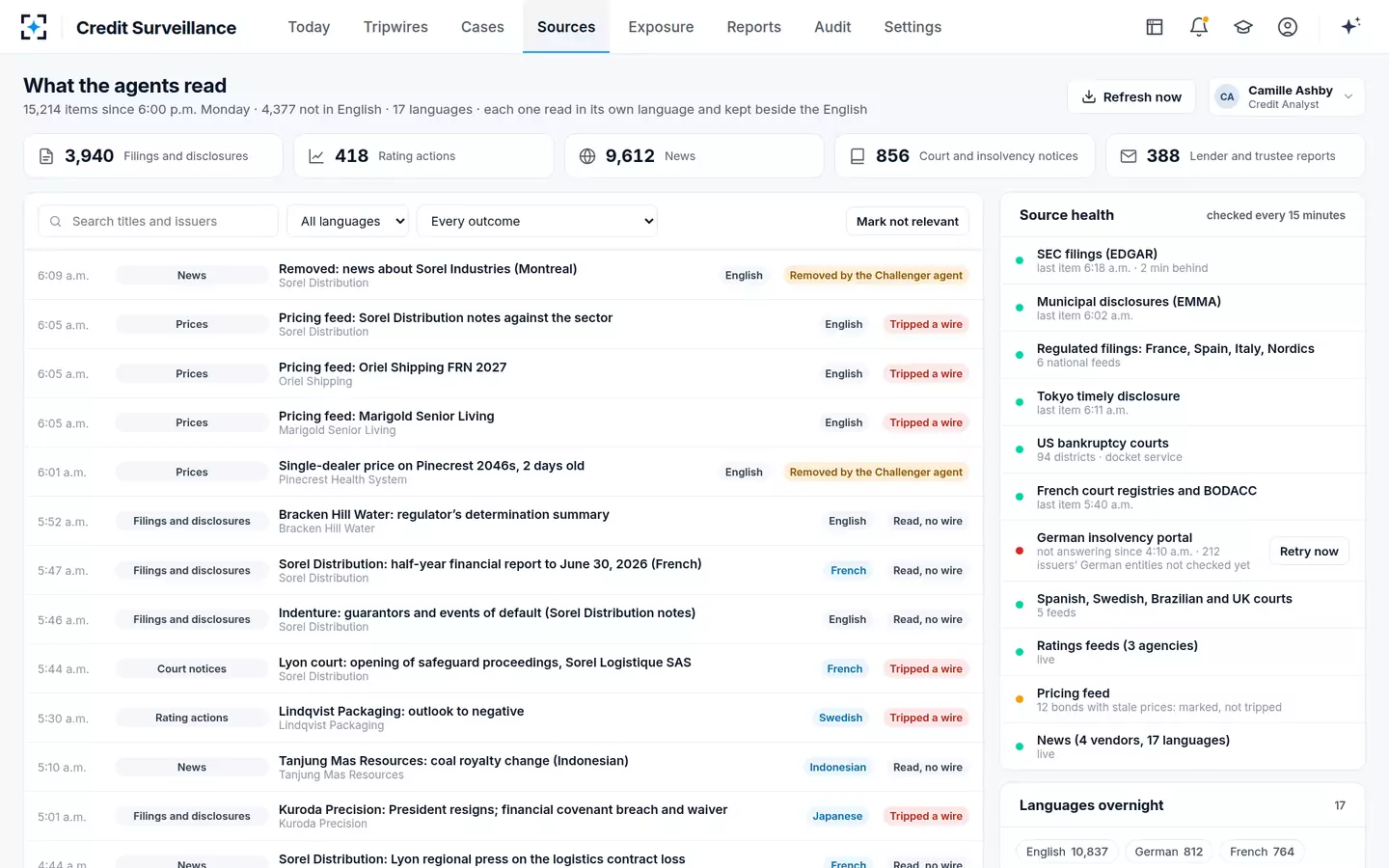
15,214 items read overnight on 2,486 held issuers
- News 9,612 · 63%
- Filings and disclosures 3,940 · 26%
- Court and insolvency notices 856 · 6%
- Rating actions 418 · 3%
- Lender and trustee reports 388 · 2%
What is a credit early warning system?
It is a system that watches every held issuer continuously, against written rules, and routes what it finds to a named person with a deadline. Each part of that sentence excludes something that is often sold under the same name. Watching every issuer excludes a screen that covers the names someone remembered to add. Written rules exclude a model nobody can explain to the committee. A named person and a deadline exclude an alert feed that everyone receives and no one owns.
For bonds the hard parts are not the alerts. They are knowing that a court notice about a French logistics subsidiary concerns the guarantor of two notes the firm holds, that a news story about "Sorel Industries" in Montreal does not, and that a finance chief's resignation, a court case and a spread move on the same issuer within three and a quarter hours are one problem, not three. Those are matching and correlation tasks, and they are where the hours go.
How does an early warning system work for bonds?
It works as a chain: specialist readers turn raw sources into checked signals, a correlator turns signals into cases, and people turn cases into decisions. In Credit Surveillance the chain has eight agents and five people, and each agent has a written limit it cannot cross.
Credit Surveillance as a chain: eight agents read and prepare, people decide
Agent
Filings agentReads SEC filings, municipal disclosures and regulated filings abroad in their own language; trips the management, auditor, late filing and covenant wires.
Never: read a rumour as a filing; under 92% confidence a person confirms
Agent
Docket agentReads court dockets, registries and insolvency portals; matches each debtor by registry number to the issuer's entity tree and guarantor schedule; sets the legal deadlines.
Never: declare a default; legal readings go to workout
Agent
Ratings, Market and News agentsCompare rating actions with the internal rating; watch spreads against the sector; read news in each language and keep reports apart from confirmed facts.
Never: trade, change a rating, or trip a wire on one unconfirmed report or a stale price
Agent
Challenger agentOpens every cited page, re-runs every entity match with a second method, back-translates key terms; removes what does not hold up, with a reason.
Never: open or close a case; every removal is shown to the analyst
Agent
Correlator and Note agentsTie signals into one watch case, size it in every fund, assign the covering analyst, start the clocks; draft a hold-or-reduce note with every sentence cited.
Never: set a view, decide a trade or stage an order
A person decides
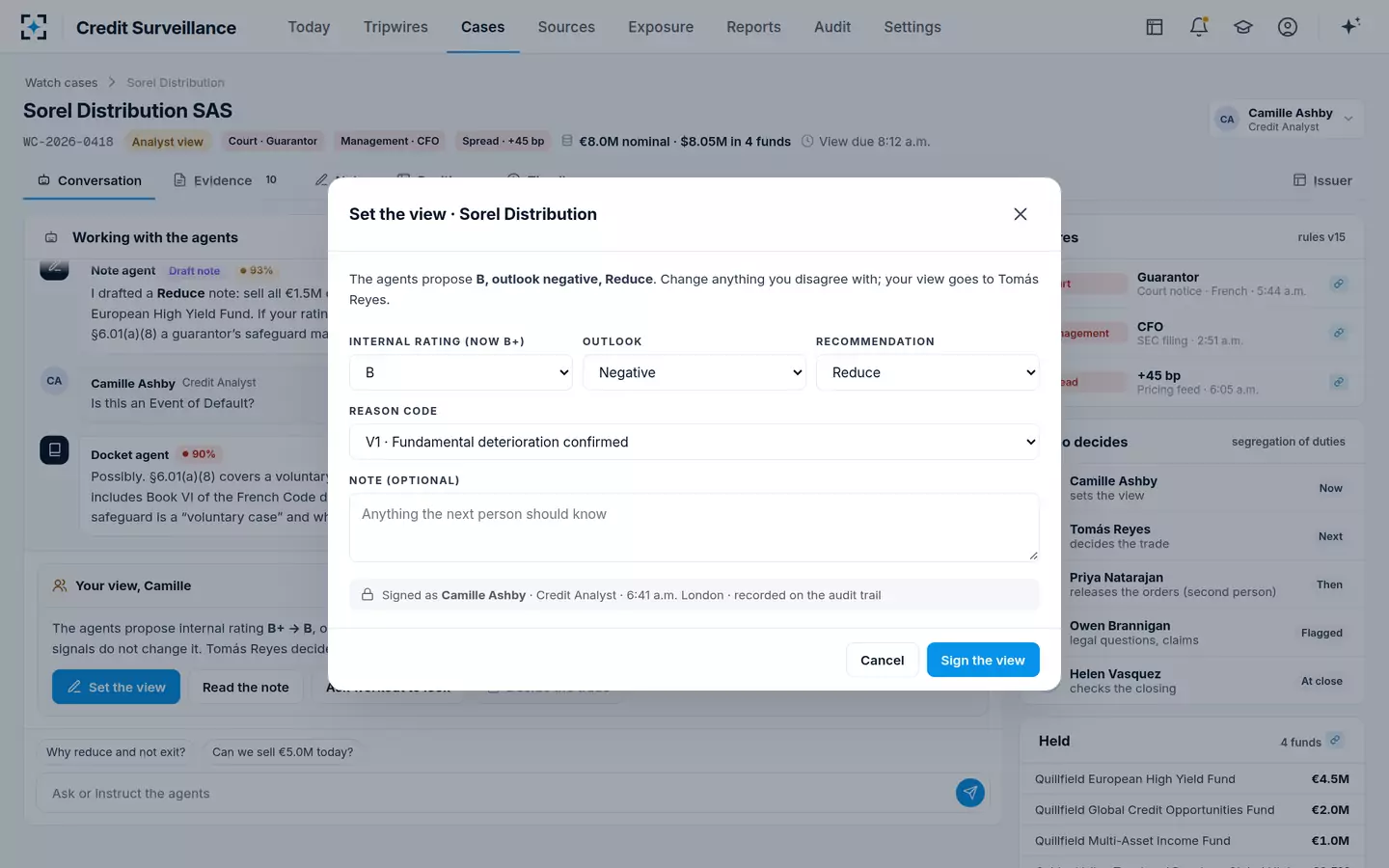
Credit analystSets the credit view and internal rating, signed with a reason code.
A person decides
Portfolio manager, then a second person on the deskThe manager decides the trade for every fund; a different person releases the orders.
A person decides
Head of credit risk and workoutCredit risk approves rule changes and closings; workout and counsel take every legal question.
The order matters. The checking step sits before anything reaches a person, so the analyst's first view of a warning is one that has already been re-read by a second agent. The correlation step sits before the analyst too, so she sees one case with three causes rather than three alerts on three screens.
Which surveillance tasks agents take on, and which stay with people
Agents can take on the tasks that are reading, matching, arithmetic and drafting; people keep the tasks that are judgment, accountability and law. The split below is the design choice at the centre of any credit early warning system, and the place to press a vendor for specifics.
Each credit surveillance task, who does it today, and who does it with agents
| Task | Usually done today by | With Credit Surveillance | Stays with a person |
|---|---|---|---|
| Read filings, dockets, ratings, prices and news on every held issuer | Analysts between other work; terminal alerts; whoever reads the language | Filings, Docket, Ratings, Market and News agents, every night, in 17 languages | Confirming any reading under 92% confidence |
| Match an item to the right entity and the bonds it touches | The analyst, from memory and the indenture | Docket and Filings agents by registry number and guarantor schedule; Challenger re-runs with a second method | Any match the agents are unsure of |
| Remove namesakes, repeats and stale prices | Nobody, or everybody, one alert at a time | Challenger agent, with a reason code on each removal | Reviewing the removals list |
| Tie weak signals into one case | The analyst, if the signals reach the same person | Correlator agent under the case rule | Changing the case rule (head of credit risk) |
| Size the position in every fund against its guidelines | Analyst or PM, from portfolio accounting and the guideline file | Correlator agent from start-of-day positions | The trade decision |
| Draft the hold-or-reduce note | The analyst | Note agent, every sentence cited, estimates marked | Accepting, changing or rejecting it; signing the view |
| Decide whether a court case is a default | Workout and counsel | Not delegated: the agents show the clause and the deadline | Always |
What signals predict credit deterioration?
No single signal does it reliably, which is why an early warning system needs several sources and a rule that combines them. The best-known academic failure models already mix two kinds of input: Campbell, Hilscher and Szilagyi estimated failure probability "from a dynamic logit model using accounting and market variables" (Journal of Finance, 2008). Accounting variables arrive quarterly; market variables move daily. Neither is enough alone.
Markets used to be a dependable early signal of rating downgrades, and they are less so now. The Office of Financial Research found that "single-name CDS incorporate less information prior to rating decreases following post-crisis reforms," and that CDS spreads lead corporate bond spreads more weakly than before (OFR Working Paper 24-04, July 2024). A system that waits for the market to move first is waiting for a signal that has grown quieter.
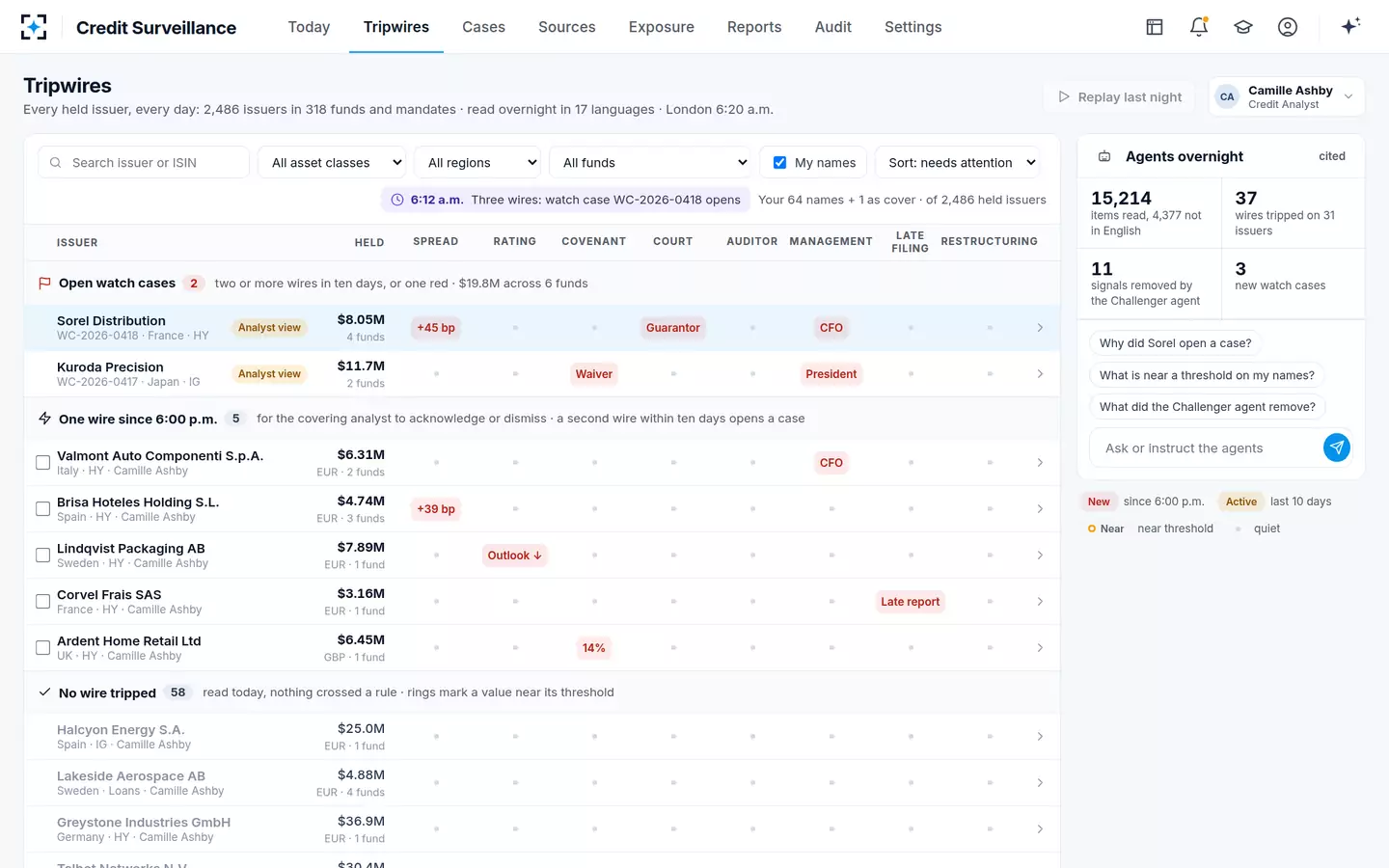
The rest of the warning signs are events, and most are public. Form 8-K lists the ones a US registrant must report, among them Item 1.03 on bankruptcy or receivership, Item 2.04 on triggering events that accelerate or increase a direct financial obligation, Item 4.01 on a change of auditor and Item 5.02 on departures of principal officers (SEC Form 8-K). Court dockets abroad, covenant waivers, exchange offers and late filings complete the set. The sample's eight tripwires are spread, rating, covenant, court, auditor, management, late filing and restructuring, and which 8-K filing triggers matter to a bondholder works through the US filings one item at a time.
The tripwire matrix: every held issuer a row, eight early warning signals as columns
What data sources does a credit early warning system use?
It uses the firm's own data and the public record, and it has to know when either has gone quiet. The firm's side is start-of-day positions by fund from portfolio accounting, the coverage list and rota, internal ratings, indentures with their guarantor schedules, and each fund's guidelines. The public side is regulators' filing systems (EDGAR, the municipal EMMA system, national storage mechanisms abroad, Tokyo's timely disclosure), court dockets and insolvency registers, rating actions, evaluated prices and dealer quotes, and licensed news.
Source health is part of the data. In the sample night, the German insolvency portal stopped answering at 4:10 a.m., leaving 212 issuers' German entities unchecked, and 12 bonds carried prices too stale to trip a wire. Both are shown on the sources screen rather than hidden, because a feed that has stopped is not the same as an issuer with nothing to report.
What the agents read, by type and language, with the health of each source
How do you reduce false alerts in credit monitoring?
Reduce them before a person sees them, by checking every signal against its source, and by refusing to let weak evidence trip a wire on its own. Most false alerts in credit monitoring are of three kinds: the wrong entity (a namesake, a different subsidiary), the same story counted twice, and a price that is no longer a price. All three can be caught mechanically.
Eleven signals removed before anyone saw them, by reason
The rules do the rest. In the sample a single unconfirmed news report never trips a wire alone, a stale price never trips the spread wire, and the high yield spread rule asks for a move against the sector, not just a move: 35 basis points in two days and 25 more than the sector. A name that widens with its whole market is a market story, not a credit story. And one wire alone asks the analyst to acknowledge or dismiss; only two wires in ten days, or one red wire, open a case.
Who acts on an early warning signal?
The analyst who covers the issuer acts first, and the system's job is to make sure that person is found, told and given a deadline. Coverage lists go stale and analysts go on leave, so the routing needs a rota. In the sample, a Japanese disclosure on a name covered by an analyst on leave until Thursday went to his named cover, and it went as a reading to confirm, because the agents were 88% sure and the threshold is 92%.
The escalation is written down too. Three or more wires on one issuer tell the portfolio manager and the head of credit risk at once. The analyst's view is due within two hours of a case opening and the portfolio manager's decision within four hours of the view; a missed clock goes to the head of credit research, then the chief investment officer for fixed income. Legal questions, such as whether a guarantor's court protection is an event of default, go to the workout specialist and counsel with the clause and the deadline attached.
Can AI monitor credit risk?
AI agents can do most of the monitoring, meaning the reading, matching, checking and drafting, but they should not own the credit risk. FINRA's 2026 oversight report reminds firms that the known risks of generative AI, "bias, hallucinations, privacy—also remain present and applicable for GenAI agents and their outputs" (FINRA, 2026 Annual Regulatory Oversight Report). The answer is not to keep agents away from the work but to design it so each agent's output is checked by another before use and every decision stays with a named person.
Supervisors are watching the same shift. The SEC's examination priorities for fiscal 2027, published on 23 October 2026, describe registrants using what the Division calls "super intelligence (SI)" tools for research, portfolio management and surveillance work, and say examiners will look at whether firms still meet their existing obligations as they do (SEC Division of Examinations, FY2027 priorities). A credit early warning system that can show who decided what, from which cited source, under which rule version, is easier to defend in that conversation than one that cannot.
The analyst sets the view; the agents only propose it
What to ask before you buy a credit early warning system
Ask questions that a demonstration on the vendor's own data cannot answer. The answers that matter are about your holdings, your entities, your languages and your rules.
Eight questions for any credit early warning system
- Does it read every held issuer, or a watch list you maintain?
A system fed by the names you remembered to add will miss the one you forgot.
- How does it match a court filing to the bonds you hold?
Ask for registry-number matching against your guarantor schedules, and what happens below its confidence threshold.
- Which languages and court systems does it read in the original?
Ask to see the original beside the translation, with figures highlighted.
- What removes false alerts, and can you see what was removed?
A removal you cannot inspect is a miss you cannot find.
- Are the rules yours, versioned and replayable?
A threshold change should be tested on recent history and approved by someone other than the person proposing it.
- Does it size the position in every fund against that fund's guidelines?
An alert without the exposure sends the analyst back to portfolio accounting.
- What can its agents never do?
Setting a view, changing a rating, deciding a trade, sending an order and declaring a default should be on the list.
- Will it run on your own last quarter before you sign?
Plant known warnings in a past period and count the catches; the method is set out in a separate guide.
The last question is the one that separates tools fastest, and planting ten known warnings in a past period turns it into a scored test.
What should a credit early warning system cost?
Vendors of credit surveillance software do not publish prices, so the useful comparison is with what the work costs your team now. A practical method is to count watch cases a year, estimate the analyst hours each takes from first signal to signed view, and price those hours. Our estimate for one high yield case is about 13 hours by hand, most of it spotting, reading and matching, against about 2.4 hours with the agents doing that part. Ask any vendor to price your issuer count, languages and court systems, and ask what is excluded: foreign registries and private-side lender reports are where scope usually shrinks.
Where Credit Surveillance fits as an early warning system, and where it does not
It fits buy-side credit teams with more issuers than their analysts can read daily: high yield, leveraged loans, emerging markets, municipals and structured credit, each with its own tripwire settings, and books spread across several funds and jurisdictions. It is strongest where warnings arrive in other languages and through subsidiaries, because that is where matching takes the most time.
It is not a rating model and does not produce a default probability. It does not replace a bank's loan monitoring, which runs on borrower statements and covenant certificates; early warning systems for banks are a different purchase. And it does not take legal decisions. The full sample night, from the first wire to orders released, is on the Credit Surveillance page.
Questions people ask
What is the difference between a credit early warning system and a credit risk dashboard?
A dashboard shows what is already known, usually exposures and ratings. An early warning system goes looking for what is not yet known, reads the sources, decides against rules whether something is a warning and routes it to a person with a deadline. In the sample, one night's reading produced 37 wires on 31 issuers and three new watch cases.
Does a credit early warning system replace rating agency alerts?
No, it includes them. Rating actions are one of eight tripwires in the sample, and the Ratings agent compares each one with the firm's internal rating. The OFR's 2024 finding that market prices now lead downgrades more weakly is a reason to watch filings and courts directly rather than wait for either the agency or the market.
How many alerts a day should an analyst expect?
Few enough to act on each. In the sample night, an analyst covering 64 issuers had one case needing her view, one foreign-language reading to confirm and five single wires to acknowledge or dismiss. If a system produces dozens per analyst, the case rule or the checking step is not doing its job.
Can an early warning system read filings in other languages?
It should, because the warning about a European or Asian issuer often appears first in a local court notice or regulated filing. In the sample, 4,377 of 15,214 items were not in English. Each was kept in the original beside the English, and key terms were back-translated by a second agent before use.
What happens when the system is not sure?
It should say so and hand the item to a person. In the sample, any reading or entity match under 92% confidence goes to a person before use; a Japanese disclosure read at 88% went to the covering analyst's cover to confirm.