An early warning system for banks is the machinery that notices a borrower is getting worse between the formal reviews, and puts that fact in front of somebody who can act on it. The agencies describe the objective in one line: an effective credit risk review system finds loans with actual or potential weaknesses promptly, so that something can be done in time to strengthen them and limit the loss (Interagency Guidance on Credit Risk Review Systems). The hard part is the second half of that sentence. An alert that lands in an inbox is noise; a signal that rewrites the line it touches on the loan's own page, cites the document it came from and names the person who must act is supervision. Botminds' Problem Loan Management is built the second way, and this guide is about how to tell the two apart before you have paid for one.
What follows is written for the credit risk officer pricing a system and the officer who will have to show an examiner that it works. The worked examples come from a fictional sample bank, Calder Plains Bank, running the solution; the requirements come from the US banking agencies, linked where they appear.
One borrower, four weeks, and what an early warning system has to keep up with
10changes
logged on one name between two committees: eight adverse, one hidden inside a modification, one good
4of 5
lines of the loan’s one-page story rewritten since the committee last read it
08:14
the plant appraisal arrived; the same morning the page carried term loan coverage of 0.82x, down from 1.10x
What an early warning system for banks has to do
Three jobs, in order. Notice something has changed. Work out what it means for this loan. Put it in front of the person who can act, with enough evidence that they can act today rather than start an investigation.
The three are not equally hard. Noticing is easy: thresholds on a data feed are a week's work. Interpretation is where the money is, because a 90% drawn revolver means one thing at a seasonal business in October and another at a distributor in March, and a 15% fall in a collateral value means nothing until somebody has recomputed coverage on the loan the collateral actually secures. And delivery is where almost every system quietly fails, because an alert that does not change the document a credit officer reads is a message the credit officer will learn to close.
The Federal Reserve's examination manual sets out the same expectation as a property of the whole lending function, listing among the marks of sound portfolio management "an independent loan-review function that identifies and evaluates existing and potential problem loans in a timely manner". Note "potential" and "timely". A system that only reports loans that have already gone past due is not an early warning system; it is a past-due report with a better name.
What should an early warning system monitor between committee meetings?
Everything the file already contains, which is much more than a feed from the loan system carries. The FDIC's examination manual organises its own list of trouble indicators by document, which is the most useful way to think about scope, because it maps directly onto what a bank already receives.
The note and its payment history show delinquency, irregular payments, "unusual or frequently modified terms", and renewal after renewal that barely reduces the principal. Financial and operating statements show declining working capital, "excessive volume or negative trend in receivables", a "drastic increase in volume of payables", "repeated and increasing renewals of carry-over operating debt" and net worth enhancements "resulting solely from reappraisal in the value of fixed assets". Cash-flow documentation shows projections that cannot meet interest and principal, or cash flow "being provided by the sale of fixed assets or nonrecurring situations". The correspondence and credit files show missing documentation and "letters indicating that a borrower has suffered financial difficulties". And the collateral file shows value acquired after the credit was extended, or security with "inferior marketability characteristics".
That list is old in substance and still describes where the evidence sits. What has changed is that reading it no longer has to wait for a human to open each document.
A signal table: what fires, from where, at what line, and who it reaches
SignalCoverage below the policy line
FromSpread statements, recomputed on the original schedule
The lineFixed-charge coverage under 1.00x
ReachesThe relationship manager and the portfolio manager, same day
SignalLine drawn hard
FromThe loan system, daily
The lineRevolver above 90% drawn
ReachesThe relationship manager, with the borrowing base availability beside it
SignalOverdrafts
FromThe deposit system, daily
The lineTwo in 30 days
ReachesThe relationship manager; the committee if it recurs
SignalStatements late
FromThe document file, by expected date
The line30 days past due
ReachesThe relationship manager, with the chase letter drafted
SignalCollateral value down
FromA new appraisal, evaluation or field exam
The lineAny fall of 15% or more
ReachesThe portfolio manager, with coverage recomputed the same morning
SignalA modification found
FromAmendments, side letters and the note history
The lineAny deferral, interest-only period, rate concession or PIK feature in 24 months
ReachesLoan review, with both schedules shown
SignalA plan item falling due
FromThe committee’s own action log
The lineDue within 5 days
ReachesThe owner of the action, by name
The signals that earn their place, and the ones that only make noise
A signal earns its place if it meets three tests. It must be observable from something the bank already receives, so that it does not depend on the borrower volunteering bad news. It must change what somebody does, not merely what somebody knows. And it must be rare enough that the people who receive it still read it a year later.
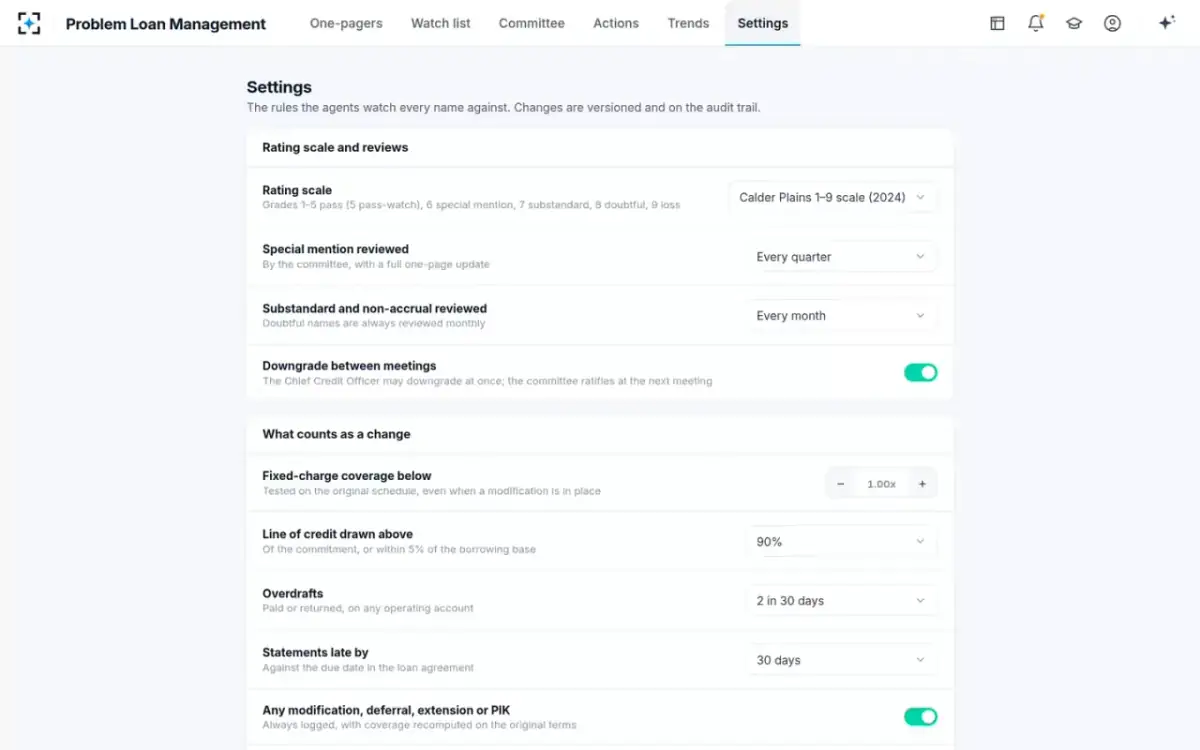
That third test disqualifies more candidate signals than the first two together. A trigger that fires on a fifth of the portfolio every month is not a warning; it is a weather report. The sample bank's settings are deliberately few — coverage below 1.00x on the original schedule, a line drawn above 90%, two overdrafts in 30 days, statements 30 days late, a collateral value down 15% — and each is tuned so that it fires on names a credit officer would want to be interrupted for.
The signals that earn their place share a shape: they come from a document with a date on it. The ones that make noise usually come from a model's opinion about a score. Both have their uses, but only one can be shown to an examiner as a reason.
One borrower against the bank's own signals: what each found, and where it came from
| Signal and line | What it found on the packaging borrower | Where the evidence came from |
|---|---|---|
| Fixed-charge coverage below 1.00x, original schedule | 0.94x on the schedule the borrower signed, against a 1.20x covenant; 1.61x on the interest-only schedule | The quarter’s statements, spread and recomputed |
| Line of credit drawn above 90% | 96% drawn, $210,000 available | The loan system, daily |
| Collateral value down 15% or more | Down 25%: $9.5M in March 2022 to $7.08M, effective 5 October | A 64-page appraisal, read the morning it arrived |
| A modification in the last 24 months | June interest-only amendment, $110,000 a month of principal deferred to December | The amendment in the credit file |
| A plan item falling due | Sponsor equity of $1.5M overdue; $750,000 offered for 15 November | The committee’s action log and the sponsor’s letter |
Thresholds are policy, not product: the triggers as settings
The single most important question to ask a vendor is who owns the numbers. If the thresholds live in the product, a bank has outsourced a piece of its credit policy to a company that does not answer for the portfolio. If they live in the bank's own settings, versioned and auditable, the system is doing what it should: applying the bank's judgement consistently and quickly.
This is not a philosophical point. Examiners test adherence to internal policy, and a threshold a bank cannot change, cannot see the history of, and cannot explain is a weak answer to a plain question. The uniform rating system judges asset quality partly on "The adequacy of loan and investment policies, procedures, and practices" — and a policy the bank does not control is not adequate in the sense meant there.
In the sample bank, every line in the signal table above is a setting, alongside the rating scale, the review frequencies, the transfer thresholds and the time the committee pack must be ready. Each change is versioned and on the audit trail, so the question "what was the trigger in March, and who changed it?" has an answer.
The credit policy as settings, not as code
What an early warning system may never decide
Four decisions belong to people, and a system that takes any of them has stopped being an early warning system and become an unaccountable credit committee. It may not set or change a risk grade. It may not move a loan to non-accrual. It may not alter an approved workout plan. And it may not contact a borrower.
Those lines are not cautious vendor boilerplate; they are what makes the output usable. A proposal that a committee votes on becomes the bank's position through a recorded decision with reasons. A grade a system assigned silently is a position nobody voted on, that nobody can explain, and that an examiner will treat as evidence about the bank's governance rather than about the borrower.
Ask the question in that form during a demonstration: show me the thing you will not do, and show me where the record says a person decided instead. A vendor who cannot answer quickly has not thought about the examination.
A document arrives at 08:14. What happens before anyone is interrupted
Agent
The document is read in placeA 64-page appraisal arrives. It is matched to the first mortgage that secures the term loan — last valued in March 2022 — and the new as-is value is taken with its effective date.
Never: files it for someone to read later.
Agent
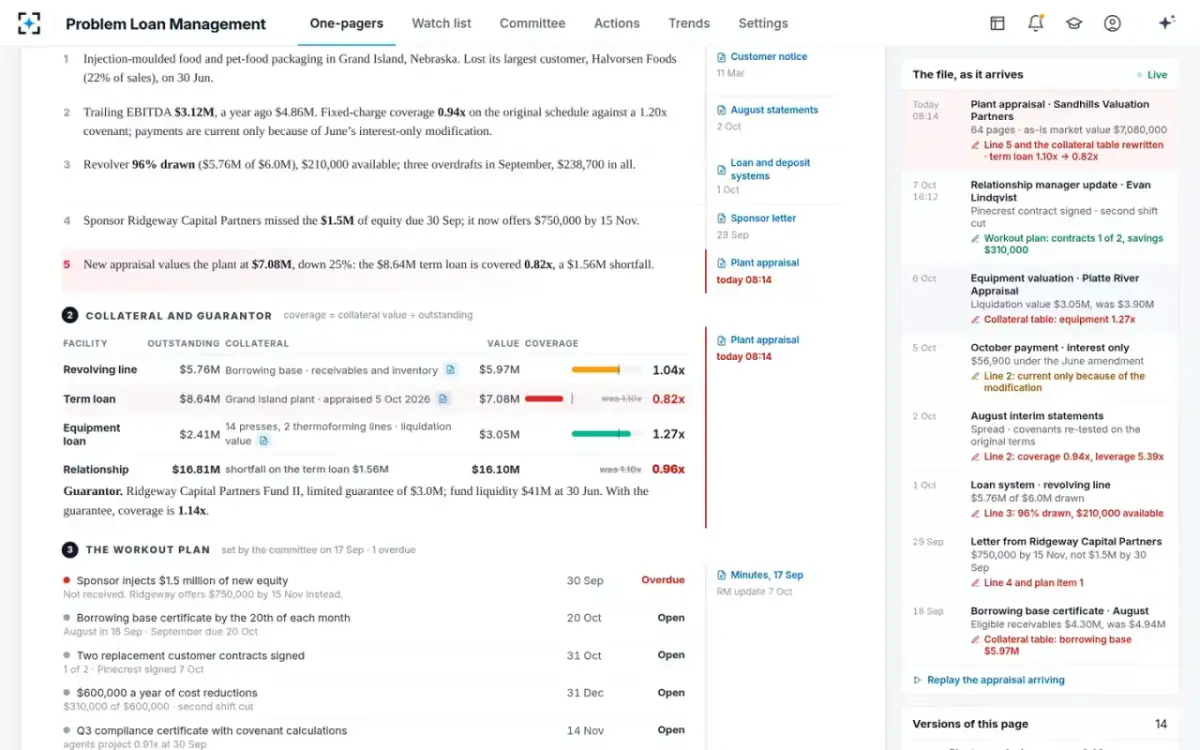
Coverage is recomputedTerm loan coverage moves from 1.10x to 0.82x; the whole relationship from 1.10x to 0.96x, or 1.14x with the guarantee. The collateral table is rewritten beneath it.
Never: changes a grade on the strength of the recalculation.
Agent
The page rewrites the line it changesLine 5 turns red, the margin note names the appraisal and the time it arrived, and the version history records what the document changed. Nobody rebuilt a slide.
Never: edits a line without naming the document behind it.
Agent
A proposal is draftedThe facts are re-tested against the bank’s scale and a downgrade is proposed, with each reason cited, the allowance effect, and the special assets rule that would apply.
Never: sets the grade. The committee votes it.
A person decides
The portfolio manager reads itWithin the same morning, with the appraisal one click away and the previous valuation beside the new one.
A person decides
The committee decidesAt the next meeting, or sooner on a member’s request, with the reasons on the record and the actions set.
How do you test an early warning system before you trust it?
Not with a demonstration. A demonstration proves a system can show you a signal it was designed to show. What you need to know is whether it would have caught the loans that actually went wrong at your bank, and whether it will interrupt your officers so often that they stop looking.
Run three tests, all of them on your own file. The first is the back test: take ten names that deteriorated over the past three years, feed the system the documents as they arrived and in the order they arrived, and ask when each signal fires. The answer you want is not "it fired" but "it fired on the document that should have caused it, and before the quarter when the grade actually moved". The second is the noise test: run the whole portfolio for one month and count what arrives per officer per week. If it is more than a handful, the thresholds are wrong or the signals are.
The third is the evidence test, and it is the one examiners care about. Pick a signal at random and ask the system to show the document behind it, the date it arrived, the calculation it drove and the person it reached. If any of those four cannot be produced, the signal cannot be used as a reason for a grade, and everything downstream of it is decoration.
One more measure is worth taking before and after: the interval between a document arriving in the bank and the grade that reflects it. That number is the real output of an early warning system, and it is the one that shows up in an examination as timeliness. The OCC's handbook on rating credit risk sets a bar for rating accuracy that makes the point concrete — significant inaccuracy is generally more than 5 percent of the credits reviewed or 3 percent of the dollar amount, and the errors that worry examiners most are the ones that understate risk (Comptroller's Handbook, Rating Credit Risk).
Build, buy, or make the loan system do it: the roads and what each costs
Five ways to get early warning, and what each one really costs
What you get: Past dues, overdrafts, line use and maturity dates, already in one place, at no new licence cost.
What it costs, and where it breaks: Sees only what the loan system holds. Blind to statements, certificates, appraisals, amendments and anything a human had to read. Fires late, because the data it holds is downstream of the trouble.
What you get: Complete control, no procurement, and the analyst understands every line.
What it costs, and where it breaks: Depends entirely on one person’s diligence; has no audit trail; cannot be shown to an examiner as a system. Fails silently when that person is on leave.
What you get: Exactly your policy, your data and your definitions, owned outright.
What it costs, and where it breaks: The connectors and the document reading are the expensive part, and the maintenance never ends. Reasonable where a bank already has the engineering and the documents are already structured.
What you get: Signals and dashboards configured quickly, often with benchmarking.
What it costs, and where it breaks: Ask where the thresholds live, and whether the output is an alert or a change to the credit file. A product that cannot write back to the loan’s own page adds a second place to look.
What you get: Documents read as they arrive, the loan’s own page rewritten line by line with the source in the margin, and a proposal for the committee with every reason cited.
What it costs, and where it breaks: Requires access to the credit file itself, not only the loan system, and requires the bank to decide its own thresholds. The division of labour has to be explicit: the agents propose, people decide.
The honest version of this choice is that many banks already have the first option and are not well served by it, because the signals that matter arrive as documents rather than as fields. Whatever road you take, the test is the same: does the thing a credit officer reads change when the file changes?
Eight questions to ask before you sign
Eight questions, and the answer that should worry you
- Where do the thresholds live?
Worrying answer: "they are built into our model." You want settings you own, versioned, with a history of who changed what.
- What happens to the loan’s own page when a signal fires?
Worrying answer: "the officer gets an alert." You want the line on the page rewritten, with the document named in the margin.
- Can you show me the document behind any number?
Worrying answer: a data dictionary. You want one click from the figure to the page of the statement, certificate or appraisal it came from.
- What will the system never decide?
Worrying answer: hesitation. You want a short, specific list — no grade, no non-accrual, no change to a plan, no contact with a borrower — and the record of the person who decided instead.
- How does it treat a modified loan?
Worrying answer: "it shows current status." You want coverage recomputed on the original schedule, and a loan that is current only because of a modification to say so.
- What does a month of alerts look like on our portfolio?
Worrying answer: an average. You want the real count per officer per week from a pilot on your own names.
- What happens when the data is missing or late?
Worrying answer: silence. A statement that never arrived should be as loud as a bad one that did; absence is a signal.
- What are the limits of your own diligence on us?
The agencies expect a bank to "identify and document any limitations of its due diligence, understand the risks from such limitations, and consider alternatives as to how to mitigate the risks". Make the vendor help you write that paragraph.
One question belongs to the bank rather than the vendor, and it is the hardest: what will you stop doing once this works? An early warning system that is added on top of the monthly chase, the quarterly spreadsheet and the rebuilt committee deck has not saved anybody anything. The saving comes from retiring the manual assembly, which only happens if the system's output is trusted enough to be the page people read.
Alerts against a page that rewrites itself
The difference is easiest to see on one morning. An alert-based system sends a message saying a new appraisal has been received on a borrower. A file-based system matches the appraisal to the mortgage, recomputes the coverage on the loan it secures, rewrites the line and the collateral table on that loan's page, notes the time the document arrived in the margin, keeps the previous version so the committee can see exactly what moved, and drafts a grade proposal with the reasons cited. The first tells an officer to go and do something. The second has done it, and left the judgement where it belongs.
The page after the document: line 5 and the collateral table rewritten
The supervisory risk of getting this wrong is stated plainly in the Federal Reserve's manual, and it is not a risk to the borrower. "If examiners observe significant and undue reliance on favorable assumptions about borrowers or the economy and about financial markets more generally—or observe that this reliance has slowed the institution's recognition of loan problems—they should carefully consider downgrading, under the applicable supervisory rating framework, an institution's risk-management, management, or asset-quality ratings (or all three)." Slow recognition is a supervisory finding about the bank. An early warning system is, in the end, a way of making recognition fast enough that nobody has to argue about whether it was.
The FDIC's manual sets the expected breadth of the review such a system feeds: "Reviews typically cover all loans that are considered significant. In addition to loans over a predetermined size, management will normally review smaller loans that present elevated risk characteristics such as credits that are delinquent, on nonaccrual status, loan modifications to borrowers experiencing financial difficulty, previously classified, or designated as Special Mention." Two of those five categories — modifications to borrowers in financial difficulty and loans designated special mention — are loans that can be current on every payment, which a status-based alert cannot see. That is the clearest argument there is for a system that reads documents rather than fields.
To see the triggers, the pages and the proposals together, start from Problem Loan Management, or read how the same evidence reaches the table in the criticized assets committee.
Questions people ask
What are early warning indicators for banks?
Observable changes in a borrower's behaviour, finances or collateral that tend to precede a default: coverage falling below the covenant on the original schedule, a revolver drawn hard against a shrinking borrowing base, repeated overdrafts, statements and certificates arriving late, a collateral value falling, repeated renewals with little principal reduction, and cash flow supported by asset sales or one-off items. The FDIC's examination manual groups its own list by the document each indicator appears in, which is a useful way to check your coverage.
Can AI spot credit deterioration early?
It can read the documents that carry the evidence far faster than a person can, match a new appraisal to the loan it secures, recompute coverage on the original schedule and flag a modification nobody logged — and that speed is where the gain is. What it should not do is decide: the grade, the accrual status, the workout plan and any contact with the borrower belong to people, and a system that proposes with every reason cited is both more useful and more defensible than one that concludes.
What are the limits of an early warning system?
It can only see what it receives, so a borrower that stops sending statements is a blind spot unless absence itself is a signal. It cannot see private facts — a lost contract, a founder's illness, a lender quietly refusing a renewal — until they reach a document. And it does not act: a system that fires perfectly into an organisation that does not follow up changes nothing, which is why the action log matters as much as the triggers.
Who should receive an early warning alert?
The person who can do something about it today, by name, and no one else as a matter of routine. In practice that is usually the relationship manager, with the portfolio manager copied for anything that affects the grade and loan review for anything touching a modification. Broadcasting every signal to a committee distribution list is the fastest way to make sure nobody reads any of them.
How do you build a credit early warning system?
Start from the file rather than the feed: list what the bank already receives on each borrower, and where in that material trouble first becomes visible. Write the thresholds into credit policy, versioned, before choosing any software. Decide what the system may never decide. Then back-test it on names that actually deteriorated, and measure the interval between a document arriving and the grade that reflects it — that interval is the system's real output.
How many signals should a bank act on each month?
Few enough that each one is still read. There is no published figure, but the test is practical: if an officer receives more warnings in a week than they can investigate properly, the thresholds are set for coverage rather than for action. Measure the count per officer per week during a pilot on your own portfolio, and tune the thresholds down until the number is one a person can honestly work through.