A criticized asset report is the periodic report in which a bank tells its senior management and its board how much of the loan book sits below pass, how severe it is, where it is concentrated, how it compares with capital, and what is being done about each name. It is the visible output of the asset-quality duties the safety and soundness standards impose, and it is one of the first documents an examiner asks for. The reason it is hard is not that anyone disputes what belongs in it: it is that the facts behind forty names live in four systems, a document store and a dozen email threads, and the person who assembles them by hand finishes a week after the oldest of them was true. Botminds' Problem Loan Management removes that gap by keeping each name's page current as documents arrive, and then building the committee package from those pages rather than from memory.
The regulatory expectations below are quoted from the federal banking agencies. The figures from the report itself come from the solution's fictional sample bank, Calder Plains Bank, and its 41-name watch list.
What is a criticized asset report, and what must it carry?
There is no form to file and no prescribed template, which is why practice varies so widely. What exists is a duty with six parts, written into the Interagency Guidelines Establishing Standards for Safety and Soundness. A bank should review asset quality periodically to find its problem assets; estimate the losses inside them and hold reserves enough to absorb those losses; set the problem totals against capital; act to resolve each problem asset; weigh the size and risk of any material concentration; and "provide periodic asset reports with adequate information for management and the board of directors to assess the level of asset risk" (12 CFR 364, appendix A, II.G).
Read the six together and the report writes its own specification. It has to name the assets, price the loss in them, set them against capital, say what is being done, show where they cluster, and arrive often enough and clearly enough that a non-executive director can form a view. A report that lists names without losses, or losses without actions, or actions without evidence that they happened, has answered part of the duty and left the rest to the meeting.
Note also what the standard does not say. It does not say "a presentation", and it does not say "quarterly". It says adequate information, periodically, for a board to assess risk. That is a test of sufficiency the bank sets for itself, and the examiner reads the answer.
The rule behind it: periodic asset reports for management and the board
The interagency guidance on credit risk review systems puts the same duty in operational terms, and adds the half that is easiest to drop. An effective system includes "a method for communicating direct, periodic, and timely information to the institution's senior management and the board of directors or appropriate board committee on the status of loans identified as warranting special attention or adverse classification, and the actions taken by management to strengthen the credit quality of those loans" (Interagency Guidance on Credit Risk Review Systems, SR 20-13).
Three words in that sentence carry weight. Direct means the information reaches the board without being filtered through the people whose lending it describes. Timely means in time to act. And the clause at the end — the actions taken by management — makes the report accountable for its own history: last month's plan is this month's evidence, and a report that quietly drops an action nobody completed has lost the thread the guidance is asking about.
The same guidance sets a floor on frequency that surprises boards used to a quarterly cycle: "An effective credit risk review system provides for informing the board of directors or appropriate board committee more frequently than quarterly when material adverse trends are noted." A deteriorating book obliges a bank to report more often, not to wait for the next scheduled meeting.
What goes in a criticized asset report, line by line
Start from what the supervisors themselves look at. Among the factors behind an asset quality rating, the uniform rating system names four dimensions — level, distribution, severity and trend — applied to six populations: problem, classified, nonaccrual, restructured, delinquent and nonperforming assets, on and off the balance sheet (FFIEC, Uniform Financial Institutions Rating System, 61 FR 67021). A report that shows one total has shown a level and nothing else.
Level is the dollars and the counts. Distribution is where they sit — by grade, by segment, by relationship manager, by region, and by the concentrations that make ten problems one problem. Severity is how far down the ladder they are, which is why a weighted ratio tells a different story from a headcount. Trend is the direction over four quarters or twelve months, and it is the dimension a single-month report structurally cannot show.
Beneath the portfolio view sits the name view, and that is where a committee actually spends its ninety minutes. One page per discussion name, with the smaller names that have not moved on a consent list so the meeting does not spend its attention evenly on things that do not deserve it.
The anatomy of one page in the committee package
1The header
Borrower, relationship manager, total exposure and commitment, the current grade and the grade proposed, accrual status, and the date of the last committee decision on this name.
2The story, in five lines
What has happened to this credit, each line carrying the document it came from: the earnings trend, the coverage, the liquidity, the collateral, the behaviour of the account.
3Collateral and support
Each position at its current value with the date of that value, the resulting coverage, and the guarantees with a view on whether the guarantor can perform.
4What has changed since the committee last read it
Marked against the version the members saw, so the meeting spends its time on what is new rather than on what it already decided.
5The workout plan
Last month’s actions with their status checked against the file, the relationship manager’s own update, and the new actions proposed with owners and dates.
6The decision owed
The recommendation and every reason behind it, the allowance effect, and the vote the committee is being asked to take. One name, one decision.
The ratio on the front page: criticized and classified against capital
The comparison the regulation actually names is problem assets against capital, and it belongs on the first page rather than in an appendix. The usual denominator is Tier 1 capital plus the allowance — the resources that would absorb the loss — and the usual numerators are two: classified assets, and criticized assets, which add special mention to the classified total. Reporting both is the honest choice, because the gap between them is the share of the problem the bank has flagged but not yet adversely classified. How the classified ratio is built term by term, and why the allowance sits in its denominator, is set out in the guide to the classified assets to capital ratio.
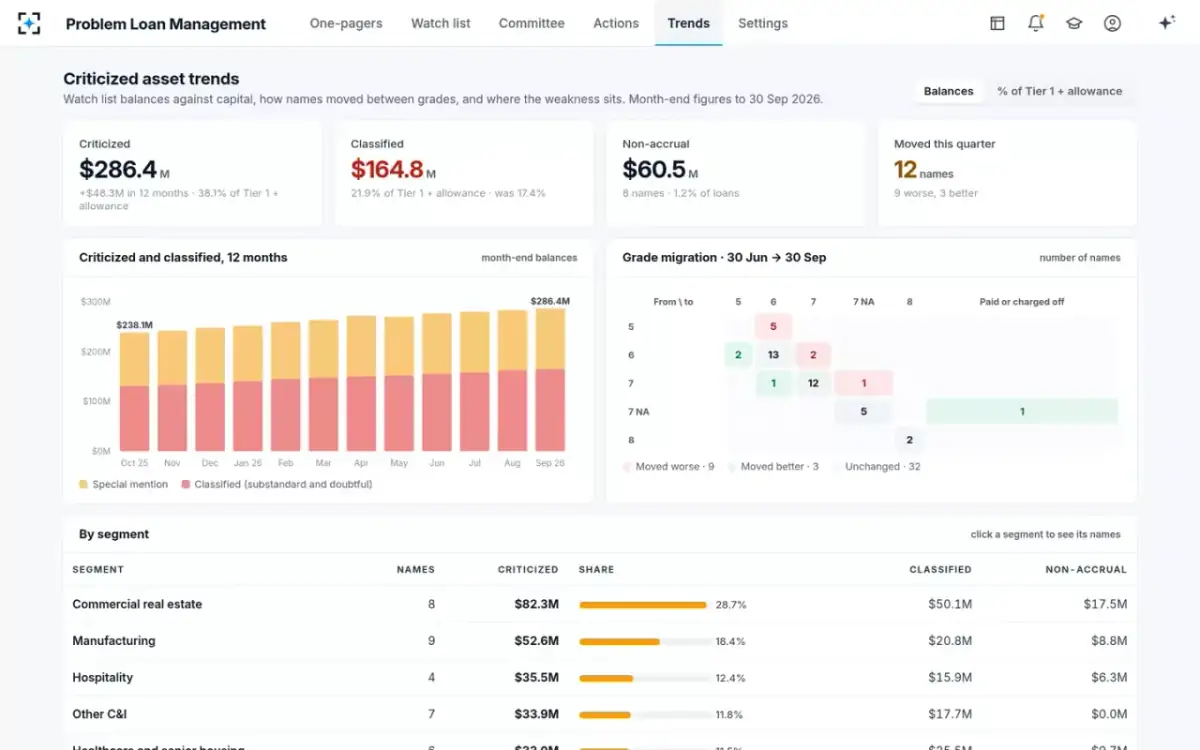
On the sample bank's figures, if all of Thursday's proposals pass, classified assets rise to $181.6 million, which is 24.2% of Tier 1 capital plus allowance, and non-accrual loans to $71.9 million. The allowance rises by about $1.7 million, $353,000 of it on one borrower. Those are the solution's sample numbers for one fictional bank and are not a benchmark for anything; what is transferable is the habit of stating the ratio with its denominator named, and of showing what a pending vote would do to it before the vote rather than after.
What one committee's votes would move on the sample bank's book
One more line belongs beside the ratios: the grade migration for the quarter. Upgrades, downgrades, new entries and exits, counted and in dollars. A flat classified balance made of twelve names leaving and twelve arriving is a different bank from a flat balance that has not moved at all, and only migration separates them. The measures a watch list board should ask for, and the ones that mislead, are set out in the guide to the credit risk dashboard.
How often is the criticized asset report produced?
Monthly for the credit committee is a common cadence at commercial banks, with a quarterly cut to the board or its risk committee, and more often when things are moving — which, as the interagency guidance says, is not optional when material adverse trends are noted. The deeper answer is that different rungs of the ladder deserve different clocks.
The sample bank's settings are a workable pattern: special mention names are reviewed by the committee every quarter, substandard and non-accrual names every month, and the package is ready two business days before the meeting. That last setting is the one that quietly determines quality. A package circulated the night before is read on the morning of the meeting; one that arrives two days early can be read, questioned and corrected while there is still time to correct it.
Frequency only helps if the content can keep up with it. A monthly cycle that takes four days to produce consumes about a fifth of the working month of the person who is supposed to be managing the loans, and it is why banks that would benefit most from a shorter cycle are the least able to run one.
Where the days go when the report is built by hand
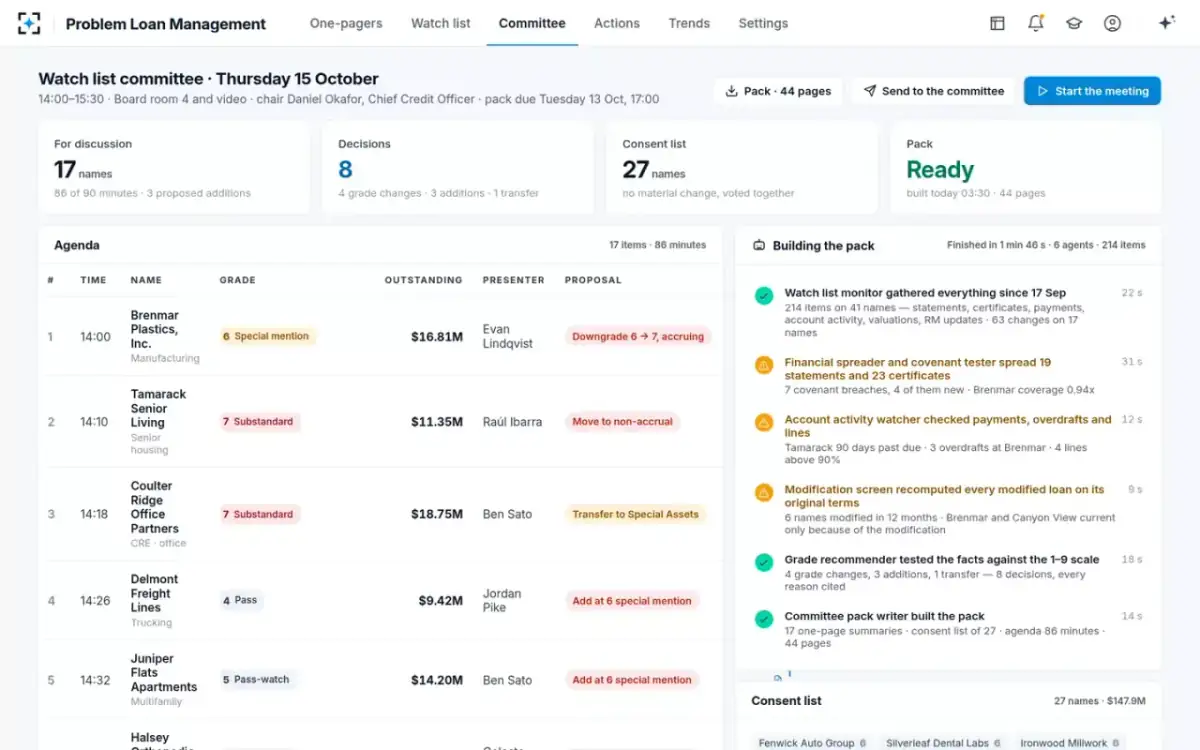
The sample bank's portfolio manager counted her own month, and the shape of it will be familiar. About four days go into each monthly package for a 41-name watch list: roughly one day chasing relationship managers for updates, one day re-keying spreads and covenant results into slides, a day and a quarter rewriting each name's story, half a day checking last month's action plan against the file, and a quarter of a day on the agenda, the consent list and assembling the document.
The same report on two clocks: about four days by hand, against one morning
- Chasing relationship managers for updates1 d
- Re-keying spreads and covenant results1 d
- Rewriting each name’s story and slides1¼ d
- Checking last month’s plan against the file½ d
- Agenda, consent list and assembly¼ d
- Ordering, writing and assembly — the gathering already happened½ d
Look at where the time concentrates. Only the last quarter of a day is the report itself. Everything before it is reassembly — gathering facts that already exist somewhere, converting them into a second format, and verifying that last month's commitments were kept. None of that is analysis, and none of it is the thing the portfolio manager was hired for.
The same package, built from pages that never went stale
214
items read across the 41 names since the last committee
17
one-page summaries for discussion, with 27 more names on the consent list
44
pages in the finished package, with an 86-minute agenda
1:46min
to build it, in the solution on its sample data
Why last month's report is the wrong report
Two reports can carry the same title, the same names and the same totals and be worth entirely different amounts, and the difference is not effort. It is which day the facts in them were true.
Two reports with the same title, and what separates them
Rebuilt from email each month: Someone’s recollection, re-keyed from a spreadsheet or a prior deck.
Built from pages kept current: The document it came from, named in the margin and one click away.
Rebuilt from email each month: As old as the slowest email reply — typically days, sometimes a cycle.
Built from pages kept current: As old as the last document to arrive, which is usually this morning.
Rebuilt from email each month: Waits for the next package, or is mentioned verbally and not written down.
Built from pages kept current: Rewrites the line it affects when it arrives, and the previous version is kept.
Rebuilt from email each month: Reconstructed from memory, or not shown at all.
Built from pages kept current: Marked against the version the committee actually read.
Rebuilt from email each month: Copied forward, often with their status unverified.
Built from pages kept current: Checked against the file, with what is overdue flagged.
Rebuilt from email each month: The conclusion. The path to it is in people’s heads.
Built from pages kept current: Every line, back to a document, with the dates it moved.
The staleness has a direction, too, and it is not random. The documents most likely to be missing when a package is assembled by hand are the ones that arrive late because the news in them is bad: the delayed statement, the appraisal nobody wanted to order, the covenant certificate from the borrower whose quarter went wrong. A report built from what came back by the deadline is systematically more optimistic than the book it describes.
What the examiner does with yours
Examiners do not simply read a criticized asset report; they test it, and the result changes how much of their own work they have to redo. The FDIC's manual sets out the prize: where examiners find the bank's internal grading — its watch list — accurate and reliable, they can draw on the bank's own data for the examination report's pages and schedules, for the overall level of classifications and for their comments on the quality of the loan portfolio (FDIC RMS Manual, section 3.2).
A bank whose grading is found accurate and reliable has its own numbers carried into the examination. A bank whose grading is not has the examiners build the picture themselves, from a sample they choose, and every difference between their conclusion and the bank's becomes a finding about management as well as about the credit.
What failure looks like is documented in the material loss reviews written after bank failures. In the review of one failed Chicago bank, the inspector general recorded that "the examination report noted that bank management appeared to be hesitant to place loans on the watch list or to downgrade loans lower than watch status" (FDIC Office of Inspector General, material loss review MLR-11-004). The report was produced; the reluctance was in what went into it. No cadence and no format corrects for a grading culture that hesitates.
The committee package built from the file, in Problem Loan Management
Writing it so the facts speak for themselves
The best single instruction on how to write the thing comes from the FDIC's own manual, addressed to its examiners but exactly right for a bank's credit officers: "Management's opinions and ideas should not have to be emphasized; if a classification is well-founded, the facts will speak for themselves."
In practice that means replacing adjectives with measurements. Not "the borrower's performance has been disappointing" but "trailing twelve-month EBITDA of $3.12 million against $4.86 million a year ago". Not "collateral coverage has weakened" but "the plant appraised at $7.08 million on 5 October against $9.5 million in March 2022; the $8.64 million term loan is covered 0.82x, a $1.56 million shortfall". Not "the sponsor is supportive" but "sponsor equity of $1.5 million was due and has not arrived; $750,000 was offered on 29 September for payment by 15 November".
Two habits follow from it. Attribute every number to its document, so a member who doubts a line can settle it in the meeting instead of deferring the name. And describe the deterioration before the recommendation, so the committee reaches the proposal having already formed the view, rather than being asked to approve a conclusion whose basis appears underneath it.
Eight things a board member should be able to find without asking
- Criticized and classified totals, and both against capital
With the denominator named. Tier 1 plus the allowance is the common one; what matters is that it does not change between reports.
- The migration for the period
Upgrades, downgrades, entries and exits, in counts and dollars. A flat total can hide a great deal of movement.
- Where the weakness is concentrated
By segment, by grade and by relationship manager. Concentration is one of the six duties, not a footnote.
- The non-accrual and restructured populations, separately
They overlap with classified but answer different questions, and the rating system lists them as separate dimensions.
- Every name above the bank’s own threshold, with its exposure and grade
Including the ones on the consent list. A name kept off the page because it did not move is still exposure.
- What changed since the last report
Not a restatement of the position, but the delta — and for each discussion name, which lines moved.
- Last month’s actions and whether they happened
With what is overdue flagged. This is the clause the credit risk review guidance asks for by name.
- The decision being asked for, one per name
Upgrade, downgrade, accrual status, transfer or exit, with the allowance effect of each so the vote is priced.
One morning instead of four days, and every line still cited
The change the solution makes is not a faster way of doing the assembly. It is that the assembly mostly stops being necessary, because the pages were never allowed to go stale in the first place. Each new statement, certificate, payment, overdraft, valuation and relationship manager update is read as it arrives and rewrites the line of the page it affects, with its source in the margin.
When the package is built, the work left is ordering and judgement: rank the agenda by decision weight and exposure, write the discussion pages, put the names with no material change on the consent list, and draft a proposal for each name with every reason cited and the allowance effect stated. On the sample bank's data that took 1 minute 46 seconds across 41 names. Afterwards, the minutes are drafted from the decisions as they are recorded — only the decisions the committee actually took — and the actions land on each name's page and in one log, which is what makes next month's "what happened to last month's plan" a lookup rather than a round of emails.
Criticized asset trends in Problem Loan Management
What none of it does is decide anything. The agents gather, recompute and propose; the committee votes every grade change, every move to non-accrual and every transfer; the Chief Credit Officer signs the minutes. Who sits at that table and how the voting works is covered in the guide to the criticized assets committee, and the grades themselves in what problem loans are. To see the pages and the package together, start from Problem Loan Management.
Questions people ask
Who reviews criticized assets?
Three groups, with different jobs. The credit or portfolio function prepares the analysis and proposes. A committee — commonly the chief credit, chief risk and chief lending officers with the CFO — decides each grade, accrual status and transfer. Credit risk review, or loan review, tests independently of the lending line that the grades follow the facts, and reports to the board or a board committee rather than through management. Examiners then test the whole system on examination.
What is a weighted criticized asset ratio?
A ratio that counts each grade at a different weight rather than treating all criticized dollars alike — a common convention counts a fraction of special mention, more of substandard, more again of doubtful and all of loss, over capital. It exists because severity is one of the dimensions supervisors assess and an unweighted total hides it: a portfolio of special mention and a portfolio of doubtful can produce the same unweighted number. The weights are the bank's own, so a weighted ratio is only comparable to itself over time unless the weights are stated.
How long does it take to prepare a credit committee package?
Where it is assembled by hand from email, spreadsheets and prior decks, several days a month is normal — the fictional sample bank's portfolio manager counted about four for a 41-name list. Most of that is reassembly rather than analysis: chasing updates, re-keying spreads and covenant results, and rewriting each name's story. Where the pages are kept current as documents arrive, the remaining work is ordering and judgement, and the design target is one morning.
How do you report problem loans to the board?
Directly, periodically and in time to act, covering the status of the loans warranting special attention or adverse classification and the actions management has taken on them. Give the board the four dimensions the supervisors themselves assess — level, distribution, severity and trend — the comparison with capital, and one page per discussion name. And report more often than quarterly when material adverse trends appear; the interagency guidance treats that as a feature of an effective system, not a courtesy.
What is the difference between the criticized asset report and the watch list?
The watch list is the working list the credit function maintains continuously — every criticized name plus the pass credits that have tripped a trigger. The criticized asset report is the periodic reporting cut taken from it for management and the board, with the totals, the ratios, the trend and the names that need a decision. One is a live register; the other is a dated document that somebody signs.
Does the criticized asset report go to the examiners?
Yes, and it is usually requested early. Examiners test the bank's grading against their own review of a sample of credits; where the internal grading is found accurate and reliable, the FDIC's manual says they can use the institution's own data for the examination report pages, the overall level of classifications and their supporting comments. Where it is not, they rebuild the picture themselves and the differences become findings.