What defines a troubled debt restructuring, in the sense the phrase carried for decades before 2022, is a concession a creditor grants for economic or legal reasons related to a debtor's financial difficulties that it would not otherwise consider. That definition no longer carries accounting consequences in US GAAP: the Financial Accounting Standards Board removed the troubled debt restructuring model for creditors in 2022 and replaced it with enhanced disclosure of modifications to borrowers experiencing financial difficulty. What it did not remove is the question underneath, which is whether the bank is now owed by a borrower who can pay. Botminds' Problem Loan Management is built on that distinction: it finds every amendment, deferral, extension, rate concession, interest-only period and payment-in-kind feature in the last twenty-four months, recomputes debt service on the original schedule as well as the modified one, and says in plain words on the loan's own page when a credit is current only because of the concession.
The rules and worked examples below come from the FASB and the federal banking agencies, linked where they appear. The borrower in the examples, Brenmar Plastics of Calder Plains Bank, is fictional sample data from the solution.
What defines a troubled debt restructuring — and what the words mean after 2022
Accounting Standards Update 2022-02 is explicit about the surgery. The amendments "eliminate the accounting guidance for TDRs by creditors in Subtopic 310-40, Receivables—Troubled Debt Restructurings by Creditors, while enhancing disclosure requirements for certain loan refinancings and restructurings by creditors when a borrower is experiencing financial difficulty" (FASB ASU 2022-02). The recognition and measurement rules went; a disclosure regime took their place. For banks that had adopted the current expected credit loss model, the change took effect for fiscal years beginning after 15 December 2022, applied prospectively.
The Board's stated reason is worth reading, because it explains why so little was lost. "Investors and preparers observed that the additional designation of a loan modification as a TDR and the related accounting are unnecessarily complex and no longer provide decision-useful information." Under an expected-credit-loss model the bank is already estimating lifetime losses on every loan from the day it is made. A separate impairment calculation triggered by the concession was measuring the same thing twice, badly.
So a practitioner asking the question today is usually asking one of three different things, and they have three different answers. If the question is about the balance sheet, the TDR category is gone. If it is about the notes to the accounts, a defined set of modifications must still be disclosed. If it is about the grade, the accrual status and the watch list, nothing changed at all: the supervisory expectations that govern those were never written in Subtopic 310-40.
What the 2022 change took away, and what it left exactly where it was
Removed by ASU 2022-02: The TDR designation itself, for creditors that have adopted the current expected credit loss model.
Untouched, and still binding: Nothing replaces it as a grade. The risk rating was always a separate judgement.
Removed by ASU 2022-02: The separate TDR impairment measurement in Subtopic 310-40.
Untouched, and still binding: Lifetime expected credit losses on every loan, concession or no concession.
Removed by ASU 2022-02: The old TDR disclosures.
Untouched, and still binding: Enhanced disclosure of modifications to borrowers in financial difficulty, by type, with payment defaults in the following twelve months.
Removed by ASU 2022-02: Nothing. The accounting standard never set grades.
Untouched, and still binding: Special mention, substandard, doubtful and loss, applied to the restructured credit on its facts.
Removed by ASU 2022-02: Nothing.
Untouched, and still binding: The nonaccrual criteria, applied to the contractual terms, and re-applied if the restructured loan later meets them.
Removed by ASU 2022-02: Nothing.
Untouched, and still binding: The loan agreement as written and amended. A waiver is a waiver, not a pass.
What replaced it: a modification to a borrower experiencing financial difficulty
The replacement is narrower and more concrete than the thing it replaced. Instead of asking whether a concession was granted for reasons related to financial difficulty — a judgement that absorbed a great deal of audit time — the standard names four kinds of change and asks whether the borrower was in financial difficulty when they were made: principal forgiveness, an interest rate reduction, an other-than-insignificant payment delay, or a term extension, or a combination of them.
Two details in the drafting matter more to a credit officer than they look. First, the disclosure reaches forward: for each income statement period, a bank discloses information about receivables that defaulted during the period having been modified in one of those four ways within the previous twelve months while the borrower was in difficulty. The standard builds in the test of whether the concession worked. Second, and this is the one that catches people, the ASU states that "covenant waivers and modifications of contingent acceleration clauses would not be considered term extensions" for this purpose.
Read that second point carefully. The most common accommodation a commercial bank grants a struggling borrower — waive the covenant, carry on — is not even a disclosable modification. If the bank's only mechanism for noticing deterioration is the accounting trigger, the single most frequent form of forbearance passes straight through it. That is not a flaw in the standard. It is a statement about where the work belongs.
What the accounting change did not touch: the credit question
The credit question is older and simpler than any of this: can the borrower repay the debt it owes, on the terms it agreed, from its own resources? A concession changes the terms the bank will accept. It does not change the terms the borrower agreed, and it is evidence — usually strong evidence — about the answer.
The FDIC's examiners frame the risk from the other end, in a line about renewals that applies to every form of accommodation: a bank's renewal standards should aim at repaying loans in an orderly way, not at keeping the past-due ratio low by extending or renewing credits that do not deserve it (FDIC RMS Manual, section 3.2). A modification granted to keep a name off the delinquency report is a reporting decision wearing a credit decision's clothes, and examiners have been taking those apart for decades.
None of which makes accommodation wrong. The agencies say the opposite: a bank that works out a loan prudently, after a comprehensive review of the borrower's financial condition, will not be criticised for doing so, even when the modified loan still has weaknesses that earn an adverse classification (Policy Statement on Prudent CRE Loan Accommodations and Workouts, SR 23-5). The statement itself is read clause by clause in the guide to prudent CRE loan accommodations and workouts. The protection is for the bank that did the analysis and then graded honestly. It is not available to the bank that used the modification instead of the analysis.
Does a loan modification hide credit deterioration?
It can, and the supervisors have said so about a market they watch closely. In its Spring 2026 risk assessment the OCC saw signs of weakening credit in parts of the private credit market, and warned that more restructurings and more payment-in-kind interest in the loan books of private credit funds could hide the deterioration underneath (OCC Semiannual Risk Perspective, Spring 2026). That warning is about private credit funds, not about bank watch lists, and it should be read that way; what it means for a bank lending to those funds is covered in the guide to banks' exposure to private credit.
The mechanism it describes, though, is not peculiar to private credit, and a bank can see it working in its own book. An interest-only period, a deferral or a payment-in-kind feature all do the same two things: they reduce the cash the borrower must find this quarter, and they leave every monitoring report that reads payment status saying the borrower is fine. Deterioration is not concealed by anybody; it simply stops being visible to the instrument the bank happened to be watching.
The supervisors' own worked example of the office building makes the point without any theory. A lender restructured a $13.6 million loan at maturity onto a twelve-month interest-only basis at a below-market rate; the borrower had been sporadically delinquent, projected 1.10x coverage on the restructured terms, and had three leases expiring within three months. The lender graded it pass and monitored it. The examiner classified it substandard — for the borrower's limited ability to service even a below-market interest-only loan, the sporadic delinquencies, the higher loan-to-value on an updated appraisal and the lease rollover risk — and then disagreed with accrual as well, because the restructured terms were not reasonable ones and the borrower had not shown it could amortise the debt. The lender moved it to nonaccrual after the discussion.
Four concessions and what each one conceals: interest-only, deferral, extension, payment-in-kind
Each common concession hides a different number, and each has a specific recomputation that brings it back. The table below is the working version of that: what the borrower's file will show, what the bank has to recompute, and what the disclosure question is.
Four concessions, what each one takes out of view, and what to recompute
| The concession | What it changes for the borrower | What the bank recomputes | The disclosure question |
|---|---|---|---|
| Interest-only period | Principal stops for a stated window; the payment falls and the loan stays current. | Debt service coverage on the original amortising schedule, every quarter, and what the resumed payment will be. | An other-than-insignificant payment delay, if the borrower was in financial difficulty. |
| Principal deferral | One or more instalments move to a later date, usually to a single later month. | The coverage in the month the deferred principal lands, not the average across the deferral. | A payment delay. The twelve-month default test then watches whether it held. |
| Term extension | Maturity moves out; the balloon is postponed and the amortisation is stretched. | Coverage on the original maturity, and whether a refinancing was available at that date without the bank. | A term extension — but a covenant waiver on its own is not one. |
| Payment in kind | Interest is added to principal instead of paid; cash service falls to nothing. | Cash interest actually received, the growing balance, and coverage excluding any capitalised interest. | Depends on the structure. The credit test does not: capitalised interest is not a payment. |
The sample bank's borrower is the first row. Since July, Brenmar Plastics' term loan has paid interest only, with $110,000 a month of principal deferred to December. The numbers below are what that does to the two readings of the same quarter.
One interest-only amendment, read two ways
$110k
of principal deferred each month from July, falling due in December
1.61x
debt service coverage on the modified schedule, from $2,990,000 of cash available
0.94x
coverage on the schedule the borrower signed, against a 1.20x fixed-charge covenant
Where a deferral puts the money: five quiet months, then one
- June: signedmonth 0
- July to November: interest only, $110,000 of principal deferred each month5 months
- December: due$550,000
Testing the covenant on the original terms, and never reading a waiver as compliance
Two disciplines keep a modification honest, and both are mechanical enough to be written into policy. The first is that every financial covenant is recomputed exactly as the loan agreement defines it, on the schedule the borrower signed, whatever the amendment did to the payments. Brenmar's fixed-charge coverage is 0.94x against a 1.20x minimum on that basis, and its senior funded debt to EBITDA covenant is in breach as well. Run on the interest-only payments, the fixed-charge test would read 1.61x and pass; that reading says the amended terms are being met, not that the borrower can carry the debt it took on. Whether the agreement as amended counts a breach is a legal question for the documents; whether the borrower can service its loan is the credit question, and only the original schedule answers it.
The second is that a waiver is recorded as a waiver. A bank that agrees not to enforce a breach has made a decision about remedies; it has not received compliance. Reports that fold waived covenants into the compliant column are reporting the bank's own forbearance back to itself as borrower performance — and, as the accounting standard's own carve-out shows, a covenant waiver will not necessarily surface anywhere else either.
Both are enforced in the solution rather than left to a reviewer's memory: covenants are always tested on the original terms, and a waiver is never treated as compliance. How headroom on those covenants is measured, and why the trend matters more than the level, is covered in the guide to covenant headroom.
Covenants on the original terms in Problem Loan Management

A modification is never shown as a cure.
Classification and accrual after a restructuring: the supervisors' own worked example
The clearest published illustration is scenario 4 of the retail property examples in the interagency workout policy statement. A lender restructured a $10 million shopping mall loan into a single new note of $10 million at a market rate on an amortising basis. Projected coverage was 0.88x because the borrower had been unable to lease space; a recent appraisal put the as-is value at $9 million, a 111% loan-to-value, and the lender charged off $1 million immediately after the renewal.
The lender then graded the remaining $9 million pass, reasoning that cash flow covered the on-book balance 1.05x, and kept it on accrual. The examiner disagreed on both counts: substandard, for the borrower's marginal condition, the absence of guarantor support and the uncertainty over the source of repayment — and then on accrual, "because the lender restructured the debt into a single note and had charged-off a portion of the restructured loan, the repayment of the principal and interest contractually due on the entire debt is not reasonably assured given the DSC ratio of 0.88x and nominal other resources".
The lesson is the arithmetic the lender did. Coverage of 1.05x on the balance that survived the charge-off is a real number about an unreal loan. The test is the whole contractual debt, which still covers 0.88x. A bank cannot write a loan down to the size its borrower can service and then treat the remainder as performing. The accrual rule that produces that answer is worked through in the guide to the 90-day test and the second trigger.
When can a restructured loan be upgraded?
After a sustained period of performance on the restructured terms — generally six months — and not before. The OCC's handbook sets that as the expectation before a restructured loan returns to a pass rating (Comptroller's Handbook, Rating Credit Risk), and the same test applied to renewals and extensions is worked through in the guide to extend and pretend. Six months is a floor on the evidence, not a timer that clears the grade when it runs out; a borrower whose only improvement is the concession itself has demonstrated the concession, not a recovery.
The restructuring is also not a one-way door. The FDIC's manual closes it from the other side: "after a formal restructuring, if a restructured asset that has been returned to accrual status later meets the criteria for placement in nonaccrual status as a result of past due status based on its modified terms or for any other reasons, the asset must be placed in nonaccrual status". A second concession to the same borrower is a much weaker fact than the first, and it should read that way in the committee pack.
Six questions that separate a cure from a postponement
- Does the borrower cover the original schedule, not the amended one?
If coverage is above 1.0x only on the terms the bank granted, the concession is carrying the loan.
- Is the performance in cash?
Capitalised interest, payment in kind and a payment funded by a new advance are the bank paying itself.
- What happens in the month the deferral lands?
Model the step-up, not the average. A deferral concentrates the problem rather than spreading it.
- Was there a second concession?
Count them over twenty-four months. A pattern of accommodation is a finding in itself, whatever each one looked like alone.
- Did anything outside the loan actually improve?
A new contract, an equity injection, a cost reduction with evidence behind it. If the only change is the bank’s own terms, nothing improved.
- Is the collateral value current, and tested against the whole debt?
An aged valuation under a restructured loan is where a pass grade and a 111% loan-to-value live together.
The multiple-note structure, and the one case where the A note may accrue
Splitting a troubled loan into an A note the borrower can service and a B note the bank charges off is a legitimate structure, and it is also the easiest one to abuse. The FDIC sets the constraint on the size of the piece that survives: where a collateral-dependent loan is modified into multiple notes, the A note is sized from the fair value of the collateral (FDIC RMS Manual, section 3.2). The A note is not whatever number makes the coverage work. It is what the collateral is worth.
The workout policy statement shows the structure done properly, in scenario 3 of the same retail example. The lender split the obligation into Notes A and B, charged off Note B, and placed the $7 million Note A on nonaccrual at the time of the restructure. It restored Note A to accrual only later, once the borrower had the ability to repay, had performed on the revised terms for more than six months, and full repayment of principal and interest was expected — and the examiner concurred. Interest received on the charged-off Note B was recorded as recoveries, because full recovery there was not reasonably assured.
Set that beside scenario 4 and the difference is sharp. Same property type, same kind of trouble, two structures: one where the surviving note was sized to the collateral and had to earn its accrual back, one where the whole debt stayed on a single note and the lender accrued on the part it liked. Only the first was accepted. The same pair of scenarios, read as choices at a loan's maturity, appears in what happens when a commercial loan matures.
Recomputing both schedules on the loan's own page
Everything above is tractable for one loan on one afternoon. The difficulty is doing it for every modified name, every month, from documents that arrive on their own timetable — because the amendment lives in a PDF, the original schedule lives in an older PDF, and the loan system holds only the terms in force today.
That is the work the solution automates and the reason the page is the unit rather than the report. The modification screen looks back twenty-four months across the file for every amendment, extension, deferral, rate concession, interest-only period and payment-in-kind feature, and computes debt service on both the original and the modified schedule. The spreader recomputes each covenant as the agreement defines it. When new figures move a line, the page rewrites that line and notes the document and the time it arrived in the margin, so the next person to read it is reading today's position rather than last month's summary of it.
The page rewrites the line a new document changes
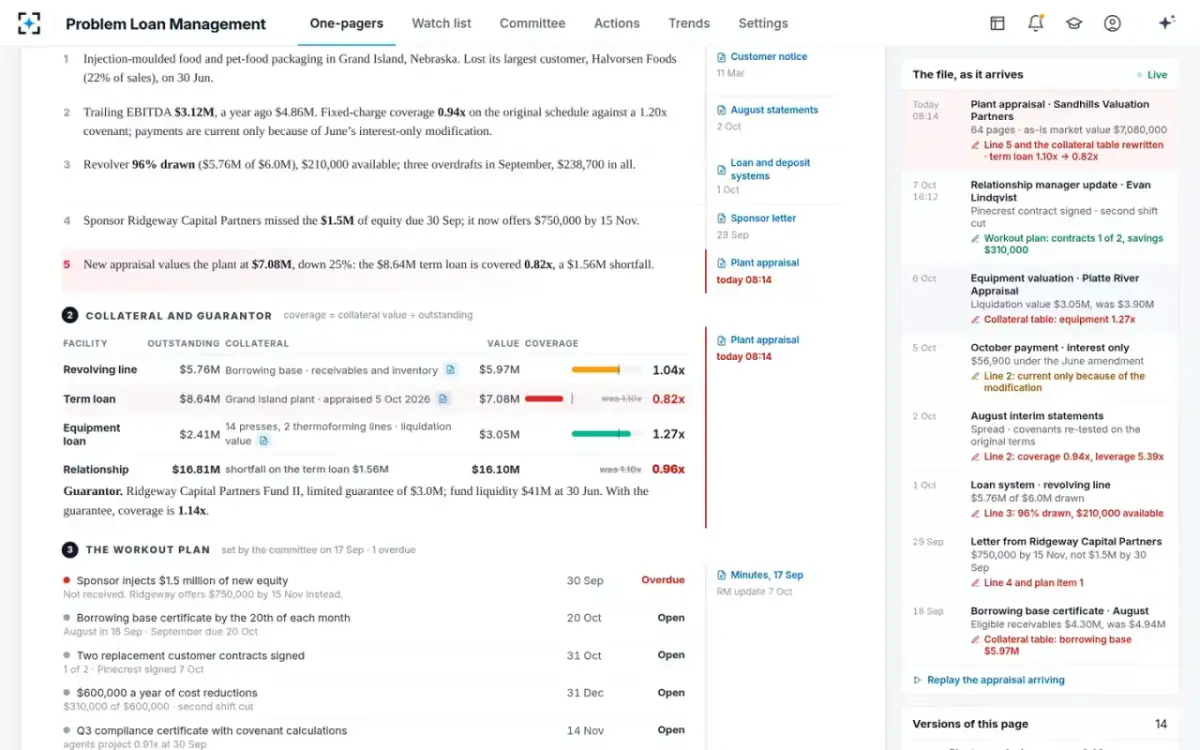
What a committee member then sees is the comparison rather than the conclusion: this is what the borrower pays, this is what it agreed to pay, this is the gap, and here is the document behind each number. The grade and the accrual status stay where they belong, with the committee that votes them. How those decisions reach the board is covered in the criticized asset report; to see the pages and the modification screen together, start from Problem Loan Management.
Questions people ask
Is troubled debt restructuring still used?
Not as an accounting designation under US GAAP for creditors that have adopted the current expected credit loss model: ASU 2022-02 eliminated that guidance for fiscal years beginning after 15 December 2022. The phrase survives in conversation, in older credit policies and in some non-US frameworks, so it is worth asking what a document means by it. What replaced it for reporting purposes is disclosure of modifications to borrowers experiencing financial difficulty.
Does a restructured loan have to be classified?
No — classification follows the facts, not the label. A restructuring granted to a borrower with a well-defined weakness will usually be substandard, and the agencies' worked examples show examiners classifying restructured credits their lenders had graded pass. Equally, the agencies say prudent accommodation after a comprehensive review of the borrower will not be criticised even where it produces an adverse classification. What is criticised is the accommodation used in place of the review.
How do you test covenants after a modification?
Exactly as the loan agreement defines them, as amended, and separately on the original schedule. The amended definitions govern whether a breach has occurred; the original schedule answers the credit question of whether the borrower can service the debt it took on. Reporting only the first turns the bank's own concession into evidence of borrower performance.
Is a covenant waiver the same as compliance?
No. A waiver is the bank choosing not to enforce a breach that occurred, and it should be recorded as one, with the date, the scope and who approved it. The point is sharpened by the accounting standard: ASU 2022-02 states that covenant waivers are not treated as term extensions for its disclosure requirements, so a waiver may not appear in the modification disclosures at all. If the bank's own reports also show it as compliance, it appears nowhere.
Does a modification restart the 90-day past-due clock?
For past-due reporting, the amended terms become the terms the loan is measured against, so a borrower performing on them is not past due. That is exactly why past-due status is a poor single test after a modification: the accrual question asks whether full payment of the contractual amounts is still expected, and a restructured loan that later meets the nonaccrual criteria on its modified terms, or for any other reason, must go back on nonaccrual.
What has to be disclosed about a modification now?
For receivables modified while the borrower was experiencing financial difficulty, disclosure covers modifications in the form of principal forgiveness, an interest rate reduction, an other-than-insignificant payment delay or a term extension, or a combination. It extends to receivables that defaulted during the period having been modified in one of those ways in the previous twelve months, which builds a test of whether the concession worked into the disclosure itself.